

Vladimir Putin’s meeting with heads of the world’s leading news agencies took place in the Constantine Palace
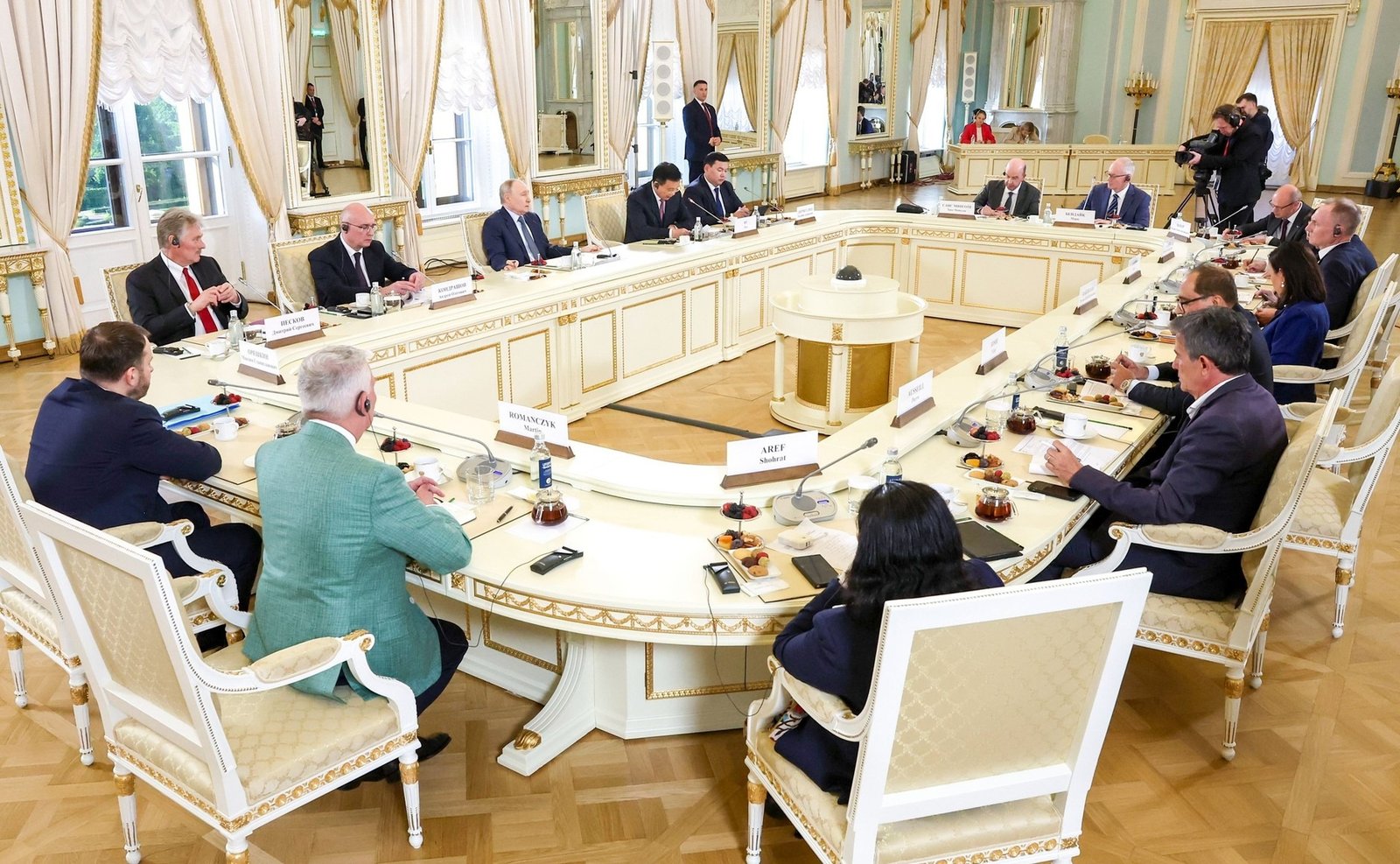
http://en.kremlin.ru/events/president/news/79953
Director General of TASS News Agency, moderator of the meeting Andrei Kondrashov: Mr President, guests,
Allow me to begin by expressing my deepest gratitude for upholding the steadfast tradition whereby the leaders of the world’s news agencies gather here, in the Northern capital, during the St Petersburg International Economic Forum, for an open dialogue with you. TASS has the honour of inviting our colleagues to this meeting.
I would note that some of our guests have forewarned us that they have come prepared with some rather incisive questions. In turn, we have cautioned them that you too may have a few questions for certain journalists from various countries.
President of Russia Vladimir Putin: No, I will not be asking questions. I am not a journalist. It is you who will be asking questions; I will be providing the answers.
Andrei Kondrashov: In any event, let us strive to make our meeting today open, candid, and dynamic. The purpose of such gatherings is, as in previous years, that the discussions here will be rapidly disseminated in hundreds of news flashes across the globe for those present here today and the agencies they represent are responsible for generating more than three-quarters of the global information flow.
Therefore, today, we will not follow any alphabetical order, but we will maintain one tradition. Let us begin our discussion with a representative of the fairer half of journalism – Ms Raushan Kazhibayeva, Director General of the Television and Radio Complex of the President of Kazakhstan.
Please, Ms Kazhibayeva, you have the floor for the first question.
Director of the Television and Radio Complex of the President of the Republic of Kazakhstan Raushan Kazhibayeva: Thank you very much.
Mr President, I have two questions for you.
Your recent state visit to Kazakhstan was a great success and undoubtedly one of the most significant events on our bilateral agenda this year.
During the visit, you and our President, Kassym-Jomart Tokayev, adopted a joint document on the seven foundations of friendship and good-neighbourly relations between the peoples of Kazakhstan and Russia. My first question: what, in your view, is the significance of this document?
My second question relates to one of the most talked-about moments of the visit – the Amur tigers that Russia gifted to Kazakhstan. President Tokayev called this gift the highlight of the visit. Could you tell us whether this is not just an environmental project, but rather a symbol – a vivid symbol of trust between our countries? Thank you.
Vladimir Putin: Our relations with Kazakhstan are advancing steadily; they are on the rise. That said, I should point out straight away that our Kazakhstani friends and partners are not easy partners. We always have very heated debates on almost every issue – whether it is financial relations, industrial cooperation, investment conditions, or major joint projects. But on both sides, there is a desire to find a compromise that doesn’t just satisfy both parties but also helps us achieve shared goals. And our shared goal is clear: development and prosperity for the citizens of Kazakhstan and Russia.
We fully understand – we know that we are bound by centuries of shared history, no exaggeration here, and we have certain advantages inherited from the time we were part of a single state. What are those advantages? Cooperation, and particularly unified transport links. You asked your question in Russian, and I am grateful for that. That too is an important factor – one that, to some extent, and in many cases, takes on a purely economic dimension. Everything is clear: we understand each other, and we speak the same language.
There is also enormous interest in continuing the benefits of education – both the evolving education system in Kazakhstan and the developments and new trends emerging in the Russian Federation. As you may recall, the President of Kazakhstan and I attended the launch of the Sirius system, which has proven successful in developing effective methods for identifying and supporting gifted children. Of course, Kazakhstan has many gifted children – they just need to be found – and this area of our cooperation will focus on this.
Energy, as you know, industrial production, space, as well as our latest major project – the construction of a nuclear power plant in Kazakhstan. I want to note that Kazakhstan is a country with abundant resources that are in high demand by the rest of the world. These resources include fuel for power plants and NPPs. We cooperate successfully with Kazakhstan in this area. I am confident that, by relying on its own resource base and developing our joint potential, Kazakhstan will achieve great success and tackle many tasks in energy, diversifying its energy resources. I believe Kazakhstan will obtain up to 20 percent of its electrical energy from the nuclear power plant.
We produce uranium together, as I said, and will continue this production. But the most important thing is not the fact that NPP units will be built in Kazakhstan. Most importantly, a new industry will emerge. This new industry will provide for professional training, research and production activities. We will work on this together. It is an extremely important sector for both us and Kazakhstan.
We will continue our cooperation in space, machine engineering, and many other industries.
I have already talked about humanitarian links. Education plays an enormous role. A great number of Kazakhstani are enrolled to study in Russian universities, and we are very grateful to the President of Kazakhstan for launching an international body to support the Russian language. I believe it is a forward-looking initiative that will help preserve our relations and promote their development across all fields, including humanitarian cooperation.
So, as concerns tigers, it is quite a natural thing. We are simply focused on the restoration of nature, the environment, flora and fauna. We also receive help – for example, Tajikistan has transferred snow leopards to us, for which we are immensely grateful to our Tajikistani friends. We have done a great deal to preserve the population of Amur tigers. By the way, they are the largest tigers in the world, second to none. Amur tigers are the largest. There were similar tigers in Kazakhstan in the past. If we can help our friends in Kazakhstan in any way, we will certainly do so.
I have seen this picture, and it is impressive. By the way, we held an event called a tiger summit here. So many countries are concerned about preserving the population of these beautiful animals. I think our cooperation on this and other environmental projects is very important.
This has to do with a very pragmatic matter of trans-border river resource utilisation. There is much to discuss in this area. Our work here is quite extensive. I am certain all the goals will be achieved.
Thank you.
Andrei Kondrashov: Mr President, to your left is Mr Fu Hua, representing the Xinhua News Agency from China.
Just two weeks ago, if you recall, he helped organise an exhibition for you and President of China Xi Jinping, together with the TASS news agency. And now, two weeks later, he is here with us to ask his question. Please, go ahead, Comrade Fu Hua.
President of Xinhua News Agency (PRC) Fu Hua (retranslated): Mr President,
It was a real pleasure to have you visit us in China. A remarkable visit – and a highly successful one. This year, we held a very important exhibition marking the anniversary of our news agencies. Thank you for your special attention to it. May I take this opportunity to ask you a couple of questions?
In May, you made your 25th visit to China, where you discussed major issues concerning our international relations with President Xi Jinping. We have counted: over the past 14 years, you have met more than 50 times. This is truly an extraordinary, unprecedented achievement. Our relationship is good-neighbourly, friendly, and truly at its peak. I believe this visit left a real mark. This close engagement at such a senior level – how did we achieve it? How did we reach this unprecedented level? That is my first question.
My second question: We have jointly issued a new, comprehensive joint statement. We, of course, remain committed to the UN Charter, upholding its principles and purposes in full, and we defend the international order. We were the victors in World War II. What should we do to protect historical truth? How do we pass it on to future generations, without allowing anyone to distort or destroy it? Those are my two questions. Thank you.
Vladimir Putin: First of all, I would like to thank you for the warm welcome during my visit to Beijing, and for the exhibition you organised together with your colleague, Mr Kondrashov. It was a fascinating and substantive exhibition. Thank you very much.
As for the results of our cooperation, here is what I would say. In recent years, especially since the events still unfolding in Ukraine, people have increasingly said: “Russia has pivoted towards Asia. It has changed its policy.”
But Russia has not changed anything, and it has not made any pivot. The agreement that underpins our cooperation – and is the foundation for our current results, which are impressive (according to various figures, our mutual trade is somewhere around $250 billion, and diversification is progressing strongly) – that agreement was signed back in 2001.
We are natural allies and partners. Indeed, we are neighbours, sharing an extensive common border. One cannot choose one’s neighbours – that is a fact of life. Such is the course of history. Over the centuries, throughout our interactions, a particular system of principles governing our relations has emerged. Not yesterday, not today, and not five years ago – but over centuries, these principles have taken shape. China is progressing rapidly and dynamically, assuming an increasingly significant role in the global economy, world politics, and international affairs as a whole. Naturally, we have been observing this closely – and not merely observing; we have been engaging in close collaboration and cooperation. Twenty five years ago, we signed the foundational Treaty, which established favourable preconditions and a robust foundation for the development of bilateral cooperation in all areas. Such is the result.
In recent years, as both the Chinese and Russian economies have expanded and diversified, new opportunities have emerged for us – encompassing a vast array of fields. I will refrain from enumerating everything I deem significant and important. The most crucial aspect is that in recent years, we have increasingly focused on matters relating to the new economy, which is rooted in artificial intelligence, information technology, advancements in biology, genetics, and so forth.
We have always cooperated – not just in the last five years, but consistently – in the military sphere, and our interaction continues unabated. There is nothing new in this regard; it is simply a tradition of our relations, both military and military-technical cooperation. We are jointly considering certain developments in this domain. I reiterate, this is not connected to current events that are capturing global attention, including those in Ukraine or even in the Middle East. We simply cooperate and maintain friendship with China – not directed against anyone, as I have stated, but rather in each other’s interests. That is all.
Here, particularly in the pursuit of advancements in the realms of artificial intelligence and high technology, lies the future of our collaboration. This is a subject we invariably discuss during our meetings with President Xi Jinping. Incidentally, we have truly trust-based relations. He addresses me as “my old friend,” and I reciprocate. This is neither an exaggeration nor a figure of speech. We have cultivated a relationship of trust.
Naturally, we are guided first and foremost by the national interests of our countries, yet these interests often align, and personal relationships provide a solid foundation for reaching ever-new horizons. That is why I believe we have established favourable preconditions for enhancing our interaction with China. I am confident that all the tasks we have set during my visit will be accomplished, and all the objectives will be achieved.
President Xi Jinping and I have outlined our schedule of bilateral contacts for this year – and this applies not only to us: the governments, ministries, and agencies, along with our leading companies, are meeting and collaborating, including in the energy sector, where, I am sure, we will soon delight the global energy market with new agreements between Russia and China.
Andrei Kondrashov: Colleagues, who would like to speak next?
Vijay Joshi, CEO and Editor-in-Chief of the Press Trust of India.
CEO and Editor-in-Chief at The Press Trust of India (India) Vijay Joshi: Mr President, first of all, thank you for this opportunity and for your hospitality.
Mr President, as you are preparing to travel to India for the BRICS summit in September and the global community is watching the evolving dynamics between Moscow and New Delhi very closely. While this special and privileged strategic partnership remains the cornerstone for both nations, some observers say that India’s alignment with Washington creates structural frictions with Russia.
From your perspective, how will you seek to inject fresh momentum into the bilateral relationship? What steps can be taken to ensure that Russia-India ties remain resilient against external geopolitical pressures? And how would you describe Russia-India relations in this redrawn geopolitical landscape in your words? Thank you.
Vladimir Putin: You have described these relations yourself, and you characterised them accurately. As you noted, this is a special and privileged strategic partnership. Such a relationship was not built overnight, or over the course of a few years. It is the result of decades of cooperation. The Soviet Union established diplomatic relations with India in 1947 and consistently supported the development of the young state. We are happy to see that, thanks to the tireless work, talent, and determination of the Indian people, India has achieved remarkable success and made tremendous progress in its development.
Everyone present here knows that India is currently demonstrating the highest economic growth rates among the world’s major economies. This doesn’t fall out of the sky; it is the result of consistent and purposeful efforts, above all by the government led by Prime Minister Narendra Modi. The country’s strong economic performance reflects the successful implementation of the policies and development strategies pursued under his leadership.
We still have a lot of work to do together, but we are confident that bilateral trade will reach $100 billion in the coming years. At present, trade turnover stands at approximately $58 – $60 billion. However, all the necessary conditions are in place to intensify our joint efforts and achieve even more ambitious goals.
Our cooperation extends far beyond the energy sector, including nuclear power. The Kudankulam Nuclear Power Plant is already operating and continues to expand, and we expect decisions on additional sites in the future. We will also continue to deepen cooperation in the hydrocarbon sector. Russia remains one of the largest foreign investors in the Indian economy, and we intend to further strengthen investment cooperation on a reciprocal basis.
Everybody knows that we also maintain close cooperation in the pharmaceutical industry, where Russian companies are ready to offer a wide range of products and solutions. I will not go into details, but we have outlined a number of highly promising, long-term initiatives that are of mutual interest to both India and Russia.
However, I find your question somewhat surprising. You suggested that India’s cooperation with the United States is creating difficulties in its relations with Russia. We do not see it that way at all. Where did you get that from? We are glad that India is developing relations with all countries. India is a major global power with a population of 1.5 billion people, a rapidly growing economy, and one of the world’s largest democracies. It is entirely natural for India to develop relations with a wide range of countries in accordance with its national interests.
It is another thing that the United States is trying to pressure India on certain issues, particularly on certain issues of cooperation with Russia. But I think everyone has long since realised that pressuring Prime Minister Modi, who leads a country with a population of 1.5 billion, is futile. Moreover, it harms international relations and bilateral relations, no matter from which side this pressure comes.
We do not see any negative consequences arising from the current situation. We believe that mutually acceptable solutions can be found with all parties involved. To date, we have not observed any serious adverse effects. Russia and India continue to strengthen their partnership, and we regard India as a reliable partner.
Andrei Kondrashov: And here’s the United States. James Jordan is one of those who came from The Associated Press to ask tough questions. Please.
Vladimir Putin: Go ahead, play hard ball.
News Director for Europe & Africa at the Associated Press James Jordan: Thank you, Mr Kondrashov, for the organisation of this gathering. It is always fascinating to hear President Putin’s views on many global matters. I have been here for three years now and it is always an interesting experience, so thank you.
President Putin, yesterday hundreds of drones were launched into Russia from Ukraine. Some struck a naval base nearby, some struck an oil depot nearby, causing a plume of smoke over St Petersburg, your home city. Flights were also disrupted into the airport here. More broadly, the Russian economy has dipped recently; your personal approval ratings have also dipped; and the US says the invasion has become a strategic disaster – those are the words of Marco Rubio. He also added that Russia won’t achieve its war aims by military means alone. Given this, is it still logical to pursue your war aim of controlling the hold of the Donbass region or are you ready to make a deal? Thank you.
Vladimir Putin: First of all, one does not exclude the other. Controlling the entire Donbass region and making a deal are not mutually exclusive.
Why do you think they are in conflict? You mentioned Mr Rubio’s statement. He is a serious partner; we are in contact with him. He recently spoke in the Senate or Congress. It is clear that the domestic political situation in the United States is complex – some support him, some attack him. What the Secretary of State says on a specific issue inside his home country is certainly of interest to us, but ultimately, we are more interested in the real situation. And if you are talking about the conflict in Ukraine right now, we are interested in the actual situation on the ground.
What does that situation look like? It is as follows. First of all, and this needs to be emphasised, Russian troops are advancing along the entire line of contact. There is not a single place where Russian troops are not advancing. The biggest problem facing the Ukrainian Armed Forces today is a disastrous shortage of personnel.
Recently, the Ukrainian Armed Forces have been reduced by 100,000 personnel. Monthly losses are around 40,000. As a result of forced mobilisation – people, as you know, are being snatched off the streets, like stray dogs, and forced into the army. I will tell you about the consequences now. Monthly losses are approximately 40,000. Forced mobilisation brings in around 15,000–16,000 per month, and about 14,000 return from hospitals after being wounded. So each month, there is a net loss of roughly 10,000 personnel. On top of that, around 20,000 desert each month. At the start of this year, the number of deserters was around 60,000. People are being forcibly taken – there is no motivation, no one wants to fight.
The almost official figure is that 200,000 criminal cases have been opened for desertions. That is one of the problems, but the most significant one. It leads to the loss of territory and towns. Just recently – I will not give the exact number of communities now, in case I am mistaken – the Russian army has brought approximately 2,440 square kilometres under its control. The offensive, as I said, is ongoing daily.
Since you mentioned Donbass, the Russian army is currently in full control of the Lugansk People’s Republic – 100 percent. Over 85 percent of the territory of the Donetsk People’s Republic is under our control. Only recently, Ukraine controlled some 25 percent of the territory, and now it’s down to less than 15 percent. We also control 80 percent of the Zaporozhye Region. This process continues on a daily basis.
True, Western sponsors supply a great number of drones for Ukraine – different categories, including long-range UAVs. Unfortunately, some of them do break through. But Russia has its own air defence system. We must sure refine it. Yes, we must reinforce it, and we will by all means do it. Ukraine has no such system whatsoever. They have some of its elements but no system. They have Patriots and other types of weapons but the shortage is catastrophic. But the system as such does not exist. Similarly, Ukraine has no strike systems like those the Russian Federation has. By that I mean hypersonic missiles, cruise missiles – sea-, air- and ground-launched. We also have something vital – the Russian people’s patriotism and strong will that guarantee that we will achieve all the goals and objectives of the special military operation.
While listing essential issues, I should mention one more circumstance. We have our own production, resource, research and workforce base to address all the objectives concerning the provisions of the Russian Armed Forces. This base is gaining strength with every passing month and, certainly, serves as the foundation for all the achievements and advances that I have just mentioned.
To summarise, I would like to add the following: Without doubt, we are ready and willing to reach an agreement with Ukraine by peaceful means – and based on what we have discussed at the meeting with President Trump in Anchorage. At that meeting, certain questions were put before Russia so that we could agree on certain compromises. Russia agrees to the compromises discussed in Anchorage. It is necessary that Ukraine also agrees to make them. Then, the conflict will be resolved naturally and quickly.
Andrei Kondrashov: Have you received answers to all your questions, Mr Jordan? Should time permit, you may pose additional queries, but for the moment, allow me, Mr President, to put my question to you.
The retaliatory strikes we are carrying out today in response to the incessant terrorist assaults from Ukraine – targeting infrastructure used by the Armed Forces of Ukraine (AFU) and military-industrial complex facilities – are, before our very eyes, taking on a systemic character. Indeed, one of our recent retaliatory strikes raises the question – was the Oreshnik used in that instance? Furthermore, what, broadly speaking, does the use of such weaponry afford us?
Vladimir Putin: As for our new systems, they are being developed – this includes the Oreshnik. However, they differ somewhat from what we used to do prior to the conflict in Ukraine.
What do I mean by this? You see, we tested such systems at proving grounds, but the Oreshnik was not tested in this way, and this did not constitute a combat use. Across the territory of Ukraine, there has essentially been no full combat use of the Oreshnik, and as for the latest instance – it is not quite that … To be perfectly candid, I will share a major state military secret with you: we simply struck locations where it was possible to observe the results. This applies to Belaya Tserkov and, even more so, to the DPR area within the main fortified zone. Afterwards, our drones flew into the structure we hit, and we meticulously observed how the separating warheads were dispersed, calculating everything to the millimetre. This is crucial for us to make future decisions on the full-scale employment of the Oreshnik against designated targets, including urban areas.
Andrei Kondrashov: Thank you.
Colleagues, who is next?
Martin Romanczyk, Deutsche Presse-Agentur (DPA), Germany.
But, you know, I would first like to put a question to Martin myself, if I may. You represent Germany’s largest and leading news agency. As a journalist, do you get the impression that your country is preparing for war? Is this really the case, or does it merely appear so to us? And is it truly gearing up to engage in conflict with Russia?
Vladimir Putin: I object. There is no need for you to respond. You are not here to be interrogated – you are here as an investigator; interrogate others.
Andrei Kondrashov: Then we will speak separately after this meeting.
Please, go ahead.
Head of the News Service of the Deutsche Presse-Agentur (DPA) (Germany) Martin Romanczyk (retranslated): I would like to respond to your question. No, I do not think so.
Mr President, thank you very much for the invitation.
I would also like to address the topic of Ukraine and return to a question that has already been asked here. You spoke about peace. Germany and many European countries wish to take part in these peace negotiations currently being mediated by the United States, despite the conflict in Iran. What role can Germany play, and what role can the Federal Chancellor assume? And, if I may, I would like to add to this question. You mentioned Gerhard Schröder as a negotiator on behalf of the Europeans. Apart from Gerhard Schröder, whom else can you envisage in this role – who could undertake these mediation functions on behalf of Germany? Thank you.
Vladimir Putin: You raised two points that I would like to pay attention to. First, you said that Europe would like to participate in the negotiations. Right? Second, you asked who, apart from Mr Schroeder, could serve as a mediator. One thing is to participate in the negotiations, and another thing is to be a mediator. How can the European Union or separate countries of the European Union be a mediator if they directly abet the efforts of the country which we have an armed conflict with? What kind of mediators can they be? If you want to be a mediator, you have to be neutral.That is my first point.
And secondly, I was surprised by the reaction to my mention of Mr Schroeder as a possible mediator. An immediate outcry followed: “No, Schroeder cannot be involved because he is Putin’s friend.” He is not Putin’s friend. He is a German statesman, and one of the best, in my view, because he has his own position and the courage to defend it. Unfortunately, there are not many politicians in Europe today who possess those qualities.
Europe is currently facing significant energy challenges. However, it was Gerhard Schroeder who championed infrastructure projects such as Nord Stream, designed to provide the German economy with reliable and affordable energy supplies from Russia. Moreover, these projects were not only about securing deliveries; they also created a framework of mutual commitments and obligations between the parties involved. What matters is not that we have a good relationship with him. What matters is that, while pursuing his country’s national interests, he has demonstrated that he is a person whose word can be trusted. That is the essence of the matter. Any individual seeking to act as a mediator must be trusted by both sides. Frankly, I find it difficult to understand how Russia could trust people who, for years, have been saying about the need to inflict a strategic defeat on Russia.
That is precisely the issue, Martin, das ist das Problem. Nevertheless, we are not refusing to talk. We have never refused contacts with representatives of the European Union in any format. As for the EU acting as a mediator in negotiations with Ukraine, there are obvious difficulties, as I have already mentioned, and I think that is difficult to dispute. But we are not rejecting contacts. If they want to talk, they know how to reach us. They can pick up the phone and call. If they want to come, they are welcome to do so. It is not Russia that is refusing engagement. I was also surprised to hear claims that the evil Russia had stopped supplying energy to Europe. We did not stop. Europe chose to stop buying, hoping that this would cause our economy to collapse. Well, they have seen that nothing has collapsed, that it’s time to stop, to realize that it was a wrong approach and perhaps make some adjustments. But instead we continue to hear the same rhetoric. They have made so many public statements and political commitments that it is difficult to change their position now.
I’m not going to comment. I just want to say that we never rejected a dialogue. I want to reaffirm it. If anybody considers it reasonable to resume dialogue with Russia – go ahead. Who will be the negotiator from Europe? I don’t know. We are not imposing anything. I’ve heard this hubbub about Russia wanting to impose something, suggest some negotiators. We are not imposing anything or anyone. Naturally, we want to know who this could be. Let me repeat: It must be some people we could trust. It is just a working matter that could be discussed quietly and calmly, say, at the level of foreign ministers or intelligence services. The contacts between our intelligence agencies continue, by the way.
Martin Romanczyk (retranslated): Mr President, you spoke about Nord Stream. Members of the Alternative for Germany party are present at this economic forum. They are supporting the resumption of Russia’s gas supplies via Nord Stream. What do you think of this party? We are holding regional and federal elections soon. What are your expectations of this party? What is your general attitude towards the Alternative for Germany party?
Thank you.
Vladimir Putin: I believe it would be improper for me to give assessments of the political forces of the Federal Republic. We know – and I know – that, if this corresponds to reality, or as far as I was informed, Alternative for Germany is currently ranked at the top among the political parties of the Federal Republic. It is ahead of CDU/CSU – in fact, quite significantly. It is also ahead of the Social Democratic Party of Germany by miles.
I don’t want to comment, but I will say one thing. In my opinion, it is happening because this party’s leaders can formulate the interests of the German people and the German economy clearly and precisely. They are not afraid to declare them and they are willing to fight for them. Hence their rating and results.
I don’t know and I don’t want to speculate about further developments on the political stage of the Federal Republic. As for opinions, we welcome any German political forces that are willing to restore and develop relations with Russia, be it Alternative for Germany or any other party. We will work with everybody who wants to work with us.
Andrei Kondrashov: If there is a country that definitely wants to work with us, it is Belarus.
I would like to give the floor to BelTA, the Belarusian news agency. Andrei Mokhor, go ahead, please.
Director General of the Belarusian Telegraph Agency (BetTA) Andrei Mokhor: Good evening, Mr President.
First, thank you for the opportunity to have this genuinely open discussion on topics that have been a matter of concern far beyond the circle of people sitting around this table. It has already been said on multiple occasions that the relations between Belarus and Russia can be regarded as a benchmark of sorts in terms of interstate relations and striking a balance between integration and the unconditional commitment to preserving sovereignty. Even the EAEU has yet to achieve this level of interaction.
I would like to ask your opinion about ways of overcoming the emerging crisis of trust between long-standing partners, our partners, whose actions sometimes de facto amount to severing ties.
Vladimir Putin: A crisis of trust with our partners?
Andrei Mokhor: Yes. A crisis of trust with our partners within the post-Soviet space. In particular, I am referring to the developments concerning Armenia.
Vladimir Putin: You know, there is nothing extraordinary about this. The political forces behind the current Prime Minister have been talking about this for quite some time now. They have no qualms and are open about it.
In fact, there is nothing wrong with striving to follow Western standards, the European standards. I believe that any sovereign country, and Armenia is of course one of them – every sovereign country has the right to set what it views as priority standards which can benefit the country and reinforce its independence, sovereignty and, most importantly, its economy, as well as to choose its partners accordingly.
What has raised our concerns? It was the fact that Armenia has adopted a law on launching the process to join the European Union – this is how it is titled, by the way, and it was Mr Lukashenko who drew our attention to this fact, while I even forgot about this, but he pointed out the actual title of the law. Business as usual, nothing extraordinary about this, if not for the fact that Armenia, as I have already said, and we discussed this in Kazakhstan too when we had a meeting with our colleagues – Armenia operates within the framework of the Eurasian Economic Union. There are different standards, technical regulations in agriculture, transport, and logistics – there are so many divergences.
I would very much like to see, at some point in the historical perspective, technical standards, logistics and all the other numerous factors involved – many of which may seem a mere formality at first glance but are in fact crucial to economic development – become aligned between the European Union and the EAEU. This would make us a truly vast economic space “from Lisbon to the Urals,” as De Gaulle said, though it would be even better if it extended all the way to Vladivostok. However, this is currently impossible for technological reasons, as the EAEU and EU free trade zones are incompatible.
Of course, this is a concern for us. If a relevant law is adopted, this goes beyond mere talk – it is the law, and we would like to ask our Armenian colleagues to decide on their development path as soon as possible. The market organisation and the legal framework within the EAEU depend on this, because we debate every issue just as it is done in the EU. Without wishing to overstate this, our colleagues sometimes become quite animated in these discussions.
Every comma is sometimes important. But it is also important for us to know how this interaction will be structured. This not only concerns energy, although this is important because the common energy market is one of the few issues that has not been coordinated in terms of our policy as a whole. As you can see, even our colleagues in Germany are concerned about Nord Stream. This [energy] is a crucial element today, and it is especially important in the post-Soviet space, that is, within the EAEU.
Moreover, Prime Minister Pashinyan has said just recently that he considers it important to hold a referendum on this issue. Our only request is that this is clarified as quickly as possible. Nothing more. We have no objections. We will maintain good relations with Armenia no matter what development path it chooses to follow.
As for other countries, as I said, we manage to come to terms, we always do, despite all the challenges of negotiations. I am confident that we will be able to do this in the future as well.
As for Armenia, Russia advocated, at Armenia’s request, for its accession to the EAEU. I mean that, in terms of a number of economic indicators, Armenia did not fully fit the overall framework at the time. However, it has now decided that it should explore a different direction. We have no objection to that – it is entirely their choice. Our only request is that a decision be made as quickly as possible and that we proceed openly and transparently. That’s all. So I do not see any major political problem here. There are, of course, economic and technical issues to address, but I hope we will be able to resolve those as well.
By the way, regarding Nord Stream. As you know, the Nord Stream pipelines were blown up, correct? But one string of Nord Stream 2 remains intact and undamaged. Through it, Russian gas could be pumped to the Federal Republic of Germany starting as early as tomorrow. You just need — and I am not joking — simply to press a button, and the gas will start flowing. But that requires a decision by the Government of the Federal Republic. We have an existing contract between Gazprom and its partner in the Federal Republic, and contacts with Gazprom are ongoing; they remain in communication. Gazprom has never refused supplies and is ready to deliver tomorrow. Its partners also want this. All that is needed is a decision by the Government of the Federal Republic.
And here we come to the key issue – a political question, a question of sovereignty. Because this system was not only blown up – I consider it an act of state terrorism, and I think you would agree – but even though one line remains intact and operational, it is still subject to US sanctions. If the German government reaches agreement with its partners, the sanctions will be lifted, we will press the button, and gas will start flowing – tomorrow, if necessary.
This is a matter of sovereignty: whether they agree or do not agree, or whether, without agreeing with anyone, they simply say no, or explain to their partners in Washington that they need this because they are going through a very difficult period. High energy prices are undermining the competitiveness of the German economy and harming the European Union as a whole, because Germany remains the locomotive of the European economy. This system needs to be put back into operation. They could reach an agreement peacefully, explaining the seriousness of the situation. That is all. With increased capacity, up to 25, and potentially 28 billion cubic metres per year could be supplied – starting tomorrow.
But what Gazprom needs from its German partners is a clear answer: will they take the gas or not? Otherwise, we will redirect it to other markets and sell it to other partners. The contract remains in force. And it is not Gazprom that is failing to meet its obligations – Gazprom is ready. The German partner is not taking the gas, because there are instructions from Brussels and Berlin not to take it. That is all.
Let’s continue.
Andrei Kondrashov: Middle East News Agency MENA, Egypt. Shohrat Aref, please go ahead.
Managing Editor for European and Middle Eastern countries at the Middle East News Agency (MENA) (Egypt) Shohrat Aref (retranslated): Thank you, Mr President, for inviting me to take part in this dialogue.
I have the following question: What are your thoughts about President el-Sisi’s role in promoting stability in the Middle East? What role could Egypt and Russia play in reducing tension in the Middle East?
Vladimir Putin: President el-Sisi is a good friend, and I have a very good relationship with him. I also hope this helps us expand our bilateral ties. Trade between our two countries has been stable and is enjoying positive momentum, and there are good prospects for undertaking major projects. For many years now, we have been discussing the project to create a Russian technology valley in Egypt’s Nile Valley. Today, we are working hard on the project to build a nuclear power plant in Egypt. I hope its first block becomes operational in 2028.
There is significant, effective momentum in our relations. We have engaged quite a few local specialists to perform construction work, which means that this is a very impactful project. We are also working in other sectors. We have developed a relationship of trust in our political cooperation on the international stage. Russia appreciates President el-Sisi’s efforts to bring about a settlement in the Middle East.
The Palestine tragedy has been somewhat relegated to the background considering the developments in and around Iran and the Strait of Hormuz, but the Palestine issue has not disappeared. It remains acute. In this regard, the President of Egypt has made and continues to make a meaningful contribution to achieving a settlement, which means arriving at a fair resolution regarding all Palestine-related matters. Of course, I would like to stress again that in the opinion of the Russian Federation, the creation of a viable Palestinian state is the only fundamental approach to resolving this issue.
I know that the President of Egypt has been working hard on the agenda dealing with settling the Iranian crisis. He has been in touch with all parties to this process at all times, and we have also maintained contact. We seek each other’s advice, listen to each other, hear each other, and take our respective positions into account. I would like to thank President el-Sisi for attaching so much importance to strengthening Russia-Egypt ties. This is instrumental. Egypt is one of our priority partners in the region.
Andrei Kondrashov: Spain has been a country that has protested conflicts in the Middle East. We have José Manuel Sanz Mingote, Editor-in-Chief of Agencia EFE, with us. You have the floor.
Editor-in-Chief and Director of International Information at the Spanish news agency EFE José Manuel Sanz Mingote (retranslated): Thank you.
I would like to thank our friends at the TASS News Agency for their hospitality.
Mr President, my question concerns Ukraine. What is preventing the achievement of a durable peace in Ukraine, one that would allow all of Russia’s legitimate concerns related to the conflict to be discussed?
We can see that some progress has been made, and you have told us about this. But it is taking too long to achieve these goals, especially in Donbass. We have seen numerous exchanges of strikes between the sides. Is now the right time for a ceasefire, for sitting down at the negotiation table to discuss all issues? Even if the EU and European countries cannot mediate the process, they could help look for a solution.
Thank you very much.
Vladimir Putin: I believe that the EU could indeed help look for a solution. In my opinion, a solution should be reached within the framework of the arrangements made in Anchorage, and the Ukrainian side is fully aware of this. I would like to reiterate that the question raised before the meeting in Anchorage was whether Russia was ready to make certain compromises. I said during my visit to Anchorage and my meeting with the US President that we were ready, and I specified the agreements and compromises we would be prepared to make. The issue is for the Ukrainian side to accept these compromises. However, judging by all indications, primarily the internal political situation, Kiev is not ready for this.
The reason is that if peace is achieved, internal political strife and the struggle for power in Kiev will intensify dramatically, and the economic situation will further deteriorate against this backdrop. It seems to me that the ruling authorities [in Kiev] are not interested in stopping the hostilities because in this situation they are unlikely to have any good prospects – let’s put this tactfully – for retaining power.
Furthermore, they will have to address economic matters. European experts know how much it will cost to rebuild the Ukrainian economy – hundreds of billions of euros – and how long this will take. I am aware of the German Chancellor’s proposals for making Ukraine an associated member, and so on. That is none of our business. We are not against this – go ahead. But we are against turning the EU into a military bloc. This is a matter of concern to us. But we are not against economic integration. Go right ahead. European experts know how much this will cost, and European farmers know what will happen if European markets open to Ukraine’s agricultural products.
I could speak about this for a long time, but this is how I will reply to your question: Yes, the EU could potentially play a positive role, though not by supplying weapons but by trying to convince Kiev to accept the compromises we discussed in Anchorage. That is all.
Andrei Kondrashov: Please, Chairman of the Board of AZERTAC news agency Vugar Aliyev, Azerbaijan.
Please, go ahead.
Chairman of the Board of the Azerbaijan State News Agency (AZERTAC) Vugar Aliyev: Good evening, Mr President.
Thank you very much for taking the time to meet with us journalists.
My question relates to relations between our countries. May I ask how you assess the prospects for developing relations between Azerbaijan and Russia?
Vladimir Putin: I would rate them as highly favourable. Our relations with Azerbaijan have always been, and continue to be, very positive. This extends to both the economic and political spheres.
We signed a Declaration on Allied Interaction a couple of years ago, and relations are developing accordingly. President Aliyev is making significant efforts to infuse this treaty with tangible substance. This is evident in the specific areas of our cooperation. I believe that accumulated Russian investment in the Azerbaijani economy exceeds 10 billion rubles. Numerous enterprises operate with Russian capital. We also have close cooperation on cultural and educational matters. A substantial number of Azerbaijanis, as is well known, work in the Russian Federation. They send money to support their families. We are striving to organise this in a proper, civilised manner.
We have numerous areas of mutual interest in logistics, in particular, the North-South corridor providing access to Iran. At present, of course, this has been somewhat hampered due to the events surrounding Iran, yet it remains an area of significant mutual interest.
We are deeply grateful to President Aliyev for assisting us in the delivery of humanitarian aid to Iran. It should be noted that the Azerbaijani side has been diligent and effective in this regard, responding promptly to our requests. This is crucial for alleviating the situation in that region as well.
Trade turnover is on the rise, and it should be noted that additional opportunities for the mutual supply of goods are emerging. We are engaged in negotiations on a wide range of specific areas. At this stage, I deem it premature to elaborate on this, but it pertains primarily to the energy sector. We will meet with President Aliyev and will certainly discuss all matters in due course. On the whole, I believe that relations between the two countries are evolving – and evolving very positively.
Andrei Kondrashov: Colleagues, the next question, please. Who is next?
The Kyrgyz agency Kabar. Director Mederbek Shermetaliyev, please.
Director of the Kyrgyz National News Agency Kabar Mederbek Shermetaliyev: Thank you, Mr Kondrashov.
Good afternoon, Mr President.
Thank you for this opportunity to take part in today’s meeting with you alongside the heads of news agencies. Allow me to ask two questions.
Mr President, President Sadyr Japarov has repeatedly underscored that Central Asia should become a region of peace, neighbourliness, and shared development. Against this backdrop, Kyrgyzstan’s election to the UN Security Council was an important event not only for our country but also for the entire region. What role, in your opinion, can Central Asia play in strengthening international security in the coming years? That is my first question.
My second question concerns the fact that this year, Bishkek is hosting the SCO summit. Against the backdrop of growing global challenges and instability, what joint initiatives within the SCO does Russia consider a priority for strengthening regional security, and what key proposals does the Russian side plan to put forward for discussion during the summit?
Thank you.
Vladimir Putin: As for what we intend to put forward at the summit, we will, first and foremost, be guided by the proposals of the Kyrgyz side as the host country of this event. We know that both the President of Kyrgyzstan and all our colleagues are giving this their close attention and working on it. Our respective government bodies are in constant contact, both through the foreign ministries and through the relevant economic agencies, coordinating their efforts. I am confident that this will lead to the necessary compromises being reached where required. More broadly, it will result not merely in formulations but in the definition of objectives for the further development of the association as a whole.
What I would like to draw attention to is the following. It was initially established as a mechanism for resolving border issues between the People’s Republic of China and those republics of the former Soviet Union that share a border with China. Today, how many member states are there – 27 countries? It is, indeed, a major organisation.
Few outside observers take note, but substantive work on economic integration is underway, and this is becoming a prominent factor in regional affairs, at the very least. And given that there are, after all, 27 countries involved, this is a significant undertaking. What is important is that Central Asia – with the resources of the Central Asian countries, its vast territory, and its growing population – is attracting ever-greater attention from the entire international community, primarily, of course, on the basis of the region’s economic potential. Everything that is being done within the framework of the organisation itself will undoubtedly be of interest both to Russia and to all our partners.
Therefore, we certainly wish our Kyrgyz friends every success and will do everything we can to ensure that this significant event, in my view, proves a success.
Andrei Kondrashov: We have not had questions from France or Great Britain yet.
Let’s start with France. A major agency, Agence France-Presse – Pierre Ausseill, Regional Director for Africa and Europe, please.
AFP Regional Director for Africa and Europe Pierre Ausseill (retranslated): Good evening, Mr President.
I have a short question on Ukraine, covering the economy and Mr Zelensky. Russian military spending has risen considerably due to the special military operation, and the economy is showing signs of strain. Can the Russian economy withstand this?
My second question concerns Mr Zelensky. If you were to sit down at the negotiating table with him to sign a peace treaty, what would you say to him? And do you consider him the legitimate representative of Ukraine?
Vladimir Putin: On the question of his legitimacy, that is a matter for lawyers, for legal analysis. Of course, if we reach the point of signing any documents – and that is not a whim on our part; any country in our position would want to sign documents of this kind, which would be truly historic for both Russia and Ukraine – then we would want to sign them with someone who is legitimate under the other country’s constitution, the fundamental law of Ukraine. This requires careful legal analysis. I will not go into the details now – I have spoken on this before, and anyone can look up what I have said.
Here is the core issue. Two years ago, in May 2024, President Zelensky’s term expired. At the end of last year and the start of this year, there was much talk of elections in Ukraine. Where is that talk now? Will there be elections or not? I suggest that you ask them these questions as well. That matters. Yet no one is asking these questions now. If elections are held, when? And of course, the outcome would be crucial.
Under the Ukrainian Constitution, a president is limited to serving two five-year consecutive terms. If we accept the view of those who say that President Zelensky has legally extended his powers, two years [of his second term] are completed. Will he run for another five-year term? This is contrary to the Constitution, which only stipulates two five-year consecutive terms, 10 years altogether. What about the two years he has been in power now? There are many questions, but if we ever reach the stage of signing documents, I believe that if there is a desire to end this military conflict peacefully – and Russia would like to do this, we will find those who should sign the relevant document. When there is a will, there is a way. This is extremely important, but we must remember that it is a legal issue.
As for what we could tell each other if we reach the end of the conflict, at the very least, we could and should say, Thank God it’s all over.
However, the legal side of the matter should be analysed at the level of good experts. I believe this is obvious.
I would like to reiterate that we can only sign such documents with those who are fully legitimate to do so. There are many options, such as the Chairman of the Verkhovna Rada, and possibly even Zelensky himself. We need to analyse the documents and what legal consequences their signing would have.
Once again, there must be the will to do it. As for the procedure, there are ways to coordinate it.
Pierre Ausseill: I also asked about the economy, if you recall.
Vladimir Putin: Regarding the [Russian] economy, as Mark Twain said – I think it was he who said it, “The reports of my death are greatly exaggerated.” That is how he joked about it once. The same here. There were forecasts of our defeat on the battlefield, and it was even said – I think it was the former US President who said it, that the Russian economy was in tatters. Don’t engage in wishful thinking. Make your assessments based on real figures, real trends and the real situation, in this case the real situation in our economy.
How much has the EU’s economy grown over the past three years? Don’t wrack your brains – it has grown by about 3 percent. And how has the Russian economy grown? It has grown by 10 percent, three times more than the EU’s economy. Germany, the leading economy of the eurozone, has grown by less than 1 percent, while the Russian economy has grown by 1 percent last year, even if this is a modest figure, and it continues to grow.
It is true that there are issues in terms of the overall macroeconomic landscape, primarily the rising inflation. It is for this reason that the Central Bank and the financial bloc have taken several decisions – and these decisions were quite harsh – to suppress inflation and improve macroeconomic indicators. The decision to raise the key interest rate was one of them. However, these measures have been effective and yielded results. As of April, the economy has not fully recovered to where it was a year before that, but we are making steady progress towards reaching the planned, or to be more exact target indicator of 5.4 percent. This is a positive development in itself.
At the same time, industrial output has continued to grow, and so did real household incomes. In fact, real household incomes increased by over 28 percent which is largely due to higher salaries, and I am talking about real, not nominal, wages. There was an increase of over 25 percent. We have been fulfilling all the social commitments we have to the people of Russia, including by adjusting for inflation pensions, benefits, minimum wages, and entitlements to support families with children, and so on and so forth.
We had a plan to reduce the number of people living below the poverty line to seven percent by 2030. In 2025, we achieved this objective ahead of schedule and went even further by reaching a level of 6.7 percent.
I want to go back to Mark Twain’s quote. Let me reiterate that our economic and financial agencies have been effective in their actions and delivering results. It goes without saying that we intentionally went down this road, of course, when the Central Bank decided to significantly increase the key interest rate. It has already cut the interest rate several times and brought it down to 14.5 percent. Many believe that this is too little, and that we need more cuts. I will not make any comments in this regard right now, since this can turn into a lengthy debate. I have been following these discussions between the Government’s economic bloc and the Central Bank, etc. But the results are there.
We did this on purpose while understanding that this would lead to a decrease in capital investment. How could it be otherwise? Of course, investment was expected to shrink with the Central Bank’s key interest rate at this level. Our decision to cool down the economy was intentional. Some may argue that there was too much cooling, or that more needs to be done in this regard. Still, we did this on purpose. We do not want hyperinflation of up to 30, 60, or 70 percent, as it happened in some countries. We are fighting for the overall health of the Russian economy.
I would like to draw your attention to another important indicator. Our public debt is equal to 15.6 percent. How big is it in France? It exceeds 100 percent, probably. I think it is 112 percent, approximately. But we have 15.6 percent. All this gives us reasons to believe that we are headed in the right direction and can feel confident.
Andrei Kondrashov: Reuters, UK, Mark Bendeich, please.
Global Managing Editor, World News, at Reuters news agency (Great Britain) Mark Bendeich: Thank you, Mr President.
I’ve got two questions. The first is on Ukraine. How do you rate President Trump’s performance in trying to end the conflict in Ukraine? Whether he has become distracted by the Iran war and indeed whether he miscalculated there, perhaps at the cost of pushing forward talks over Ukraine?
My second question is about your own political future, Mr President. You have been running the country now, been in power for 26 years, and whether you plan to stay in office until 2036, I think under the Constitution. And if you don’t mind me saying so, you look quite fit, whether you feel you have the stamina and the health to go the distance to 2036?
Thank you.
Vladimir Putin: Only God knows whether any of us – you, me, everyone in this room – stay healthy enough to survive until tomorrow or the day after, let alone to solve the problems we face and reach the goals we have set. That is for starters.
As for my own plans: yes, the Constitution allows me to run for re-election in 2030. But frankly, it is far too early to talk about that. I am not even thinking about it right now – I tell you completely honestly. The country faces many large, far-reaching, and urgent issues. The way to address them is not to think about that, it is to think about Russia’s future. That’s the first point.
Now, on Ukraine and what the US President has done to try to resolve the conflict. I have said this before, and I do not mind repeating it. I believe President Trump is genuinely committed to resolving the Ukraine crisis. He has already said publicly that he did not expect it to be so difficult. And yes – from the outside, some things may look straightforward, but once you dig in, you realise there are many unknown factors, and they matter.
Now, settling another crisis, the one concerning Iran is indeed urgent. We see that the US administration is distracted and forced to focus primarily on that issue. But here is the difference: the Ukraine crisis is primarily local, though I regret that European countries are trying to give it a global dimension. The crisis around Iran, by contrast, is clearly global. Just look at the impact the closure of the Strait of Hormuz has on the world economy. So of course, the administration is giving it serious attention. That said, President Trump’s proposals, as I have already mentioned, could very well form the basis of a peace agreement.
So to answer your question of whether the administration was on the right track – yes. Those proposals require compromise – for both countries. For Russia, too. And we have broadly agreed to those compromises. We just need to convince the Ukrainian side. That’s all. Overall, I believe these proposals could serve as the foundation for an agreement between Russia and Ukraine, and could end the conflict.
Global Managing Editor, World News, at Reuters news agency (Great Britain) Mark Bendeich: Sorry, just one follow-up question on Iran. Do you think Russia could play a role in terms of settling that dispute in particular in relation to the highly enriched uranium?
Vladimir Putin: I believe so. We harbour no desire to impose our assistance; however, our proposal is well known to the US administration, as well as to our Iranian friends and partners. In 2015, Russia played an entirely positive role by facilitating the removal of enriched uranium from Iran to the Russian Federation, thereby establishing the foundation for the JCPOA– effectively resolving the crisis. This endeavour was supported by the American administration of the time, implemented successfully, and led to a de-escalation of the situation.
What is the current state of affairs? The uranium is present on Iranian territory, a fact currently undisputed by any party. The question that therefore arises is: what follows? The uranium would immediately come under the control of the IAEA, and consequently, the entire international community – including the United States and Israel – would become engaged in the process of eliminating highly enriched uranium. This is because everything would be under their purview – effectively, under IAEA control – while all parties contribute to the IAEA’s efforts, and there is universal trust in the IAEA. Immediately, the uranium is accounted for in terms of volume and quantity, control is established, and the process of de-enrichment and dilution commences.
We possess the capability to undertake this now as well – if you will. However, I reiterate, this decision rests with all parties seeking a resolution to the crisis. We have successfully implemented this before and stand ready to do so again. Our relations with Iran are good and based on trust; Iran is a friendly country. It is no secret that we are implementing a project there to construct the Bushehr nuclear power plant. We have completed one unit, which is now operational, and are continuing with further construction. I believe that the Iranian leadership and the Iranian people repose complete trust in us.
Incidentally, this uranium could, in the future, be diluted and utilised for peaceful nuclear programmes within Iran under the oversight of the international community and the IAEA. I think that this constitutes a viable option. In this regard, I believe that Iran would find such a resolution acceptable, and all other parties involved – who may harbour certain suspicions – should also find it satisfactory. The uranium would be declared, removed, and placed under control. Wherein lies the problem? I see none. I may be mistaken in some respects, yet I struggle to see what could be objectionable to anyone in this scenario.
Furthermore, initially – since we have broached the topic, I will elaborate – initially, and admittedly not this year – there was unanimous agreement. Subsequently, positions hardened on all sides. We said: “Very well. If not, then not. Please, resolve this among yourselves.” The proposals remain on the table – please, we are prepared to proceed as we did in 2015. If that is not the case, we hope that the parties involved in this conflict will find an alternative solution. Should another solution emerge, we would be most pleased. And if our assistance is required, we would gladly support any solution of this nature that leads to a de-escalation of the situation.
Andrei Kondrashov: Mr President, we have already been speaking for an hour and a half. Would you allow us another 20 minutes?
Vladimir Putin: We can do a couple of questions. The President of Uzbekistan is due to arrive shortly, and we have an event scheduled – the launch of a nuclear power plant construction project in Uzbekistan.
Andrei Kondrashov: I have already caught the eye of three colleagues – Martin Romanczyk, Vijay Joshi, and Jose Manuel Sanz Mingote.
Vladimir Putin: Well, by all means.
Andrei Kondrashov: Three more questions, colleagues, and then we’ll conclude.
Vladimir Putin: Please.
Andrei Kondrashov: Martin, go ahead please.
Martin Romanczyk (retranslated): Mr President, two years ago, when asked whether Russia was planning to attack NATO, you said that such claims were nonsense. At least, that is how your remarks were reported. Yet today, amid US plans not to deploy intermediate-range missiles in Germany and new details concerning the redeployment of American troops from Europe to Asia, there is still speculation that Russia could attack NATO territory in the foreseeable future. How do you assess such claims?
Vladimir Putin: You know, anyone who seriously considers such claims should ask themselves a simple question: What for? Why would Russia need that? It’s clear – the conflict in Ukraine. At the heart of the conflict are the coup d’état and the subsequent suppression of everything associated with Russia as well as of a significant portion of the country’s population who refused to accept the outcome of that coup. Ukraine is, after all, a largely Russian-speaking country. Even those so-called nationalists speak Russian at home.
But that is not really the point. The point is that the coup was followed by a series of developments inside Ukraine itself. In the end – and I will not go into all the details of how this unfolded, including the Minsk agreements and everything that followed – we found ourselves in a situation where it was necessary to support those people living in the territories that did not recognise the outcome of the coup. At the same time, there were ongoing efforts to bring Ukraine into NATO.
Just think about it. We were simply deceived – openly deceived. You know that perfectly well. Since 1991, we were repeatedly told that NATO would not move one inch to the east. This was stated at the time by NATO Secretary General, a citizen of the Federal Republic of Germany – I must admit I cannot recall his surname at the moment. That was the assurance we were given.
But what does Europe have to do with this? Why would Russia attack Europe or go to war with NATO? What would be the purpose? As I have said before, these claims are not merely nonsense. In my view, they are a deliberate provocation designed to create the impression of a threat that does not actually exist. The objective is to persuade their populations to increase defence spending and, as a first step, to pay for the regime that seized power in Kiev. That, I believe, is the real explanation. It is not simply nonsense; it is a provocation.
What surprises me, however, is that some people in European countries appear to believe it. I find that astonishing. The whole notion is simply absurd. It would be amusing if it were not so sad.
We have consistently stated that one of the objectives of our special military operation is the denazification of Ukraine. Yet, from various quarters, we have been asked: “What do you mean by denazification? What is this “denazification” you refer to? You are speaking irrationally. (And they say we are speaking irrationally.) Why denazify Ukraine?”
Colleagues, let me be clear. This has been plain to see for all, yet scarcely anyone addresses it – the reburial of Nazis and nationalists who, during the Second World War, exterminated Jews, Poles, and Russians in Ukraine. How many, you ask? In my view, a million Jews were exterminated in Ukraine. A million innocent souls. And now, in Ukraine, their [Nazis’ and nationalists’] remains have been reburied with military honours and a gun salute, hailed as heroes of Ukraine. Only Poland reacted, albeit feebly; Israel – even more feebly. Everyone seeks not to notice, shamefully ignoring the truth. And who is responsible for this? The current head of the Kiev regime, ethnically Jewish. His grandfather, who fought against Nazism, must be turning in his grave.
There exists an organisation of Ukrainian nationalists known as the UPA [Ukrainian Insurgent Army] – an entirely pro-Nazi entity. Its name is currently being bestowed upon active units within the Armed Forces of Ukraine. Observe: to the best of my knowledge, it has been enshrined in legislation, or is on the brink of being enshrined, that Nazi propaganda is forbidden. However, the Ukrainian authorities should be reminded that enshrining it into law is insufficient – the law must be implemented effectively.
Listen, I understand that the so-called collective West does not want Russia to grow stronger. The collective West wants to use Ukraine so that Russia does not defend its national interests so vigorously, that it should know its place, and so forth. But you must understand what a threat the revival of Nazism poses to everyone. Not only is weaponry spreading from the territory of Ukraine across the world – that is already a matter of record. Not only is corruption flourishing there, it has taken over everything, it has sunk such deep roots. But Nazism is being revived. What then is to be done about that?
Colleagues say that Ukraine should be part of the European Union, or an associated member, or in some other capacity. Very well, so be it. But one ought at least to reflect upon this. These are facts; this happened just recently. A few days ago, one of the Nazis was reburied. It was by his hands that Jews, Poles, Russians, and Roma people were exterminated – a million people. Yet he was reburied with military honours, with a gun salute, and – silence.
I understand that some countries want to use everything in their fight against Russia. But this is a threat to everyone. One ought to think about this.
Therefore, as regards the notion of Russia attacking Europe – this is, of course, nonsense, but not only that. It is also a provocation and misinformation aimed at deceiving their own populations in order to secure funding for the fight against Russia and for the militarisation of their own economies.
CEO and Editor-in-Chief at The Press Trust of India (India) Vijay Joshi: Mr President, earlier in this interaction you spoke about Russia’s relations with China. You said it was not born yesterday; it has grown over and been fostered over centuries. India has a similar relationship with China, but probably of a different nature. It is a difficult relationship. At the same time, India has a difficult relationship on its western border with Pakistan. I think you see where I am going with this. Pakistan today is helped by China in military terms. About 80 percent of Pakistan’s military hardware is of Chinese origin. China is also supplying technology, advanced technology to Pakistan, intelligence, and military hardware. So, this is causing some concern in India. You have very good relations with both China and Pakistan. Is there anything you would like to do at all in ensuring that India’s security interests are not compromised?
And a related question to that is that I just heard today that the S-400’s latest battalion has been delivered to India. A fifth one remains. What is the advanced technology that the fifth battalion will include? And if you can give maybe a definitive timeline on the joint development of the Su-57 stealth fighter and the delivery of the Akula-class nuclear submarine? Thank you.
Vladimir Putin: Of course, we are well aware of all the potential issues and challenges, even if not all of them, but the main challenges dealing with the situation along the border and in terms of Pakistan – India relations – we know them. You said that China has Pakistan under its total control, but I do not think so. First, Pakistan is quite a big country, and Pakistan has multifaceted ties. Of course, matters dealing with Pakistan’s cooperation with the People’s Republic of China have a lot of importance for the country. But everyone seeks to expand relations with China. This is one of the world’s largest economies and it is second to none around the world in terms of purchasing power parity. It is the number one economy by this indicator. India is third, and Russia is fourth in terms of purchasing power parity. By the way, this also answers the question from your French colleague about the state of the Russian economy. China, the United States, India and Russia are the world’s top four countries in terms of purchasing power parity. By the way, we have surpassed all European countries, as well as Japan.
What an ingrate thing it would be to interfere in these sensitive and multifaceted relations between two countries, India and China. That said, we maintain contacts with our friends in both India and China.
What I would like to point out in this context without going into much detail, since it would be inappropriate for me, is that I can assure you that both Prime Minister Modi and President of the PRC Xi Jinping are both committed to addressing all matters of mutual interest, including in terms of border relations. I have no doubt about this whatsoever.
Russia has special relations with both China and India, as you have said. This is not a problem for anyone, trust me. It took decades to forge these ties, decade after decade of work. It all came together quite naturally. Relations between Russia and India do not cause any trouble to China, and the same goes for Russia’s relations with China not causing any trouble to India, while everyone stands to benefit from the three countries working together.
We are talking about BRICS. Do you know where BRICS was born? It was here, in St Petersburg. It was here that I suggested having a meeting between the Chinese leader, the head of the Indian Government and yours truly. And all three of us had a meeting here. This is how the RIC – Russia, India, China – format was born. It goes without saying that we found topics on which we could agree, and agree we did. Brazil joined us later by asking to become part of this trilateral format. This is how we got the BRIC group. After that South Africa followed, and we got BRICS. And the group continued expanding. This goes to say that when we come together and talk to each other, we are able to reach agreements.
Let me reiterate that no one questions Russia’s cooperation with China or Russia’s cooperation with India. Everyone knows the multi-pronged ties we have in terms of military technical cooperation. It is true that we are working with India, including on developing the latest weapons systems. Everyone knows the BrahMos intermediate-range missiles. They now exist in sea-based and ground-based declinations. And the list goes on, and we are expanding it.
As for the Su-57, there was a time when we offered our friends from India to work together on developing this plane. This is a fifth-generation plane, and I think that it is currently the best in the world. Our Indian friends told us to go ahead and do it on our own, while they would wait and see. This plane could have been our joint manufacturing venture, but we developed it on our own. Of course, we are ready to work with India by supplying these planes and developing them. The sky is the limit in this regard, and we are free from any restrictions.
The same goes for air defence systems. Having specific hardware may be important, but creating an air defence system has even greater importance. What does this mean? This means being able to engage various types of targets at various altitudes, including low-altitude, slow-flying and high-altitude targets. It is instrumental that all these elements are part of a single information system working in real time. This is a formidable, tech-intensive task. Russia is now working on perfecting this system. There are still pending questions, but this is a unique experience. No one else has any experience of this kind. We have it, and we are ready to share it with both our Chinese and Indian friends. And share we do. There is work in progress on all these fronts, and we will continue working with India too.
Andrei Kondrashov: Colleagues, one final question, please. Keep it brief.
José Manuel Sanz Mingote of EFE news agency.
José Manuel Sanz Mingote (retranslated): Thank you very much.
I would like to ask a brief question to clarify whether I understood your answer correctly. Are you ruling out a suspension of military action for starting negotiations?
My second question concerns Latin America. Over the past few months, have you had any contacts with the United States regarding Cuban issue?
And regarding what happened in Venezuela. Have you mentioned the capture of President Nicolás Maduro? What will Russia’s response be?
Vladimir Putin: As regards contacts on the Cuban issue, I will answer your question directly. You asked whether we have had contacts with the US administration regarding the Cuban issue. Yes, we had, but I do not wish to comment further.
As you know, we recently delivered a tanker carrying oil products to Cuba. Cuba is our friendly nation; we have maintained longstanding relations with it for decades. The US administration is aware of this, and our contacts with Cuba continue.
As for the suspension of hostilities in order to begin negotiations, such a suspension is not necessary for starting negotiations. Negotiations can take place while military actions continue. We have already had such a situation: negotiations took place while the military operations continued.
So where is the issue? Speaking candidly, I have already outlined the key factors that shape the course of the conflict when answering the question posed by an American colleague. There are many factors at play. Russian forces are advancing every day, and anyone following developments closely can see that new settlements are coming under the control of the Russian Armed Forces on a daily basis. Recently, I repeat, nearly 2,500 square kilometres – specifically, 2,440 square kilometres – have come under Russian control. Under these circumstances, it is understandable that the Ukrainian side would prefer Russian troops to halt their advance.
Our forces continue to make advances daily in the Zaporozhye Region by kilometres – say, by 1,200, 1,300 or 800 metres along the front and in depth. Obviously, there is a desire to stop this advance. However, rather than merely halting military actions, it would be better to end the war altogether by reaching the compromises that were discussed in Anchorage.
Please go ahead.
News Director for Europe & Africa at The Associated Press (USA) James Jordan: Thank you, Mr President. One more question about Russia’s relationships with its European neighbours. Associated Press reporting has tracked 191 incidents of malign or illegal activity across Europe since 2022. Western officials attribute these to Russia and its proxies, and they include….
Vladimir Putin: Do you mean Russia’s activity on the territory of European countries?
James Jordan: Correct, Russia and its proxies. These actions include sabotage, attempted assassination, cyberattacks and influence operations. Western officials say this is just the tip of the iceberg, and these are the ones that have been tracked or proven. Does this mean that Russia is already waging a war against the West and does it not risk escalation?
Vladimir Putin: This means only one thing: an attempt by certain political figures in Western European countries to push ahead with their aggressive plans against the Russian Federation.
You mentioned cyberattacks and other attempts, and you pointed out that you are only talking about proven, verified facts. What does this prove? Name even one proven fact. How did one prime minister put it? She said: “highly likely.”
Andrei Kondrashov: “Highly likely.”
Vladimir Putin: “Highly likely.” Everything you have described is highly likely. Where is even one fact? There is not a single one. That means there is no desire to engage with Russia as an equal partner. But that will have to happen – we are in no hurry. As the saying goes, even if you put nine pregnant women together, the baby still will not be born in a month. The situation needs time to mature. I believe that is where we are heading. And it seems to me that it is gradually maturing.
We, I repeat, are ready. We need to stop these mutual accusations. And if the Europeans want to work with us, then they should drop their colonial attitude, talk to Russia as an equal partner, and look for solutions together. Even with highly complex issues – issues that need to be resolved in the interests of both Russia and our European partners – we are ready for that.
Please.
Andrei Kondrashov: Thank you very much, Mr President.
Vladimir Putin: You should’t treat women like that or end this meeting like that. Proceed, please.
Shohrat Aref (retranslated): Thank you.
I would like to hear your views on the energy crisis caused by the crisis around Iran and its outlook.
Vladimir Putin: If you addressed this question to members of the US administration, they would probably not answer it because I have a feeling that they have not found the solution yet. However, it is obvious that the Iranian people have demonstrated that their interests must be also taken into consideration in the resolution of such crises. The Iranian people have demonstrated cohesion and determination to fight. This factor must certainly be taken into consideration in the final resolution of these problems.
Of course, the situation is not simple for us from the political perspective, in part because we have developed very good and friendly relations with Arab countries, including Persian Gulf states, over the past decades. We always emphasise this in our contacts with our Iranian friends. I can tell you frankly that since the start of the conflict, especially since it began during the month of Ramadan, we have been urging our Iranian friends to refrain from military actions against other Islamic countries, especially in the holy month of Ramadan.
But the logic and dynamics of events took a different turn. We hope that the efforts of the US administration and President Trump, and the consistent stance of Iran’s spiritual leader to protect the interests of his country and look for a compromise – we see that both sides are doing this – we hope that these efforts will succeed and an end will be put to the conflict. If anything depends on Russia, we are always ready to lend a hand. If not, we will celebrate together with everyone else when this crisis ends.
It is nothing more than an unsubstantiated allegation that Russia is well-nigh the sole beneficiary of this conflict because of growing energy prices. It is true that prices are growing, which we can see, and we understand that our companies will benefit from this, to a certain extent. But such benefits are temporary and short-lived, whereas we would like to develop long-term relations with all our partners on the solid basis of mutual interest. In this case, we are interested in the conflict to end as soon as possible. It is gratifying that the ceasefire regime is being maintained, even if despite certain problems. We are doing everything we can to help this bring out an overall settlement.
We maintain contacts with all our friends and, as I have said, we will do everything we can if our assistance is needed to end the conflict.
This will be all. Thank you very much.
Andrei Kondrashov: Mr President, thank you very much for this frank conversation. All the best.