

China urges Philippines to stop provocations in SCS amid ASEAN meetings
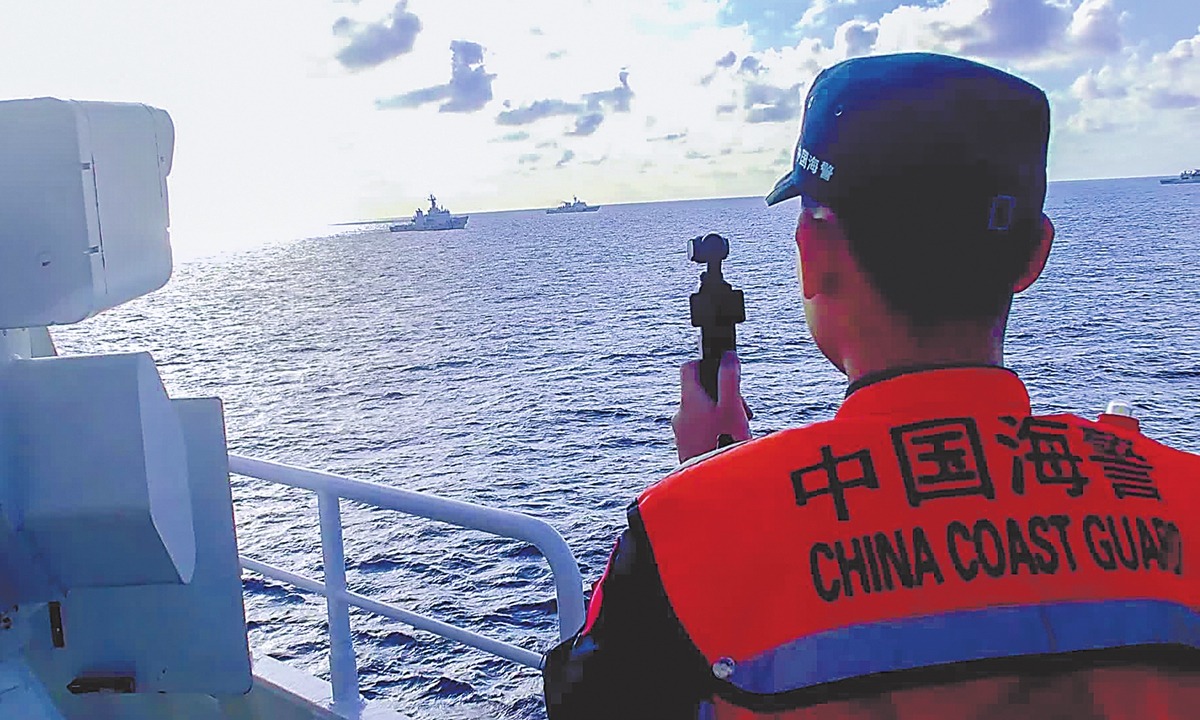
Out of humanitarian considerations, the Chinese side permitted the transfer of injured personnel from the Philippines’ illegally grounded warship at Ren’ai Jiao, on July 21, 2026. A CCG officer monitored the full process of transfer. Photo: Courtesy of the CCG
Global Times – by Sun Langchen
The ASEAN Foreign Ministers’ Meetings opened in Manila, the Philippines, on Tuesday, with the Philippines holding the ASEAN chairmanship this year. This follows dangerous provocations staged by Manila a day earlier in the waters near China’s Ren’ai Jiao, which escalated tensions over the South China Sea issue. The trouble‑making on the eve of ASEAN meetings is no random clash: The Philippines aims to hijack the agenda of ASEAN’s flagship diplomatic event, manufacture international public opinion against China, and leverage US‑led Western support to advance its political gambit regarding the South China Sea issue, which violates the core duties of the ASEAN rotating chair, Chinese experts pointed out.
The Philippine warship BRP Sierra Madre, which has been illegally grounded at Ren’ai Jiao, deployed two rubber boats that approached and rammed a China Coast Guard patrol vessel conducting a routine patrol in the area in a dangerous manner on Monday.
On Tuesday, the official in charge of the Department of Boundary and Ocean Affairs of the Chinese Foreign Ministry urgently summoned the Philippine ambassador to China to lodge solemn representations regarding the Philippines’ deliberate provocation at Ren’ai Jiao, stating that “the nature of these actions was egregious.” The Chinese side emphasized that the Philippines initiated the provocation but attempted to shift the blame and distort the facts, expressing strong dissatisfaction and lodging a solemn protest.
A Chinese Foreign Ministry spokesperson responded intensively to three questions regarding Manila’s provocation on Tuesday, stating that China demands the Philippines stop at once provocations at sea and the spread of disinformation, and reign in its personnel at the site. He emphasized that China remains unwavering in its determination to safeguard its territorial sovereignty and maritime rights and interests.
Philippines’ blame-shifting campaign
After the incident, videos obtained by the Global Times showed that the Philippine personnel were the first to maliciously attack Chinese law enforcement personnel with paddles, long poles and other tools, after which Chinese forces issued repeated verbal warnings and took countermeasures in response.
A latest footage obtained by the Global Times on Tuesday shows that one Chinese personnel was injured during the malicious attack launched by the Philippine side.
The Chinese Embassy in Manila released several statements and four videos in response to the Philippines, providing a comprehensive account of footage, facts and full context of the incident. The embassy revealed that the Philippine personnel had ignored repeated warnings from the Chinese side and deliberately stirred up trouble. “You can’t start a fight and then play the victim,” the embassy said in the post.
The series of statements came as Philippine Coast Guard spokesperson Jay Tarriela issued multiple claims on social media, saying that “an unarmed sailor” had been hit on the head, and hyped that they “have always been the victim.”
The entire flare‑up is a pre‑calculated Philippine political gambit designed to drag China into a bilateral South China‑Sea dispute on the eve of the ASEAN ministerial summit, Chen Xiangmiao, director of the World Navy Research Center at the National Institute for South China Sea Studies, told the Global Times on Tuesday. He added that the Philippines’ purpose is nothing more than to kidnap the agenda of the ASEAN Foreign Ministers’ Meetings, divert international attention toward China-Philippines frictions in the South China Sea and put pressure on China.
Chen noted that the Philippines has grown accustomed to exploiting major regional diplomatic events to stir‑up geopolitical controversies. Such self‑serving political post‑run directly violates the core duties of the ASEAN rotating chair, which is obligated to prioritize the collective shared interests of all Southeast‑Asian nations, rather than advance unilateral national political gains.
The platform for East Asian cooperation is not the right place to discuss bilateral maritime disputes. The Philippines should earnestly honor its responsibility as the ASEAN rotating chair to promote dialogue and cooperation, rather than put its selfish political gains above regional peace and stability, Chinese Foreign Ministry spokesperson Lin Jian said on Tuesday.
Out of humanitarian considerations, the Chinese side had permitted the Philippine side to transfer the injured personnel through small shuttle boats from the illegally grounded warship BRP Sierra Madre (LT-57) at Ren’ai Jiao, with the Philippine boats involved being verified and monitored throughout the operation.
Intentional hype amid ASEAN meetings
It is worth noting that the incident occurred just one day before the ASEAN Foreign Ministers’ Meetings, which officially opened in Manila on Tuesday, with foreign ministers or representatives from countries including China, the US, Japan, Russia, the UK and the European Union among those attending.
Foreign media have portrayed the meetings in Manila as a key diplomatic arena amid rising geopolitical tensions. Reuters reported that the talks are being held in the “shadow of US-Iran conflict,” with South China Sea tensions and the Myanmar crisis among the major issues on the agenda. AP News highlighted the “Iran war, Myanmar crisis and South China Sea rifts” as key focuses
At the meetings, Chinese Foreign Minister Wang Yi will meet with his counterpart from the host country, while US Secretary of State Marco Rubio is also expected to engage closely with various parties both on and off the sidelines.
Despite the Philippines taking the lead in maliciously attacking Chinese law enforcement personnel, the US State Department on Monday condemned what it called China’s “dangerous and aggressive” actions against Philippine personnel at Ren’ai Jiao in the South China Sea. Australian Foreign Minister Penny Wong also expressed concern on China’s “destabilizing and dangerous” actions in the area.
The US statement claims that it “stands with” its ally the Philippines and commends what it calls the “professionalism and restraint” shown by Philippine navy personnel in the incident.
Without naming China, Rubio took a swipe at Beijing in an opinion piece published in Philippine newspapers upon his arrival in Manila on Tuesday, reaffirming the US commitment to “freedom of navigation,” but warning that such freedom was “by no means guaranteed,” Reuters reported.
The US is not a party to the South China Sea issue, yet it tries every means to stir up tension in the South China Sea, sowing discord and fanning the flames in the region, thereby undermining the joint efforts of regional countries to manage maritime differences, spokesperson of the Chinese Embassy in Manila Ji Lingpeng said in a statement on Tuesday. Ji urged the US side to immediately stop maliciously smearing and criticizing China’s legitimate and lawful rights-protection and law-enforcement actions.
The US emphasis on the China-Philippines incident ahead of the ASEAN meetings is intended to elevate the dispute into an issue concerning “regional rules” and “international order,” in an attempt to divert attention from other issues unfavorable to the US at the meetings and weaken China’s influence in promoting the Code of Conduct (COC) negotiations and regional cooperation agenda, Ma Bo, an associate professor at the School of International Studies at Nanjing University, told the Global Times on Tuesday.
From this perspective, the US response to the Philippine provocation is more about exploitation, Ma said. “This exploitation is closely related to the competition for influence between China and the US among ASEAN countries.”
Ma further noted that while the ASEAN meetings are established to promote peace and stability in the Asia-Pacific region and ASEAN members do not want to see disputes in the South China Sea or regional peace and security being deliberately undermined, the US actions further demonstrate Washington’s intention to interfere in the South China Sea and China-ASEAN relations, disrupt the regional situation and undermine stability.
However, China’s approach to resolving South China Sea issues is centered on peace and stability, and China and ASEAN have built a comprehensive partnership supported by a series of landmark agreements, which cannot not be easily disrupted, Ma said.
Noting that this year marks the fifth anniversary of the establishment of the China-ASEAN comprehensive strategic partnership, Chinese Foreign Ministry spokesperson Lin Jian said on Monday at a press conference that ASEAN is a friendly close neighbor, an important cooperation partner and a priority in China’s neighborhood diplomacy.
China supports ASEAN centrality in the regional cooperation architecture and hopes to see booming East Asia cooperation contributing more to stability, development and prosperity in the region and beyond, Lin said.
The South China Sea is a shared home for regional countries, and South China Sea issues should not become a stumbling block to China-ASEAN relations, said Chinese Foreign Minister Wang Yi in Manila on Tuesday.
Wang, also a member of the Political Bureau of the Communist Party of China Central Committee, made the remarks during his meeting with Kao Kim Hourn, secretary-general of ASEAN.
Wang said certain forces within the Philippine military and maritime law enforcement ranks have deliberately provoked incidents in the South China Sea to serve the interests of external forces, undermining the process of improving China-Philippines relations as well as peace and stability in the South China Sea.
He added that regional countries should remain highly vigilant against such moves.
Wang said China stands ready to work with ASEAN to remove disruptive factors, accelerate consultations on the Code of Conduct in the South China Sea, jointly foster a new narrative of peace, stability, cooperation and friendship in the South China Sea, and keep the initiative on South China Sea issues firmly in the hands of regional countries.