

Trump and Irish Reunification: A Remark That Carries More Weight Than It Appears
By Prof. Engr. Zamir Ahmed Awan,
US President Donald Trump’s statement in Dublin that he would “love to see” Irish reunification and that it would “may as well happen now” has reopened one of the British Isles’ most sensitive political questions. The comment may have been made casually, but coming from a sitting American president, it cannot be treated as an ordinary remark. It touches history, identity, sovereignty and the carefully constructed peace settlement in Northern Ireland.
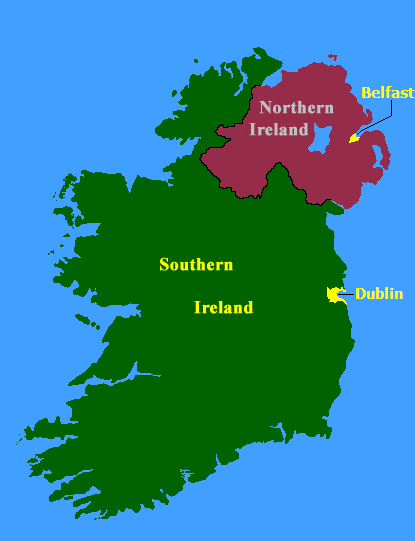
To understand the sensitivity, Ireland was partitioned in the early 1920s after a long struggle over British rule. Six predominantly unionist counties in the north remained within the United Kingdom, while the remaining 26 counties eventually became the independent Irish state. Northern Ireland consequently developed two competing political identities: unionists, mainly from the Protestant tradition, generally wanted to remain British, while nationalists and republicans, predominantly Catholic, sought closer ties with or eventual union with the rest of Ireland.
These divisions produced decades of political tension and, from the late 1960s, the violent period known as “the Troubles.” More than 3,000 people were killed. The 1998 Belfast, or Good Friday, Agreement finally established a political framework based on power-sharing, equality and, most importantly, consent. Northern Ireland remains part of the United Kingdom unless its people democratically decide otherwise.
That principle is crucial to understanding the significance of Trump’s intervention. The Agreement does not prohibit reunification. It provides a democratic route to it. A border poll can be called when the British Secretary of State considers that a majority in Northern Ireland would favour constitutional change; a united Ireland would ultimately require majority support in both Northern Ireland and the Republic of Ireland.
So what are the implications of Trump’s words? Politically, they strengthen the confidence of Irish nationalists and republicans, particularly Sinn Féin, while alarming unionists who regard Northern Ireland’s place in the United Kingdom as fundamental to their identity. Yet Trump’s statement does not itself alter Northern Ireland’s constitutional status. Nor can Washington decide whether a referendum is held. That remains governed by the British-Irish settlement and democratic consent.
For the British Government, the sensible response is neither panic nor confrontation. Prime Minister Andy Burnham’s government has already maintained that there is insufficient evidence of majority support for a border poll and that its position has not changed. That is constitutionally and diplomatically defensible. London should reaffirm the Good Friday Agreement rather than allow Trump’s remarks to turn into a transatlantic dispute.
An excessive British reaction, however, could be counterproductive. Treating a presidential comment as an attack on British sovereignty could give it greater importance than it deserves and unnecessarily damage an already complicated US-UK relationship. The wiser course is to state calmly that Northern Ireland’s future belongs to its people and that Britain will respect whatever democratic outcome emerges.
The question of whether Trump spoke deliberately is more complicated. His remarks were probably neither a formal policy announcement nor completely meaningless. Trump has frequently used unscripted political language and personal judgments, particularly when speaking abroad. His visit to Ireland also had obvious political and personal dimensions. Nevertheless, he chose to make the comment publicly, alongside the Irish prime minister, while discussing a subject whose sensitivity is well known. That gives the statement political weight even if it was not carefully drafted policy.
The deeper concern concerns American foreign-policy credibility. For decades, Washington played a distinctive role in Northern Ireland: not as the power deciding the outcome, but as an influential supporter and mediator of peace. The Clinton administration helped broker the Good Friday Agreement, while American officials subsequently described the United States as an impartial adviser and supporter of the Agreement.
That history makes Trump’s language unusual. A mature foreign policy should distinguish between supporting the right of people to determine their future and openly advocating one constitutional outcome. The former reinforces the peace settlement; the latter risks making Washington appear partisan.
Ultimately, Trump’s remarks will not reunify Ireland. Demography, elections, economics, identity and public consent—not presidential preference—will determine that question. The real test for American diplomacy is whether Washington continues to be a credible supporter of the rules it helped create.
A United Ireland may or may not eventually emerge. That decision belongs neither to London nor Washington alone. It belongs to the people of Ireland, north and south, through the democratic process established by the peace agreement. That is precisely why presidential words on the subject should be measured with greater care than Trump’s latest remark suggests.
Author:
Prof. Engr. Zamir Ahmed Awan,
Sinologist – Diplomat – Advisor – Consultant,
Founding Chair, Global Silk Route research Alliance.
A good article, yet it seems to ignore the fact that everything the Orange Oaf touches turns into either shite, or an own goal. “So what are the implications of Trump’s words? Politically, they strengthen the confidence of Irish nationalists and republicans…” Really? – I would assume the polar opposite… Read more »