

Michael Hudson and Steve Keen : Economics Belongs in Fiction
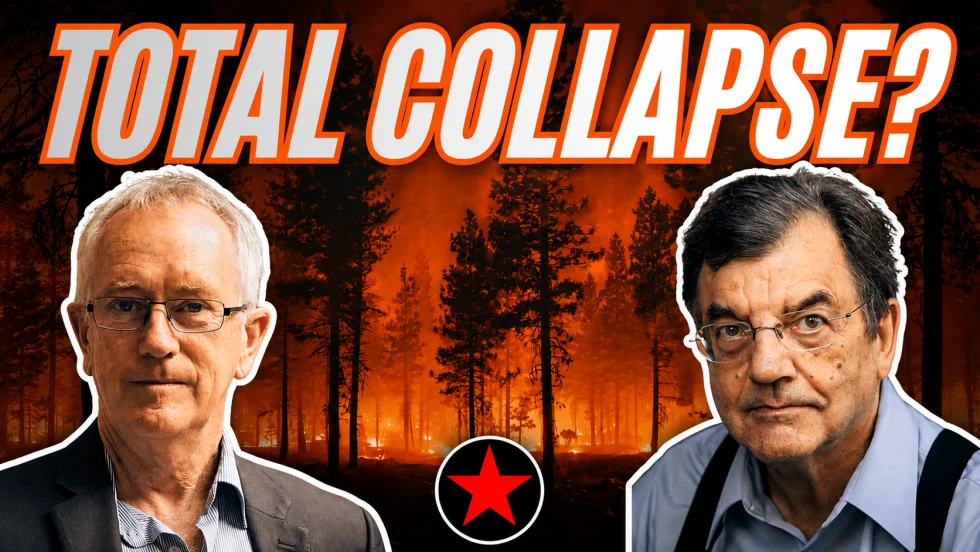
‼️ 📌This is not a comfortable message, but it is a must-read or hear out the video. This is a finalized litmus test. Anything that brutally externalizes the human condition on our planet, is a fairy story.
https://michael-hudson.com/2026/09/economics-belongs-in-fiction/
Class Unity recently continued its conversation with economists Steve Keen and Michael Hudson about the U.S.–Iran conflict, the Strait of Hormuz, and the mounting economic risks of a wider regional war. They discuss the military-industrial complex as a central force in American political economy and consider what ending the country’s permanent-war footing would entail. The conversation then turns to Silicon Valley, artificial intelligence, energy and water use, and whether new technologies could serve the public rather than intensify inequality. Keen and Hudson close by examining climate breakdown, debt, the failures of neoclassical economics, and the need for a new intellectual framework adequate to an interlocking civilizational crisis. Steve Keen is an Honorary Professor UCL, and Distinguished Research Fellow at the Institute for Strategy Resilience & Security, University College London. Michael Hudson is an American economist who is Professor of Economics at the University of Missouri–Kansas City and a researcher at the Levy Economics Institute at Bard College.
War, debt, artificial intelligence and climate breakdown are no longer separate crises. Steve Keen and I examine the permanent-war economy, the physical limits confronting Silicon Valley and the intellectual failure of a discipline that treats everything essential to life as an externality. Economics may now be better understood as a branch of fiction.
TRANSCRIPT
Class Unity recently continued its conversation with economists Steve Keen and Michael Hudson about the U.S.–Iran conflict, the Strait of Hormuz, and the mounting economic risks of a wider regional war. They discuss the military-industrial complex as a central force in American political economy and consider what ending the country’s permanent-war footing would entail. The conversation then turns to Silicon Valley, artificial intelligence, energy and water use, and whether new technologies could serve the public rather than intensify inequality. Keen and Hudson close by examining climate breakdown, debt, the failures of neoclassical economics, and the need for a new intellectual framework adequate to an interlocking civilizational crisis. You can find more from Class Unity, Steve Keen, and Michael Hudson on their respective websites.
Class Unity: What do you make of the most recent state of affairs in the Middle East and the conflict with Iran, the Strait of Hormuz, and energy? Where do you see it going?
Are there options for better or worse outcomes, or is it simply going to be a collision course for collapse?
Steve Keen: I think “collision course for collapse” is well put—good alliteration there. The only way we can get out of this is for Trump to declare victory and then leave, and he shows no sign of doing that. He still seems to be gaming the oil market and the stock market with his on-again, off-again announcements. The Iranians recently said they do not intend to listen to Trump anymore. They know that he does not hold to a promise for more than thirty seconds, so what is the point of negotiating with him? They intend to push forward and try to drive America out of the Middle East. I think that would be the best possible outcome. America has been a destabilizing force in global energy supplies and global politics for far too long. Getting it out of the Middle East would give the region’s predominantly Muslim countries some possibility of overcoming the Sunni–Shia conflict and constituting a Muslim part of the world. That is a positive development I can ultimately see happening.
In the meantime, however, we are going to be destroying the productive capability of the planet.
The real danger is that Trump may act on some of the nonsense he is talking about and commit war crimes by destroying civilian infrastructure inside Iran. Iran has said, in effect: “We have put up with six months of this. Your two-day war has already lasted six months. If it lasts longer, we are going to launch preemptive strikes. We are going to hit twice as hard each time you hit us.” Iran is threatening that, if its energy or water infrastructure is damaged, it will do the same thing to any country siding with America in the Middle East.
Geography rules in this situation. Iran is very difficult to defeat:it is a mountainous country of roughly ninety million people, and about 96 percent of its water apparently comes from natural sources. On the other side of the Persian Gulf are Arab states that obtain roughly 90 percent of their water from desalination plants. All Iran has to do is take out a couple of desalination plants, and that will not merely defeat but depopulate countries that side with America on the other side of the Gulf. The only real long-term solution is for the countries of the region to cooperate and drive the Americans out. I am afraid, however, that the Americans will commit war crimes by taking out civilian infrastructure in Iran. Iran will retaliate, and God knows which particular country it will target. It could become necessary to evacuate those countries; otherwise, people will not merely starve to death, which is bad enough, but die of thirst.
Michael Hudson: What Steve has described is the major danger people are worrying about. For the time being, however, hardly anything is happening. Every day I look at the stock and bond markets, and everything is absolutely stable. The claim is that the United States does not have to do anything at all: “We are blocking all of Iran’s oil exports. We are going to starve the country.” That is said as if Iran had not been living under sanctions since 1979 and had not created an economy capable of living with those sanctions for the last forty-five years. Psychologists call this projection: you believe your opponent is just like you. The American economy would certainly starve if there were a suspension of trade, so the assumption is that a poorer economy such as Iran must starve first.
Iran is going to say: “If you want to wait it out, we will wait it out. If we cannot export our oil, nobody is going to export oil.” That is why it attacked another tanker trying to go through the Strait, while the Yemenis are preventing Saudi Arabia from exporting oil tankers through the Red Sea and the Suez Canal. One possibility is to do absolutely nothing and let the oil trade stop. How is this happening without any immediate crisis? The United States and other countries are emptying their national petroleum reserves. In another month, by early September, those reserves will be empty. Much of the U.S. oil being sold from the reserves ends up in Europe and other countries in an effort to keep the prices of oil and diesel fuel down.
What will happen when the reserves and inventories have been depleted? The backlog of unproduced oil, combined with that depletion, is going to create the price inflation we have been discussing. Iran will be able to get by, but the United States and other countries will suffer. At that point, you may find Trump doing what Steve has described: saying that the United States has to do something and should bomb Iran. Trump wants to be another Napoleon; he has used that metaphor all his life, as if Napoleon did not end up losing first to Russia and then at Waterloo. Trump may end up like Napoleon without ever having achieved a victory, which is not exactly what people associate with Napoleon.
Steve Keen: Another crazy element is that, as Michael said, Trump expects the other side to behave as he does. He is behaving like a Mafia boss: “That is a nice shopfront you have there. It would be terrible if somebody smashed it up. Why don’t I send somebody down to make sure that does not happen? All I want is ten percent of your profits.” You effectively have a Mafia chief in charge of the American economy. The other side is not a bunch of mafiosi. These are people with their own culture who want to maintain it, and they are saying that they will outlast America because they have no intention of becoming subservient to it.
The same situation applied in Vietnam. America foolishly thought it could crush the Vietnamese by the sheer weight of arms. That was Robert McNamara’s line throughout the war: count body bags and rely on statistics, because any day now the Vietnamese were going to be defeated. What was the result? Americans clambered onto the roof of the embassy in Saigon to board the last helicopters as North Vietnamese tanks came through the gates. It will not be quite that dramatic this time, but it could be even more dramatic for the📌 global economy. Iran may say: “We have had enough. We will inflict upon the people supporting you the same damage you inflict upon us.” We would then lose productive capacity not merely while the Strait is closed but until oil facilities and desalination plants could be rebuilt. The world would lose the capacity to produce those inputs in the first place, and the global economy would contract as a result.
Michael Hudson: Rebuilding would take five years. A point of order, Steve: Trump has actually said he wants 20 percent of the total oil revenues from oil sent through the Strait of Hormuz. I have an article at the Democracy Collaborative, which is also being put on my website, in which I provide the relevant quotations. Trump said as early as 2018 that America’s balance-of-payments deficit stems mainly from its overseas military spending, and he wants foreign countries to pay for America’s Cold War. He singled out Saudi Arabia and the OPEC countries, saying, in effect, “We are their guardian angel. We are defending them.” One reason he defaulted on the memorandum of understanding he signed with Iran—and had no intention of honoring it—was that he did not want Iran to charge fees for tanker transit through the Strait of Hormuz. He wanted that revenue himself, and he wanted a 20 percent fee on the total. Talk about mafiosi: that is the vigorish he wanted.
Iran has said that its fees would be nowhere near as large, but its position remains that if it cannot export its oil, nobody can. If it takes five years to rebuild, and if Iran does what Steve says it has threatened to do when attacked—hit desalination plants, refineries, and production capacity—you can close down the Near East. Iran hopes that the rest of the world will say that it cannot afford to have 25 percent of the world’s oil supply shut down and will bring pressure on the United States.
But there is no longer an effective United Nations, and the United Nations does not have an army or enforcement procedures. The only tool other countries have is to isolate the United States, just as the United States has tried to isolate Russia, Venezuela, Iraq, and Iran with sanctions. They are not going to do it, however, because so many of their investors have made money in U.S. stock and bond markets, their funds remain tied up there, and their governments—including Saudi Arabia’s—hold U.S. bonds. The United States can simply say, “We are keeping the money.”
Class Unity: Relatedly, on the military-industrial complex and the permanent-war economy, we have a question about what would happen if the United States suddenly decided to be nice—or were stopped by Iran or someone else. In 1987, George Kennan said that if “the Soviet Union were to sink tomorrow under the waters of the ocean, the American military-industrial complex would have to remain substantially unchanged until some other adversary could be invented. Anything else would be an unacceptable shock to the American economy.” What do you think would happen if America stopped waging war? What would the effects be? Would it affect only America, Steve?
Steve Keen: I think you have identified it: the main enemy America has is its own military-industrial complex. That is what needs to be destroyed if America is to have a viable culture, because its members have profited from all these wars. That is why the wars keep happening. It is also why the weapons do not work: the industry wants expensive weapons because it can charge large amounts of money and make large profits. Expensive weapons no longer work in the modern world, but they remain the entire focus of the American arms industry. If America stopped that and reduced the power of the military-industrial complex, it might finally return to being a nation that cares about its own people.
I cannot see that happening, however. The real problem, in many ways, is the Constitution that everybody eulogizes, because it prevents the kind of change America needs. I would like to see a referendum that completely bans private donations to election campaigns and funds campaigns with government money creation in a way that would allow new parties to evolve. It is quite feasible to imagine that. But the one country that cannot readily do it is the United States, because its Constitution puts responsibility for calling such a process in the hands of the current political system. A constitutional amendment requires, I think, a two-thirds vote in Congress. The people who have been bought by the military-industrial complex and the oil interests are the last people who will make such a change. You need an independent basis for enabling it to happen, and the American Constitution does not give you one. Britain, Australia, and most European countries have at least some chance of doing that sort of thing. America is stuck with the best politicians money can buy and the worst military-industrial complex money can buy.
Michael Hudson: What Steve is saying is that, if America tried to get rid of its military-industrial complex, it would no longer be America.
Steve Keen: That would be a good change.
Michael Hudson: But that is the problem, for the reasons Steve gave. There is not going to be a change, because the military-industrial complex is the most profitable American industry. Its way of making profits is not how industrial capitalism works in the textbooks, where firms are supposed to cut costs and become competitive. Seymour Melman wrote a whole book about this in the 1970s, Pentagon Capitalism. These companies have cost-plus contracts with the United States. They say, in effect: “We never want to be accused of making a profit or monopoly rent. Whatever it costs us to produce these missiles and fighter aircraft that constantly have to go in for repair, we will simply take a ten-percent commission. That is not really profit.” How do they increase their commissions? They make the most expensive aircraft and missiles they can.
These missiles are trophies; they are not really for use. It is like buying a trophy bottle of wine for one thousand or ten thousand dollars. The wine is not for drinking—you try to drink it and it may have turned to vinegar. It is for trading. Likewise, U.S. weapons are not really for fighting. We have seen in the Iran war that these arms were designed for the world of the Second World War. They are not designed to cope with the weapons Russia, Iran, or China have: weapons that go straight through Patriot defenses and enable them to strike at will, including the radar stations that guide U.S. missiles. Iran has had relatively few problems neutralizing the products of the American military-industrial complex, yet the system continues. In his most recent budget, Trump increased military spending from one trillion to one and a half trillion dollars.
Class Unity: We have one last question before final thoughts, and it concerns Silicon Valley, the technology sector, and artificial intelligence. What is their place in the political-economic system, nationally and internationally? What do we need to understand about their development, and where do you see the whole process going? What should we be watching? We are asking, in part, for a Marxist perspective: what is the business model, how does it work, and how does it relate to the FIRE sector? Is it simply a bubble, or will it leave behind something useful, as the railroads did after their bubble burst?
Steve Keen: This is an interesting question. It takes us back to the fact that few people actually understand the capitalist economy. One of those who did was Joseph Schumpeter, in The Theory of Economic Development, with his analysis of what causes profits and technological booms and busts. His argument was that a new technology initially causes a boom because companies borrow money into existence for their investments, and everybody dives in at once. There is overinvestment on a grand scale. Every railroad company thought it was going to be the only successful railroad; every AI company thinks it will be the only successful AI company. Massive overinvestment develops the technology. When the technology comes online, it undercuts existing industries, so it goes from causing a boom to causing a slump. During the slump, the technology permeates society and changes its nature. I think we are seeing part of that with AI.
The reason AI could be truly transformative is that it could create the sort of Star Trek future in which we do not need to work, the robots do all the work, and we live as a society of philosopher-astronauts. That would be a wonderful future if we could reach it, but I think it is completely antithetical to the American capitalist system. When capitalists can replace workers, they sack them and give them no compensation. If you want a system that captures the benefits of AI and distributes them throughout the culture, you need a socialist system. That is something China can comparatively achieve, because more than half of its production comes from state-owned enterprises. Its private enterprises are incredibly competitive with one another, but they know they operate within an overall national framework. If China decides to reduce the retirement age and increase retirement benefits, that effectively functions as the “universal high income” Elon Musk talks about without breaking the nature of Chinese society.
I find it ridiculous that somebody such as Musk, who was so hostile to government spending, now says he wants a universal high income. The only way it can happen is for the state to create the money that enables the non-working class—which is what we will all become—to buy the goods and services produced by the oligarchs. For America, that would be a huge social transformation, and I cannot see the country moving toward it. My expectation for America is not universal high income. It is The Hunger Games. China might be able to achieve the universal-high-income outcome.
Michael Hudson: I wonder whether Steve has thoughts about global warming and drought, because that is what the AI revolution is also about. AI has to be run with electricity, and there are plans for a giant expansion of computer-chip factories and data centers. They need an enormous amount of electricity. Who is going to produce it? It cannot be produced in America within at least five years, which is how long it takes to build a new electric utility and obtain all the local, state, and environmental permissions. Amazon, Google, and Meta have said, in effect: “We cannot get the energy to run AI here. Let us go where the energy is produced. Let us go to the Persian Gulf—to Bahrain, Abu Dhabi, the Emirates, and Saudi Arabia.” Iran, meanwhile, has concluded that the only way to get the United States out of West Asia and the Persian Gulf is to prevent those countries’ economic ties with the United States. It therefore bombed Amazon and other computer facilities used to run cloud services.
How can all this expected AI investment be made without not only enormous amounts of electricity but also enormous amounts of water? Computer chips generate heat, so the facilities need water for cooling. The western states are already experiencing drought, largely as a result of global warming, and that is already contributing to the collapse of farm, crop, and wine prices. How can Anthropic suddenly have a valuation of two trillion dollars on the basis of its AI prospects? Somebody in the chat asked whether this technology is going to displace labor. What is all this AI actually used for? It is used to read everything on the internet—not only to displace labor but also as a kind of surveillance program for government and marketing. Is anybody saying something that criticizes a party the authorities do not like? What is everybody likely to buy, where are they coming from, and how can this information be used for marketing?
That is not the kind of AI China is investing in. China is building robots to make cars in entire factories without human labor. That is not what is happening in the United States, where AI is primarily used for gathering information. It has no clearly positive social function. They call it automatic intelligence, but it is essentially a modern machine for processing everything people write and drawing it together. It has an entirely different relationship to the productive sector from anything Marxists could have imagined. Marxists were very optimistic about capitalism evolving into socialism. What is happening is a travesty of the dynamic Marx found in industrial capitalism. We are now in some other kind of economy.
Steve Keen: Michael is right that the timing is absolutely disastrous. Energy use is the obvious cause of increasing global temperatures because we still rely on fossil fuels. Anybody who does not believe carbon dioxide increases temperature can use the exit door on the right. Neoclassical economists are, I think, the biggest enemies capitalism has ever had. They reacted to The Limits to Growth study in 1972 by saying that it called for state intervention to control population, reduce pollution, and so on. They rejected that in favor of a market-based solution, and, for such a solution, global warming had to be treated as a small problem. They therefore pretended that global warming would effectively do nothing more than move New York to Florida: perhaps a ten-degree increase in temperature and a twenty-percent fall in GDP—serious but supposedly bearable.
Economists have confused the relationship between income and temperature across space with the relationship between income and temperature through time. That is why they produce such trivial estimates. They looked across geographic locations, concluded that climate does not have much impact on GDP, and assumed that a ten-degree increase in temperature would be no big deal. But a six-degree fall in temperature from current levels would return us to the Ice Age, when Chicago was under a couple of kilometers of ice. Economists have taken the relatively trivial effect of temperature differences across space and projected it through time, even though six degrees separates an ice age—the condition that prevailed for most of the previous ninety thousand years—from the Holocene period in which civilization developed. A six-degree rise would be similarly transformative in the opposite direction. Scientists say the temperature increases that economists treat as having a minor impact on GDP could drive us extinct.
That is the real danger. AI could not be worse timed, arriving when energy use is so critical. We will probably find that one of the easiest ways to reverse the catastrophe we are walking into is to shut down nonessential industries that use the greatest amounts of energy. The three I would nominate are international tourism, Bitcoin, and AI. The approaching El Niño may finally make many people realize how devastating even the roughly one-and-a-half degrees of warming we are experiencing can be. It could push the rise to two degrees, beyond the level climate science describes as dangerous and toward the level it calls catastrophic. We are finally going to see disasters that—pardon me for putting it this way—kill large numbers of white people. When that happens, political leaders may at last take the problem seriously, but it may be too late to reverse direction.
Class Unity: We are going to move into closing comments and ask both of you for final thoughts. Before that, I want to mention two funny comments from the chat. In response to The Hunger Games, somebody said, “I prefer The Running Man.” Another person described the AI economy as “an M. C. Escher hellscape.”
Steve Keen: That is pretty accurate. At least Escher’s drawings looked attractive. I do not think the American economy—or the global economy—is all that attractive at the moment.
Class Unity: Final thoughts. Steve, would you like to start?
Steve Keen: I think we are at a critical juncture, not only for the American economy but also for the global civilization of which we are a part. The next book I am publishing, which I am still trying to finish, is titled How Economists Will Destroy Capitalism. That is the real trouble. The economics Michael and I have fought throughout our careers has been accepted by conventional thinkers and the financial class because it gives them free rein to run the global economy. It is fallacious at every possible level. Besides misleading us about the nature of capitalism, it has misled us about the dangers of global warming.
We are going to discover that this is existential for human civilization. The only way to survive is to treat it as the Second World War on steroids, which means rationing and dramatic state control to avert complete calamity.
It is a toss-up whether we will be able to reverse the forces we have unleashed, because their scale is almost unthinkable and most people have not thought about them. That is why climate scientists are going hoarse trying to warn us. A classic example is the Atlantic Meridional Overturning Circulation, or AMOC. Climate scientists originally estimated that it would take three to five degrees of warming to cause it to break down and perhaps two or three centuries for that breakdown to have a dramatic effect on the climate. More recent research says it could happen at any time between last year and 2095. When the AMOC shuts down, the transfer of heat from the southern Atlantic Ocean to the north will disappear. Some of the latest research suggests that temperatures in Europe could fall by ten degrees over three decades. Ironically, global warming could wipe out Europe through glaciation while the rest of the world goes in the opposite direction. The stability we have taken for granted during the Holocene is being destroyed. Fighting that will require measures that make what happened during the Second World War look like a picnic, and I do not think that is going to happen. I am extremely pessimistic about our future, and I blame the economics profession for putting us in this situation.
Michael Hudson: I agree with Steve. The problem goes beyond the neoclassical economics he has criticized so well to the idea that the economy somehow works in cycles: what goes up must come down, and then it goes on and on, up and down, with self-correcting feedback mechanisms. That is not what has happened. The myth exists because, if markets have “automatic stabilizers,” to use the National Bureau of Economic Research’s term, then we do not need government regulation. People do not need to do anything, and they certainly do not need to bring what Steve and I are discussing into the economics curriculum. The economy supposedly continues on a steady-state cycle, going up and down.
That is not what has happened. Every business takeoff since 1945 has begun at a higher and higher level of debt. Private debt is like driving a car with a foot on the brake: it slows the recovery. Each recovery has been slower than the preceding one. Now, instead of a recovery, we have an attempt to create the illusion of recovery by turning the economy into a financial Ponzi scheme. The American economy itself has been deindustrializing, as have European economies. On top of that are the global-warming and weather problems Steve has described. That is the environment—but economists do not talk about the environment. They say it is a different topic, an “externality.”
Steve Keen: Isn’t that nice?
Michael Hudson: An externality—another department. Everything important to our lives, everything that is changing the way the world works and creating this civilizational crisis, is external to what economists discuss.
Economics has become a vestigial intellectual antique. We need a new body of thought, but we cannot call it economics because that term has already been wrecked. We have to find a new word for what we are doing. I called myself a futurist beginning in the 1970s because the term did not mean anything at all; it could mean whatever we wanted it to mean. Maybe Steve and I can devise a term for what our work should be. People have spoken of systems analysis, which is part of what we do, and of future studies, which is also part of what we do. But economics should be left in the literature department as a branch of fiction.
Steve Keen: Michael, I am going to give you a really crazy suggestion. We need to form a new religion, because human beings learn and retain stories indefinitely through religious belief. You and I are both atheists, but I think we should all become Saganists. Carl Sagan gave us the image of the pale blue dot by turning Voyager around and looking back at Earth: less than one pixel containing everybody you know, everybody you have ever fought with, everybody you have ever loved, and everybody you have ever read about, surrounded by the vastness of the universe. Science, an understanding of reality, and the realization that we are part of a living system have to replace the mercantilist attitudes of modern economics. We need a new religion. I am going to call it Saganism. You and I need to be its high priests.
Michael Hudson: I agree.
Class Unity: I think we can wrap it up here. We are about to go into the after-hours discussion, and both of our guests are welcome to join us. Thank you so much to our guests. This has been a fantastic discussion, and I look forward to putting it up and seeing people’s responses in the comments. Thank you again, Michael. It was great to see you. Be well.