

A war story
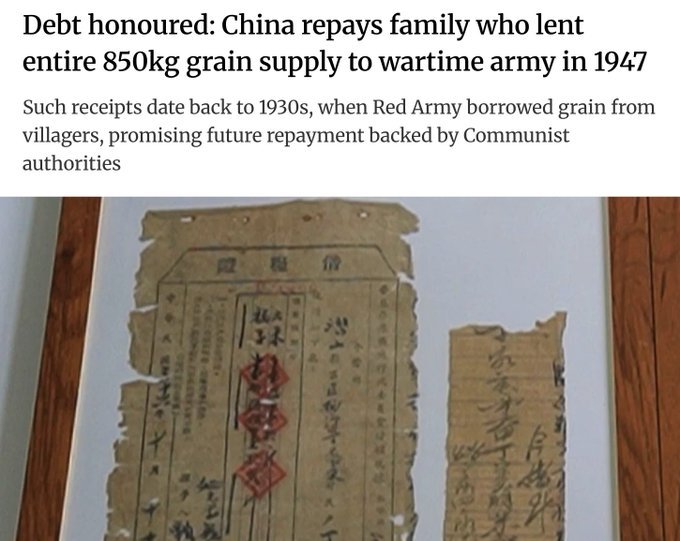
In 1947, a People’s Liberation Army unit pushed into the Dabie Mountains during the counteroffensive against the Kuomintang. The men arrived exhausted and desperately short of supplies, in thin clothing and straw sandals. Kuomintang forces had already been through those villages. They had plundered them, and forcibly conscripted the son of a local farmer, Ding Wanmin.
The PLA behaved very differently. Cold and hungry as they were, they kept strict discipline, even sleeping outdoors rather than intruding into people’s homes. Ding Wanmin was so impressed by their behaviour that he lent them more than 850kg of grain – very nearly everything his family had. In return he was given a handwritten receipt recording the date, the quantity and the officials involved: a grain loan certificate, a wartime IOU. Such documents go back to the 1930s, when the Red Army borrowed from villagers and local granaries during food shortages and issued promises of repayment backed by the communist authorities.
The Red Army and the PLA operated under the Three Main Rules of Discipline and the Eight Points for Attention, which Mao issued in definitive form as a General Headquarters order in October 1947 – the very year of Ding’s loan.
Do not take a single needle or piece of thread from the masses. Pay fairly for what you buy.
Return everything you borrow.
Pay for anything you damage.
This is a big part of why the communists won. Not equipment: they had straw sandals, while their opponents had US aircraft, US artillery and US money. But ordinary people looked at the two armies and supported the one that treated them with respect and dignity, and that represented their interests. As Peng Dehuai put it, tactics matter, but “we could not exist if the majority of the people did not support us”.
Ding never sought repayment; neither did his son. His grandson comments that “my grandfather lent the grain because he believed the Communist Party could help ordinary people build better lives”.
The certificate lay hidden for decades, and was only found in the 1990s, wedged in a yellowed paper packet between the bricks of the old family home as it was being demolished. Ding’s grandson kept it as a family heirloom. Last year he heard the local government was collecting historical artefacts, and at a recent ceremony he donated the certificate outright, asking for no compensation. Upon discovering that the wartime debt had never been settled, however, officials awarded the family 70,000 yuan (US$10,300), taking into consideration historical grain prices, inflation, and the cultural significance of the document. An amazing story!