

The Revolution Lives On In Sudan
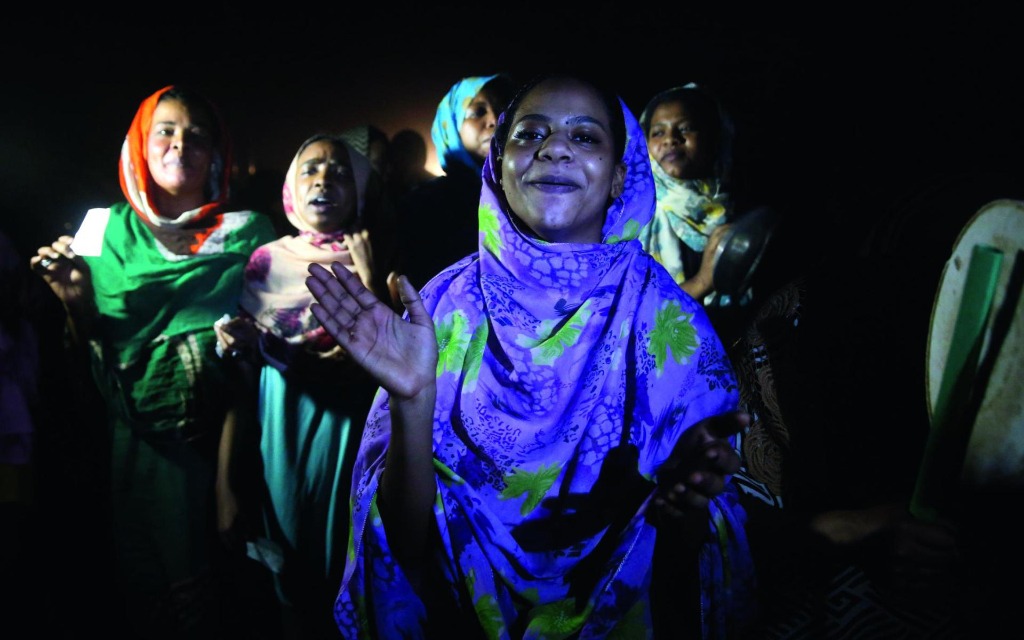
Sudanese protesters shout pro-revolution slogans as they march in Khartoum, Sudan, on 19 June 2019 (Hussein Malla/AP Photo/Alamy).
Lara Lamie traces Sudan’s revolutionary spirit, from tearing down a dictator’s regime to keeping the hope of civilian rule alive in a brutal war.
In December 2018, Sudanese citizens took to the streets over the price of a loaf of bread. Within weeks, that anger had grown into something far bigger: a demand to tear down the regime of dictator Omar al-Bashir, who had ruled by fear for 30 years.
Millions filled the streets of the capital, Khartoum, united by a simple call: freedom, peace, justice. For a moment, it seemed like the ultimate proof of people power: that a nation could remake itself from the ground up, not just topple a dictator but rewrite the relationship between citizens and the state.
Now, nearly eight years on, Sudan is deep in a war that has plunged the country into one of the world’s worst humanitarian crises. And with the war came the machinery of counter-revolution. Civilian networks have been dismantled, political action crushed and activists have been hunted down by both warring parties.
As two generals fight for control of Sudan, the war is often described as a bloody struggle for power and resources. But alongside that struggle lies a shared objective: to crush Sudan’s most successful revolutionary project. In pursuing that aim, have the generals succeeded in destroying Sudan’s democratic future? And what remains of the revolutionaries who once came so close to changing the country?
A History of Revolt
Sudan has a long history of popular uprisings, with mass protests helping to overthrow military governments in 1964 and 1985. The generation that filled the streets in 2018 had spent most of its life under Bashir, who seized power in a 1989 military coup and remained president for almost 30 years. Under his rule, political opposition was violently suppressed, the media restricted, and conflicts across Sudan devastated civilians.
Despite brutal repression, Sudanese continued to resist. In 2013 large-scale protests sparked by cuts to fuel subsidies shook the country – until the regime quashed them with lethal force. The memory of those killed remained part of the revolutionary consciousness.
What made the 2018 uprising different to the waves of resistance that came before was both its scale and its organization. The Sudanese Professionals Association (SPA) helped co-ordinate national mobilization, while neighbourhood Resistance Committees organized protests at the more local level. The movement continued to grow despite arrests, censorship, internet shutdowns and violence by the security forces.
On 6 April 2019, this momentum culminated in a massive, permanent sit-in outside the army headquarters in Khartoum. ‘The revolution came after a long time of silence, so people were relieved by the ability to actually scream and talk about Sudan,’ recalls Samah, a young activist and medical student, now residing in Egypt. Within days the sheer scale of the protest forced the military to mount a coup. On 11 April Omar al-Bashir was officially overthrown.
However, removing a dictator was not the same as removing the system that had sustained him. Immediately after Bashir was ousted, the military moved quickly to take control, forming a transitional military government led by army general Abdel Fattah al-Burhan, with Mohamed Hamdan Dagalo, known as Hemedti, the commander of the Rapid Support Forces (RSF), as his deputy.
But protesters had not taken to the streets simply to replace one military ruler with another, and they demanded an immediate transition to civilian rule. For nearly two months, the sit-in became a world of its own: people slept in tents, artists painted walls, volunteers organized food and medical care, and strangers debated politics late into the night. After decades of authoritarian rule, public space had suddenly become theirs.
Surviving the Massacre
The military, however, was not willing to relinquish the power it had accumulated over decades. On 3 June 2019 security forces, led by the RSF, violently dispersed the sit-in and a vibrant symbol of hope was brutally cut short. At least 120 people were killed, hundreds more were injured, and protesters were subjected to rape, sexual violence, beatings and arbitrary detention.
‘That day was very hard on me,’ recalls Cairo-based activist Mohammed, who was just 16 years old when he witnessed the massacre. ‘It changed my whole perspective of the world, not just politics… The world is not just rainbows and colourful anymore.’
The attack was meant to break the movement the sit-in was part of, but Mohammed and thousands of others did not give up.
In August 2019, negotiations – and months of protest – produced a new transitional government led by prime minister Abdalla Hamdok, which combined civilian and military leaders and promised a path towards democratic elections.
But the military retained considerable political and economic power and many of the protesters’ demands remained unfulfilled. Bashir was gone, but the institutions and people who had sustained his rule were still pulling the strings.
In October 2021, Burhan and Hemedti jointly overthrew the transitional government, returning Sudan to direct military rule. Renewed protests were again met with violence, killings and arrests, but still people continued to demand civilian rule.
By that point the revolutionary movement was still thriving, having survived both the massacre at the sit-in and the 2021 military coup. It was going to take a devastating war to splinter it.
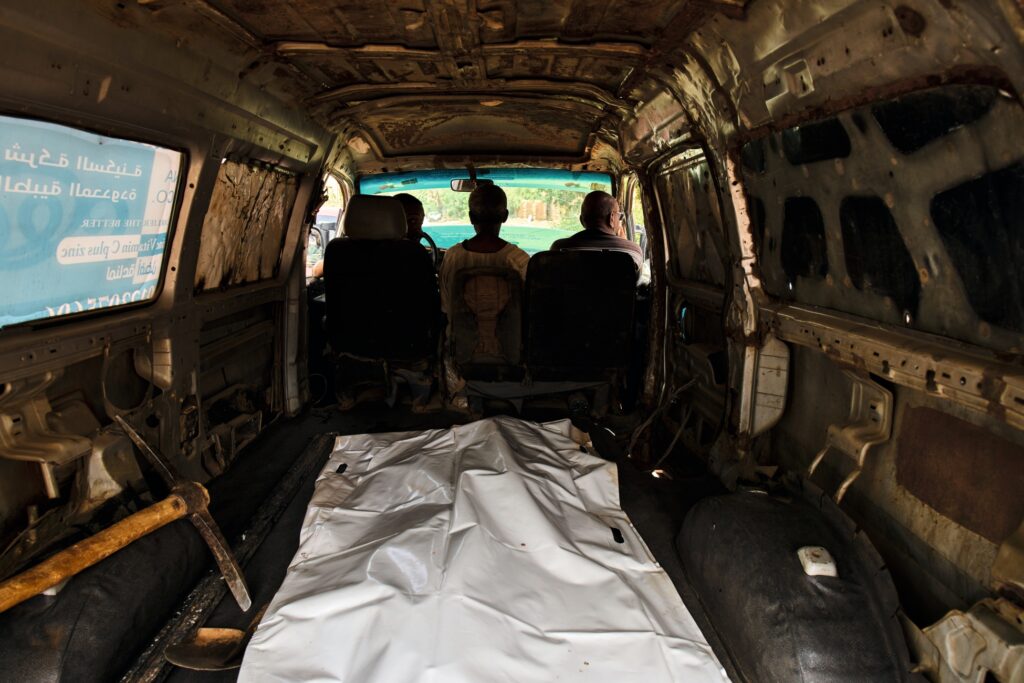 The body of Mohammed Alsawi, who was killed in 2023 by the paramilitary Rapid Support Forces, is carried in a van after being exhumed by staff from Sudan’s Forensic Medicine Corporation in Omdurman on 20 April 2026 (Bernat Armangue/AP Photo/Alamy).
The War That Scattered Everything
On 15 April 2023 fighting broke out in Khartoum between the Sudanese Armed Forces (SAF), Sudan’s national military under Abdel Fattah al-Burhan, and the Rapid Support Forces (RSF) under Hemedti. The immediate trigger was a dispute over the RSF’s proposed integration into the regular army, but the conflict reflected a much deeper rivalry between two forces that had built their own political and economic power under Omar al-Bashir.
Bashir had deliberately cultivated both forces as pillars of his rule. The RSF grew out of the Janjaweed militias that Bashir’s government mobilized in Darfur, where they carried out widespread killings, rape and forced displacement against non-Arab communities.
In 2013, Bashir formally established the RSF as a counterweight to the army. Under Hemedti, it developed an increasingly independent economic base, particularly through gold. Sudan was producing around almost 90 tonnes of the precious metal a year before the war, making it one of Africa’s largest gold producers, although much of the trade went unrecorded.
The RSF and businesses linked to Hemedti’s family gained control over important gold-mining and trading networks, particularly in Darfur. The SAF, meanwhile, sat atop a large network of military-owned companies spanning agriculture, banking, industry and other sectors. By the time war broke out, both forces had therefore become more than military institutions: they were competing centres of political and economic power.
These centres became increasingly difficult to reconcile with the transition to civilian rule. After jointly dissolving the civilian government in the 2021 coup, the two forces remained divided over how their militaries should be merged, disagreeing over the timetable and command structure. For the SAF, integration was tied to maintaining the army’s dominance; for the RSF it risked subordinating a force that had spent years building its own military and economic power. Overall, both Burhan and Hemedti had benefited from the military’s continued role in politics, making a genuine transfer of power to civilians a threat.
When fighting began in 2023 it quickly spread beyond Khartoum, with battles expanding across Darfur, Kordofan and other parts of the country. The war came unexpectedly to many civilians: ‘It felt like I woke up in the midst of fire,’ says former activist Maryam* tearfully. ‘We woke up from sleep and the world was at war. It was like a strange movie.’
Since then the conflict has become increasingly fragmented, with territory changing hands and different armed groups joining one side or the other. By 2025 the army had regained control of Khartoum, while the RSF retained significant territorial control in Darfur. In April 2025, the RSF and its allies set up their own parallel government, the ‘Sudan Founding Alliance’, although it goes unrecognized internationally.
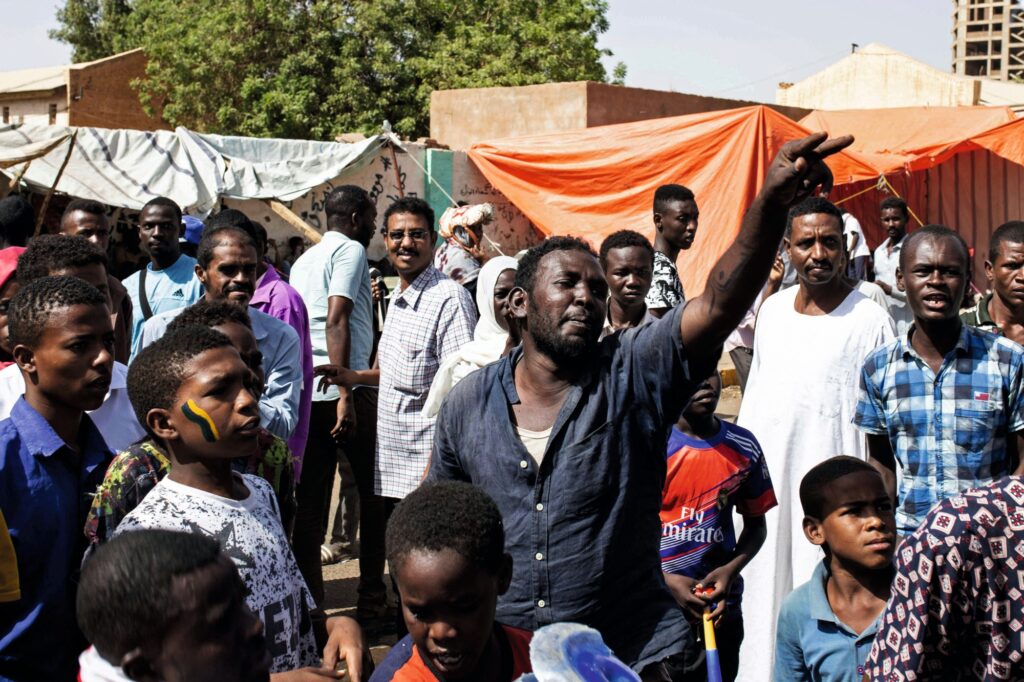 A protester shouts: ‘Freedom, justice, and peace, the revolution is the choice of the people’ during the sit-in at the Armed Forces Square, in Khartoum on 28 April 2019 (Salih Basheer/AP Photos/Alamy).
The struggle over money and power that helped drive the conflict’s outbreak remains central to the war, and has become deeply internationalized. Both sides have sought outside political, financial and military support, while regional interests in Sudan’s gold, trade routes and strategic position add another layer. Economic stakes could also help explain resistance to ceasefire talks – commanders on both sides are getting very wealthy from the war, as companies they control profit from the instability.
RSF-linked gold is smuggled largely through the UAE, while mines in army-held areas, some partly controlled by senior officers, also send much of their gold to the UAE. The UAE has been linked to alleged support for the RSF, while Egypt, Turkey and Iran have increasingly provided military support to the army, and Saudi Arabia has offered firmer backing.
The result has been catastrophic for civilians. As the late Sudanese analyst Hamid Khalafallah wrote in 2025: ‘Whenever one warring faction gains control of an area, it allows opposing troops to withdraw peacefully, only to unleash retaliatory violence against civilians… either as punishment for alleged collaborators or elimination of potential opposition.’
The war has destroyed homes, hospitals and other civilian infrastructure, while hunger and disease have spread alongside the fighting. Around 14 million people had been forced to flee by April 2026, with millions still displaced inside and outside the country. Tens of thousands of people have been killed.
At least 165 ERR volunteers have been killed since the start of the war, while others have experienced arbitrary detention, torture and forced disappearance.
From The Streets To Aid Tents
The war has scattered much of the Sudanese revolutionary movement across Northeast Africa and the wider world. People who had once organized demonstrations in Khartoum were suddenly trying to escape the chaos and possible persecution; both warring factions have actively targeted civilian networks, resistance committees, trade unionists and pro-democracy activists with detention and executions.
‘While they may differ in tactics and motivations, both the SAF and RSF share an interest in suppressing pro-democracy actors and movements that challenge their authority,’ wrote Khalafallah.
For the revolutionaries who stayed in Sudan, activism has shifted from organizing protests to responding to the country’s humanitarian catastrophe, particularly through coordinating the grassroots Emergency Response Rooms (ERRs). More than 700 ERRs have been delivering emergency aid, run by over 26,000 volunteers providing food, water, emergency medial care and support for displaced people. This work is not without risk. At least 165 ERR volunteers have been killed since the start of the war, while others have experienced arbitrary detention, torture and forced disappearance.
During the war, activists have also been documenting human rights abuses, working with refugee organizations and advocating internationally for Sudan. In many ways, this humanitarian work grew out of the same grassroots networks that had sustained the revolution. Yet the shift also reflects how dramatically Sudanese priorities have changed. Before the war, activists were asking how to build a democratic state. Now, many are asking how to keep their communities alive.
But not everyone who was at the vanguard of the 2018 revolution has remained politically engaged. Some have stepped away altogether, exhausted by years of political upheaval, war, displacement and personal loss. Others no longer believe political engagement could shape Sudan’s future.
Cairo-based Amal* stopped posting about Sudan on social media, despite having once been highly active; she was a student activist who helped lead protests at her university in Port Sudan. She even stopped following the news, explaining that ‘being up to date would make me stop functioning’. Reflecting on her previous activism she is despondent, feeling that her efforts had ultimately been ‘for nothing’.
Others described an even more painful reality: watching former revolutionaries join either the army or the RSF. For some this was particularly difficult to reconcile with the ideals that had united them during the revolution, leading to deep disagreements and broken friendships. ‘How can you be part of a revolution and fight for a democratic future and then one day stand beside one of the two fighting sides?’, said Amira* who now lives in Uganda. ‘War is very ugly, and I don’t know how people are accepting it.’
A Revolution in Exile
Those activists who were forced beyond Sudan’s borders have also faced their own challenges in sustaining the struggle. Spread across countries and continents, their ability to organize has been profoundly shaped by where they have sought refuge.
For many, Egypt – which is a staunch supporter of the SAF – has been one of the most difficult places to sustain political activism. The North African country hosts the largest population of Sudanese displaced by the war, and for many families it was the most accessible destination because of its proximity, common language and relatively accessible border. Activism has not disappeared, but it has become quieter, more cautious and often invisible.
Monzir* is a human rights activist who recently moved to France because of the repression he faced in Egypt, describing it as ‘sitting in a very big jail’. He points to random police arrests of Sudanese in Cairo.
Sudanese activists now living in Egypt say they have been avoiding demonstrations, limiting political discussions to trusted friends and becoming increasingly cautious online, fearing that speaking publicly about Sudanese or Egyptian politics could jeopardise their security or legal status. Many know someone who has been arrested. ‘No-one wanted to disappear and worry their families,’ says Fatma*, a journalist and feminist activist now living in Cairo.
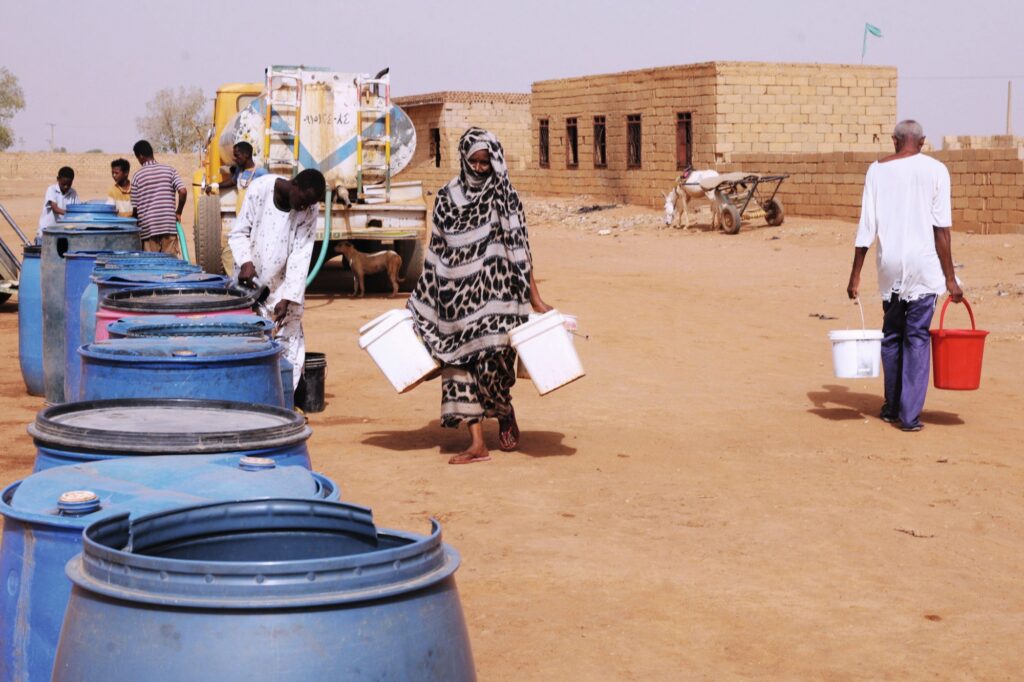 People fill water containers at a free distribution point amid water outages in Khartoum on 18 May 2026 (Marwan Ali, File/AP Photo/Alamy).
While reporting on this story, one interviewee suddenly stopped responding. A week later, his mother got in touch: ‘Hi, I’m Musa’s mom. Sorry we didn’t reply to you before. Musa* was arrested… He has UNHCR papers, but they still said he would be deported. Right now we are trying to handle the deportation procedures.’ Musa was deported to Sudan a week later. While the Egyptian government does not publish official statistics, it’s estimated that more than 5,500 Sudanese have been deported from the country since November 2025.
An example of a very different experience for Sudanese in exile is East Africa, particularly Nairobi. Financial insecurity, uncertain legal status and the emotional toll of displacement remain constant realities, while mistrust within the Sudanese diaspora can still limit activists’ sense of safety. Yet unlike in Egypt, many described feeling able to participate openly in Sudanese civic life.
‘The politics of Sudan and Egypt are too similar, too oppressive, too authoritarian,’ says Dina*, a refugee based in Kampala, Uganda. ‘But in East Africa, it’s more free. I love East Africa.’
Nairobi has consequently become an important hub for Sudanese civil society. Former Resistance Committee members now coordinate relief efforts from the Kenyan capital, document human rights violations, host public discussions and engage with international organizations working on Sudan.
What Remains of the Revolution?
Looking back, few activists describe Sudan’s revolution simply as a success or a failure. For most, it remains the defining moment that transformed their understanding of Sudan, their place within it, and their political identity. Those who were coming of age during the revolution described 2019 as the first time they became politically aware. Demonstrations, Resistance Committees, documenting abuses and neighbourhood initiatives reshaped their understanding of citizenship and collective responsibility.
The future they imagine is no longer simply a return to the Sudan they left behind. ‘I don’t think Sudan will be what it was before,’ says one member of the Sudanese Youth Network (SYN) in Nairobi. ‘[Many] people have died; those who are left have changed.’
Yet even amid deep pessimism about the near future, many continue to believe that the values of the revolution are worth carrying forward. They describe their activism as an investment in those who come after them. ‘We will never see Sudan with unity and all that. It’s not for us. We make it for the next generation,’ says Tariq, a Nairobi-based civil-society activist.
This long-term perspective is particularly strong among activists who work with children and young people, teaching them about human rights, politics and civic engagement. They acknowledge that a ‘better Sudan’ may not come in their lifetime but see their work as a way of keeping alive the possibility of a nation shaped by the values that brought millions onto the streets in 2019.
A democratic future in Sudan should be led by the people, yet civilians have struggled to secure a meaningful role in international efforts to end the war. While initiatives such as the AU-IGAD Roadmap and the Saudi-US mediated Jeddah process have called for a political solution and civilian-led transition, negotiations have largely centred on the warring parties and ending the fighting. This leaves open the question of what kind of Sudan will emerge from the war.
Those who have ‘given up’ on activism generally accept that military rule may be unavoidable in the short term, though most still hope for a better alternative. Those who remain active continue to believe in a democratic future, where the military’s political role is contained – or at least diminished. Fatma anticipates that the struggle for democracy will inevitably continue: ‘When the right time comes, we will rise and shine and flourish again,’ she says.
For now the revolutionaries are scattered across their war-torn country and beyond, many exhausted, some silent and others forced into humanitarian work simply to keep their communities alive. But the ideas that brought millions onto the streets have not disappeared.
The war may have ripped up the streets where the revolution once raged. It has not erased the dreams that filled them.
*Names have been changed for safety reasons.
Lara Lamie is a journalist and researcher based in East Africa, specialising in Sudan. She has spent several years researching, reporting on and working with Sudanese communities. Her work focuses on Sudan’s political landscape, activism and the regional consequences of war.