

Selecting leaders in China – Part 2

Complex Interlocking System for Meritocracy
In the first part of the essay, I wrote about how the Chinese select their leaders based on a fundamentally different philosophy from the West.
It prioritizes competence and performance over procedural legitimacy. It assumes the system itself is more knowledgeable as the judge for selecting leaders than the general public.
The philosophy is a mixture of Marxist principles and centuries-long Chinese historical traditions.
The governance system is designed to avoid many pitfalls of the Western universal suffrage model as well as the rigidity and decay of the Soviet central planning model.
Of course, it is hardly a perfect system, as with any human organizations.
It has its flaws and can be manipulated as any other system. The same approach may and may not work outside China.
However, the Chinese system has delivered results beyond argument, to date, for the Chinese.
The system is also constantly being adapted and optimized to deal with new realities in a dynamic, fast-changing world.
In this part, I’ll get into the mechanics of the machine.
I have a confession to make. I didn’t plan well and just found out that splitting the essay into two parts would still leave the second part too long (over 6,000 words).
Therefore, I’ve split this second part further and will publish the 3rd and final part a day later.
How does the Chinese system work?
The mechanics of the Party leadership selection in China is highly complex and nuanced. I’ll break it down in a simplified framework:
– Basic mechanics: political cycle, Party pyramid, career ladder, and selection criteria (i.e. how the Party selects both ordinary members and leadership)
– Unique features: the Party School and the Organization Department
– How the system works in real life: career history of senior Chinese leaders, present and past as well as rising next-gen stars
– Common myths: princeling rule, corruption without accountability, and conservative vs. liberal dichotomy
To start, the CPC leadership system is heavily influenced by Chinese historical political traditions.
A particularly important influence is the keju system, which was the official exam and promotion system of Chinese dynastic courts used continuously for over 1,300 years.
That influence permeates the running of the present-day governance machinery.
Political cycle and party hierarchy
The CPC holds a National Party Congress every 5 years. Leadership shuffle happens at the same cadence.
The last one was in 2022 and the next one, the 21st National Party Congress, will be held in the autumn of 2027.
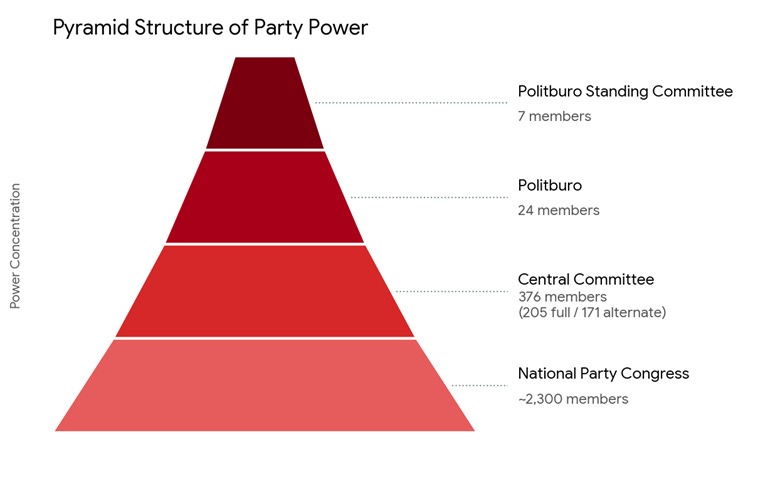
The roughly 100 million CPC members across the country elect 2,300 National Party Congress delegates to select the central leadership called the Central Committee.
Central Committee is composed of 205 full members and 171 alternate members.
They vote for the 24-member Politburo, the next tier of the pyramid. Politburo members are the national leaders.
During this process, Central Committee alternate members can contribute to discussions but don’t have a vote.
The 7 most senior members from the Politburo form the Politburo Standing Committee, the core leadership team and the pinnacle of power in China.
President Xi Jinping is the head of the Politburo Standing Committee.
 Unlike the West, in China the Party, the Government, and the Military (called dang/党, zheng/政, jun/军) are intertwined and come under the same leadership.
President Xi is simultaneously the head of the Party, the state, and the military.
By tradition, the Central Committee holds all-member meetings for 7 times during its 5-year tenure.
Each meeting focuses on a different subject including leadership formation, senior government appointments, the economy, law and order, 5-year plan, party building, and preparation for the next National Party Congress.
Government pyramid
The Chinese government is structured as a pyramid like the Party itself.
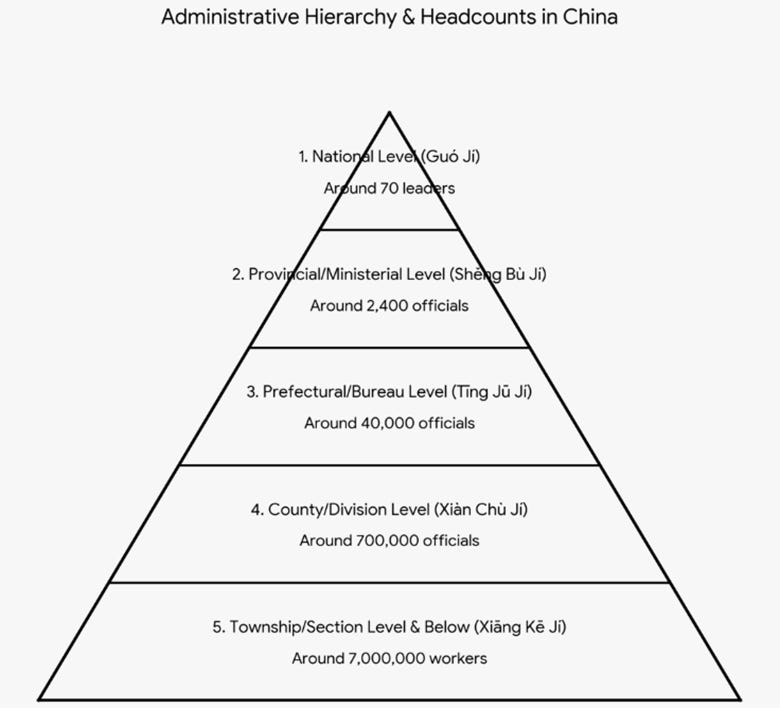
Out of a population of 1.4 billion, there are 20 million government employees in public administration and services. That’s roughly 1.5% of population.
These government workers are structured in a system known as the “Five Levels of Government” from township, county, prefecture/city, province, to national.
The above graph shows the hierarchy and number of officials with administrative ranks, known as cadres.
The 5 ranks are further divided into 10 job grades with each rank having a full grade and a deputy grade.
Cadres – government workers with rank – are expected to rise through each job grade as their careers progress.
The bulk of cadres are concentrated in township/section level (xiang ke ji 乡科级). There are roughly 7 million of them, or one third of total government employees and 0.5% of the population.
This is the foundation of the bureaucracy, representing the millions of frontline civil servants and town managers delivering public services at grassroot.
The next level, county or xian chu ji (县处级), numbers 700,000 and is one tenth the size of the grassroot cadre population.
This is the crucial “proving ground” of the middle administration, consisting of county heads, district chiefs, and heads of municipal divisions.
They are tasked to run the economy, manage crisis, and solve livelihood issues. This is the critical policy execution layer.
Every senior central leader in Beijing is expected to have experience working at this level or its equivalent in academia or state-owned enterprises (SOEs).
The next administrative ranks are prefectural/city level (ting ju ji 厅局级) and provincial/ministerial level (sheng bu ji 省部级).
Cadres at these levels are senior local officials or heads of state ministries, bridging regional/local governance with central directives.
Some are the heads of key state enterprises and banks. Others include heads of elite universities and research institutes. Some military generals are also at this level.
Ministerial level cadres number only 2,400 and they are appointed by Central Committee. These cadres constitute the pool from which next-generation national leaders will emerge.
The national level cadres, or guo ji (国级), is the ultra-exclusive layer that comprises the ultimate decision-makers of the state, including the Politburo, state councilors, and top national committee heads. They number roughly 70.
Only a subset of the Central Committee serves at this level.
Statistically, 1 out of 100,000 cadres could ever reach the apex (70 out of 7 million).
Ladder and career path
One out of three government employees (20 million) is promoted to become a cadre (7 million).
Around 30% government workers are not Party members. Most of the 7 million cadres are drawn from the 100 million Party members. Roughly 10% come from outside the Party.
The higher up in the government, the fewer non-Party members.
Entry level government employees usually take 4 to 6 years to get promoted as the most junior cadre (deputy section or fu ke level).
A cadre is expected to work in his job grade for at least 2 years before getting promoted to the next grade. No skipping grade is allowed.
To move from the most junior cadre grade to the most senior will take a minimum of 20 to 25 years in theory, 30 to 40 years in practice.
For example, a deputy minister level cadre spends 6 years, on average, before getting promoted to minister level. If he ever gets such a promotion.
President Hu Jintao, Xi’s predecessor, moved up the ladder in record time – 27 years. Xi himself took 30 years from the grassroot to reach the top. Jiang Zhemin, Hu’s own predecessor, took 42 years.
A critical feature of a Chinese cadre’s career path is the rotation system.
Within the government and the Party system, there are broadly 4 distinct tracks for career advancement – local governments, state-owned enterprises (SOEs), universities/research institutes, and the military.
For example, among the 376-member Central Committee, 25% are from SOEs, elite academia, and the military.
Examples include Hou Jiangguo, President of the China Academy of Sciences; Qiu Yong, President of Tsinghua University; Liao Lin, the president of ICBC Bank; Guo Zhuxue, chairman of China Rail; and General Zhang Shengmin, Vice Chairman of the Central Military Commission.
Most senior cadres are rotated across geography and industries during their tenure. The goal is to achieve both depth and breadth of experience and knowledge across roles.
A prime example is Chen Jinin, the Party Secretary of Shanghai.
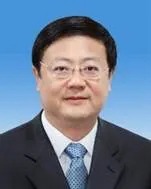
Chen graduated from Tsinghua University in 1986 and holds a PhD in Environmental Systems Analysis from the Imperial College London.
Chen started his career at Tsinghua faculty as a professor and rose to become the Dean of the Environmental Science Department.
He was promoted as the President of Tsinghua University at age 48. Three years later, he was appointed as the Minister of Environmental Protection for nearly 3 years.
After that, he was appointed to local administration and served as the Mayor of Beijing for 5 years.
By 2022, he became the Party Secretary of Shanghai and a full member of the Politburo at age 58.
Chen is a leading contestant for the Politburo Standing Committee (PSC) in 2027.
Another promising candidate for PSC is Yuan Jiajun.
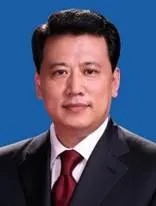
Born in 1962, Yuan was a child prodigy and received a PhD in Solid Mechanics at Beihang University, China’s most prestigious school in aerospace and aeronautics.
Yuan started his career as an aerospace engineer and rose to direct China’s top space initiative – the Shenzhou Manned Spaceflight Program, which is responsible for China’s manned moon landing plan by end of the decade.
Widely known as the “Aerospace Boy Wonder”, Yuan later ran the China Aerospace Science and Technology Corp (CASC), a top defense contractor, for 5 years.
Yuan was transferred to local government administration in 2012 and served as the deputy governor of Ningxia for 2 years.
In the job, he oversaw one of China’s most ambitious infrastructure projects: the ultra-high voltage power line running from energy-rich Ningxia in China’s northwest to Zhejiang on the east coast.
In 2014, Yuan was appointed as Governor and later Party Secretary of Zhejiang Province for nearly 9 years, taking over from Li Qiang, the current Premier.
Yuan has been Party Secretary of Chongqing and a Politburo member since 2022.
The cross-region and cross-sector rotation system is designed to groom top level bureaucrats to fully understand the country they govern.
For example, a successful cadre from a wealthy coastal province like Guangdong might be reassigned to govern a struggling inland or western region like Gansu.
Another official might spend 5 years as an elite university president, then the next 5 years running a massive SOE like China Telecom, and another 5 years as a provincial governor to build a diverse portfolio of experiences.
As a rule, an official in line for promotion to central leadership in Beijing is expected to have run at least one territory or portfolio with a population and economy equivalent to a medium-to-large country.
However, unlike most developing countries, there is no case of uniformed military officials to enter the highest echelon of state power at PSC.
How the Party selects ordinary members
Chinese citizens above 18 can apply to party membership. They are screened on academic qualifications, past criminal or court records, and political orientation.
Then they go through interviews, a formal training program, and need sponsorship from two Party members.
In 2025, 2 million out of 20 million applicants were accepted into the Party.
President Xi himself famously applied 10 times to get admitted into the Party.
He was denied repeatedly because his father, a senior national leader, was purged during the Cultural Revolution before being rehabilitated under Deng Xiaopin.
The Party also proactively grooms and recruits from universities.
Back in my college years in the early 90s’ Beijing, 3 students were recruited from my class of 48. They were the top students in the cohort.
Civil servant (i.e. government worker) selection is separate from Party member selection.
They are selected from exams and interviews, which are as fiercely competitive as top universities.
In national exams for roles in central ministries, the pass rate is 100:1. In local exams, the pass rate is 40~50:1.
As mentioned earlier, approximately 70% of civil servants are Party members. The most senior ones are usually Party members.
In short, the Party and the State select only the cream of society for members and government workers, ensuring competence starts at grassroot.
How the Party selects its leaders
As mentioned earlier, officials do not skip steps on the career ladder. It is an arduous meritocratic climbing process.
To reach the top of the pyramid, a cadre typically spends 20 to 30 years rotating through different provinces and industries, proving their worth at one tier before being vetted and promoted to the next.
The promotion track is governed by rigid minimum time-in-service rules.
An official typically spends 2 decades or more just to reach the Prefectural/Bureau level (the top 1%).
As the cadre moves up the pyramid, the criteria for evaluation pivot.
At the lower end of the pyramid, the focus is on compliance and execution. A cadre needs to meet strict performance metrics such as growth targets, social stability, and citizen complaints.
In middle and upper middle roles, the KPIs include local GDP, crisis management, poverty reduction, tax revenue, environmental records, and quality of growth.
Quality of growth means things such as green energy adoption, high-tech manufacturing, and innovations.
More senior roles at ministerial level and above are expected to oversee regional development (e.g. economic hubs like the Yangtze River Delta or the Greater Bay Area), strategic industries, and global supply chain resilience.
An example is Hefei, the capital city of Anhui Province. Starting from the early 2000s, successive local administrations have identified key industries to groom in the city, including LED screens, DRAM semiconductors, and electrical vehicles (EVs).
A series of blue-chip public and private businesses were incubated locally and became national champions (e.g. NIO Motor).
CXMT, funded by the city government in 2016, has become a global leader and the world’s fourth largest memory chip maker after Samsung, SK Hynix, and Micron. Its revenue is expected to reach $60 billion in 2026.
Celebrated as the “Hefei Model”, multiple city officials were promoted to become provincial executives across the country.
Criteria for national leaders
At the top of the pyramid, the key selection criteria include:
1) age – candidates reach the apex of the political hierarch usually after decades of work. They are expected to serve another 5 to 10 years in the top roles before retiring by late 60s or early 70s.
So the younger they get into the pool of senior contestants, the better positioned to be selected.
China doesn’t have the “nursing home” Congress in the US where 24 House Representatives and Senators are over 80 years old and the oldest is 92 (Iowa Senator Grassley).
2) academic/technical qualifications – historically, the Chinese leadership are heavily geared towards engineering backgrounds from elite schools.
The past three paramount leaders were all trained as engineers: Jiang Zhemin at Shanghai Jiao Tong University for Mechanical Engineering; Hu Jintao at Tsinghua University for Hydro Engineering; and Xi Jinping at Tsinghua for Chemical Engineering.
No Chinese leader will ever be caught asking questions such as “does TikTok connect with my home WiFi?”. Or question a Singaporean executive repeatedly whether he is a member of the Chinese Communist Party.
Both questions were from the US House hearings on TikTok in 2024, directed at Shou Zi Chew, the company CEO on live TV.
3) depth and breadth of experience – key governance roles in different geographies, different industries, and different assignments are mandatory. For example, Xi was tasked to run the 2008 Beijing Olympics as the Vice President.
Real estate mogul with a side career as reality TV star doesn’t quality for a county level position in China. Similarly, a cable news host with a Major’s rank would never make a Defense Minister.
4) career-long performance evaluation – all senior leaders are subject to 360-degree performance reviews and job audits throughout their career, which are institutionalized by the Organization Department, which we’ll discuss later.
President Xi’s own career path is highly illustrative of this process.
Born in 1954, Xi was sent down to an impoverished rural village in Northwest China in 1969 at the age 15 when his father was purged for liberal views as the Vice Premier.
He lived and worked there for 7 years before enrolling into Tsinghua University.
He joined the Party in 1974 after 9 unsuccessful applications. After college, he worked for 3 years as a staff to then Defense Minister.
Then he applied to work in grassroot government position in a small township in Hebei Province in 1982. In that role, Xi was a division level cadre (xian chu ji).
Over the next 25 years, Xi moved through the ranks and ran three major coastal regions (Fujian, Zhejiang, and Shanghai) before ascending to Vice Presidency and membership at the Politburo Standing Committee in 2007.
After 5 years tenure as VP, Xi took the helm in 2012 at the age of 58. It took him over 30 years to reach the apex of the power structure.
Every step of the way, Xi was closely evaluated by his performance and track record.
He oversaw export trade growth in Fujian and rise of private sector high-tech industry in Zhejiang where Alibaba and Geely Motors (owner of brands like Volvo, Polestar and Lotus) are headquartered.
Even as the Vice President and heir apparent, he was tasked to manage the 2008 Beijing Olympics as part of his portfolio training in international relations.
He also led the Central Party School which is the nation’s premier training ground for future leaders.
His life story is documented extensively in the 2022 biography by political scientist Alfred Chan, titled “Xi Jinping: Political Career, Governance, and Leadership, 1953-2018“and published by Oxford University Press.
In the last instalment, I’ll discuss a couple unique features of the CPC cadre management system as well as some myths commonly held in the West.