

Michael Hudson & Radhika Desai : He Ran The Fed For 18 Years And Left An Economic Time Bomb
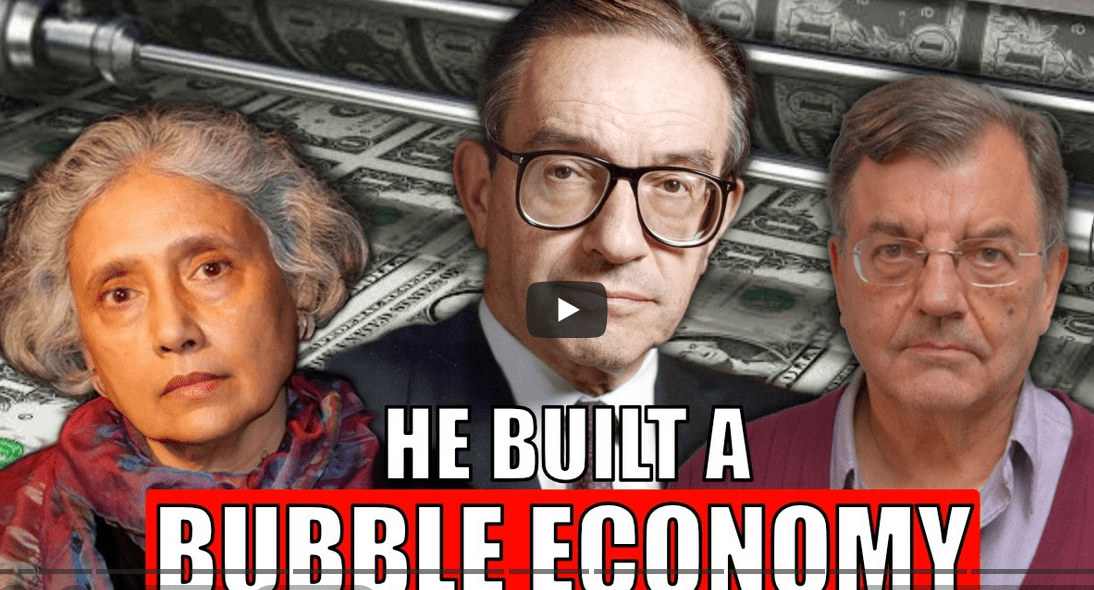
Geopolitical Economy Hour 76, July 1, 2026, “He Ran the Fed For 18 Years And Left An Economic Time Bomb.” https://www.youtube.com/watch?v=WaU33KJOa0s
[Note: I would suggest that you take the time and read the transcript. Too much happens here in this discussion to follow it in the video unless you watch it a few times. This is an important discussion in order to understand the economy of today. War or no war in West Asia (and I’m still of the opinion that it will be War/No War) the economic fallout is now very visible. Besides, Michael’s vignette as to ‘who fired Greenspan’ is precious.
Another issue that this discussion raises is the question of high interest rates in Russia. I am not a good enough economic thinker to assess this, but at the time, just before the previous SPIEF gathering, the commentary about this from the Russian business class was not flattering and they openly stated that the interest rate level affects business and the Russian economy on a macro and micro level negatively vs the government commentary that they are ‘cooling down the economy’. I am reliably assured that the conversation in Russia continues, although at a less frantic level than before the SPIEF gathering and the ‘change in the methodology of persuasion’ (Zakharova) with respect to the SMO. There is a further basic question in terms of ownership of the Russian Central Bank and the structure being similar to that that is outlined in the discussion raised here by Michael Hudson and Radhika Desai. Radhika’s comment has relevance: “That means monetary policy is set without any political considerations, which really means without taking into consideration what ordinary people need.” I don’t see that in Russia but I now feel I don’t have a strong enough base for my own thinking. For myself, this discussion has put me right at the drawing board again.]
Radhika Desai:
Hello and welcome to the 76th Geopolitical Economy Hour, the conversation that illuminates the fast-changing political economy and geopolitical economy of our times from a socialist and anti-imperialist point of view, the point of view, that is, of the world majority. I’m Radhika Desai, and you’re watching Radhika Desai: Geopolitical Economist.
Before we continue with this episode, let me take a minute to remind you to please like and share this video, subscribe to our YouTube channel, and if you can, please donate. You can do this through our Patreon, by becoming a paid subscriber on Substack, or by becoming a member here on YouTube. It helps us to produce high-quality content and keep it free.
And now back to the main topic of the day. With me today is our regular guest, Professor Michael Hudson. Welcome, Michael.
Michael Hudson:
Good to be here. A lot of things are happening in the world, especially financially, that we should talk about.
Radhika Desai:
Exactly. In fact, Michael, one of our most popular topics of discussion ever since we began the Geopolitical Economy Hour all those years ago has been the dollar system. This past week, two major things have happened which focus our attention on it. Both have to do with the Federal Reserve. There has been a beginning, and there has been an ending. We are going to discuss them and all that they imply for different parts of the disintegrating US empire. Of course, I say that slightly facetiously because I’ve been arguing that there has been no such thing as a US empire, but that’s another matter. These are just different parts of the disintegrating power of the United States.
Before we do that, let me remind our audience to please like and share this video, subscribe to the YouTube channel, and if you can, donate here through YouTube, Patreon, or Substack. Your contributions help us keep our high-quality content free across all platforms.
Now, Michael, regarding the beginning and the end I mentioned: the beginning was Kevin Warsh’s appointment as the governor of the Federal Reserve and his first meeting with the Federal Open Market Committee, the committee that sets interest rates. The ending was the death, at the age of 100, of Alan Greenspan, the “maestro,” the longest-serving Federal Reserve chairman who, over nearly 20 years, became a rockstar central banker. In many ways, I would say that Greenspan is the figure with whom the centrality of central bank monetary policy to the running of our modern economy can be dated. He was the pivotal figure under whom essentially every other sort of government or public action took a back seat, and the reins of the economy were handed over to the Federal Reserve and other central banks.
Both of these things, the beginning and the ending, are happening at a time when speculation about the health of the US financial system, given the twin threats of the AI bubble and inflation, and the dollar system that rests on it, is rife. What are your initial reactions, Michael?
Michael Hudson:
Well, I’m glad we’re talking about Alan Greenspan because we’re still in the kind of era that he initiated. Back in the ’60s, I actually was saddled with having to work with him briefly. I was working at Chase Manhattan on the balance of payments of the oil industry, and Socony-Mobil insisted that we hire him to calculate the balance of payments and profits of the oil industry in Europe. Well, my boss, who had been recommended to Chase by Milton Friedman, told me, “Greenspan’s just a shill. He says whatever the clients want.” He was notorious for just having his reports up for sale.
We had a discussion with David Rockefeller, who said, “Well, people are not going to trust our study if Greenspan’s part of it. They’ll think we’re acting just as lobbyists for the oil industry.” So, my boss, John Deaver, asked me to check his work: “Can you see anything wrong with his statistics? I’m sure the little bastard did something in there somewhere.” That was how people talked about Greenspan in the 1960s. Well, sure enough, I found that he’d faked some figures from the European data. As a result, I was assigned to go over to his office and give him the news that he was off the project. I obtained some renown as the man who fired Alan Greenspan, but I was just the low man on the totem pole being told to do it.
Well, how did this person ever rise to be head of the Federal Reserve? That’s the question. The answer lies in the 1980s. The era when he emerged was very different from the 1960s. You had the era of Ronald Reagan, the Republicans, and the anti-federalists. Earlier this week, Matt Stoller had a great Substack report explaining how Newt Gingrich designed a whole strategy for the Republicans to shrink government, and what you do is shrink Congress. In the 1980s, for the first time, Congress was taken over by the Republican Party. What the Republicans did, Matt explains, was to cut back all the budgets for the government staff—the staffs of the representatives and senators who had been doing all the research to make sure they were anti-monopolists and acting in the public interest. All of that was unwound.
To quote briefly from his report: “In 1995, the Republican Party took control of the US House of Representatives, led by Newt Gingrich and a small group of right-wing politicians who called themselves ‘jihadists.’ These men sought to revamp a legislative chamber held by the Democrats since 1949.”
That was the environment in which they got Alan Greenspan appointed as head of the Federal Reserve. His job was basically to represent their clients—the commercial banks—not the economy at large. When people talk about an “independent” Federal Reserve, they mean independent from US policy; independent from congressional and presidential policy. Just days ago, you had the Supreme Court rule that Donald Trump can fire policymakers anywhere he wants in the US government, but not from the Federal Reserve. Its independence means that the banks are pretty independent of having money and credit operated and managed in the public interest.
Well, that’s what Alan Greenspan did. He deregulated everything. He sat there and let the huge savings and loan bubble explode. He let the 1998 dot-com bubble explode. That is exactly the same policy that we’re seeing today. The reason Greenspan got such a write-up of editorials and obituaries all over the press was because he opened the doors for this setup.
By being independent, the banking system in effect controls government tax policy, monetary policy, and the allocation of credit. Who gets the credit, and for what? Well, we know the credit is used to create a bubble. This is the result of all of these changes that occurred with Greenspan in the 1980s.
Radhika Desai:
You know, first of all, let me underline one thing you said which I think is absolutely central. Greenspan became Federal Reserve chairman in 1987. Indeed, he became chairman just weeks before the 1987 stock market crash, and I’m going to come back to that. But let me say that it’s very ironic, considering he was appointed by Ronald Reagan to be the chairman of the Federal Reserve because he had clearly given the president to understand that he would be malleable vis-à-vis monetary policy.
This was because Paul Volcker refused to be malleable in this fashion. Ronald Reagan wanted him to bring interest rates down, and Paul Volcker was not going to relent. So, Alan Greenspan wormed his way into the position. Ironically, they then inaugurated the era of the so-called independence of central banks.
Now, this independence meant and continues to mean two things. Number one, it means that central banks, as you say, cannot be influenced by the government of the day. The government of the day is not allowed to have influence on the central banks. That is the mantra of central bank independence. That means monetary policy is set without any political considerations, which really means without taking into consideration what ordinary people need.
The second thing it means is that actual monetary policy is set by the financial institutions whose creature the Federal Reserve is. I want to say one or two more things about this because a lot of people take the idea of the independence of central banks as natural, that somehow they must be independent. On the contrary, like every other aspect of economic policy, monetary policy has huge distributive consequences. It can take money from the pocket of the ordinary person and put it in the pocket of the rich person, and it can also do vice versa. But once the central bank is in the pocket of the financial institutions, it will only do the first and not the second. It will only take money from ordinary people and put it in the pockets of rich people.
So, this independence has become a very ingrained idea.
But like all economic policy, monetary policy is inherently political. It should be under democratic control and nowhere else. This is part of the larger expert culture. Our politics have deteriorated so badly that it is easier to say, “Oh well, we’ll let the experts decide it.”
One final point: the era of central bank independence was also the era in which, basically everywhere but particularly in the United States, governments ceased to have any real economic policy. That is to say, fiscal policy was supposed to play no role. Or rather, the only role given to fiscal policy, the question of deciding how much revenue the government would raise, from whom, and how it would spend it, took a back seat. The only thing permitted to governments now in terms of fiscal policy is to cut taxes for the rich. For the rest, the central banker became the economic manager.
That is why Greenspan went out of his way to cultivate this cult of enigmaticness and his oracle-like words. That’s why the word “maestro”, which is also the title of Bob Woodward’s hagiographic biography of Alan Greenspan, was used. This is the larger background against which we have to see this man.
Michael Hudson:
Yep, that’s right. That’s what the Federal Reserve has become. What we’re seeing today is the result of a total deregulation of the markets. Even the Financial Times and the Wall Street Journal are saying, “Wait a minute. You’re cutting capital requirements for the banks to lower the amount of reserves they have to hold against these loans.” These loans are being used primarily for the artificial intelligence sector, to buy back their own stocks, and to pay dividends. This is a bubble in the making, and that’s in the interest of banks. They make money when their credit creates a bubble. Their customers make money off the bubble, and out of those profits, they pay the banks back for the loans used to undertake debt leveraging.
You talked about monetary policy being in government hands. The job of the government is to run monetary policy in favor of economic growth for the whole society, which requires treating money and banking as a public utility. Instead, the Federal Reserve has been privatized. It’s not a public utility; it’s in the hands of central bank campaign contributors and the beneficiaries of the bubble.
We’re seeing the financialization of the economy, in contrast to countries that avoid financialization and follow an industrial policy, like China and many Asian nations.
Radhika Desai:
You remind me, by the way, that I cover a lot of these events in my book Geopolitical Economy, which is an account of how this financialization occurred and how it relates to the dollar system. But let me get back to the other reason why Greenspan was considered “better” than Volcker by the establishment. Volcker went some way towards deregulation, but he was not willing to deregulate to the extent of eliminating Glass-Steagall.
The elimination of the Glass-Steagall Act did not happen until 1999. That Act separated investment banking from commercial banking, protecting the latter by giving them federal deposit insurance coverage, whereas investment banking was allowed to gamble on its own dime without such coverage. They could speculate all they liked, but the public was not going to pay for it. That meant speculation was kept within bounds.
The push for the repeal of the Glass-Steagall Act actually came from the commercial banks, which wanted to have their cake and eat it too. They wanted to continue to have federal deposit insurance, but at the same time, they wanted to be permitted to gamble on the stock exchange. They knew that compared to investment banks, which were relatively small boutique banks, they had a huge advantage. They could bring the savings and deposits of every Joe and Jane in the United States and throw them into these big trades. They could profit whether margins were small or large, because if you throw in enough money, you make a lot of money.
This discussion was already going on in the late ’80s. It didn’t happen until 1999 because the different major interests involved couldn’t agree. The commercial banks, the investment banks, and the insurance companies could not agree on a compromise. That’s why it took that long, and in the end, it was Greenspan who forced it. The key point is that Greenspan was a free-marketeer with a completely ideological and unrealistic belief that if you let markets work on their own, they will self-regulate.
Of course, the irony is that Greenspan didn’t let markets work on their own. And this is where the “Greenspan put” comes in. The Greenspan put later became the Federal Reserve put. In trading language, a “put” is basically an option to sell at a certain price, acting as a hedge. The Greenspan put refers to the action of Alan Greenspan during one of his first crises in office. He took office in August of 1987, and by October of 1987, the big stock market crash hit. He responded by opening the floodgates of liquidity, pouring money into the system to buoy asset and stock prices. This was regarded as having saved the day, and people claimed the crash didn’t have much of an effect on the real economy because of Greenspan’s genius.
That is complete rubbish. The reason why the crash didn’t heavily affect the economy is because the financial world had already ceased to have a direct relationship with the productive economy by this time. This injection of liquidity has since become the standard response. After the dot-com bubble burst, they did the same thing. After 2008, they did the same thing. They responded to every crisis by opening the floodgates of liquidity through low interest rates, quantitative easing, you name it. He was the father of deregulation and easy money policies.
Michael Hudson:
You said something in passing that’s very important to explain for the audience, especially the foreign audience. You talked about commercial banking versus investment banking. These were two different worlds until Glass-Steagall was repealed. The commercial banking industry was a stayed industry, not very highly remunerated. Most of its credit went to real estate, some consumer credit, and corporate credit collateralized by tangible capital investment. The commercial banks didn’t have much to do with the stock market. That belonged to the investment banks.
The 1980s was the decade of Drexel Burnham and corporate takeovers. Before Drexel Burnham and its law firm, Skadden, Arps, commercial banks would not lend money for corporate takeovers; that was considered ungentlemanly. The “white shoe” law firms, as they were called, would not do that. It was Drexel Burnham that got together a group of investment bankers who wanted to launch enormous corporate raids. By the way, I addressed their annual meeting on a number of occasions; my friends at Drexel helped promote my career, and they were very open. They said, “The commercial banks don’t lend money for takeovers. That’s for us to do. We will gather the savings of individuals, put our own money in, and make these enormous corporate raids.” That was what leveraged buyouts were all about.
Junk bonds were created by the investment banking community, not by the commercial banking community. As the power of the investment banking community grew and was able to create bubbles, commercial banks found them more and more creditworthy to lend money to, even though they weren’t initially allowed to do this business themselves. That’s where Bill Clinton came in and abolished Glass-Steagall. The commercial banks, which had been fairly stayed before all this, were turned into investment banks with that exact mentality.
Instead of banks financing construction, real estate, and tangible capital investment, they suddenly became absorbed into this financialized economy centered on the stock market. They created money in the form of capital gains for industrial companies that were bought out with high-interest junk bonds, paying investors by carving up and breaking up those very companies. All of that was the legacy of this idea that finance should be independent from the economy, even giving it the power to carve up the economy, de-industrialize it, and destroy it, leaving it in shreds as we see today.
All of this was the result of the Ayn Rand philosophy that all government regulation is awful, and that free enterprise and free markets should be entirely unregulated. We’re seeing the results today. Most people that I know on Wall Street think a huge stock market bubble is about to crash, just as we’re seeing the results of energy and oil crises spread throughout the world, including the US economy itself.
Radhika Desai:
Michael, you are pointing to such important facts. Let me advance our discussion a little bit, because remember we said that there has been an ending, the passing of Alan Greenspan, but also a beginning: the appointment of Kevin Warsh and his chairing of his first FOMC committee meeting where interest rates are set.
One of the things that Kevin Warsh has done is actively invoke the memory of Alan Greenspan, stating that he wants to take the Federal Reserve back to that era. Let me say just one thing about this. Alan Greenspan is often regarded in all the hagiographic commentary we have seen over the last week as a “great communicator.” The other thing said about him is that he was great with statistics; he loved baseball statistics, he loved all sorts of data. In reality, I think he used rhetoric and statistics not to clarify anything, but to deliberately muddy the waters so that people would not know what he was really up to.
If you search the internet for Greenspan quotes, you will find plenty of examples. For instance, he famously told a congressional committee at one point: “I guess I should warn you, if I turn out to be particularly clear, you’ve probably misunderstood what I’ve said.” This is the kind of guy he was. He wanted to be regarded as inscrutable. He wanted people to hang on his every word so they could wrestle with trying to figure out what he meant.
Kevin Warsh says he wants to bring that back, but a final thing about Alan Greenspan is that he was essentially a bit of a weasel in policy terms. Even with his supposed conviction for free markets, his free-market principles didn’t go so far as to allow big financial corporations and big banks to suffer the consequences of their own crimes and misdemeanors. He was always there to clean up after every wild speculative party that these interests had. That’s Greenspan.
Now, Warsh has been saying he’s going to say as little as possible to remain just as enigmatic as Greenspan. Many people originally thought Warsh had been appointed because he would do Donald Trump’s bidding and keep interest rates low. But then when Walsh was appointed people thought: “Oh well, he’s not so bad”. When we actually look into his biography, what we discover is that he is as much of a weathervane as Greenspan was. He’s willing to go in every different direction. He has talked about tight monetary policy when it suited the political climate, and loose monetary policy when it didn’t.
In his address to the Federal Open Market Committee, in his very short remarks, on the one hand, he said, “We are not raising interest rates this time,” clearly siding with the president and his preferences. But at the same time, he gave people reason to believe that there was lots of room for raising interest rates later. That’s just kicking the can down the road. I suspect that in the long run, what we’ll see is a continuing easy monetary policy.
Of course, anybody in the mainstream press who actually cares about inflation is talking about increasing interest rates. But as we’ve discussed many times before, if he raises interest rates much beyond where they already are, he risks pricking all the different bubbles that have been inflating over the past decade and a half; nearly two decades, actually, since 2008.
This is the danger. If he doesn’t tackle inflation, the dollar’s value will continue to decline as it has been doing broadly speaking. Even geopolitical crises, which would normally be expected to create a “safe haven” phenomenon – strengthening the dollar because people rush to it in times of crisis – have had an extremely weak effect. In that context, I think the dollar will continue to weaken, but he will probably not raise interest rates because Trump does not want him to, and because they are all aware that their own wealth depends on inflated asset prices.
Michael Hudson:
Well, Radhika, you used the words “muddying the waters.” You could say that entire academic money and banking courses, along with monetary theory, exist to muddy the waters. The whole public discussion we’re seeing today muddies the waters because here’s the problem: we know that prices are going to go way up because of energy and oil. That’s on the news every night. Oil prices are going up, and while they talk about gasoline prices, what’s going up even more are prices for the fuel used for trucks—diesel fuel—as well as airline fuel, chemical fuel, and fertilizer. Everything connected with interrupting oil exports pushes up prices.
So people are talking about inflation, and here comes the “junk economics”, a term that you and I are credited on the internet for inventing. They think the way to keep down prices is to raise interest rates to create unemployment, operating on the myth that all price rises are the result of labor’s wages going up. They believe any inflation, no matter what causes it, can be cured by hurting labor. That basically is the theme song of central bank monetary policy and money management.
But the effect of oil prices and all of its derivatives going up is that there are going to be closeouts and shutdowns. You can look at Germany as the model for what’s going to happen in the United States and elsewhere. Volkswagen cut back its employment very sharply a few days ago. German industry has been cutting down because they can’t make a profit with today’s high sulfur and energy prices. That means labor is being laid off. It does not help at all to raise interest rates to create yet more unemployment when there’s already unemployment spreading in the American economy beginning in about two or three weeks, when the national oil reserves are essentially depleted as much as they can be. Then the prices go up and breakdowns will occur. This is an awful mess in the making
You can’t cure everything with monetary policy, but that’s what the monetarists believe. Milton Friedman said that inflation everywhere and at all times in history is the result of too much money. Well, what about Trump’s going to war or attempting to control the oil trade? That has nothing to do with printing money. If you try to bring down oil prices by cutting back credit, and that credit has primarily been pushing up the stock market bubble, then all of a sudden people are going to have to sell their stocks to pay off debt. It won’t pay to borrow money to bid up technology prices anymore, and there will be a crash. That is what looks to be in store for the United States and other countries.
By the way, the US dollar has gone up slightly since the Iran war, that’s because the crisis is hurting foreign nations so much that there’s a wind-down of foreign investment in US government bonds. Other countries are having to sell off their investments in the United States in order to survive these higher prices. The sell-off of bonds normally would increase interest rates. The Federal Reserve has been creating an enormous amount of credit on its balance sheet, and both Warsh and Treasury Secretary Scott Bessent have said we’ve got to cut back the Federal Reserve’s monetization of government debt.
Well, what does that mean? The Federal Reserve, according to Warsh and Bessent, should begin selling all of these bonds it has been holding back into the banking system. Imagine what that’s going to do to the financial and credit markets if everybody, foreign countries and the Fed alike, sell bonds at the same time. It’s going to pull all the liquidity out. It was that surplus liquidity and deregulation that puffed up this whole stock market bubble to begin with. That’s why I’m very pessimistic.
Radhika Desai:
I wasn’t saying that the dollar didn’t go up recently; what I’m saying is that the dollar’s rise has been far short of previous historical episodes of the safe-haven effect, which means structurally the dollar has been weakening. Essentially, its broader trend has been downward.
But let me come back to some of the very interesting points you made. I want to continue for a minute on the discussion of muddying the waters, because people hang on the words of the Federal Reserve chairman. Ben Bernanke and others came out with this idea of “forward guidance”, the notion that the Federal Reserve, just by talking, adds rhetoric to its toolkit to play a role in controlling expectations and inflation.
First of all, inflation itself is deeply political. Generally speaking, the Federal Reserve has a dual mandate. In the late ’70s, in addition to keeping prices stable, the Fed was given a mandate to keep employment levels up. Of course, Chairman Paul Volcker, who was determined above all else to slash inflation, proceeded to completely ignore this second mandate and induced a punishing recession which sent unemployment rates up massively in the early 1980s. So, we know that the Federal Reserve does not give a fly’s ass about unemployment.
Nevertheless, in all the rhetoric they use to justify their policy decisions, they will always invoke the state of the labor market as if they care. They say, “Oh, we must have easy monetary policy because the labor market is loose.” They don’t care. The reason why they really want easy money policy is in order to continue to move asset prices up.
Occasionally, they intentionally induce a recession. Volcker did it, and Greenspan caused unemployment and then went on to sneer about it by talking about the “traumatized worker” who was afraid to ask for higher wages. On the basis of extremely dodgy statistics in which part-time employment was counted more or less the same as full-time employment, people were talking about how tight the American labor market was. The American labor market was not tight; American workers were desperate. They often had to have more than one job to keep body and soul together and keep their families provided for. In this context, Greenspan essentially said, “Well, if the labor market is so tight, why isn’t inflation going up?” and put it down to the “traumatized worker”, another expression he is famous for.
The Federal Reserve constantly refers to the state of the real economy, but all it truly cares about is the state of the asset markets. All monetary policy is basically geared towards keeping asset prices up. Obviously, there are important sections of the banking community that are increasingly worried about inflation, but we have a very new situation here. Paul Volcker could allow interest rates to go up as high as 20% in order to quell inflation because he didn’t have to worry about an “everything bubble.” Today, there is a bubble in every single asset class. The wealth of the rich people in the United States rests entirely on this financial bubble; it no longer rests on manufacturing investment to a degree not seen since Volcker’s time forty years ago.
I think their bias is going to be towards keeping monetary policy as easy as possible for as long as possible in order to prevent the pricking of this financial bubble.
The Federal Reserve and Greenspan have been in the business of inflating bubbles. When the dot-com bubble was inflating, mainstream commentators said, “Oh, Alan Greenspan warned investors that there may be ‘irrational exuberance.'” In reality, when you actually read the sentence in which this expression occurs, what he’s actually saying is: “How do we know? We cannot assume that just because there’s irrational exuberance on the part of investors that there’s actually a bubble.” He was speaking out of both sides of his mouth.
Later on, when people expressed concern about the possibility of a credit bubble and a housing bubble, Greenspan said, “Oh, there is no national housing market, so there can be no national housing bubble.” That was literally a year or two before the housing bubble crashed. Greenspan was in the business of inflating bubbles, in part by denying they existed and therefore claiming there was nothing to be concerned about, but often by actively promoting them.
He justified the dot-com bubble by saying there was no bubble for several reason. Number one, a lot of the expenditures undertaken by American companies are actually capital expenditures so they should be counted as increasing the capital base of the company and therefore the capital base is not so far off from the company’s stock market evaluation, so there is not bubble. Then he claimed that there was actually a “productivity miracle” going on. If you asked him how he figured there was a productivity miracle given that the actual productivity statistics were so bad, he said, “Well, the productivity statistics don’t show it; the miracle is hidden from the statistics.” Then if you asked where the evidence of this miracle was, he answered, “Well, it’s in the stock market exuberance.” It is a completely circular logic: just because investors are taking prices up, there must be a productivity miracle. Later, under the housing and credit bubbles, he claimed that “financial innovation” has created a whole new world where risk had been eliminated. In all of these ways, he used his famous rhetoric to inflate asset bubbles.
Michael Hudson:
We’re talking about the word “bubble.” Let’s talk about what the dynamics of a bubble actually are. In my view, every bubble is a Ponzi scheme. In other words, you have to keep the bubble going by constantly borrowing money to pay the dividends and capital gains via new entrants into the stream. In this case, the new entrant is the Federal Reserve.
You’re absolutely right to bring attention to the fact that Greenspan denied the bubble. The entire University of Chicago free-market theory rests on the principle of the “efficient market hypothesis”, that the stock market and asset prices are the result of all investors coming together as the rational “brain” of the economy. If the whole market is a function of all investors making perfectly informed decisions, then by definition, there’s no such thing as a bubble.
That philosophy which denies the existence of a bubble, ignores the reality of where this money comes from. If stock prices increase, it requires that the investors who borrowed money to buy stocks and bonds on credit, paying banks interest rates that are now going up very sharply. They have to sell some of the stocks that have gained in price to pay the interest, making the bubble appear self-financing.
Unlike Charles Ponzi’s original scheme, where Ponzi couldn’t print the money for new investors to come in, the Federal Reserve can step in for the whole economy. They become the “sucker investors” that join the scheme, saying, “Well, it’s made a lot of money so far, it’s got to keep going up.” These are the people who say “the trend is your friend,” not realizing that this trend is entirely financed by an increasing ratio of debt to revenue.
As the debt-to-income ratio goes up, if interest rates rise, speculators realize they can’t pay a high interest rate to buy stocks that are now just going sideways. They decide it’s time to sell out, pay off the bank debt, take their gains, and leave the pension funds, mutual funds, and private small-fry investors to bear the costs. That basically is the strategy for what’s going on now. We’re seeing the insiders, the billionaires, and the top 10% make all of this gain in stock market wealth, while the economy at large has been going flat since the Obama bank bailout.
The rest of the economy is going to be sacrificed, and you’re going to have even more economic polarization, this time, not by the stock market going up more, but by the rest of the economy really going down. Not only does 40% of the American population have no savings, but they are actually going to be forced deeper and deeper into debt, leaving less income to buy goods and services. The whole economy falls into a shrinking dynamic. That’s what a Ponzi-style bubble does.
Radhika Desai:
I just wanted to make a couple of points here as we start winding down our discussion. Regarding bubbles, since Greenspan passed away, people have sometimes noted, “Oh well, at least he could admit his mistakes.” Famously, after having left office, in the aftermath of the 2008 financial crisis, he was asked to testify before Congress about exactly what he did wrong. One of the things he said was: “I made the mistake of presuming that the self-interest of organizations, specifically banks and others, were such that they were best capable of protecting their own shareholders and their equity in the firms.” He claimed he was in a state of “shocked disbelief” that this had not actually happened.
First things first: Greenspan says that the self-interest of organizations should have helped them see there was a bubble and refrain from investing in it. But in reality, when a bubble is inflating and everybody is piling into certain trades, if you are a fund manager, you face a very difficult choice. Even if you realize it’s a bubble, not joining the herd means you will be accused of failing to make money for your clients. If you alone stand back, you will be pilloried. Whereas if you follow the herd and the market crashes, nobody blames you uniquely because you can say, “Well, everybody was piling into the trade, so it wasn’t my fault.” There is a structural incentive for all investors and traders to keep blowing up bubbles ever further. This is a dynamic that is often not paid attention to.
The second thing is that ordinary Americans do not need high interest rates. Further financial tightening and recession-inducing tight monetary policy will only lead to massive suffering for American workers. However, at the same time, American workers also do not need the easy monetary policy of the Fed, because they are not its beneficiaries. In fact, they suffer from easy monetary policy because asset prices and house prices skyrocket, as they have been doing ever since the 2008 financial crisis. Rents go up, and since the bulk of this cheap money is not being invested in productive activity, it does not generate jobs.
What American workers need is a complete break with the idea that the only economic policy you need is monetary policy. Secondly, they need to have a financial system which is geared towards productive investment and not towards short-term speculation and predatory lending. For decades now, the American financial system has played absolutely no role in productive investment, despite all the noise made about venture capital. Venture capital only comes into the matter when obscene claims are made about how much there is to be gained through marketing hype and propaganda, as we see with AI right now. Ordinary Americans need a financial system which is the polar opposite of the financial system they’ve got right now.
Michael Hudson:
You used the words “shocked disbelief.” I wish we could insert the film clip from Casablanca: “I’m shocked, shocked to hear that there is gambling going on here!”
You said what we need is tangible capital investment. The fact is that tangible investment is not considered to be a good gamble these days because you can’t just increase the short-term cost of investment by turning on the monetary spigot, which is what the Federal Reserve does to financialize the economy. Capital investment requires making a productive profit on hiring labor to produce actual goods and services that people buy. That can’t be easily done today in the economy that the United States has created.
That’s why companies in America and Europe have outsourced their industry to China. China is following an industrial policy that treats investment not as a mere speculative gamble, but as a planned support for industrial capital investment—just like the United States, Britain, and Germany did during their own industrialization in the 19th century.
What China’s doing is the exact historical policy of industrial capitalism. It wasn’t supposed to be a gamble to make industrial capital investment; it was national policy. That included a mixed economy with a government providing basic needs at a low enough price so that you could keep the cost of living stable, employing labor to produce industrial goods to export and become more competitive.
But the United States, by dismantling government, has dismantled the government’s ability to reduce the cost of living. Instead of providing public services, it privatizes them at rising prices; instead of public health, it provides privatized Obamacare at 20% of the GDP; and it maintains a banking system whose main business is inflating real estate prices, which increases the costs American labor has to pay for housing. All of these policies have made domestic industrial investment a bad gamble.
Traders on Wall Street are only asking, “How much can we make today, this week, or this month?” That’s their timeframe, not the long term. America lives in the financial short term, while Asia, especially China, has adopted the long-term philosophy of industrial investment. We’re really seeing the world break up into two entirely different approaches to the economy. That’s the big setting for what we’ve been talking about.
Radhika Desai:
Absolutely, Michael. One final point to close on: when the United States had a different financial system, a more long-term, productive one in the immediate post-World War II period, that was a period during which there were next to no major financial crises. In contrast, during the neoliberal period, the entire history has been punctuated regularly by devastating financial crises. That’s really one of the major lessons. The two different types of financial models are what we have highlighted today.
Thank you very much, Michael, and thanks to our audience for listening. Michael and I will be back in a fortnight. I’ll, of course, continue to do my other shows in between. I hope you liked this episode. If you did, please like it, subscribe, share, and donate if you can. Until next time, goodbye.