

Building With People: Architecture, Conflict, And Social Justice In Gaza – Salem Al Qudwa In Conversation With Asato Ikeda
Asia-Pacific Journal: Japan Focus
Abstract: This interview with Palestinian-American architect Salem Al Qudwa explores the relationship between aesthetics, politics, and humanitarian architecture through his experiences working in Gaza and abroad. His work with international NGOs in Gaza revealed tensions between donor-driven “sustainable” building models and the practical needs of extended families, leading him to advocate for incremental, cement-based housing rooted in local practices. The conversation also addresses the ethics of representation, including his critique of foreign artists who aestheticize destruction, and his later projects focused on widowed women and orphans, where architectural design was used to address domestic and gender-based violence. Al Qudwa argues for a socially engaged architecture grounded in community knowledge, especially in the context of ongoing conflict and reconstruction.
Salem Al Qudwa is an award-winning Palestinian architect, academic, and researcher specializing in emergency architecture, post-conflict reconstruction, and, notably, housing in the Gaza Strip. As a former Fellow in Conflict and Peace at Harvard Divinity School, he focuses on designing sustainable, and socially responsible living spaces for marginalized communities. Most recently, as Construction Manager and Housing Specialist, he helped lead workforce housing developments and affordable housing initiatives for Native American communities in Rapid City, South Dakota.
Asato Ikeda is Associate Professor of Art History at Fordham University, New York.
Ikeda: Perhaps we could start with your background and training. You were born to a Palestinian family in Libya, and then returned to Gaza at the age of 21. Later on, you also stayed in Egypt and India.
Al Qudwa: I had a very beautiful childhood in Libya. Benghazi was an Italian colony, so I grew up surrounded by North African vernacular and Italian classical architecture. That influenced me a lot, although I had no idea what architecture was or what it meant to be an architect. We also made frequent visits to Cairo and Alexandria, where part of my mother’s family lives, and traveled through places like Malta, Athens and Cyprus. Those visual experiences of dense urban developments shaped my childhood deeply.
When I finished high school in Libya around 1993-94, I hoped to attend a Libyan university. But after the Oslo Agreement, the Libyan government decided not to accept Palestinian students. So, the region was basically closed to me. The only option was India, where engineering education was strong, and it was my parents’ dream for me to become a biomedical engineer.
I went to India in 1995 and studied – unhappily – electrical engineering for about three years, but I struggled and realized it was not my path. In 1998 I joined my family in Palestine and enrolled at the Islamic University to study architectural engineering. My childhood memories of North African architecture and the colors of India, while seeing many slums around, came together in that decision, along with the influence of the Egyptian architect Hassan Fathy and ideas about architecture for the poor.
After graduating in 2003, I worked for the Palestinian Ministry of Finance on World Bank-funded projects, but I didn’t like the office work. In 2006 I joined Islamic Relief Worldwide and worked with them for about seven years as an emergency architect, engaging directly with local communities.
At the same time, I taught part-time at the Islamic University. I believed that before pursuing a master’s degree, I needed at least ten years of practical experience, so I could teach students based on real reconstruction and emergency work.
Ikeda: And then you did your PhD in the UK at Oxford Brookes University and eventually moved to the United States in 2020. You were the 2020-2021 Fellow of Conflict and Peace at Harvard University. I would like to discuss your architecture design in Gaza. You were talking about how important it was to build something functional, minimalist, and long-lasting.
Al Qudwa: Cement is the main construction material. Using sand, rubble, or mud is mainly an idea influenced by international donors, in terms of sustainability and resilience. But my people would not understand such things, because at the end of the day they are only interested in having cement and implementing natural growth that responds to the extended family.
In Gaza we live with grandparents, uncles, and grandchildren. When you provide a mud shelter, a wooden shelter, or a sandbag shelter, it does not respond to those social dynamics. Most donors come to implement caravans and wooden shelters, but they are not truly responding to the extended family.
Ikeda: You made houses for more than 160 low-income families.
Al Qudwa: Yes. The projects at that period also included hospitals, public schools, and primary healthcare clinics, but as a housing specialist I tried to concentrate on houses. My experience included other projects too.
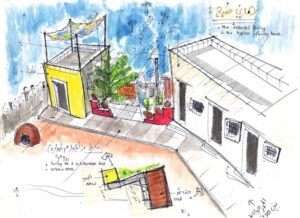
Sketches from a project with Islamic Relief where new housing units were added to allow horizontal expansion for extended families in rural and marginalized areas in the Gaza Strip.
Ikeda: Since I do not specialize in architecture, I am curious – you design something, and how does it get materialized? You need funding, you need to be commissioned?
Al Qudwa: Exactly. International NGOs often get good funding through the Arab region or other funding offices. For example, Islamic Relief, based in Birmingham in the UK, with funding offices in the USA and Germany – Islamic Relief Germany, Islamic Relief USA. They fundraise based on proposals I wrote in Gaza, based on needs assessments I did for hundreds or thousands of families. Then we would get approval for the proposal, get funding, hire local contractors, and I would work side by side with them to implement housing.
Ikeda: So, they could make your design happen, but they also hired designers who wanted to build houses with mud or wood?
Al Qudwa: Yes. During that time, I was struggling against those ideas. Luckily, in some cases they listened: okay, cement is cement – it responds to the natural growth of the family. But other international NGOs kept spending millions and implementing mud bags, sandbags, and mud houses, just to keep the cycle going. And for sandbags and wooden structures, the designers were often foreign.
Let me give you an example. In Japan or Germany, you have advanced construction techniques and you use words like sustainability, green buildings, green architecture. When I, as a local architect, approach you, sometimes I have to use the same terminology. Or an Italian architect might come to Gaza to implement a so-called resilient or sustainable building using mud and sandbags. Once I asked an Italian architect, “Is it possible to implement the same project back in your country?” And he said no – because local communities would stand against it. But in Gaza, Sudan, Somalia – it becomes a “playground.”
It’s their playground because the donation is coming from the EU, and they should hire European consultants; if funding is coming from Japan, they hire Japanese architects; if from the US, they hire Americans. They use donor money to implement experimental designs in these “playgrounds.”
But it’s not that in Gaza there are no architects. There are local people with knowledge, ideas, and designs – local experience. The mother helps her husband build the house because they are familiar with construction techniques, which is cement. The children help too. That’s why I focused on the self-help approach: we give the basic core – a room, a bathroom, a kitchen – and then over time they keep expanding. They can add more.
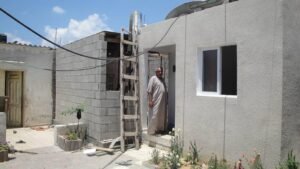
A basic housing unit constructed of a simple form with a visual calm.
Ikeda: You talked about the importance of acknowledging gender violence, gender justice, and domestic violence. Would you elaborate on that?
Al Qudwa: Yes. When I was finalizing my PhD around 2018-2019, I went back to Gaza. During that time, I was hired as a shelter program manager, working on shelter rehabilitation for widowed women who lost their husbands because of the conflict, with Islamic Relief France.
At the beginning, I assumed it would be similar to the extended-family cases I already knew. But when I started visiting houses, I insisted on having a female site engineer with me. When you have a female engineer, women share horrible stories they won’t share with a male architect. For me, I focus on the physical structure, but women reveal what is happening socially.
They told us about domestic violence and being treated badly by the extended family. Sometimes, when a woman loses her husband, the family forces her to marry one of her brothers-in-law. At first, I thought it was to protect the children, but then I realized that’s not the main reason. The main reason is access to money that the children receive as orphans.
In Islam, the “orphan” is the child who loses his father. After that, the child may be sponsored through charities. If the woman takes the children and goes back to her own family, then the husband’s family loses access to that money. So, they pressure her to marry one of the brothers-in-law to keep her under their umbrella.
Ikeda: I’m sure it’s something people don’t want to acknowledge publicly.
Al Qudwa: Exactly. In our tradition, it is difficult to talk about these things. People hide it. But we need to combine efforts – social workers, site engineers, architects, anthropologists—because we need to help those families. Now, look at what has happened in the last two years: we have an army of orphans and an army of women, and no one is mentioning that crisis, because it is a hidden social crisis. The physical war may pause, but there is another social war happening.
Ikeda: Given that kind of domestic violence, how would design help – concretely?
Al Qudwa: Most of the time, the answers come from the users of the space. I’ll give you one example. A woman came to the office at Islamic Relief France crying and said, “I need you to help me.” She stayed in her parents-in-law’s house without marrying another brother-in-law, but they looked at her like a piece of meat. She was hiding her children in one corner, and she could not even wear her own night clothes because everyone was watching her. They wanted her to become a second wife.
So, her solution was simple: she wanted an additional room on top of the house, with a small staircase leading to her room, and a small kitchen, and a lock from outside. The problem was that the cost of that incremental unit was expensive and beyond our budget. But that was the solution.
So, to answer your question: by building a separation wall, reorganizing the interior, adding another room, adding a small kitchen or bathroom, and giving her a separate entrance with a lock, you give physical protection and also protection from harassment.
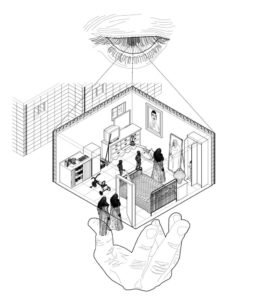
My project for widows in Gaza aims to clarify how these women adapt to their new situation within their in-laws’ family house, and how this difficult situation reshapes the contours of everyday architectural design when it comes to privacy and long-term security for women and children.
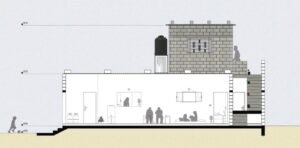
A section drawing for the proposed extension of a courtyard house from the horizontal level to the vertical and adding a room for a widow and her children on top of the house, with a small staircase leading to the room.
Ikeda: That’s very important.
Al Qudwa: Yes. We need an army of social architects, not only architects who draw plans. We need people who understand domestic abuse and how designers can help resolve such problems. And you only learn this if you are inside the community. Foreign designers don’t speak the language; they need translators. And often families or women won’t speak openly in front of a translator, and translators try to protect their people. So, something is always missing.
Ikeda: You also worked on the Rafah Crossing in addition to housing.
Al Qudwa: I was involved in the project at the Rafah crossing between Egypt and Gaza. It used to take five to seven minutes to walk from the Palestinian side to the Egyptian side, but now you hear about it in the news – it’s horrible. It can take days or weeks just to cross.
The project started because passengers from Gaza used to spend many hours waiting for the Egyptian side to open. So, it began with implementing a couple of toilet units, and then they asked me and my team to expand the proposal and write something about renovating the arrival hall and the departure hall. We wrote that, and we got funding from the Islamic Development Bank from Jeddah, Saudi Arabia.
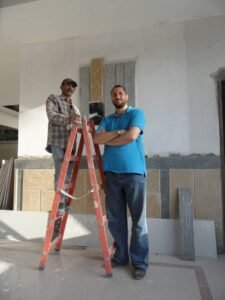
At the Rafah Crossing supervising the finishing of the departure hall, 2013.
I was the project architect, handling everything, with junior architects and engineers helping with technical drawings. It was not a new design so much as a renovation of the existing halls, including interior details and finishing materials. It was fully materialized in 2013, but it was seized and destroyed by Israel in 2024. And it is in the news now under headlines about the opening or reopening of the Rafah border, because thousands are waiting to leave Gaza or to return from Egypt, so it’s complicated.
Ikeda: You recently published a journal article on the idea of “aesthetics of the everyday.”
Al Qudwa: While working with Islamic Relief, I covered the whole Gaza Strip, from north to south. It was like I had a “third eye,” trying to see the aesthetics of the everyday.
I had my camera and I took thousands of pictures while evaluating houses that needed rehabilitation after destruction. I was moving across borderlines and buffer areas – places that are hard to imagine reaching as a normal city resident, because they are at the far ends of the Strip. I saw examples of local “art” made by ordinary people.
I was not trying to be nostalgic or romantic. I was trying to give credit to my people. You don’t need “high art” like paintings or sculptures to find something meaningful or beautiful in everyday life. They don’t know who Mondrian is, but they create things that have their own logic and beauty. If we take that aesthetics and develop them into design or architectural elements, it can become something important.
Ikeda: That’s a good contrast to the concept of “high art.” Perhaps we can discuss the tension between well-meaning foreign artists versus local people; more specifically, the foreign artists’ aestheticization of destruction. I’m talking about somebody like Dutch artist Marjan Teeuwen who created The Rubble House. You wrote a letter – you were angry – and you asked them to stop having fun in Gaza. And then there was a conversation organized in 2017 by the gallery Framer Framed in Amsterdam. You were invited to participate, but the artist was not present. There were a curator and a couple of theorists, and they basically said they understood your concern. But first, they said the local people were happy about it. Second, they said maybe it was the context of white-cube photography, presented in a Dutch context, that decontextualized the plight of the people.
Al Qudwa: First of all, the family was not happy. The artist asked the family not to step inside the house for a while because she was waiting for the spring season to come. Then she brought an international photographer, funded by the EU, to take these artistic pictures. So, she abused the place, she abused the family. I came to know these things from a friend of mine, a journalist who worked closely with her and who knew the family, and he revealed almost the same thing: that the family was very upset because she was trying to get fame.
They are coming with EU funds, USAID funds, and this kind of “superior” position over us: “You are in need – okay, we will implement such a thing.” Maybe in Gaza, maybe in Yemen, maybe in Iraq, maybe in Somalia. And who cares? And then calling somebody else’s destroyed house a sculpture, basically.
Then she had an exhibition – not in Gaza – in the white-cube clean space. Because why would people in Gaza like it? They’re surrounded by this kind of destruction.
And with respect, I asked: could you please stop having fun in my country?
Ikeda: I’m wondering if you are willing to share with us about your personal experience. The photograph you shared in my class about Israeli soldiers occupying your house in Gaza made my students – and myself – very emotional. Would you be willing to talk about the past two years?
Al Qudwa: First of all, that moment was specific to us as a family. But it’s happening on a daily basis in the West Bank. This is the problem.
At that time, more tension was going to Gaza because of what was going on, even in our neighborhood. It’s one of the safest neighborhoods in the Gaza Strip. It’s called Hay al-Rimal, in the heart of Gaza City. Most people were taking shelter in our neighborhood, so no one thought Israeli soldiers would occupy that specific area.
Even after occupying our house, I lost everything. The gold of my wife was kept in the cupboard in our bedroom. They invaded the house, they stole everything. But when you compare our situation to other families – who lost their houses, who lost their children, who lost everything – I used to tell my wife: we are so blessed that at least we are alive, and we still have each other. We have to be thankful.
Ikeda: Do you still have family there?
Al Qudwa: Yes, Alhamdulillah – relatives and cousins.
Since fall 2023, I gave one voluntary course – one entire architectural design course – for almost one semester, virtual. It was a horrible experience because my students had to move for half an hour, one hour, sometimes one and a half hours, to reach an internet café to submit drawings and assignments. I felt very sad giving them this experience, but it was the only way to help them survive and continue a design course.
And last summer I gave voluntary training to almost twenty engineers – many of them I had taught five or ten years ago. Some were from the Islamic University, some from other universities in Gaza. Again, it was hard, but the good news was what I kept hearing from them: “You are taking us out of the atmosphere—you are giving us an emotional and artistic design break to help us keep our dreams.”
During that time, we initiated a Telegram group in Arabic. Those are my students, most of them in Gaza – architectural engineers, and most of them were female engineers, because male engineers were busy trying to provide food. Every morning I sent exercises or projects to analyze, and we had discussions supported by drawings and collages, and then I gave feedback and assignments. It was informal education, but the important thing was transferring field experience – social mapping, how to deal with families, how to listen carefully, and how to document needs.
So, I tried to give them part of my experience. It lasted about a month and a half, and then I stopped, because it is emotional and it puts pressure and responsibility.
Ikeda: Now that the more intensive fighting has slowed, though many people have still died even after the ceasefire. Are they starting the reconstruction process?
Al Qudwa: Yes, even while attacks are still happening. Living in a tent is like living in the street. So, you have to find something more physical.
Sometimes I try to think as a selfish person. When I implemented small intervention projects, I used to tell myself: “Oh my God, I’m just building a bathroom, a kitchen, and a bedroom.” As an architect, I still have my own artistic ego. I want to design monumental buildings, museums, these kinds of architectural services. But then many families told me, “It’s as if you are building us a dream house, a castle.” That was during the period when I worked as an emergency architect.
These days, after the huge destruction – the scale of destruction now is massive – the dream of hundreds of thousands of families is just to have a single room. Only one room, a bathroom, a kitchen, or not even a room – just a wall, because they lost everything. Instead of living in a tent or a caravan, that is their dream.