

History of the Tokyo Trials
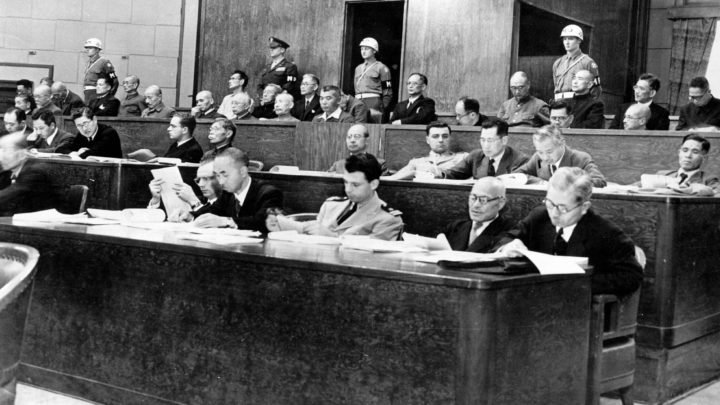
Today is the 80th anniversary of the opening of the International Military Tribunal for the Far East, known as the Tokyo Trials.
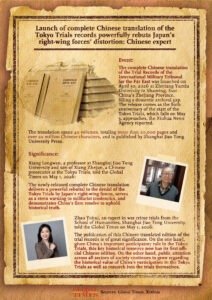
Given that China is livid in general with Japan and their rearming process, I saw a headline in the Global times: “Launch of complete Chinese translation of the Tokyo Trials records powerfully rebuts Japan’s right-wing forces’”
So, it turns out that China has never had a complete Chinese translation of the Tokyo Trials.
This is the first complete Chinese translation of the Tokyo Trials records.previous Chinese-language materials were either partial, selective, or secondary analyses, but not the full, authoritative trial transcripts. While there was no complete Chinese translation before 2026, some partial materials and related publications did exist. Individual speeches or documents by Chinese participants (such as prosecutor Xiang Zhejun) had been translated or published separately
Tokyo Trials stand as litmus test of humanity’s conscience and delivers historical justice, Chinese FM remarks on 80th anniversary of its opening.
As we are limited as to how much material we can use from the Chinese sites, please read it here: https://www.globaltimes.cn/page/202605/1360207.shtml
In simply browsing through a massive amount of material I saw the strangest comment. There were nine or so justices and there were five dissenting opinions at the end of these trials. The major dissenting opinion came from India whose justice announced that the whole trial is a ‘victor’s trial’, and although the atrocities indeed happened, every accused should be set free. That dissenting opinion is clearly part and parcel of the unhappiness between China and India today. Yet the Indian justice was of the opinion that so much criminal and war action happened in the region, that the Japanese part of it was only a part.
At a very cursory and quick comparison of the Nuremberg Trial and the Tokyo Trial, I came across the actual accusations. The complexities are almost impossible:
Accusations at the Tokyo Trials (International Military Tribunal for the Far East)
The Tokyo Trials (1946-1948) charged 28 Japanese military and political leaders with 55 separate counts organized into three main categories of crimes, following the model established at Nuremberg
Three Categories of Charges
Class A: Crimes Against Peace
- Count 1: Conspiracy to secure military, naval, political, and economic domination of East Asia, the Pacific, and Indian Oceans through wars of aggression
- Counts 2-5: Specific conspiracies to dominate Manchuria, all of China, and to collaborate with Nazi Germany and Fascist Italy in global domination schemes
- Counts 6-17: Planning and preparing wars of aggression against specific nations including China, the United States, the British Commonwealth, the Netherlands, France, Thailand, and the Soviet Union
- Counts 18-36: Initiating and waging specific aggressive wars, including the invasion of Manchuria (1931), the full-scale war against China (1937), and the Pacific War beginning with Pearl Harbor (1941)
Class B: Conventional War Crimes
- Murder, ill-treatment, and forced labor of prisoners of war and civilian internees
- Denial of adequate food, shelter, clothing, and medical care to captives
- Wanton destruction of cities and villages beyond military necessity
- Plunder of public and private property
Class C: Crimes Against Humanity
- Mass murder, rape, pillage, torture, and other barbaric cruelties against helpless civilians in occupied territories Specific incidents like the Nanking Massacre (Count 45), where defendants were accused of ordering the slaughter of thousands of Chinese civilians and disarmed soldiers
Notable Murder Charges (Counts 37-52)
- Unlawful attacks on nations with which Japan was at peace (e.g., Pearl Harbor, Count 39)
- Systematic killing of POWs and civilians during occupation
Key Legal Framework
“Crimes against Peace, Conventional War Crimes, and Crimes against Humanity”
Unlike Nuremberg, the Tokyo Tribunal required that defendants be charged with crimes against peace as a prerequisite for prosecution—only those whose crimes included aggressive war planning could be tried by the IMTFE
Outcome Summary
- Of the 55 counts, the Tribunal ultimately ruled that 45 counts (including all murder charges) were either redundant or not authorized under the Charter
- 7 defendants were sentenced to death by hanging
- 16 defendants received life imprisonment
- 2 defendants died during the trial; 1 was found mentally unfit
But there were war criminals that were not brought to trial. Read it, and weep!
In addition to the trials at Nuremberg in Germany, the Allies set up a tribunal to bring to trial the leaders of Japan, another member of the Axis powers in World War II. Japan’s campaign to conquer or control Southeast Asia and the Pacific Ocean had begun in 1931 when its forces occupied the province of Manchuria in China. Six years later, Japan invaded the Shanghai-Nanjing region of China and occupied the city of Nanjing. There, Chinese civilians and prisoners of war were killed in a savage campaign of rape, torture, and mass murder by Japanese forces. Similar acts were committed by Japanese forces in other areas of China and during their wartime occupation of Manila in the Philippines.
At their final wartime conference, held in July 1945 at Potsdam, Germany, Allied leaders agreed on a policy for post-war Japan and stated their intention to hold the Japanese responsible for war crimes, including inhumane treatment of Allied prisoners:
The Tokyo Trial: An Introduction
There must be eliminated for all time the authority and influence of those who have deceived and misled the people of Japan into embarking on world conquest, for we insist that a new order of peace, security and justice will be impossible until irresponsible militarism is driven from the world. . . . We do not intend that the Japanese shall be enslaved as a race or destroyed as a nation, but stern justice shall be meted out to all war criminals, including those who have visited cruelties upon our prisoners.
After the United States dropped two atomic bombs on Japan in August 1945, the emperor of Japan issued a statement of unconditional surrender. General Douglas MacArthur of the United States was put in charge of the occupation of Japan, which lasted from 1945 to 1952. He established the International Military Tribunal for the Far East, with trials set to begin in May 1946 in Tokyo. Based on the precedents set at Nuremberg (see reading, Establishing the Nuremberg Tribunal), the Far East tribunal indicted 28 Japanese military and civilian leaders for war crimes, crimes against peace (which included planning a war of aggression), and crimes against humanity.
But many others who might have been indicted were not. Historian John Dower describes the choices of whom to prosecute—choices that were later criticized:
[T]he absence of certain groups and crimes [in the Tokyo indictments] was striking. No heads of the dreaded Kempeitai (the military police) were indicted; no leaders of ultranationalistic secret societies; no industrialists who had profited from aggression and had been ultimately involved in paving “the road to war.” The forced mobilization of Korean and Formosan colonial subjects was not pursued as a crime against humanity, nor was the rounding up of many tens of thousands of young non-Japanese who were forced to serve as “comfort women” providing sexual services to the imperial forces. The Americans who controlled the prosecution chose to grant blanket secret immunity to one group of Japanese whose atrocious crimes were beyond question, namely, the officers and scientific researchers in Unit 731 in Manchuria who had conducted lethal experiments on thousands of prisoners (they were exempted from prosecution in exchange for sharing the results of their research with the Americans). The prosecution did not seriously pursue evidence concerning the Japanese use of chemical warfare in China.
The most notable absence among those indicted was that of Emperor Hirohito, the leader of Japan throughout the entire pre-war and wartime period. The decision not to try him was made by General MacArthur; it reflected the American policy of leaving the emperor on the throne as a way of helping the Japanese people accept their defeat, the occupation, and the guiding principles that MacArthur would follow to turn Japan into a democracy.
The same concerns about ex post facto (“after the fact”) justice that were expressed about the Nuremberg trials were raised about the Far East tribunal, but there, too, they were dismissed. One important difference, however, was that at the Tokyo trials, defendants were held responsible for crimes of omission—the failure to act to prevent war crimes from occurring or continuing. This played a significant part in the conviction and subsequent execution of two of the defendants: General Iwane Matsui, who directed the campaign to capture Nanjing, and Koki Hirota, who was Japan’s foreign minister at the time of the Nanjing atrocities. The prosecution presented evidence that both had known of the atrocities but had done nothing to stop them. The final judgment against Hirota read:
The tribunal is of the opinion that Hirota was derelict in his duty in not insisting before the Cabinet that immediate action be taken to put an end to the atrocities, failing any other action open to him to bring about the same result. He was content to rely on assurances which he knew were not being implemented while hundreds of murders, violations of women, and other atrocities were being committed daily. His inaction amounted to criminal negligence.
Seven other defendants at the Tokyo trials were convicted of either crimes against peace or war crimes, and they were executed. The others were sentenced to prison terms; no one was acquitted.
In addition to criticisms made during and after the Tokyo trials that they were simply “victor’s justice,” some people also claimed that the tribunal and its indictments reflected a strong racial bias. Only three of the 11 judges presiding at the trials were Asian. Justice Radhabinod Pal, who was from India, noted that the Japanese leaders were being prosecuted and convicted for starting a war of conquest against countries like Indonesia (colonized by the Dutch), Indo-China (colonized by the French), and Malaysia (colonized by the British), all of which had been “acquired by such aggressive methods” as the Japanese were accused of using. Historian John Dower notes that Justice Pal also commented, with no little sarcasm, on the ways in which the positive rhetoric of imperialism and colonialism of the Europeans and Americans became transmogrified [changed] when associated with Japan: “As a program of aggrandizement of a nation we do not like, we may deny to it the terms ‘manifest destiny’, ‘the protection of vital interests’, ‘national honour’ or a term coined on the footing of the ‘white man’s burden’, and may give it the name of ‘aggressive aggrandizement’ pure and simple.”
A cursory read, and mine was cursory as the amount of information is incredible, should convince you why Netanyahu and his co-accused do not care a hoot about the charges brought against them. If the Emperor of Japan can walk free, so can he and his co-accused.
Here is a research guide for those who want to take a more comprehensive look. https://peacepalacelibrary.nl/research-guide/tokyo-trial