

The Great AI Credit Bubble
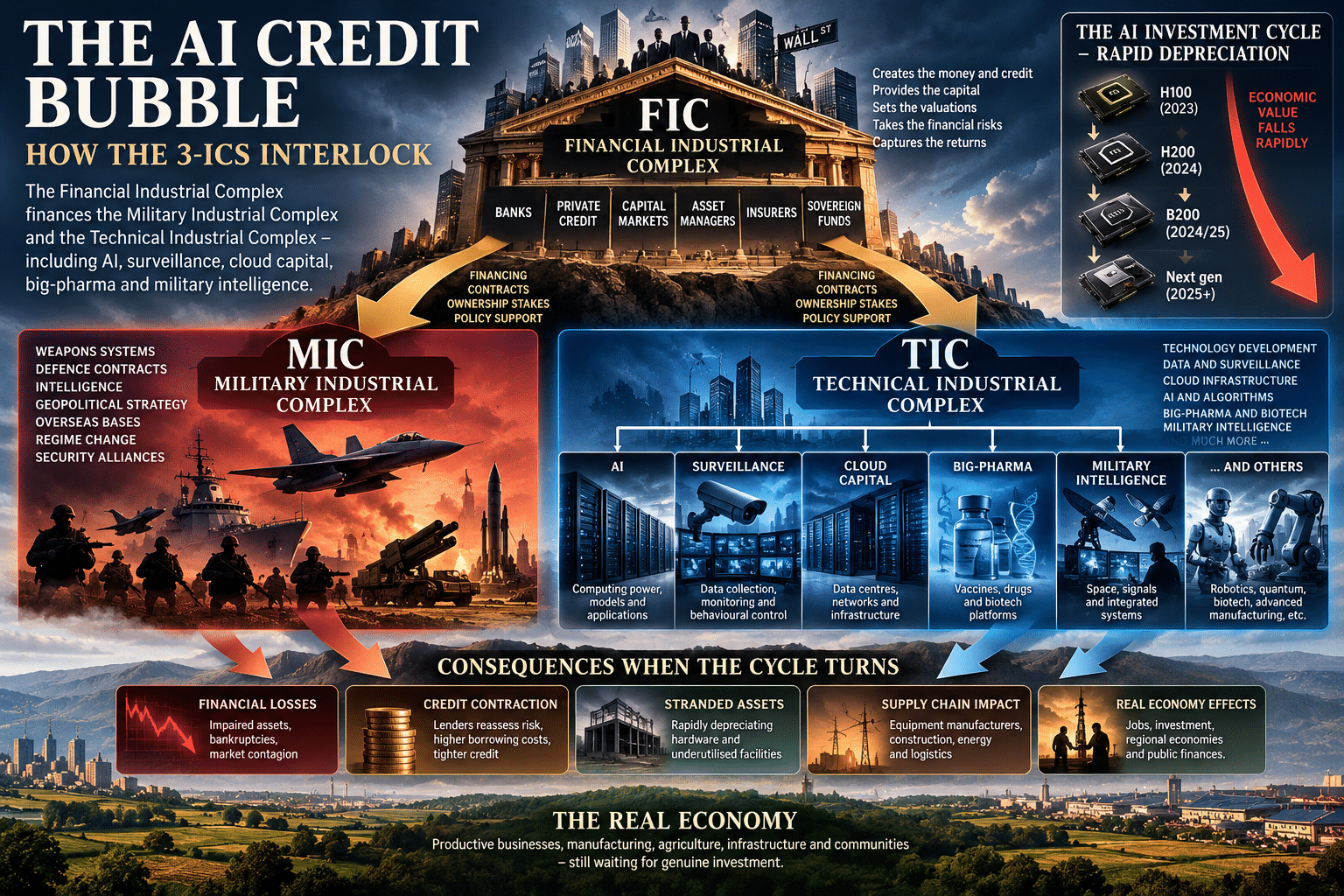
WHEN THE HARDWARE DIES BEFORE THE DEBT
by Colin Maxwell
Circular finance, technological boondoggles, five ticking clocks – and the extraordinary difference between financial promises and productive economic reality.
THE FIRST CRACKS IN THE AI GOLD RUSH
Something fascinating is happening in the financial markets.
Australia’s Firmus Technologies abandoned a proposed A$7 billion sharemarket flotation in October, having sought a valuation in the region of A$44 billion.
This was no insignificant little technology venture. Firmus had attracted backing from some substantial interests, including Nvidia.
Yet institutional investors were unwilling to swallow the proposed valuation.
Even more remarkably, Reuters Breakingviews reported that the proposed valuation was approximately three times that established in an August funding round – and some 23 times the company’s valuation only a year earlier.
Now there’s a number worth contemplating.
Meanwhile, concerns are growing about the enormous financing requirements of artificial intelligence, the increasingly complicated financial relationships supporting it, and whether the eventual revenues can possibly justify the expenditure.
The comparisons with the Dotcom bubble are becoming difficult to ignore.
But I suspect there is something potentially much more dangerous lurking beneath the surface.
And it has very little to do with whether artificial intelligence itself turns out to be a revolutionary technology.
THE MACHINES MAY DIE – THE DEBT DOESN’T
Think back to some of the great investment manias of the past.
The railway booms left behind tracks, bridges, tunnels and transport corridors. Many companies collapsed, but much of their physical infrastructure continued serving productive purposes for generations.
The telecommunications bubble left behind enormous networks of fibre-optic cables. Investors lost fortunes, but those networks eventually became indispensable components of the modern economy.
Property bubbles frequently leave behind buildings and land, even when their speculative valuations collapse.
Now consider the extraordinary AI infrastructure boom.
At its centre are vast installations of highly specialised computing equipment, including extremely expensive graphics processing units, or GPUs.
And here is the catch.
These machines can become commercially obsolete at a remarkable rate.
New generations of processors can deliver substantially superior computing performance, energy efficiency and cost effectiveness. Equipment that was state-of-the-art only a few years earlier may remain perfectly functional while becoming increasingly uncompetitive.
A GPU does not have to stop working to become a poor investment.
It merely has to become too expensive to operate relative to the next generation.
Older equipment may retain value for AI inference and less demanding applications. Buildings, electrical connections and cooling infrastructure can also remain useful.
But the expensive computing hardware at the centre of this boom presents a very different risk profile from a railway bridge or fibre-optic cable.
And the debt used to purchase that hardware does not depreciate alongside it.
THE DEPRECIATION TIME BOMB – FOLLOW THE NUMBERS
CoreWeave, one of the prominent AI infrastructure operators, offers a particularly revealing case study.
Its 2025 annual report disclosed approximately US$21.6 billion in total indebtedness at year-end, including around US$5.2 billion in equipment and software financing arrangements.
CoreWeave also uses a six-year accounting life for its computing equipment.
That accounting treatment deserves particular scrutiny alongside the equipment’s actual earning power, recoverable collateral value and the repayment schedules attached to its financing.
Some financing facilities have maturities approaching that six-year accounting life, while other arrangements have different terms. There is no single debt maturity that applies to the entire business.
But accounting depreciation and commercial obsolescence are two very different things.
Think about that for a moment.
The equipment may be depreciated over six years in the company’s accounts, while technological advances alter its earning potential much sooner.
Consider a simplified illustration.
A company borrows US$1 billion to purchase specialised AI computing hardware, repayable over six years.
Suppose its economic value declines by 50% annually – a hypothetical stress assumption rather than an established industry-wide depreciation rate.
After three years, the equipment would have an estimated economic value of just US$125 million.
If the company had repaid principal evenly, it would still owe US$500 million.
And interest would have been payable throughout.
That represents a potential collateral shortfall of US$375 million.
A profitable operator may still generate sufficient cash flow to repay the debt. But if revenues disappoint and refinancing becomes necessary, the difference between outstanding debt and recoverable asset value becomes critically important.
Now multiply that exposure across an interconnected network of data-centre operators, equipment financiers, private-credit funds and institutional investors.
The implications become rather more interesting.
FIVE CLOCKS – ALL TICKING AT ONCE
There are five clocks running simultaneously throughout this extraordinary investment boom.
The first is technological obsolescence.
Hardware begins losing competitive economic value as successive generations of processors arrive.
The second is the debt clock.
Lenders expect interest and principal repayments according to their contracts, regardless of what happens to equipment values. Short-term borrowing against longer-term investments introduces additional refinancing risk.
The third is the revenue clock.
The business depends on sufficient demand for computing services at profitable prices. But what happens if computing becomes dramatically cheaper, competitors build excessive capacity, or anticipated demand fails to materialise?
The fourth is the replacement clock.
Operators may face pressure to purchase the next generation of processors before the original equipment has finished paying for itself.
The fifth is the construction clock.
Data centers require electricity generation, grid connections, transformers, cooling equipment, construction materials and skilled labour.
What happens when those essential components take years to deliver?
A project can accumulate financing costs long before it generates meaningful revenue.
And during those delays, the technology continues advancing.
By the time a facility becomes operational, its original commercial assumptions may already have deteriorated.
Five clocks, all ticking away, while the financial obligations continue accumulating.
YOU CAN CREATE THE CREDIT – BUT NOT THE ELECTRICITY
And here is another elephant wandering around this increasingly crowded room. Electricity.
The AI industry requires extraordinary amounts of reliable electrical power, sophisticated transmission infrastructure, cooling systems, transformers, copper, specialised equipment and skilled labour.
These things cannot simply be conjured into existence through financial engineering.
The United States is encountering serious grid-connection constraints, lengthy construction lead times and competition for electrical equipment.
Some major transformer orders have reportedly faced delivery times stretching into years.
Meanwhile, enormous AI infrastructure projects continue to be announced.
But announcing a data centre and supplying it with reliable electricity are two very different propositions.
And consider the collision with our five clocks.
A developer may secure financing, sign equipment contracts and begin construction, only to discover that essential electrical infrastructure will not be available for several years.
During that period, newer processors arrive, operating economics change, and financing costs continue accumulating.
This is where the distinction between the financial economy and the productive economy becomes impossible to ignore.
Financial claims can be created relatively quickly.
Physical productive capacity takes time, materials, energy, engineering and skilled labour.
And that brings us to a particularly revealing international comparison.
CHINA’S ELECTRICITY SUPERHIGHWAYS
China has spent more than fifteen years constructing an extraordinary network of Ultra-High-Voltage electricity transmission lines.
These are no ordinary power lines.
Its most advanced long-distance transmission systems operate at up to ±1,100 kilovolts, allowing enormous quantities of electricity to be transported thousands of kilometers from generating regions to major industrial centres.
The Changji–Guquan transmission project was designed to carry approximately 12 gigawatts across 3,293 kilometers.
For a given quantity of power, higher transmission voltage reduces the current required, potentially reducing resistive transmission losses substantially.
By the end of 2024, China had completed 42 ultra-high-voltage transmission projects – 22 AC and 20 DC.
And State Grid has announced plans to invest approximately US$574 billion between 2026 and 2030, including further expansion of long-distance transmission capacity.
Meanwhile, the United States continues confronting grid congestion, transmission permitting difficulties and delays connecting new electricity generation and large industrial consumers.
The US possesses advanced electrical engineering expertise and substantial high-voltage infrastructure of its own. But China has developed its UHV network on a scale unmatched by the American system.
And China’s advantages extend beyond transmission lines.
They include extensive electrical-equipment manufacturing, industrial supply chains, engineering capability and the ability to coordinate major infrastructure development.
These are tangible foundations of productive economic strength.
Of course, transmission capacity alone does not guarantee cheap electricity at every data centre, nor does it resolve China’s constraints in frontier semiconductors.
The international AI competition will be determined by chips, software, talent, research, energy, industrial capacity and commercial adoption.
But an economy’s ability to mobilise finance is not the same as its ability to deliver the physical infrastructure that finance is supposed to purchase.
You cannot manufacture industrial capacity simply by inflating financial valuations.
CIRCULAR FINANCE – FOLLOW THE MONEY
And now we arrive at another extraordinary feature of the AI boom.
CIRCULAR FINANCE.
Some of the largest technology companies are simultaneously suppliers, investors, customers and financiers within the same rapidly expanding ecosystem.
Chip manufacturers invest in AI businesses that purchase their chips.
Cloud providers finance infrastructure that AI developers contract to use.
Data-centre operators borrow against expectations of future demand.
And the resulting contracts, investments and revenue projections can help support further financing. Around and around it goes.
None of these arrangements is automatically improper. Strategic investment and long-term supply contracts can be entirely legitimate commercial activities.
But growing financial interdependence creates an important question.
How much genuine demand exists independently of the financing relationships themselves?
Are end customers generating sufficient economic value to justify the infrastructure being constructed?
Or are enormous amounts of capital being committed on the assumption that somebody else will eventually provide the profitable end-market?
Circular finance can make the underlying economics increasingly difficult to disentangle.
And if several participants depend upon the same optimistic assumptions, apparently separate financial exposures may prove to be remarkably interconnected.
That is when the whole arrangement begins to resemble a financial house of cards.
BOONDOGGLES – WHEN INVESTMENT BECOMES THE PRODUCT
There is another word that deserves a prominent place in this discussion. BOONDOGGLES.
Enormous projects that consume extraordinary amounts of money and resources while delivering little sustainable economic value.
The danger is that speculative financing may encourage the construction of infrastructure far beyond what profitable demand can support.
A completed data centre can be an engineering achievement and a commercial failure at the same time.
It can contribute to measured GDP during construction while ultimately destroying enormous amounts of investor capital.
And if the project was financed through debt, the financial obligations remain even when the original business case collapses.
We should be particularly wary of confusing the amount invested with the amount of productive value created.
That distinction becomes even more important when political prestige, financial incentives and technological competition combine to encourage ever-larger investment announcements.
A US$50 billion project does not become productive simply because somebody has found US$50 billion to finance it.
And the ultimate boondoggle would be a facility that arrives late, costs far more than expected, and becomes commercially obsolete before its investors have recovered their money.
THE THREE INDUSTRIAL COMPLEXES
This brings us to a framework I have discussed previously – the three interconnected industrial complexes, or 3-ICs.
At the apex sits the Financial Industrial Complex – FIC.
This is the overarching financial architecture through which capital, credit, investment and financial influence are channelled.
Beneath it sit two enormous concentrations of industrial and technological power.
The Military Industrial Complex – MIC, encompassing defense production, military contracting and the wider defense-industrial infrastructure.
And the Technical Industrial Complex – TIC, with its expanding branches of artificial intelligence, surveillance, cloud capital, Big Pharma, military intelligence and related technological systems.
These complexes overlap in numerous ways.
AI technology has military and intelligence applications. Defense contractors depend on advanced computing and surveillance systems. Financial institutions provide capital across the entire structure.
The AI boom offers an unusually revealing illustration of these relationships.
And it raises another question.
When enormous concentrations of financial and technological power become mutually dependent, how effectively can the system distinguish genuine productive investment from speculative expansion?
RICHARD WERNER – AND THE MISSING PRODUCTIVE ECONOMY
Professor Richard Werner has spent decades explaining why the destination of newly created bank credit matters enormously.
Credit directed towards productive business investment can expand an economy’s capacity to produce goods and services.
Credit directed towards purchasing existing assets can instead inflate their prices without creating corresponding new productive capacity.
But the AI boom introduces an interesting complication.
A data centre is a genuine physical investment.
It requires buildings, electricity, equipment, engineering and labour.
Yet physical investment is not automatically economically productive in any sustainable sense.
If a US$10 billion facility ultimately generates insufficient returns to cover operating costs, financing costs and equipment replacement, its construction does not establish that the investment was commercially justified.
The amount of capital invested tells us very little about the productive value ultimately created.
And this is where I would introduce another measure that deserves far greater attention.
Productive GDP – PGDP.
Conventional GDP captures economic activity, but its headline figure does not adequately reveal the composition, resilience and underlying productive capacity of an economy.
PGDP is intended to bring those distinctions into sharper focus.
How much genuine productive value is being generated relative to the financial obligations accumulated in the process?
How much credit is supporting sustainable industrial development, and how much is financing increasingly speculative expectations?
These are the questions that matter.
And they lead directly to the monetary architecture itself.
THE THREE PILLARS – AN ALTERNATIVE ARCHITECTURE

The deeper problem is the monetary and banking architecture that determines how credit is created, allocated and ultimately repaid.
My proposed Three Pillars framework examined public-utility banking and productive credit allocation, fundamental tax reform through a Financial Transaction Tax, and a more neutral international monetary settlement architecture.
These proposals do not promise to eliminate investment failures or technological bubbles.
They address a more fundamental question – how the monetary system might be redesigned to serve sustainable productive development rather than repeatedly amplifying speculative financial expansion.
I won’t regurgitate this here – the full hypothesis is explored in my earlier essay, THE FINANCIAL HOLY GRAIL.
The essential principle is simple.
The financial system should serve the productive economy – rather than the productive economy being subordinated to the financial system.
THE REAL BUBBLE IS IN OUR THINKING
Artificial intelligence may prove to be one of the most consequential technological developments in modern history.
It may transform medicine, engineering, manufacturing, logistics, agriculture, scientific research and countless other productive activities.
But technological promise does not automatically justify every financial valuation attached to it.
Nor does technological progress guarantee that the investors financing it will earn satisfactory returns.
The internet survived the Dotcom crash.
The railways survived railway speculation.
Artificial intelligence can continue advancing even if substantial parts of its present financing structure prove unsustainable.
The more important issue is how much damage might be inflicted along the way, and who ultimately bears the losses.
Perhaps the most revealing feature of this entire episode is how little attention is being paid to the monetary architecture beneath it.
We debate interest rates, valuations, technological disruption and government regulation.
But rarely do we examine who creates the credit, where it is directed, what productive value it generates, and whether the resulting financial obligations can be sustained.
Richard Werner has spent decades urging economists to examine precisely these questions.
The AI boom may provide another very expensive demonstration of why they matter.
And this time there is a particularly uncomfortable twist.
The financiers are lending against tomorrow’s technological revolution – but tomorrow’s technological revolution may be precisely what destroys the value of yesterday’s collateral.
Meanwhile, electricity grids, transformers, industrial supply chains and productive infrastructure cannot be created by financial promises alone.
The machines may depreciate.
The debt doesn’t.
And somebody eventually has to settle the account.
Cheers to all
Col