Chronicles - Sovereign Global Majority

Archives

Resistance News Translation : Mohammad Reza Naqdi (IRGC) discussion
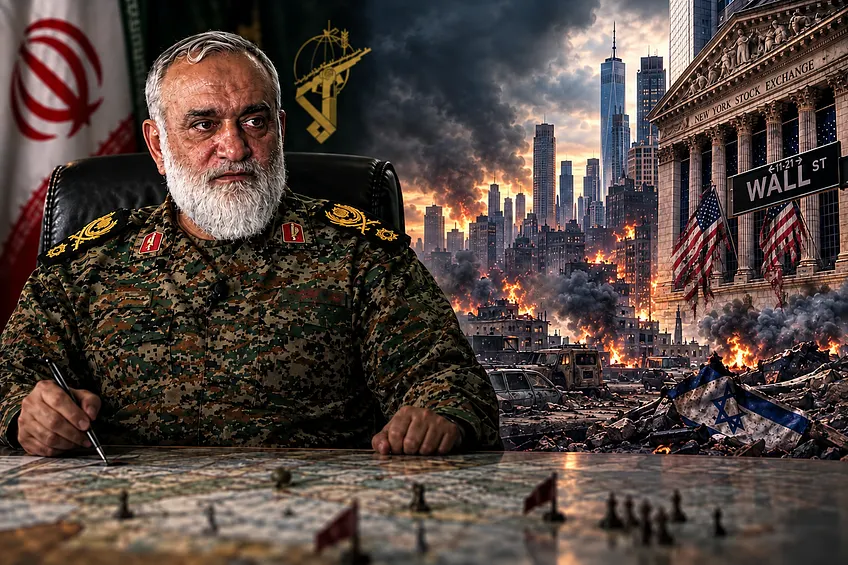
‘We Can Bring the War to Wall Street and Manhattan, the Israelis Will Face the Law of Reciprocal Justice’

Interview with General Mohammad Reza Naqdi, Top Advisor to the Commander-in-Chief of Iran’s Islamic Revolutionary Guard Corps (IRGC).
Source: Al-Mayadeen, August 31, 2026

Translation: resistanceaxis.substack.com

  • The United States, a paper tiger
  • Iran possesses more than 90% of its missiles
  • Conventional war vs. asymmetric war
  • Israel is doomed to destruction and massacre
  • The Iranian home front

Journalist: May the peace, mercy and blessings of God be upon you. Welcome, dear viewers, to this special interview. We host a prominent Iranian figure, who has distinguished himself over the past years and decades in the course of the military and security establishment, having held several positions over the years, among them command of the Basij organization, the popular mobilization forces; he was for years deputy to the commander of the Revolutionary Guards, and currently holds the position of senior advisor to the Commander-in-chief of the forces of the Islamic Revolutionary Guard Corps in Iran. Our guest is General Mohammad Reza Naqdi.

The United States, a paper tiger

My greetings to you, General, and thank you for granting us this opportunity. General, the last war — what did it reveal about the dimensions and military capabilities of Iran, and about American military capabilities? Did you expect this outcome from the very start of the war, especially since Iran has always affirmed, in recent months, that it emerged victorious from this war?

Naqdi: In the name of God, the All-Merciful, the All-Compassionate. I first convey my greetings to the pure souls of the martyrs, in particular our dear martyrs in beloved Palestine, in Gaza, in Lebanon, as well as to the peoples of these honorable regions who rose up with courage and valor, and likewise to the zealous Yemeni people in this great resistance. The entire world today owes a debt to the peoples of Gaza, Lebanon and Yemen, to the Iraqi resistance, and to all the fighters who continue to wage the battle on these fronts.

Yes, this war revealed many truths. We expected victory, because we were certain and confident in God’s promise and His support; but we did not expect victory to be achieved with such ease. Our assessment of the capabilities of the American armed forces was higher than what turned out to be the reality: they greatly exaggerated the propaganda about their capabilities.

That image has now collapsed, and it has become clear that the aircraft carriers and fighter jets that were so heavily promoted did not carry that kind of importance. The entire world saw that these aircraft carriers, from the very start of the war, stopped at a distance of a thousand kilometers from the Strait of Hormuz and were unable to move; and during these six months, not one of them was even able to dock at the pier in Bahrain where the American Fifth Fleet is stationed.

Yes, certainly, they were dropping bombs worth millions of dollars using aircraft worth tens and hundreds of millions of dollars, taking off from aircraft carriers each worth more than 11 billion dollars; in Tehran, for example, they were bombing a simple Basij mobilization forces center, a very modest building whose value may not even reach a few tens of thousands of dollars. That is why their operations were hollow.

Journalist: It is said that most of the buildings you are speaking of had already been evacuated.

Naqdi: There is no doubt about that. Naturally, when they strike a Basij center, the other centers get evacuated. They targeted popular institutions enjoying popular support, and that is why nothing fundamental happens to the structure of the state. They had illusions that Iran would sink into chaos, unrest, sedition, or regime change; but it became apparent to them that this was mistaken information. It turned out that the American army is hollow and fragile; it turned out to be a paper tiger, and that its actual capabilities are far weaker than what the American president keeps repeating when he says: “We possess the greatest army in the world.” Yes, it’s true, they possess the greatest quantity of weaponry and the greatest budget, but they lack the motivation to fight.

Journalist: You had previously said that the American army was far weaker than we imagined, and that Iran’s missile stockpile would never run out, even if the war were to continue for years. Do you still hold to that assessment?

Naqdi: Yes, and that is because we rely on our domestic production.

Iran possesses more than 90% of its missiles

Journalist: The American president speaks of the destruction of more than 90% of your missiles.

Naqdi: More than 90% of them still exist [laughs]; the missiles that no longer exist are the ones we fired, and other missiles have taken their place. We do not suffer from a depletion of our stockpiles. Our advantage in this war is that the entirety of our weaponry is manufactured domestically. We had only one weak point: certain factories and production sites were in known locations, above ground, and their addresses were known, which is why they were bombed; but all of these facilities have now been rebuilt in extremely secure locations, and operate using modern, advanced technologies, at higher production rates. We are currently producing at a rate that exceeds the rate of consumption at the front; our stockpile is increasing.

Journalist: Inside these underground missile bases, does missile production also continue on a constant basis? Is that correct?

Naqdi: Besides production at the front, there are also other modes of production. In Gaza, for example — a narrow strip whose far end can be seen with the naked eye — despite all the Israeli detection tools and surveillance devices, they had secret production lines, and production continued even a year and a half after the al-Aqsa Flood operation. Now imagine a country as vast as Iran, where we have hundreds of cities and industrial complexes; we have immense capabilities that allow us to conceal our production in different, distributed ways, whether underground or above ground, such that they cannot trace it. But we do not rely on these weapons alone; they believe that we only have missiles and drones, and that if these weapons were to run out, it would be the end for us.

Journalist: That is precisely what I wanted to ask you. Naturally, Iran unveiled, during the last war, a large number of weapons — missiles and drones in particular — but does Iran still possess military capabilities that it has not used during this war?

Naqdi: Yes, they exist, and this too is important for the enemy to take into account; but above all, in our war, we rely on our faith. The day our last bullet is fired will, in reality, be the beginning of our revolutionary war.

Observe with me: every football player has a ball, and all their balls meet the same standard specifications, but they are not all Ronaldo, capable of scoring goals; they are not all Pelé. Scoring a goal requires a human being endowed with motivation, intelligence and ability, who knows how to use the tool. The Americans possess a hundred times more weapons than we do, and they have better missiles and drones, but they are not capable of using them (effectively).

Journalist: So there are weapons Iran has not yet unveiled. General, what were the most effective weapons and missiles used by the Iranian armed forces during the last war?

Naqdi: Their air superiority collapsed due to the density of Iranian drones and missiles; that is why even our old, ineffective weapons became effective against them. The enemy’s defense relies on weapons that are extremely costly, precise and highly sensitive, which were not built to wage a real war. When war becomes real, it leaves the framework of military maneuver, and things change. For instance, take aircraft carriers: when they place 5,000 people aboard one of them, if a missile strikes a sensitive point on it, those 5,000 people find themselves trapped — the aircraft carrier in reality becomes a floating, mobile prison. These tools, therefore, are not suited for waging war.

Journalist: General, Iran frankly states that it has moved beyond the defensive doctrine, or that it is in the process of transitioning toward a fully offensive doctrine. When and how will this transformation be translated concretely on the ground during the coming phase? We have seen that this approach was applied, to a certain extent, on the ground at a certain stage, and at the conclusion of the confrontation that lasted 13 days, through the targeting of American bases in Jordan, which resulted in the death and injury of dozens of American servicemen.

Naqdi: In reality, this is the current operational doctrine. This thinking already existed within our forces; some commanders supported this doctrine, but most of the great commanders who were martyred tended toward the defensive rather than the offensive doctrine. It may be that most of the commanders present today tend toward the offensive doctrine, prefer it, and pursue its implementation.

Journalist: Can it be said that they are more uncompromising in confronting the United States and Israel?

Naqdi: If you wish to use the word “extremism,” that term would not be very appropriate; but they all resemble one another in terms of motivation. The difference between them lies in their military conceptions, nothing else. There are discussions and debates among the great commanders about military doctrine; some adopt offensive thinking, others adopt defensive thinking, and this depends on their vision of what they regard as success from an operational standpoint. This war has revealed that thinking based on the offensive doctrine is extremely interesting, entirely feasible, and highly rewarding from an operational standpoint.

Conventional war vs. asymmetric war

Journalist: Naturally, the war against Iran, in recent months, has been multidimensional: military, security, political and economic. Is the military war truly over, in your view, or is the current calm merely a phase preceding another military confrontation?

Naqdi: America has become incapable of continuing the war: it stopped because it has become powerless, for militarily it accomplished nothing; that is to say, the more it tried, the more it lost of its reputation, suffered further damage, incurred further losses, and took further blows. That is why it abandoned the war, because it judged that military war yielded no benefit. In their perception, economic pressures, sanctions and psychological warfare are capable of bringing Iran back to a state of internal turmoil and weakness, and if we do not surrender and do not accept their demands in negotiations, they will relaunch the war: this conception exists in the minds of some of them.

Journalist: In your view, if we consider this scenario probable, do you think the next war will be a limited war, or a broad and comprehensive one, or even an existential war between Iran on one side, and the United States and Israel on the other?

Naqdi: Our priority is neither war nor negotiation; neither war nor negotiation carries intrinsic value for us. The issue is that we must achieve deterrence, meaning that we must reach a point where the enemy no longer dares to attack us, and this can be achieved through a political, military, or attritional path, depending on the conditions of the war. We are not sitting here now making our decisions on the basis of an imposed, rigid plan. We have flexibility, and our commanders make their decisions in accordance with the requirements of each day and each moment. What is the goal? To achieve deterrence. The commitments announced by the Iranian Supreme National Security Council mean that we are carrying out our commitments, but they must understand that they will have to pay a very heavy price if they attack Iran.

Journalist: Could Iran resort to carrying out preemptive strikes if American economic sanctions were applied on a broad scale?

Naqdi: Look, these are sanctions that can do nothing. We are a country that enjoys, to a large extent, economic self-sufficiency; in food, medicine, equipment and needs, we secure our own requirements ourselves. Even if they erected a concrete wall around Iran and posted guards on it, Iran would remain steadfast and strong. Iran is an exceptional country in this respect; we are capable of manufacturing everything ourselves, from raw ore to aircraft, and of producing everything, from the raw materials stage to the finished product. This foundation and this capability exist in Iran, and from this standpoint, we fear nothing. Naturally, if necessity requires it and if our commanders order the execution of a preemptive operation, we will carry it out.

Journalist: A question arises forcefully: are there real indications within the Iranian armed forces suggesting that the United States or Israel are genuinely preparing for a new round of war?

Naqdi: In my view, if the Americans wish to make a rational decision serving their interests and their hegemonic power, they will not wage another war against us. If they wish to calculate precisely, compare the options, and examine whether or not they should fight, they will choose the non-military path — and that is indeed the path they are also currently taking, namely the economic path and similar means, even though that too leads to no result. But in these wars, the personal interests of many individuals, including for instance the President of the United States, have become highly influential; he makes his decisions for his own personal interests and those of his companies and institutions. All Americans know that he calibrates the pace of the war in a way that generates profits in the stock market, or that allows those close to him to make gains in the oil sector. If the Americans wanted to act according to their interests, even in order to preserve their colonial influence, the best option for them would be not to wage war.

Journalist: If war broke out again, and this time it were more intense and more widespread, is there a possibility that American interests might also be targeted outside the region?

Naqdi: We have not yet entered asymmetric warfare. Regarding asymmetric warfare, the media and analysts say that Iran defeated America through this type of warfare, but that is not accurate, and the victory did not take that form. What we have done so far was conventional warfare: we launched drones and missiles, and they too launched aircraft and missiles. We have not yet entered the phase of asymmetric warfare. Asymmetric warfare means that we would carry out an action such that the enemy has absolutely no idea where it will occur, or how it will occur, or by what tool it will be carried out; and even if it perceives what is happening, it does not possess the tool that would allow it to overcome it and confront it. Asymmetric warfare is a particular, special situation.

Journalist: General Naqdi, in this asymmetric warfare you speak of, and beyond military capabilities, missiles and drones, what tools, assets and capabilities does Iran possess at the regional level in confronting the United States?

Naqdi: The fundamental energy of the Islamic Revolution has not yet been unleashed; this energy is reserved for the final phases. Asymmetric warfare means war on Wall Street and in Manhattan, that is to say, war in any place and at any time, using the uninvested capabilities that will enter the field of action. Until now, necessity has not required it, and we have been able, using drones and missiles, to manage the war and preserve our security.

Journalist: So, in reality, you do not consider the last war to have been existential?

Naqdi: No, absolutely not. It was a conventional war, waged at a conventional level. We truly did not expect our war to reach this point, nor to wage it at this level.

Israel is doomed to destruction and massacre

Journalist: What is your assessment of Israeli military capabilities under current conditions? Does Israel currently possess the capacity to sustain a long-term war?

Naqdi: Israel has two major weaknesses. The first is that its army is not independent, meaning that it does not possess an independent state with an independent army, but rather an entirely dependent army. Neither is the Israeli economy capable of waging war, nor is Israeli weaponry capable of waging war, nor is Israeli media capability capable of managing the war: all of it depends on American lifelines.

Journalist: Does Israel possess, on its own, the capacity to launch an aggression against Iran?

Naqdi: If Israel’s supply lines were cut, it would collapse immediately. If American support were cut off from Israel, they would be absolutely unable to invest at all. They depend entirely on inexhaustible resources that reach them continuously from America, as well as on munitions that arrive to them permanently. They have no mastery of advancing except over scorched earth; they depend on air power, bombardment and missiles, and nothing else. What is the Israeli army? The Israeli army means dependence on bombardment; that is to say, the ground forces, without that bombardment, amount to nothing. It is the weakest ground force in the world. Why? Because it can only move over already-scorched ground. Look, Gaza demonstrated this, and southern Lebanon demonstrated it as well: their army does not possess the combat capability that our armed forces possess, nor even the capability possessed by other ordinary armies. If the Israelis enter somewhere and come under fire, to the point of being forced to respond with fire, they are compelled to destroy every house and then walk over its rubble. If their munitions run out and no longer reach them, it is over for them, and then you could walk, on foot, without fighting, until you reach Palestine and Al-Quds (Jerusalem).

Journalist: Speaking of Israel leads us to the front of the Resistance. After six months of war, where does the relationship stand between Iran and the front of the Resistance? Has this relationship been strengthened, has it been affected by the war, or has it receded, perhaps under the effect of the pressures exerted by the United States of America?

Naqdi: I want first to add a point to your previous question. Look: our martyred commander [Sayed Ali Khamenei] had proposed a peaceful solution before the supporters of the Zionist entity, namely the holding of a referendum, that is to say, that the inhabitants of Palestine [the indigenous population, excluding the settlers] vote to determine the type of government they wish to have.

Let the Zionists know, and let those who came from other countries and usurped Palestine know: the conduct that the forces of Islam will adopt when they arrive there will be the very same conduct applied to the Banu Qurayza [a Jewish tribe of Medina which had a pact with the Prophet, and violated it to ally with the confederates during the Battle of the Trench; all the men were beheaded, the women and children were taken captive, and the property was confiscated]. Let them return, then, to history and read what happened. If they wish to save their lives, they must return quickly to their countries; otherwise, and in view of the crimes they have committed, they will not be dealt with according to the notion of “a day of mercy.” Let them flee quickly, and whoever remains will be treated according to the method applied to the Banu Qurayza, in accordance with the judgment of the Torah [an eye for an eye, a tooth for a tooth], and not according to Islamic mercy.

To return to your question: one of the enemies’ objectives was to provoke a rift between us and the Resistance, but this rift never occurred; on the contrary, our bonds with one another have become far stronger. I myself went to Iraq before this war: every young man who knew we were Iranian would come toward us, embrace us and kiss us, then take out his phone to show us photos of our commander and our martyrs, expressing his pride in them. Our bonds with one another have become far stronger.

The Iranian home front

Journalist: Final question: on the level of the Iranian home front, to what extent does this front appear cohesive and united, and how do you assess the relationship between the military establishment — the Islamic Revolutionary Guard Corps in particular — and the government of President Pezeshkian? The Israelis and Americans are spreading the idea that there exist significant disagreements between the military institutions and the government in Iran. Do such disagreements exist?

Naqdi: Look, if we want to assess things according to grades — weak, average, good, very good, excellent — I would rate the relationship between the Revolutionary Guards and the government, on the emotional level, of friendship, intimacy and personal relations between the military commanders and the current government, as excellent and extremely solid. The discussions that take place among us reach them as well; these discussions are normal among us, but they are not normal among them. They are dictatorships: one person says something and everyone must say yes, otherwise they are put to the sword. But we are not like that. Debate and discussion on the country’s issues before decision-making are entirely normal things among us, even within the Revolutionary Guards itself: we debate with our commanders; we are not like a military unit in certain armies of the world where the commander says something and everyone answers “Yes.” We debate with our commanders; we were raised this way from the very beginning. We arrive together at a conclusion, and we convince one another, but during these discussions, respect is maintained, and once the discussion is over, we all carry out the commander’s decision, and there is no more discussion after that. That is why the enemy must stop building false hopes on these matters, and must not delude itself. They thought they would seize Iran within three days and plunge Iran into chaos. What happened? Six months have now passed. [Laughs]

Journalist: Thank you very much, General Mohammad Reza Naqdi, senior advisor to the commander of the Islamic Revolutionary Guard Corps, for granting us this opportunity, for your answers and your clarifications. Thank you as well to you, dear viewers. Take care, and may God keep you.

Subscribe
Notify of
guest

0 Comments