

Resistance News Translation : Mohammad Reza Naqdi (IRGC) discussion
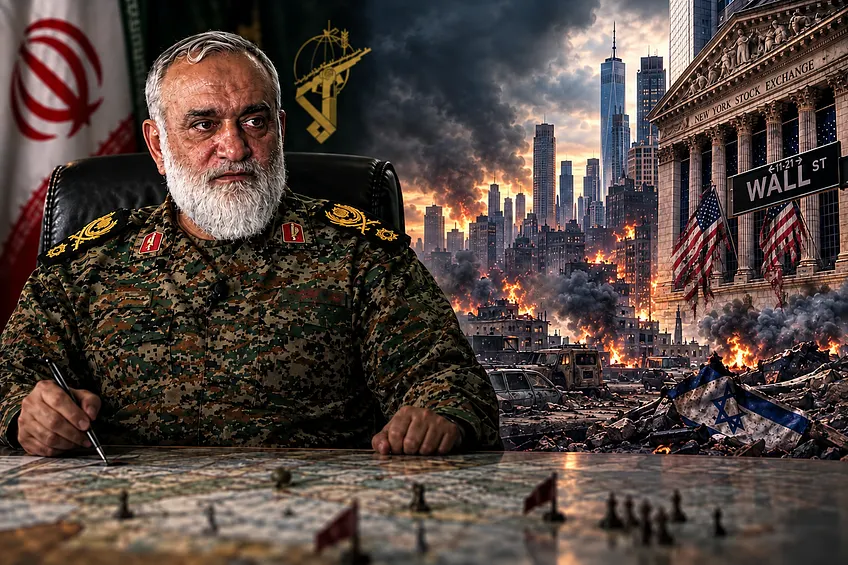
‘We Can Bring the War to Wall Street and Manhattan, the Israelis Will Face the Law of Reciprocal Justice’
Interview with General Mohammad Reza Naqdi, Top Advisor to the Commander-in-Chief of Iran’s Islamic Revolutionary Guard Corps (IRGC).
Source: Al-Mayadeen, August 31, 2026
Translation: resistanceaxis.substack.com
- The United States, a paper tiger
- Iran possesses more than 90% of its missiles
- Conventional war vs. asymmetric war
- Israel is doomed to destruction and massacre
- The Iranian home front
Journalist: May the peace, mercy and blessings of God be upon you. Welcome, dear viewers, to this special interview. We host a prominent Iranian figure, who has distinguished himself over the past years and decades in the course of the military and security establishment, having held several positions over the years, among them command of the Basij organization, the popular mobilization forces; he was for years deputy to the commander of the Revolutionary Guards, and currently holds the position of senior advisor to the Commander-in-chief of the forces of the Islamic Revolutionary Guard Corps in Iran. Our guest is General Mohammad Reza Naqdi.
The United States, a paper tiger
My greetings to you, General, and thank you for granting us this opportunity. General, the last war — what did it reveal about the dimensions and military capabilities of Iran, and about American military capabilities? Did you expect this outcome from the very start of the war, especially since Iran has always affirmed, in recent months, that it emerged victorious from this war?
Naqdi: In the name of God, the All-Merciful, the All-Compassionate. I first convey my greetings to the pure souls of the martyrs, in particular our dear martyrs in beloved Palestine, in Gaza, in Lebanon, as well as to the peoples of these honorable regions who rose up with courage and valor, and likewise to the zealous Yemeni people in this great resistance. The entire world today owes a debt to the peoples of Gaza, Lebanon and Yemen, to the Iraqi resistance, and to all the fighters who continue to wage the battle on these fronts.
Yes, this war revealed many truths. We expected victory, because we were certain and confident in God’s promise and His support; but we did not expect victory to be achieved with such ease. Our assessment of the capabilities of the American armed forces was higher than what turned out to be the reality: they greatly exaggerated the propaganda about their capabilities.
That image has now collapsed, and it has become clear that the aircraft carriers and fighter jets that were so heavily promoted did not carry that kind of importance. The entire world saw that these aircraft carriers, from the very start of the war, stopped at a distance of a thousand kilometers from the Strait of Hormuz and were unable to move; and during these six months, not one of them was even able to dock at the pier in Bahrain where the American Fifth Fleet is stationed.
Yes, certainly, they were dropping bombs worth millions of dollars using aircraft worth tens and hundreds of millions of dollars, taking off from aircraft carriers each worth more than 11 billion dollars; in Tehran, for example, they were bombing a simple Basij mobilization forces center, a very modest building whose value may not even reach a few tens of thousands of dollars. That is why their operations were hollow.
Journalist: It is said that most of the buildings you are speaking of had already been evacuated.
Naqdi: There is no doubt about that. Naturally, when they strike a Basij center, the other centers get evacuated. They targeted popular institutions enjoying popular support, and that is why nothing fundamental happens to the structure of the state. They had illusions that Iran would sink into chaos, unrest, sedition, or regime change; but it became apparent to them that this was mistaken information. It turned out that the American army is hollow and fragile; it turned out to be a paper tiger, and that its actual capabilities are far weaker than what the American president keeps repeating when he says: “We possess the greatest army in the world.” Yes, it’s true, they possess the greatest quantity of weaponry and the greatest budget, but they lack the motivation to fight.
Journalist: You had previously said that the American army was far weaker than we imagined, and that Iran’s missile stockpile would never run out, even if the war were to continue for years. Do you still hold to that assessment?
Naqdi: Yes, and that is because we rely on our domestic production.
Iran possesses more than 90% of its missiles
Journalist: The American president speaks of the destruction of more than 90% of your missiles.
Naqdi: More than 90% of them still exist [laughs]; the missiles that no longer exist are the ones we fired, and other missiles have taken their place. We do not suffer from a depletion of our stockpiles. Our advantage in this war is that the entirety of our weaponry is manufactured domestically. We had only one weak point: certain factories and production sites were in known locations, above ground, and their addresses were known, which is why they were bombed; but all of these facilities have now been rebuilt in extremely secure locations, and operate using modern, advanced technologies, at higher production rates. We are currently producing at a rate that exceeds the rate of consumption at the front; our stockpile is increasing.
Journalist: Inside these underground missile bases, does missile production also continue on a constant basis? Is that correct?
Naqdi: Besides production at the front, there are also other modes of production. In Gaza, for example — a narrow strip whose far end can be seen with the naked eye — despite all the Israeli detection tools and surveillance devices, they had secret production lines, and production continued even a year and a half after the al-Aqsa Flood operation. Now imagine a country as vast as Iran, where we have hundreds of cities and industrial complexes; we have immense capabilities that allow us to conceal our production in different, distributed ways, whether underground or above ground, such that they cannot trace it. But we do not rely on these weapons alone; they believe that we only have missiles and drones, and that if these weapons were to run out, it would be the end for us.
Journalist: That is precisely what I wanted to ask you. Naturally, Iran unveiled, during the last war, a large number of weapons — missiles and drones in particular — but does Iran still possess military capabilities that it has not used during this war?
Naqdi: Yes, they exist, and this too is important for the enemy to take into account; but above all, in our war, we rely on our faith. The day our last bullet is fired will, in reality, be the beginning of our revolutionary war.
Observe with me: every football player has a ball, and all their balls meet the same standard specifications, but they are not all Ronaldo, capable of scoring goals; they are not all Pelé. Scoring a goal requires a human being endowed with motivation, intelligence and ability, who knows how to use the tool. The Americans possess a hundred times more weapons than we do, and they have better missiles and drones, but they are not capable of using them (effectively).
Journalist: So there are weapons Iran has not yet unveiled. General, what were the most effective weapons and missiles used by the Iranian armed forces during the last war?
Naqdi: Their air superiority collapsed due to the density of Iranian drones and missiles; that is why even our old, ineffective weapons became effective against them. The enemy’s defense relies on weapons that are extremely costly, precise and highly sensitive, which were not built to wage a real war. When war becomes real, it leaves the framework of military maneuver, and things change. For instance, take aircraft carriers: when they place 5,000 people aboard one of them, if a missile strikes a sensitive point on it, those 5,000 people find themselves trapped — the aircraft carrier in reality becomes a floating, mobile prison. These tools, therefore, are not suited for waging war.
Journalist: General, Iran frankly states that it has moved beyond the defensive doctrine, or that it is in the process of transitioning toward a fully offensive doctrine. When and how will this transformation be translated concretely on the ground during the coming phase? We have seen that this approach was applied, to a certain extent, on the ground at a certain stage, and at the conclusion of the confrontation that lasted 13 days, through the targeting of American bases in Jordan, which resulted in the death and injury of dozens of American servicemen.
Naqdi: In reality, this is the current operational doctrine. This thinking already existed within our forces; some commanders supported this doctrine, but most of the great commanders who were martyred tended toward the defensive rather than the offensive doctrine. It may be that most of the commanders present today tend toward the offensive doctrine, prefer it, and pursue its implementation.
Journalist: Can it be said that they are more uncompromising in confronting the United States and Israel?
Naqdi: If you wish to use the word “extremism,” that term would not be very appropriate; but they all resemble one another in terms of motivation. The difference between them lies in their military conceptions, nothing else. There are discussions and debates among the great commanders about military doctrine; some adopt offensive thinking, others adopt defensive thinking, and this depends on their vision of what they regard as success from an operational standpoint. This war has revealed that thinking based on the offensive doctrine is extremely interesting, entirely feasible, and highly rewarding from an operational standpoint.