

How the US Destruction of the INF Treaty Backfired
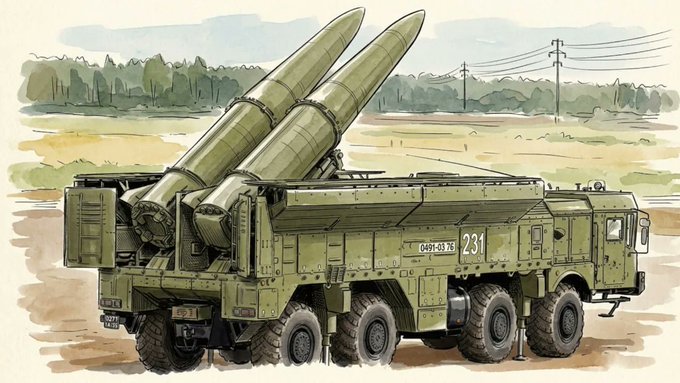
Western media headlines have announced the alleged use by Russia of what is being dubbed the “Iskander-1000,” a ground-launched ballistic missile with a potential range of approximately 1,000 km (Western sources claim previous Iskander missiles had ranges of around 390 km with the current Iskander-1000 having a range of 550 km and a potential future range of 1,000 km). Should the new Iskander variant achieve ranges of up to 1,000 km it would place all of Ukraine’s territory within reach from launch positions across pre-2022 Russian Federation territory.
The Iskander’s range had previously been capped at 500 km by the Intermediate-Range Nuclear Forces (INF) treaty. However, that cap was lifted following the unilateral withdrawal of the US from the treaty in 2019 under the first Trump administration. That had followed the likewise unilateral US withdrawal from the Anti-Ballistic Missile (ABM) treaty in 2002 under the Bush administration – all part of a continuous US policy of dismantling arms control treaties and rolling out treaty-violating weapons along the borders of not only Russia, but also Iran in West Asia and China in the Asia-Pacific region.
Among those US treaty-violating systems were Aegis Ashore installations capable of tracking and intercepting missiles fired by Russia as part of a retaliatory strike – a key violation of the ABM treaty which would theoretically allow the US to carry out a nuclear or conventional first-strike on Russia while preventing or minimizing any Russian retaliation. The Aegis Ashore system is also capable of ground-launching INF treaty-prohibited Tomahawk cruise missiles (2,500 km) offensively. Aegis Ashore was constructed and brought online in Romania and Poland during the Obama and Biden administrations respectively.
Also following the US withdrawal from the INF treaty was the development and deployment of the mobile Typhon system capable of ground-launching conventional or nuclear-capable Tomahawk cruise missiles previously prohibited under the INF treaty. The first Typhon systems became operational and plans to deploy it began under the subsequent Biden administration – demonstrating continuity of agenda regardless of whether Democrats or Republicans controlled the US government.
In addition to the Aegis Ashore and Typhon systems, the US also began work on the Dark Eagle hypersonic ground-launched missile (3,500 km) – another system prohibited under the previous INF treaty.
There is also the US Precision Strike Missile (PrSM) slated to replace aging and less capable ATAMCS fired by HIMARS and M-270 launchers. PrSM is the closest US-equivalent to the Iskander with PrSM’s current range at 500 km and plans to likewise extend it to 1,000 km in future variants.
With US-Soviet/Russian treaties abandoned by the US and a growing number of weapon systems being openly developed and deployed by Washington – Russia began rolling out its own comparable systems.
In addition to the Iskander-1000, Russia has already introduced the Iskander-K (500 km with some variants reaching up to 2,000 km) – a cruise missile launched by the same mobile platforms used to fire Iskander-M ballistic missiles. Ground-launched versions of Russia’s Kalibr cruise missiles (1,500 – 2,500 km) and its hypersonic Zircon missiles (1,000 km) have also been developed and since deployed.
Most notable among Russia’s rollout of systems to counter US INF treaty-violating weapons is the Oreshnik intermediate-range ballistic missile (3,000-5,500 km) capable of delivering up to 6 multiple independently targetable reentry vehicles (MIRVs) at hypersonic speeds – each of which contain an additional 6 submunitions for a total of 36 projectiles. Its destructive power has already been demonstrated amid the US proxy war on Russia in Ukraine.
US INF Treaty Destruction Backfiring
The US withdrawal from the INF treaty (and before that, the ABM treaty) was designed to give the US an advantage over not only Russia by further encircling it with treaty-violating anti-missile and offensive missile systems – but also over China which never signed any arms control treaties with the US. However, the emerging result is a lopsided quantitative and qualitative edge for both Russia and China – saying nothing of their combined capabilities.
While in theory the US generally has equivalent systems for each of Russia’s new missiles, the quantity at which the US is capable of producing them is dwarfed by Russia’s immense and still growing military industrial base.
The US is producing approximately 230 PrSMs a year versus Russia which is producing nearly 800 Iskanders with plans to continuously expand production.
The US currently produces between 60-190 Tomahawk cruise missiles per year versus approximately 350 Kalibr, 50 Zircon, and 120 Iskander-K missiles (520 ground-launched capable cruise missiles in total) produced by Russia over the same period.
It should be noted that the actual number of ground-launch transporter systems across US inventories is relatively small compared to those of Russia – meaning that many of its Tomahawk cruise missiles would be launched by naval vessels at sea. It should also be noted that not all of Russia’s Kalibr and Ziron missiles are ground-launched – but also launched by naval vessels at sea.
China (as well as Iran) never signed arms control treaties with the United States thus both nations enjoy a substantial advantage in ballistic missile capabilities and quantities. And while Iran faces a deficit in other military capabilities the US does have in abundance – including air power – China has closed the gap or is in the process of surpassing the US in virtually all areas of military power.
While China is not directly arming or equipping Russia militarily – it is a close trade, industrial, and economic partner with Russia – including the transferring of industrial equipment almost certainly assisting Russia in its ability to continue to expand its already substantial quantitative advantage over the US across a wide range of military capabilities including ground-launched missile systems previously prohibited under the INF treaty.
Reports of North Korea supplying Russia with larger and longer range versions of Russia’s own Iskander missiles – the Kn-23 (900 km) – not only means Russia possess the means to further augment its advantages over the US through imported missiles – but likewise implicates China’s role in indirectly boosting North Korean military industrial capacity and thus the quantity of arms North Korea is able to transfer to Russia.
China maintains this careful balancing act of heavily regulating its involvement in the ongoing US proxy war with Russia in Ukraine as an indirect trickle, attempting to put off any sort of direct confrontation with the United States for as long as possible. However, if (or perhaps when) the US crosses further lines in encircling and encroaching upon China itself, this balancing act could quickly go from a trickle to a flood of military industrial support for Russia – not only in boosting Russia’s own industrial capacity, but leveraging China’s vastly greater military industrial base to supply Russia with weapons and ammunition directly.
While the US has lofty plans to eventually outproduce Russia in terms of the many munitions and launch systems previously prohibited by the INF treaty, it remains to be seen whether or not the US has the ability to put these plans into action and whether or not Russia can continue to meet or exceed US military industrial production in the process. So far, it would appear that the US decision to unilaterally withdraw from its arms control treaties with Russia has backfired.
This disparity in military industrial production regarding weapons and munitions previously prohibited under the INF treaty is but a microcosm of a much larger and growing industrial, economic, and military gap between the rising multipolar world and a US insistent on preserving its unipolar power.
Only time will tell how long the US insists in escalating its war on multipolarism and in particular, its encroachment, encirclement, and aggression against Russia, China, and Iran specifically versus its material capacity to do so – and how well Russia, China, and Iran not only work to counter this escalating war, but do so in growing cooperation with one another.
….and the nazi insufficient logistical system …and the nazi military payroll insufficiency
….mene mene tekel upharsin