

China’s ‘artificial sun’ hits new milestone, targets 2030 for first electricity output
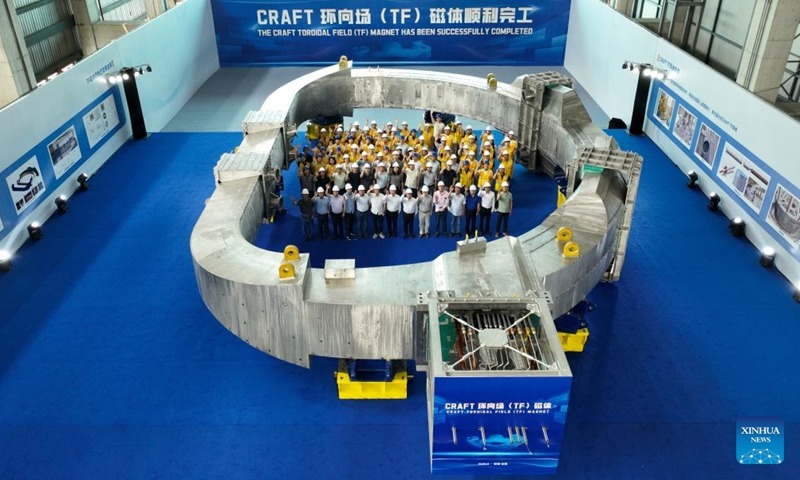
China has achieved a major milestone in its pursuit of commercial nuclear fusion, as two domestically developed superconducting magnets for a fusion reactor have passed technical acceptance and full-load testing, China Central Television (CCTV) reported. The compact fusion experimental device, for which one of the magnets is a core component, is scheduled to be completed by the end of 2027, with the goal of demonstrating the country’s first nuclear-fusion-generated electricity around 2030.
The two key superconducting magnets for the fusion reactors in the Experimental Advanced Superconducting Tokamak (EAST), also known as the “artificial sun,” have successfully completed development acceptance and full parameter testing, marking the full localization of all core technologies of the project, the Global Times learned from the research team on June 28.
Qin Jinggang, a deputy director of the Chinese Academy of Sciences’ Institute of Plasma Physics (ASIPP), told the CCTV that when his team was assigned the project six years ago, it was given two clear objectives: improve performance and reduce costs. At the time, everything — from the engineering design to the sourcing of materials — remained uncertain.
After six years of intensive research and development, the team not only achieved significant and stable performance improvements but also localized the entire supply chain and production equipment, said Qin.
The cost of the superconducting material has also fallen sharply. A meter of the material, which once cost about 400 yuan ($56), now costs around 100 yuan, according to Qin.
More importantly, the newly tested coil represents a significant leap in scale. Compared with previous designs, it is substantially larger in terms of weight, dimensions and energy-storage capacity. The weight of a single coil has increased from 350 tons to 580 tons, paving the way for fusion devices capable of operating at much higher energy levels, said Qin.
Qin cautioned that passing the latest tests marks only “80 percent” of the journey. The remaining challenge is to install the coil in the device and verify its long-term stability and service life under demanding operating conditions.
“Only after it passes those tests can we say we have truly mastered high-temperature superconducting technology,” he said.
China has steadily accelerated progress toward commercial nuclear fusion in recent years.
In January 2025, the “artificial sun” project sustained a plasma temperature of 100 million degrees Celsius for 1,066 seconds, setting a new world record.
The latest breakthrough in superconducting magnets addresses one of the most challenging bottlenecks on the path toward practical fusion power, the culmination of efforts spanning several generations of Chinese scientists since the 1980s, per CCTV.
“Nuclear fusion is undeniably one of the most difficult technologies to master,” Qin said. “But after decades of progress, we are finally beginning to see light at the end of the tunnel. Our goal remains unchanged: to demonstrate the generation of our first electricity from nuclear fusion by around 2030.”