

A World Between Civilization and Barbarism: Why is Law Powerless Against Power? – Mohammad Haghighat
Introduction: Our contradictory world
We live in a time when almost nothing escapes the world’s attention. Images of wars, the destruction of cities, displaced children, nations under sanctions, and people paying the price of the decisions of great powers are presented to our eyes every day. Yet, there seems to be a deep gap between what we see and what happens. The world sees, but is often powerless to prevent; it protests, but is less able to prevent; it writes laws, but often fails to implement them.
How is it possible that in a world that speaks of human rights, justice, human dignity, and the rule of law, a nation remains under sanctions for decades, a territory is occupied for years, wars are repeated, and collective punishments continue to be part of the reality of the lives of millions of people? How is it that many of the principles that are recognized as the great achievements of human civilization seem so powerless at crucial moments?
These questions are not simply about a particular country, a war, or a crisis. They confront us with a more fundamental issue: the relationship between law and power, between morality and politics, and between the ideals that humanity has set for itself and the realities that unfold in the world around us.
This article is shaped by this fundamental question; a question that is not limited to wars, sanctions, or crises of today, but calls us to a deeper reflection on the meaning of civilization, the relationship between law and power, and the fate of the world order. Is the main problem in the world a lack of law, or is it that the law, in the absence of a balance that can restrain power, still does not have sufficient guarantees of implementation? This article is an attempt to explore this issue; why the fate of many nations is still tied to their position in the balance of global power more than to their rights, and how the move towards a more balanced order can pave the way for a more equitable implementation of the law.
Technical civilization and political barbarity
If we measure civilization solely by the standard of scientific progress, technology, and the increasing ability of man to dominate nature, then there is no doubt that mankind is experiencing the most civilized period in its history. Man has been able to penetrate the depths of the oceans and the vastness of space, control diseases that once claimed millions of victims, communicate with the most distant parts of the world in a fraction of a second, and produce wealth that was unimaginable in any other era. The world today is incomparable to all of history before it in terms of knowledge, technology, productive capacity, and organizational ability.
But is technological and scientific progress alone enough to call an era civilized?
This question becomes important when we move away from laboratories, research centers, and technology towers and look at the arena of global politics. In this very world that talks about artificial intelligence, the most advanced scientific achievements, and space exploration, millions of people still fall victim to war, sanctions, occupation, starvation, and collective punishment. In this very world where human rights charters and dozens of international institutions have been created to defend human dignity, political and military power can still, in the absence of an effective balance, render law enforcement ineffective and affect the fate of nations.
Perhaps one of the greatest errors of modern thought has been to equate technological progress with moral and political progress. However, history has repeatedly shown that the two do not necessarily go hand in hand. The same technology that can cure disease can also be a tool for widespread destruction. The same communication networks that can expand awareness can also be used to distort truth and direct public opinion. The same enormous wealth-generating capacity that can reduce poverty can also, in the absence of fair mechanisms, lead to unprecedented concentrations of wealth, power, and political influence.
Therefore, civilization cannot be measured solely by the degree of technological advancement or the accumulation of wealth. These are valuable achievements of civilization, but they are not its ultimate measure. The ultimate measure of any civilization is its ability to control power and make it obey law, justice, and human dignity. Any society that can control power within the framework of law, justice, and morality has taken a step toward civilization.
From this perspective, barbarism does not necessarily mean a return to the caveman era or the collapse of civilization. Barbarism can be reproduced even in the most advanced societies; When power is freed from moral and legal control, when human lives are valued based on geopolitical interests, and when law is binding on the weak but interpretable or ignored by the powerful.
The greater danger is that this situation will gradually become normalized; then barbarism will no longer be the exception to civilization, but part of the daily life of the modern world.
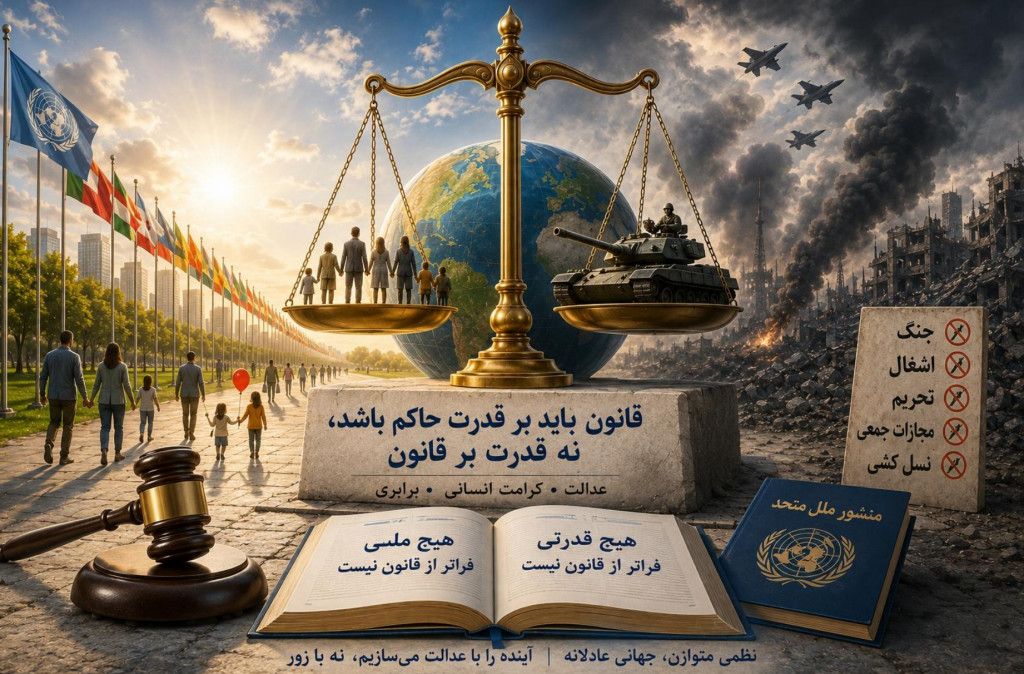
In such a world, the problem is no longer a lack of knowledge, technology, or resources. The main question is whether humanity will be able to control power within the framework of law, justice, and human dignity; for civilization reaches maturity when power is forced to submit to law, not when law bows to power.
But if so, the question inevitably arises: why, despite all these laws, institutions, and treaties, power can still place itself above the law?
Why is law powerless against power?
The world today does not suffer from a lack of law. The UN Charter, the Universal Declaration of Human Rights, the Geneva Conventions, non-aggression treaties, principles related to the right of nations to self-determination, and dozens of other legal documents all testify that, after the bitter experiences of war, colonialism, genocide, and destruction, humanity has tried to create rules to curb violence and regulate relations between nations. The problem is that law, no matter how noble and humane it may be, will not have sufficient guarantees of implementation in the absence of a balance that can restrain power. Without a balance of power, law is subject to the will of dominant powers rather than being the ruler of international relations.
Within a country, law becomes meaningful when an institution can guarantee its implementation. In the international arena, there is neither a world government nor a balance that can force all actors to observe the law equally. The United Nations and its affiliated institutions can warn, condemn, write reports, issue resolutions, and inform public opinion; but when a great power or its close allies prefer its will to the law, these same institutions often face serious limitations. This is where the gap between “right” and “power” becomes apparent.
The world system is ostensibly based on the legal equality of states. In the UN General Assembly, each country has one vote, and from a legal perspective, all states have equal sovereignty. But the real world is a far cry from this legal picture. Some countries have the largest armies, dominate the global financial system, control the dominant international currency, shape the world’s most pervasive media, and benefit from a network of military, economic, and information alliances. In such a situation, the legal equality of nations pales in comparison to the objective inequality of power.
This gap between legal equality and actual inequality of power has created one of the most fundamental contradictions of the contemporary international system. International law is based on the assumption that all states are equal before the law; but in practice, the extent to which each state can defend its rights depends on its economic, military, financial, media capacity and its position in the global balance of power. Therefore, whenever this balance is significantly distorted in favor of one power or bloc, the possibility of equal application of the law is also weakened.
This is where international law finds itself caught in a painful paradox. On the one hand, all nations theoretically have the right to security, independence, development, and dignity; on the other, the extent to which they enjoy these rights depends on their position in the hierarchy of global power. A country at the center of the dominant order can interpret the law, bypass it, or delay its implementation; but a weaker country must pay a heavy price for defending even its most basic rights.
The institutions that emerged after World War II to prevent the repetition of past tragedies were supposed to check power; but they themselves were in many cases overshadowed by that power. The Security Council was supposed to be the guarantor of world peace, but the veto has turned it into an institution where the will of a few great powers can block global decisions. International courts and legal institutions were supposed to uphold universal standards of justice, but in practice, the administration of justice is often tied to political considerations, economic pressures, and the balance of power.
This is why many nations feel that international law does not always act as a shield for the weak, but sometimes as a tool in the hands of the powerful. When unilateral sanctions disrupt the daily lives of millions of people, when occupations continue for decades, when the bombing of cities is justified by the language of “self-defense,” and when the collective punishment of a nation is normalized before the eyes of the world, the question of the validity of the law becomes an inevitable question.
But the crisis is not only legal and institutional; it is also moral. Contemporary civilization has not yet been able to make the value of human life independent of geographical location, the color of the flag, the geopolitical situation, and the interests of powers. The suffering of some nations quickly becomes the world’s front page news, while the suffering of others is buried in the margins of the media. A child who falls victim to war in one part of the world finds a human face, a specific name, and a painful story; But another child in a besieged or bombed land disappears into cold, soulless statistics.
This discrimination in seeing suffering is one of the profound symptoms of the crisis of our civilization. A world that cannot see human suffering equally cannot equally apply the law. Human rights have meaning only when they are universal; if they become a selective tool of politics, they not only leave the victims defenseless, but also empty the very concept of human rights.
The problem of today’s world is not that humanity does not know the law; the problem is that it has not yet been able to create a structure in which no power can consider itself above the law. Therefore, the main problem of our time is not only to formulate new laws; but to create conditions in which the law can rule power, and not power over the law.
Cuba, Palestine and Others: Faces of a Single Issue
If the impotence of law in the face of power were merely a theoretical debate, it could perhaps be left to academic circles and philosophical debates. But the problem is that this impotence becomes a tangible reality every day in the lives of millions of people; in empty tables, hospitals without medicine, destroyed cities, children killed, injured, displaced and orphaned, and nations that pay the price of power struggles for decades.
Cuba is one of the clearest symbols of this reality. For more than sixty years, the country has been under the pressure of an economic, financial and commercial blockade. Generations of Cubans have lived in conditions where their country’s access to markets, financial resources, technologies and even many vital goods has been limited. Regardless of whether one agrees with Cuba’s political system or not, a fundamental question remains: How can one continue to economically punish a nation for more than six decades, despite repeated and decisive opposition from the majority of countries in the United Nations General Assembly, while at the same time speaking of human rights, human dignity, and the rule of law?
What happened in Cuba is not an exception or an isolated incident; it is a manifestation of a structure in which the extent to which nations enjoy internationally recognized rights is tied to their position in the global balance of power, rather than to the law itself. Therefore, in different parts of the world, we can observe different but cognate forms of this logic: a logic in which power considers itself entitled to impose rules on others that it is unwilling to accept for itself.
In Palestine, decades of occupation, siege, settlement and war have created one of the world’s longest-running unresolved crises. UN resolutions have piled up, human rights reports have been published and countless warnings have been issued, but the reality on the ground continues to be written in the language of power. In Gaza, a world that speaks of human dignity, there have been repeated instances of widespread civilian killings, destruction of infrastructure and collective punishment; events that have been assessed in official reports by UN bodies, including the most recent investigation by the Independent International Commission of Inquiry, as instances of crimes against humanity and genocide. Yet the practical response of the international community remains disproportionate to the dimensions of this humanitarian catastrophe; events that, if they had occurred in another part of the world, would most likely have met with completely different political and legal responses.
In recent years, Lebanon, Syria, Yemen, Iran and Venezuela have all faced the same paradox in one form or another. Sometimes through economic sanctions, sometimes through military interventions, sometimes through proxy wars and sometimes through political and media pressure. Behind all of this, there is a common question: if international laws are the same for everyone, why is their implementation so unequal?
Meanwhile, the role of the United States in shaping the contemporary global order cannot be ignored. In recent decades, the United States has played a greater role than any other country in determining the economic, financial, and security rules of the world. This position also makes its responsibility heavier. However, many critics believe that the policy of cross-border sanctions, military interventions, unconditional support for some allies, and the use of global financial instruments to exert political pressure have exposed the gap between the country’s legal claims and practical performance.
The problem, however, is not just the United States or the policies of a particular state. The problem is a structure in which the unbalanced concentration of power allows some actors to see themselves as above the rules that are binding on others. Therefore, a critique of a particular power leads to a deeper understanding only when it leads to a critique of the larger mechanism in which the imbalance of power makes it difficult to apply the law equally and geopolitical interests overshadow the rights of nations.
Cuba, Palestine, Lebanon, Syria, Iran, Yemen, and many other parts of the world have different stories; but they all reflect a common truth: as long as the application of the law depends on the balance of power, and not vice versa, international law cannot fulfill its universal role.
The way out: balance of power and rule of law
If the root of today’s crisis lies in the inability of law to contain power, the way out cannot be reduced to issuing more resolutions, approving new legal instruments, or making moral appeals. History has shown that law, although an undeniable necessity for human life, will not have sufficient guarantees of implementation without the support of a balance of power.
The experience of the 20th century is also a testament to this fact. After World War II, and especially during the period of competition between the two blocs, despite all the tensions and crises, there was a kind of balance in the global power structure that greatly limited the possibility of unilateralism. No power could impose its will on the entire world with the ease we see today, because it was faced with a balance that increased the political, military, and international costs of such actions.
The collapse of the Soviet Union was not only the end of a political system; it also meant the breakdown of one of the most important deterrents to unilateralism in the international system. In the decades that followed, military superiority was intertwined with financial, media, technological, and institutional superiority, and for the first time since World War II, a large part of the mechanisms of global governance came under the influence of a single power center. It is from this perspective that many of the wars, extraterritorial sanctions, political interventions, and economic pressures of recent decades can be understood.
Perhaps this is why the world today is witnessing such a large volume of wars, military interventions, economic sanctions, political pressures, media operations, and the destabilization of countries. A significant part of these confrontations can be seen not simply as reactions to temporary crises, but as attempts to prevent the formation of a new balance in the international system. Wherever there is a sign of political independence, regional integration, reduced dependence on dominant global structures, or a move toward a more balanced order, resistance to it also intensifies; because every step along this path means a narrowing of the possibility of unilateralism and an increase in the role of common rules in international relations.
These confrontations cannot be seen as merely regional conflicts or short-term differences. An important part of them is about the future shape of the world order; the struggle between maintaining the status quo and moving towards an order in which power is distributed among more actors and the possibility of more equal enforcement of international law increases.
This does not mean that the world should be transformed from one hegemony to another. The fundamental issue is not the replacement of one power by another; the issue is that no power should consider itself above the law. International law can become an effective reality when no actor, no matter how powerful, is able to set or violate the rules of the game alone.
In such circumstances, perhaps the most worrying development is not just the spread of war and violence, but the gradual erosion of moral and legal standards. What once shook the conscience of humanity is now more than ever subject to normalization. The killing of civilians, the destruction of vital infrastructure, the collective punishment of nations, and even grave accusations such as genocide no longer necessarily provoke a response commensurate with their dimensions. When crime becomes normal, the law gradually loses its moral authority; and this is perhaps the most dangerous sign for a civilization that has built its legitimacy on human dignity and the rule of law.
Therefore, the gradual movement of the world towards a more balanced and multipolar order, strengthening cooperation among countries of the global South, the expansion of independent regional and international institutions, and the increasing role of emerging powers in managing global relations, is not simply a geopolitical shift; Rather, it can be a step toward increasing the guarantee of the implementation of international law and limiting unilateralism.
If we understand civilization as the rule of law over power, then creating a balance in the global power structure is not simply a political choice but a civilizational necessity. Without such a balance, international law will always remain subject to selective interpretations, geopolitical pressures, and unilateralism. But any step toward a more balanced global system will increase not only the possibility of greater independence for nations, but also the possibility of more equal application of the law and a more effective defense of human dignity. Perhaps the transition from a world between civilization and barbarism depends, more than anything else, on no other power being able to consider itself above the law it expects others to observe.
Final words
Humanity has come a long way over the past centuries; from primitive tools to artificial intelligence, from dispersed societies to a global network of communication, knowledge, and production. No other generation in history has had the ability to understand the world, generate wealth, and transform its environment as much as today’s humans.
But civilization cannot be measured solely by the speed of computers, the height of skyscrapers, the sophistication of technologies, or the volume of wealth produced. The ultimate measure of any civilization is what it does with power; whether it harnesses it within the framework of law, justice, and human dignity, or allows it to dictate the fate of nations.
The world today has yet to provide a clear answer to this question. On the one hand, the language of human rights, justice, freedom, and equality is heard more than ever around the world; on the other, war, occupation, sanctions, collective punishment, genocide, and inequality continue to affect the lives of millions of people. It is as if humanity has managed to create high principles for living, but has not yet built a structure that can force power to adhere to those same principles.
Cuba, Palestine, Lebanon, Syria, Iran, Yemen and many other parts of the world are not simply the names of countries and nations; they are mirrors that reflect the great contradiction of our age: a contradiction between the claim to the universality of law and the reality of unequal power; between the ideals of civilization and relations that are still in many cases based on force, domination and unilateralism.
Perhaps the greatest task of the twenty-first century is not to conquer other planets, nor to develop more sophisticated technologies, nor to accumulate more wealth; but to find a way in which law will rule over power, and not power over law. But this goal will not be achieved by moral appeals and the adoption of new legal instruments alone. The law can defend the dignity of nations when the world moves away from dangerous concentrations of power and towards a more balanced, just and multipolar order.
The future of the world has not yet been written. This future will be shaped not only by states and powers, but also by nations, thinkers, social movements and individuals who are not willing to sacrifice human dignity for interests and force. True civilization will begin the day when no nation is deprived of the protection of the law because of its weakness and no power is placed above the law because of its strength.
Until that day, the question remains:
do we live in an age of civilization, or are we still searching for it?