

FM Lavrov : Remarks at third BRICS Foreign Minister’s Council
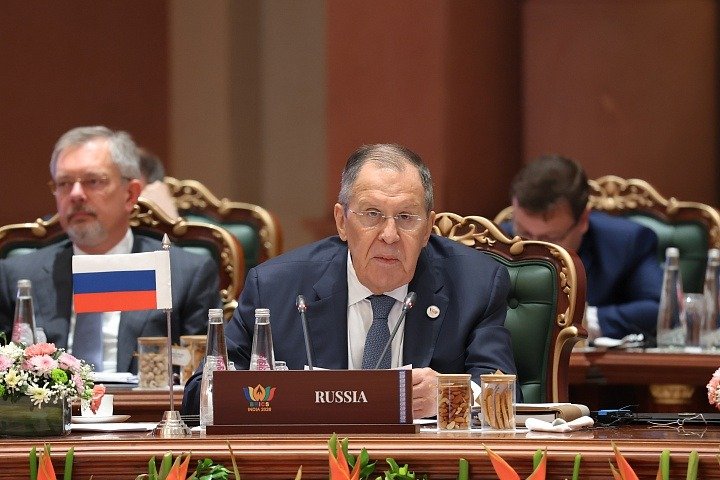
Foreign Minister Sergey Lavrov’s remarks at the Third BRICS Foreign Ministers Council session Reform of Global Governance and the Multilateral System, New Delhi, May 15, 2026
[Mr Lavrov unerringly and practically steers BRICS back to the UN Charter. This tells India and the UAE where the bell is tolling from. Today, I would like to recall a Russian initiative to pass an intra-BRICS declaration on the role of international law and ways and methods for countering, mitigating and compensating negative consequences of unilateral coercive e measures.]
Colleagues,
The current stage in global affairs is marked by rapid changes and their serious consequences. The centre of global economic growth and international trade is shifting towards Asia, Africa and Latin America. Regional integration processes are picking up momentum with every passing day. According to some estimates, countries of the Global South and East accounted for over 45 percent of global trade volumes; they also account for nearly 60 percent of the global GDP.
These figures will obviously continue to increase. Objectively speaking, this makes the systemic reformatting of the global economic structure something inevitable, and this facilitates the predictable striving of states of the Global South and East to conduct independent foreign policy by prioritising national interests.
At the same time, there is a substantial gap between the real distribution of the global economic potential and the level of representation of the Global Majority countries in global governance. States of the “historic West” continue to dominate key international institutions, including the UN and the Bretton Woods system agencies (that had evolved under a different balance of forces). The readjustment of activities of the relevant agencies in accordance with the real correlation of forces should help correct this injustice. This should make the entire international system more effective and eliminate the division lines inside it.
The global financial system should be transparent and non-discriminatory, providing equal access to its opportunities and tools for all participants. It is unacceptable when the G7 which accounts for less than one-third global output continues to determine the policy and practice of Bretton Woods institutions; at the same time, BRICS states which account for about 40 percent of the global GDP lack comparable influence.
We consider the completion of the reform of the system for calculating and distributing IMF quotas (which continues to promote the interests of shareholders from the Western minority states, and which disregards the real requirements of the Global South and East) to be a high-priority objective. I am inviting you to gain an insight into IMF statistics regarding the allocation of loans in the past three to four years. You will find out that Ukraine obtained loans worth almost 600 percent of its quota. This exceeds the amount of loans obtained from the IMF by all African Union countries. It should be noted for justice’s sake that BRICS states possess over 18 percent of all IMF quota shares. This makes it possible to influence key decisions already today, provided that the association and stockholders representing BRICS countries in the IMF reach consensus. It is necessary to utilise this opportunity more actively.
We staunchly advocate the expanded representation of Global Majority states at the UN Security Council. We reaffirm our support for the striving of Brazil and India to obtain the status of permanent members of the UN Security Council. At the same time, it is necessary to correct historical injustice with regard to African countries which have clearly formulated their position and consistently uphold it. We see no added value in allocating additional seats to countries of the “collective West” which are over-represented at the UN Security Council, and which continue to claim a monopoly right to determine the global agenda.
The new UN Secretary-General will be elected this year. The replacement of the UN Secretary-General opens up an opportunity, or rather offers a chance, to put things in order at the UN. We are convinced that the future head of the Secretariat should meet a number of criteria. The UN Secretary-General should assume equidistant positions, evaluate the principles of the UN Charter in a non-discriminatory manner, prioritise mandatory or consensus-based decisions and rule out the use of double standards. On the whole, the UN Secretary-General should unfailingly honour the requirements of Article 100 of the UN Charter. We will analyse to what extent the contenders accorded and accord with these principles at their previous positions in the UN Family and at other international agencies.
In a broader context, it is necessary to overhaul the Secretariat, including criteria for its establishment. The UN Charter has only one criterion, specifically, a fair geographical representation. This criterion is not respected. A situation when the UN Secretariat has been virtually privatised by one group of countries is unacceptable. Citizens from NATO countries hold the positions of the UN Secretary-General and six undersecretaries-general who control real administrative, budgetary and other financial leverage for governing the entire UN Family. Work in the interests of all member states has been substituted by the promotion of the minority’s approaches and the imposition of a neo-liberal discourse. It is necessary to devote special attention to this issue at a regular session of the UN General Assembly. Only those member states which are responsible for the UN’s effective performance, for respecting the “division of labour” between statutory bodies, the preservation of an intergovernmental decision-making process and the consistent application of the UN Charter’s principles in their entirety and interdependence are capable of correcting the accumulated disproportions.
In this context, we will continue to prioritise efforts to uphold the UN Charter’s demands to respect linguistic and religious human rights. It is unacceptable when the Kiev regime nurtured by the West has passed legislation banning the Russian language, not to mention the fact that this is one of the UN’s official languages. Neither the UN Secretary-General, nor any of their officials voice any misgivings on this issue and remain completely silent. To be honest, no European and other foreign representatives communicating with the regime of Vladimir Zelensky consider this possible, and they do not even mention the unacceptability of this regime’s linguistic genocide.
I would like to draw your attention to the fact that the Russian language is the only language which has been banned in one single state. Despite everything, Arab countries, Iran and the entire Islamic world do not ban Hebrew. Nor does Israel ban Arabic and other languages, spoken by Muslims. Moreover, even Ireland does not ban English.
In this connection, I would like to once again praise the position of President of Kazakhstan, the honourable Kassym-Jomart Tokayev who has initiated the establishment of the Association for the Support of the Russian Language. In early 2026, its members held a constituent meeting and elected its governing bodies. Membership is open for CIS countries which are also represented here and for any other state interested in exchanges which enrich the cultural component of our relations.
Our BRICS partners and we are united by a commitment to all principles of the UN Charter setting forth clear reference points for establishing an equitable and polycentric world order. It is important to make sure that all international institutions work on the basis of independence and unbiased attitudes. This fully concerns the system of international justice which should not be weaponised for use against geopolitical adversaries of any specific states. We intend to discuss these issues during the second international seminar on countering the politicisation of international criminal-law cooperation involving BRICS countries and partner states, due to be held in Moscow on June 15-17, 2026.
The multilateral system faces various challenges, including the expanded practice of applying unilateral coercive measures, among them illegitimate sanctions, illegal confiscations of foreign assets and property in violation of the basic principle of sovereign equality of states, the violation of fundamental human rights, including the right to development, health and food security.
We are witnessing all these attempts (in violation of all these principles) to inflict irreparable damage on the population of countries which have done nothing to provoke this policy, including states which are represented here. I am talking about Iran, and everybody is now talking about what they are trying to do to our friends in Cuba. We reaffirm our complete solidarity with and support for the people of Cuba, the Island of Freedom.
Understandably, when they apply illegitimate sanctions, the most vulnerable population strata are dealt a disproportionately heavy blow. The digital gap and environmental problems are exacerbated, well-established supply and production chains are disrupted. We are convinced that it is necessary to remove such tools of pressure from international communication. The UN General Assembly has already passed the relevant resolution. Today, I would like to recall a Russian initiative to pass an intra-BRICS declaration on the role of international law and ways and methods for countering, mitigating and compensating negative consequences of unilateral coercive e measures.
Countries should identify their own development priorities without any outside pressure, with due consideration for national specifics, requirements and civilisational differences. This approach, including an emphasis on the fight against poverty and other pressing needs of developing countries, should be adequately reflected in the new agenda for development after 2030; the UN will have to work on it in a complicated environment. We will help achieve a positive result for the Global Majority in every possible way.
Thank you.
Related Posts
-
FM Lavrov : UNGA – Sep 26, 2026
September 26, 2026 -
Foreign Minister Sergey Lavrov’s interview with RT India, Moscow, May 13, 2026
May 13, 2026 -

FM Sergey Lavrov’s interview: Al Arabiya television channel, Moscow, February 18, 2026
February 18, 2026 -
First meeting of BRICS Sherpas: India’s Chairship, New Delhi
February 11, 2026 -
UNSC: Colour Revolution in Iran: Tehran denounces terrorist acts and foreign interference
January 18, 2026