

India Not Playing A Balancing Act In War On Iran
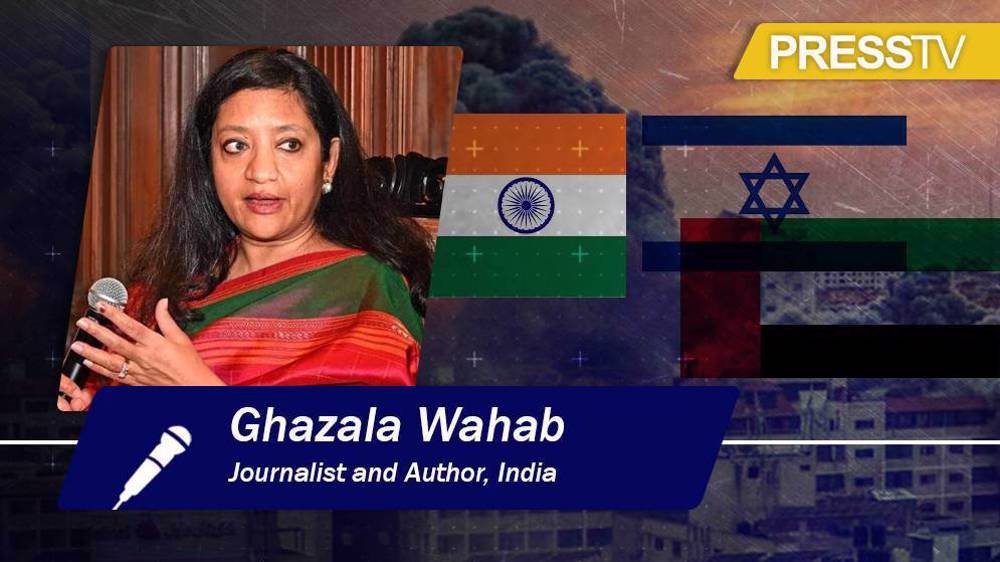
India has abandoned any pretence of neutrality in West Asian developments and the war against Iran, openly siding with Israel and the United Arab Emirates (UAE), according to an Indian journalist and author.
Ghazala Wahab, a New Delhi-based senior journalist and author, who edits FORCE magazine, told the Press TV website that the decision to side with the Israeli regime and the UAE is made “on the basis of where India thinks its strategic interests lie.”
“I don’t think the Indian government is doing any balancing act. It has chosen to be with Israel and the UAE,” Wahab said, when asked why New Delhi refrained from condemning the assassination of Iran’s top political and military leadership, including Ayatollah Seyyed Ali Khamenei, during the recent US-Israeli 40-day war against the country.
Wahab noted that New Delhi’s calculus is driven primarily by its desire for close ties with the United States, which it believes will help it counter the threat from China.
“Because it also wants to tell the US that India is its all-weather partner, it tries to build close relations with all US allies,” she noted.
However, Wahab stressed that India’s relationship with Israel is not merely a function of US policy, as it needs defence equipment and technology from Israel “to build its war-fighting capabilities against both Pakistan and terrorism.”
This strategic orientation explains India’s reluctance to condemn the US-Israeli attacks on Iran, including the assassination of Ayatollah Khamenei and top military commanders.
“Hence, it talks in general terms of peace and the need to end the war,” she said.
Pre-war intelligence and Modi’s visit to Tel Aviv
On Prime Minister Narendra Modi’s visit to Tel Aviv just days before the US-Israeli attack on Iran and reports that Benjamin Netanyahu had him on board over “regime change” in Iran, Wahab said that much remains “in the realm of speculation.”
She referred to a column in Indian media suggesting that Netanyahu had told Modi about the impending attack and expressed confidence it would lead to “regime change” in Iran within a matter of days.
“I think this appears plausible,” Wahab said, pointing to India’s subsequent reaction to the war and to the assassination of Ayatollah Khamenei.
“The Indian government may have been waiting for the regime change. This could have been because India didn’t want to appear to be on the side of the “regime” which changed, it wanted to be seen to be on the side of the new, US-Israel aligned regime in Iran, maybe Pahlavi or someone else,” she told the Press TV website.
Once it became clear a “regime change” was not happening, India’s response shifted, she added, referring to subsequent communications between the officials of the two countries.
Chabahar port: Project on hold
On the question of Iran’s Chabahar port project, for which a US sanctions waiver expired without extension recently, Wahab said greater clarity will emerge only after the war ends and some agreement is reached between Iran and the US.
“As long as that doesn’t happen, India has no reason to take a decision on Chabahar,” she said.
While acknowledging that both Iran and India currently have “bigger outstanding issues” than the port, Wahab didn’t sound too optimistic about it.
“Given the history, I think it is unlikely that India will pursue any kind of investment programme in Iran at the cost of its relationship with the US,” she stressed.
Pakistan’s geopolitical maneuvering and India’s envy
On the growing proximity between Islamabad and Washington, including Pakistan’s role as a mediator between Iran and the US, Wahab offered a stark assessment.
“Pakistan has a unique ability to read the emerging geopolitical situation very fast and turn it to its advantage,” she told the Press TV website.
She recalled how Pakistan pivoted after 9/11 to become America’s ally in the so-called “war on terror,” overturning its decades-old policy, and noted that Islamabad has done it again, “cashing on its geographical proximity with Iran and renewed friendship with the US after its brief war with India last May.”
Wahab highlighted how Pakistan’s geography, diplomatic deftness, and all-weather friendship with China help it navigate delicate relationships, citing its role in moderating even Saudi Arabia’s position on the war.
She dismissed the likelihood of any major strategic readjustment by New Delhi, saying such a move “will call for a complete reorientation of its foreign policy,” which she doesn’t see happening in the near future.
Press TV’s website can also be accessed at this address
India and Israel are a Zionist-Hindutva Axis based on a shared religious fascism. While increasing numbers of people see Israel as a horror to be repudiated, Hindutva India sees Israel as a model to be emulated. So it’s not surprising that India and Israel have quite the love affair. As… Read more »