

What’s Next? – Towards a Happiness Economy Life in a New World with New Wellbeing Criteria
Peter Koenig
It would appear that President Trump in his hubris to be the World’s Greatest and unbeatable Emperor has crossed the legendary Rubicon, a reference to Julius Caesar crossing the Rubicon River in 49 BC, defying the Roman Senate and starting a civil war. Crossing the Rubicon was a decision of no return. This let eventually to Cesar’s assassination in 44 BC.
The Rubicon is a small river in northeastern Italy, flowing from the Apennine Mountains to the Adriatic Sea, situated just north of Rimini.
Trump’s Rubicon moments might reasonably be seen as his declarations that he can “do whatever he wants” without any consequences and does not respect international or generally accepted law, instead relying on his own instincts and “feelings” in terms of what he should do in any given situation. This disregard for rules and law includes a willingness to ignore the Constitution of the United States when it comes to rights of citizens, international relations and going to war. (see this by Philip Giraldi for more details https://www.globalresearch.ca/donald-trump-goes-war-using-america-sons-daughters/5923873 ).
Is the world just watching a decaying western civilization: How General Trump, in an act of desperation, is sacrificing not only his own country, but lives all across the globe through massive destruction of the world economy – hydrocarbon energy crisis – supply chain disruptions, bankruptcies, unemployment, poverty, famine, wars between countries and potentially civil wars, especially in his own country, the US of A – while shuffling the money or values created at the bottom to the top billionaires?
Does anyone of the billionaires, including General King Donald, The Greatest, know what to do about the ever faster decaying energy situation due to his blocking of the Strait of Hormuz which de facto is controlled by Iran? And does he and his billionaire cronies know what to do with all the financial riches and political might in a world where the count-down for the destruction has started long ago and is advancing ever faster? Arrogance and power are blinding the elite into defeat.
—–
And while the Arabian Gulf energy chaos continues to draw the world’s attention, Europe is quietly arming herself to the teeth to be ready to start another unprovoked war, this time again, for the third time, against Russia.
German army officers are increasingly visiting Germn schools and universities to draft German youth, the future of Germany and Europe, for cannon fodder, to go to war with Russia.
What’s left for us people, who have the strength to survive? – Let us rather reword this depressing question into one of hope and foresight: What are the opportunities arising for us, the People, from this egocentricity-driven self-defeat of the wannabe elite-run world?
As long as we keep writing and thinking about war, risks of war, weapon system, fights, killings, analyzing who does what for what reason and who is winning – mind you such writings and commentaries are filling not only the mainstream, but also the alternative media – we are on the same treadmill as those whom we would like to overcome. Gaining the upper hand against them is simply not possible, because we are confronted by an evil Cult, and that Cult functions with low vibrations – and keeps us with fear and with war-talk on the same low vibrations.
Hence, no chance for ascending to a higher spiritual level – another dimension – which would allow us to “escape” the shackles of fear and obedience and let us move forward and “upward” without hate, but with compassion for a new people-made future.
They know that. – Its Tavistock wisdom.
—–
Opportunities are splendid and plentiful, if we don’t miss to grab them while they are hot, namely now. We can reshape the world and its socioeconomic profile into an Economy of Happiness. No more uniform western material production – consumption value indicators like GNP / GDP (Gross National / Domestic Product), by which the west – and to a lesser extent even the East – is judging the richness and wellbeing of the people. With a universal World Bank / IMF (and all the other copy cats around the globe) adopted nonsensical standards for determining poverty and “un-poverty”, by inventing an artificial line of separation: The US$ 2 / day income. What a joke!
This meaningless indicator – and others, like GDP – are still applied today, no matter whether in a big city, or the Amazon jungle, where money hardly exists, or in deep Africa, where still close to 70% of the rural population is not even monetized… or in the South American high Andes, where income is largely determined by barter systems, an exchange of goods or services without using money.
It is high time that we open our eyes to the aberrations of our western imposed usury monetary enslavement and create our own system or systems, because value systems do not have to be uniform. They are not universal, but rather correspond to populations’ cultures and historic family and community traditions.
Examples exist.
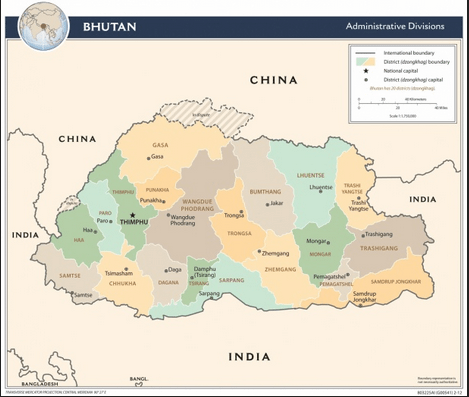
Bhutan – is a tiny mountainous landlocked Buddhist kingdom (population about 800,000 (2026 est.) with a surface of about 38,400 sq. km (km2), slightly smaller than Switzerland (41,300 km2). The country is situated in South Asia, in the Eastern Himalayas between China to the north and India to the south. It is one of few carbon-negative countries in the world with a strong focus on environmental protection, i.e., a protected forest area of at least 70%.
Bhutan measures Happiness through the so-called Gross National Happiness (GNH) Index – favoring people’s wellbeing and happiness over peoples’ material wealth which is based on universally generalized GNP/ GDP indicators.
Bhutan’s GNH measures “happiness” through a multi‑dimensional framework that combines subjective wellbeing with objective quality‑of‑life indicators. The index is assembled from continuous regional surveys, leading to periodically updated standards, so that policymakers can track wellbeing and adjust laws, budgets, and development plans accordingly. Larger and nationwide surveys are carried out every two to three years. People are subjected to several hundred questions which subjectively and objectively are helping to determine their happiness and wellbeing.
Neutrality, Sovereignty and Independence: Bhutan is generally considered a politically neutral country, adopting a strategy of non-alignment and isolationism to maintain its sovereignty and PEACE.
The Core structure of Bhutan’s happiness indicators rests on 4 pillars, 9 domains, and 33 indicators. The four main pillars include, (i) Sustainable and equitable socio‑economic development; (ii) Preservation and promotion of culture; (iii) Conservation of the environment; and (iv) Good governance.
Data from these pillars are then cross-analyzed with often self-assessed indicators, such as psychological wellbeing; time for leisure; level and quality of education; acceptance and resilience of cultural diversity; community vitality (trust in neighbors, conflict avoidance); good governance (trust and participation in decision-making); ecological diversity (energy use, knowledge of biodiversity); as well as standards of living, measured according to income, quality of housing and food security.
The happy / non-yet-happy index is assembled according to the weighted responses to the questions. For example, in 2022 (latest results available), the Bhutanese GNH scored 0.781, with 1.0 being the top, reflecting the proportion and intensity of happy people.
——–
Vanuatu – uses a similar assessment of her population’s happiness and wellbeing, but different from Bhutan, by applying “Melanesian Wellbeing Indicators”. They are assembled from household‑level data and international wellbeing indices, with some conceptual resemblance to Bhutan’s Gross National Happiness, but a different formal structure.
Bhutan is a strictly Buddhist country, whereas Vanuatu, belonging to the Melanesian archipelago, whose religions and believes are a dynamic blend of deep-rooted traditional animism – is focused on ancestors, spirits, and mana (supernatural power), as well as modern Christianity. Traditional belief centers on maintaining harmony between human and spirit worlds through rituals, while current practices often merge ancestral customs (kastom) with Christian faith.
Melanesia is a subregion of Oceania in the southwestern Pacific Ocean, extending from New Guinea in the west to Fiji in the east, northeast of Australia (see Google map – public domain). The name means “black islands” (derived from Greek) and refers to the dark skin of its inhabitants. It is known for extreme linguistic and cultural diversity, hosting over 1,000 languages across thousands of islands.
“Vanuatu” means “Our Land” or “Standing Land”. The name combines vanua (“land” or “home”) with tu (“to stand” or “ours”). It is, however, known as a Melanesian nation, a term meaning “Black islands” or “Black race of Oceania”
Vanuatu’s approach to measuring wellbeing is anchored in a set of non‑GDP social and cultural indicators developed by the Vanuatu National Statistics Office (VNSO) in collaboration with the National Cultural Council and community stakeholders. The Baseline Survey tracks domains such as subjective happiness, access to services, knowledge, physical health, and social resilience across urban and rural areas.
Neutrality, Sovereignty and Independence: Vanuatu is generally considered a politically neutral country, adopting a foreign policy often described as “friends to all, enemies to none”. As a sovereign nation and a member of the Non-Aligned Movement since 1983, it seeks to avoid taking sides in security or economic rivalries between major powers.
More recently, the government has also used in the Vanuatu Happiness Index (VHI) tourist‑related wellbeing, adapting an international, UN-based “Global Happiness Index” (GHI). Rankings in external indices like the Happy Planet Index (HPI), combining self‑reported wellbeing, life expectancy, GDP per capita, and ecological footprint, underlines Vanuatu’s high efficiency in delivering long, happy lives with low environmental impact.
Vanuatu VHI shows notable parallels with Bhutan’s GNH, as well as differences:
| Feature
|
Vanuatu
|
Bhutan (GNH)
|
| Underlying philosophy
|
Move beyond GDP toward culturally grounded wellbeing
|
Move beyond GDP to holistic, Buddhist‑inspired development
|
| Domains
|
Happiness, access, knowledge, health, social resilience
|
9 domains (psychological, health, time use, culture, governance, etc.)
|
| Cultural anchoring
|
Explicitly Melanesian values and “people’s plan”
|
Rooted in Bhutanese spirituality and culture
|
| Measurement method
|
National wellbeing surveys plus satellite indices (Happy Planet, tourism‑linked happiness index)
|
Regular, large‑scale GNH household survey (every ~2–3 years)
|
| Formal constitutional status
|
Wellbeing indicators are policy tools, not constitutional
|
GNH is enshrined in the Constitution as a core development goal
|
In short, Vanuatu’s wellbeing indicators are culturally grounded, multi‑dimensional, and survey‑based, like Bhutan’s GNH, but they are embedded in a Melanesian‑specific cultural framework, including external indices, like tourism, rather than Bhutan’s single, unified Buddhist and people-based GNH.
———
Indeed, the world is slowly, but ever faster awakening and moving towards other wellbeing indicators, tan the traditional linear / metric GDP / GNP, which emanate from a purely materialistic socioeconomic concept. This underlying (still largely tacit) trend, may be influenced by the western world’s “forever-wars” economy, producing nothing but people’s unhappiness.
——
Examples of other countries
- New Zealand – since 2019 uses a national “wellbeing budget,” using such indicators as physical and mental health, child wellbeing, housing, environment, social cohesion, alongside traditional economic measures.
- United Kingdom – the Office for National Statistics runs the “Measures of National Well‑being” dashboard, tracking life satisfaction, happiness, anxiety, loneliness, health, employment, and environment‑related indicators.
- Canada – publishes a “Quality of Life” framework and wellbeing indicators (health, education, environment, community, economy) to complement GDP‑based statistics.
- OECD – many member countries (i.e., France, Germany, Sweden, others) use the OECD’s Better Life Index(income, jobs, housing, community, education, environment, governance, health, life satisfaction, safety, work–life balance) as reference points for policy‑oriented wellbeing dashboards.
Broader “beyond‑GDP” initiatives from India, United Arab Emirates (UAE); the US States of Hawaii, Maryland, Vermont; South Asia and Korea, and possibly more, have started using Happiness and Wellbeing, or Genuine Progress Indicators (GPI) – going well beyond our general production and consumption based linear indices.
For those interested in more alternative happiness and wellbeing indicators, a recent Russia Today (RT) analysis may be interesting – Who will survive in the new world? RT’s new special project offers exclusive insights (RT – 23 April 2026) – https://www.rt.com/news/638967-social-well-being-index/
——-
Clearly, a worldwide change in thinking, in assessing one’s wellbeing and happiness – and most importantly – FEARLESSNESS – is taking place.
We can only hope – and pray – that this change in thinking towards a spiritual dimension, will take hold and will be fast enough to stop the wars-driven globalist economy.
Wealth must not be measured in accumulation of financial and other material assets, but rather in dimensions of spiritual happiness, societal harmony and PEACE.
———-
Peter Koenig is a geopolitical analyst, regular author for Global Research, and a former Economist at the World Bank and the World Health Organization (WHO), where he worked for over 30 years around the world. He is the author of Implosion – An Economic Thriller about War, Environmental Destruction and Corporate Greed; and co-author of Cynthia McKinney’s book “When China Sneezes: From the Coronavirus Lockdown to the Global Politico-Economic Crisis” (Clarity Press – November 1, 2020).
Peter is a Research Associate of the Centre for Research on Globalization (CRG). He is also a non-resident Senior Fellow of the Chongyang Institute of Renmin University, Beijing.