

Ever-intriguing Daoist calendar : Spring Equinox and Zhonghe Festival
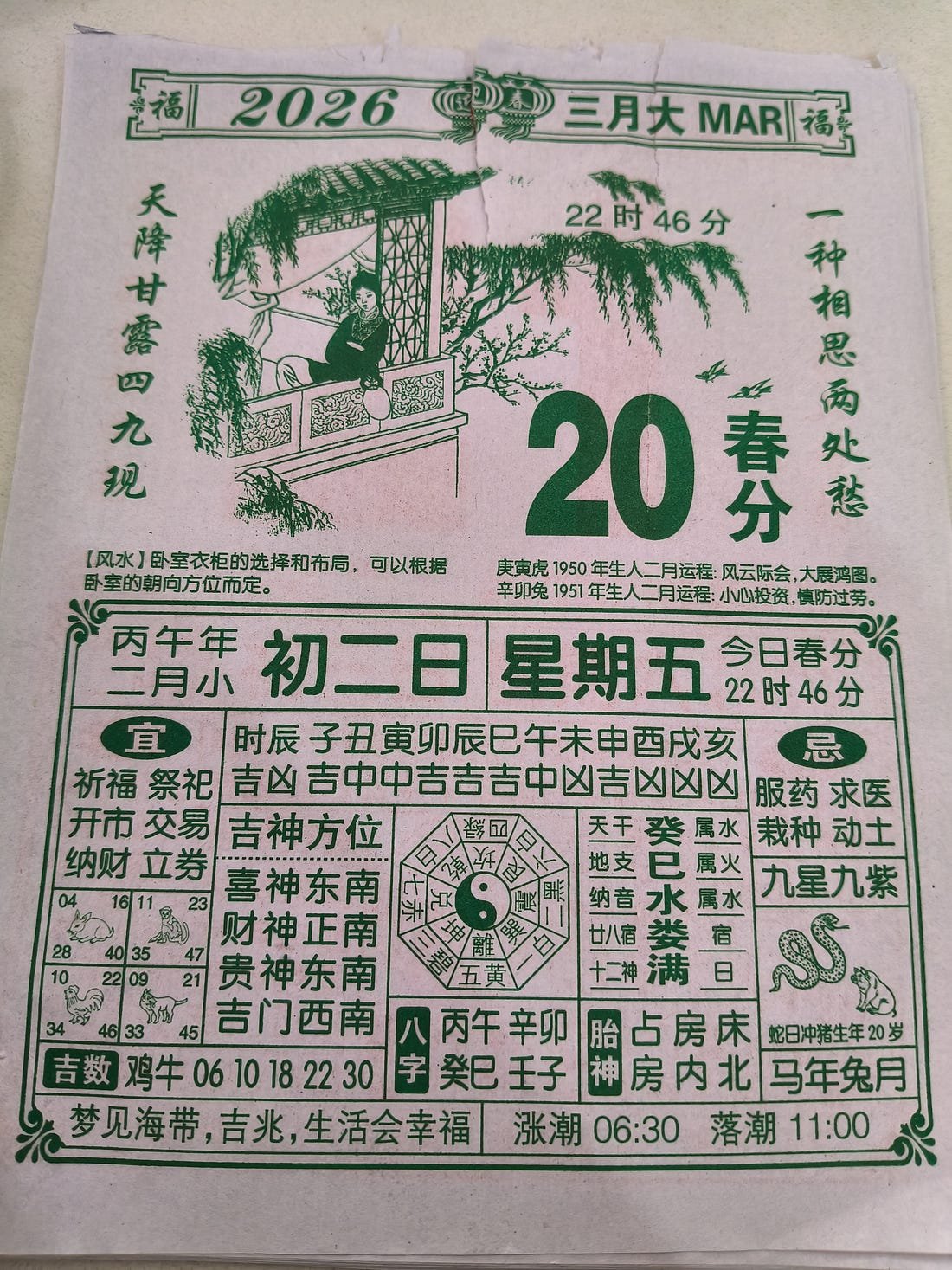
Here is what our ever-intriguing Daoist calendar says about Spring Equinox and Zhonghe Festival. 5,000 years of fascinating culture and traditions. Radio Sinoland 260320
From Jeff Brown
Table of Contents
My introduction
Illustration of the woman on a terrace
Two vertical sentences on each side of the illustration (a two-line poem)
Combining these two sentences on the day of the vernal equinox, the ultimate message conveyed is:
My introduction
Illustration of the woman on a terrace
Echoing the theme of “longing” – The woman depicted in the painting is often regarded as the protagonist of the poem “One kind of longing, two places of sorrow.” She sits on the terrace, gazing into the distance, symbolizing looking towards the faraway and yearning for the return of the loved one. The terrace serves as a transitional space connecting the indoors and the outdoors, representing her being trapped in “this place” (loneliness) while yearning for “that place” (the person she misses).
Corresponding to the season of “Spring Scenery” – The poem mentions “dew falling from the sky” (a rain scene during the spring equinox). If there is drizzle, willow branches, or fresh green in the picture, then the woman on the terrace is experiencing the spring atmosphere, which also reflects the loneliness of “having a beautiful scenery but no one to share it with”.
Continuation of Traditional Imagery – In the artistic conception of traditional Chinese paintings and poems, “a woman leaning against a building (or leaning on a railing)” is almost a fixed visual symbol of “lovesickness”. Her appearance on the terrace is to receive that unresolvable melancholy.
Summary: If there is a woman on the terrace in the picture, her significance lies in “looking” – looking for spring, looking into the distance, and looking for someone to return. She is the embodiment of one of the “two sorrows”.
Two vertical sentences on each side of the illustration (a two-line poem)
天降甘露四九现 (Tiān jiàng gānlù sìjiǔ xiàn) = Sweet dew falls from the sky, manifesting in the number 49
一种相思两处愁 (Yī zhǒng xiāngsī liǎng chù chóu) = One loves, two feel sorrow
The two phrases “甘露四九现” and “天降甘露” placed on the calendar for March 20, 2026 (the vernal equinox) together form a profound contrast between “heavenly order” and “human affection”.
The specific meaning is analyzed as follows:
First sentence: Sweet dew falls from the sky, appearing on the 49th day of the lunar month (astronomical and natural significance) – Surface meaning: During the spring equinox season, the cold air recedes, and spring rain (sweet dew) descends upon the world as scheduled.
– Deeper meaning: This sentence embodies the laws and gifts of nature. “Si Jiu” typically refers to the cold season, and the vernal equinox marks the point where day and night are equally divided and cold and heat alternate. It tells people that the movement of heaven and earth follows a rhythm, with rain falling when it should and warmth arriving when it should. This is a grand, fair, and selfless natural force.
Second sentence: A kind of love, two places of sorrow (the significance of human emotions and inner feelings) – Surface meaning: Lovers deeply miss each other, but due to being separated by two places, they can only feel sorrow individually.
– Deeper meaning: This sentence reveals the helplessness and depth of human emotions. Unlike the selfless rain that falls from the sky, human emotions are “selfish” – they are only directed towards that one person. And the “two sorrows” point out the regrets of life: even if there is mutual understanding (a kind of love), it may be obstructed by spatial distance, making it impossible to share the present moment.
The complete meaning of juxtaposing two sentences
When these two sentences are placed on the page of the vernal equinox, their significance goes far beyond the literal, but rather constitutes a philosophical dialogue:
The beauty of contrast: Heaven is impartial, yet humans differ. On the day of the Spring Equinox, the sun shines directly on the equator, dividing day and night equally. Dew falls generously, and all things are touched by it—this is the fairness of nature.
– However, human longing, due to distance, is divided into two separate and unbridgeable sorrows – this is the bias and helplessness of the human heart.
The depth of contrast: the more beautiful the scenery, the stronger the melancholy. – “Heavenly Dew” depicts a vibrant spring scene where everything comes back to life.
– In such a beautiful season, not being able to enjoy it with the person you miss – the beautiful scenery only deepens the sense of loneliness. As the ancients said, “good times and beautiful scenery are in vain”, this “sorrow” is even more unforgettable with the backdrop of spring.
Eternal Theme: Time, Space, and Emotion – The vernal equinox, as an astronomical node, arrives punctually every year (heavenly movements have their regular patterns) – while human longing and separation, like spring grass, thrive endlessly, occurring year after year (emotions are eternal).
Combining these two sentences on the day of the vernal equinox, the ultimate message conveyed is:
Heaven and Earth are impartial, and every year at the vernal equinox, sweet dew arrives as scheduled. On Earth, there is love, yet unfortunately, you and I, our yearning for each other leads to sorrow in separate places.
Since the Chinese agricultural and lunar calendars intersect differently every year (within a range of month or so), this year Zhonghe Festival (中和节 = Zhonghejie) and Spring Equinox (春分) fall on the same day – March 20.
Both are celebrated and the two are very important milestones for Chinese farmers.
—
Here are excerpts from my Chinese calendar article concerning Zhonghe and Spring Equinox. Zhonghe is also known as Longtaitou (龙抬头), all explained in the today’s first article (). The next two weeks are known as Chunfen, one of the 24 fifteen-day agricultural periods farmers live by. https://radiosinoland.com/2026/01/28/its-that-time-of-year-again-learn-about-the-incredibly-fascinating-chinese-lunar-and-agricultural-calendars-explained-in-this-year-of-the-fire-horse-2026/