

China opposes using the anticipated summit between Xi Jinping and Donald Trump in Beijing to be used as a pressure tool against Iran
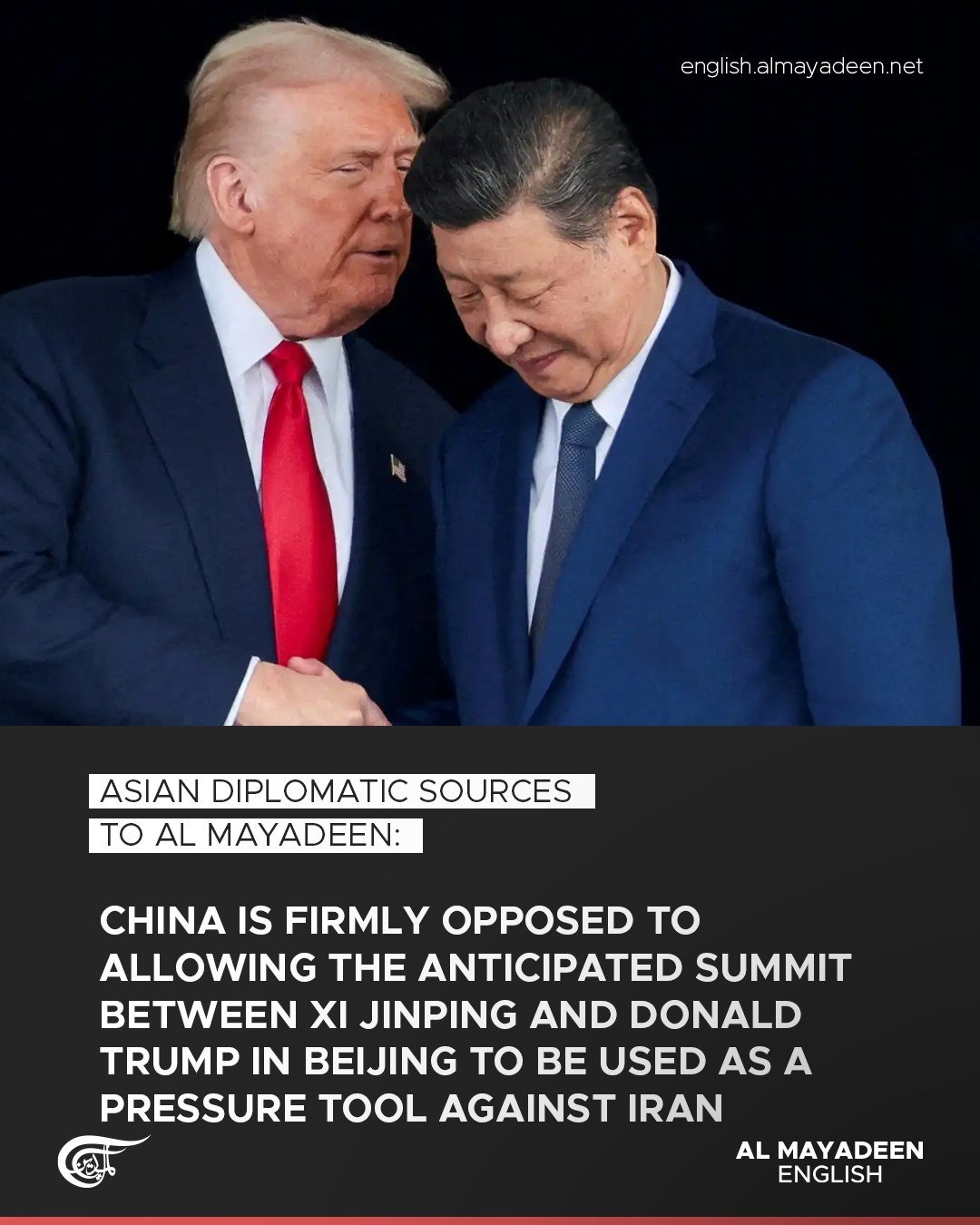
Asian diplomatic sources told Al Mayadeen that China is firmly opposed to allowing the anticipated summit between Xi Jinping and Donald Trump in Beijing to be used as a pressure tool against Iran.
According to the sources, Beijing quickly concluded that Trump’s announcement of a “freedom of navigation mission” was aimed at exerting political pressure ahead of the summit. They added that China believes Washington was counting on its war on Iran as leverage, or even a form of coercion, in broader negotiations. However, the failure of this maritime initiative has deprived Trump of a key bargaining chip in his pursuit of a larger settlement with China, the sources asserted.
Furthermore, they stressed that while China remains deeply engaged in the Gulf region and maintains strong economic and political ties with all Gulf states, this will not come at Iran’s strategic expense. Beijing is also focused on the future of the region after the war and is keen to promote an independent regional security framework in which Iran plays a central role, rather than being sidelined, according to the sources.
They noted that China maintains robust economic relations across the Gulf but rejects the idea of applying external pressure on one party against another, particularly against Iran at this stage. Beijing has also warned against fully aligning with US policies or turning some Gulf states into forward bases for military action against Iran, emphasizing that the future of Gulf nations should remain in the hands of their own peoples.
From China’s strategic perspective, the sources said, no viable political or security arrangements for the Gulf, or its key waterways, especially the Strait of Hormuz, can be achieved without Iran’s active and central participation. China is therefore working toward a comprehensive framework that integrates economic, political, and security dimensions, but without offering exclusive security guarantees to any single party, in line with its broader policy.
Instead, Beijing believes Gulf states should provide mutual security assurances among themselves, while China contributes through substantial economic guarantees and large-scale investments. The sources added that China views economic integration as the foundation for political settlements in the Gulf, arguing that strong investment momentum can help prevent future wars, stabilize the region, and ensure the durability of any agreement.
The sources also pointed out that, just as China seeks stability in the Gulf, it is equally interested in maintaining stability in East Asia, particularly with neighboring countries. They noted that the perceived decline of US influence in East Asia has coincided with the war on Iran and has become more pronounced as Iran has shown resilience.
As an example, the sources cited positions taken by countries such as Japan and South Korea, which declined to participate in military action against Iran or in operations in the Strait of Hormuz, developments that Beijing views positively.