

Iran and unprovoked strikes
With gratitude to Nat South,
The shipping and naval dimension to this conflict is summarised in the article in several parts, touching on the U.S. planning, shipping traffic crisis in the Gulf, Iranian Navy posture and losses.
I’ll start with this extract from a speech made by Trump himself before becoming president 47, showcasing the sheer duplicity and projection that sets the scene for what is happening now in the Middle East:
These globalists want to squander all of America’s strength, blood and treasure, chasing monsters and phantoms overseas — while keeping us distracted from the havoc they’re creating right here at home..
The Trump-led U.S. administration, is indeed chasing their own fabricated phantoms and imagined bogeymen, creating absolute havoc, especially with the latest round of bloodshed taking place in Iran.
There was no imminent threat to the U.S. by the Iranians. There was a threat to Israel. If we equate a threat to Isreal as the equivalent of an imminent threat to the U.S. then we are in uncharted territory. Senator Mark Warren
Uncharted territory, which includes how Iran is responding to the brutal unprovoked attack on its government and country. It is clear that the U.S. administration bumbled through the operation, with very poor planning, muddled response to Iran, and with stated objectives changing on an almost daily basis. There is an expression in English, being led by the nose.
…means to completely control, dominate, or manipulate someone, making them do exactly what you want.
It is clear that the U.S. administration is being led by the nose by the settler colony implanted in the Middle East.
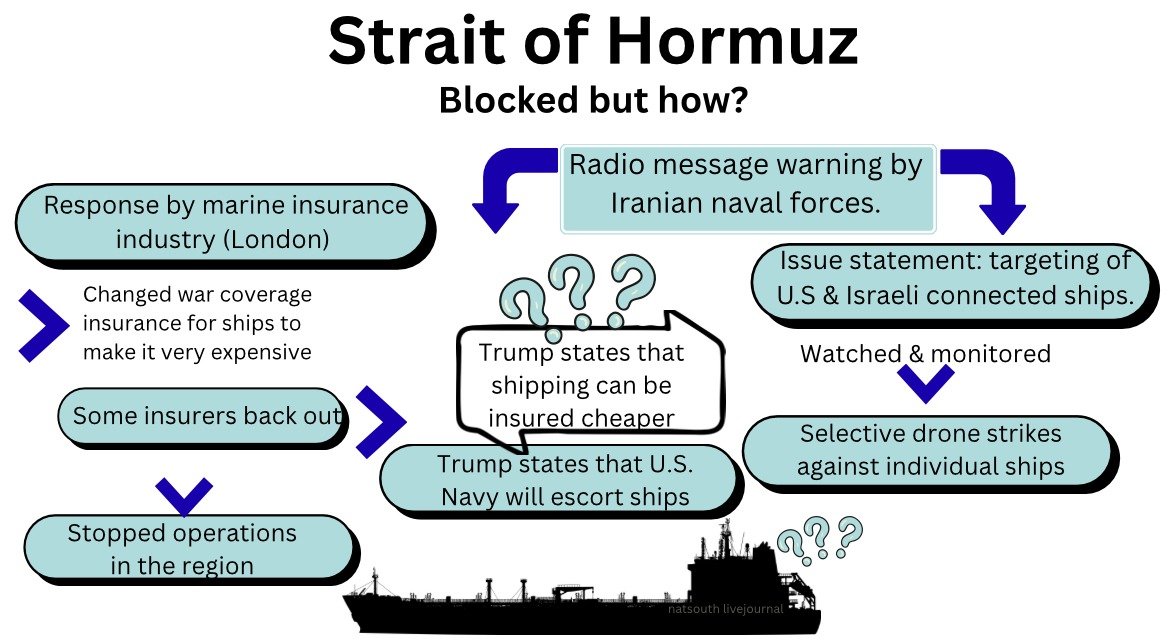
Yet some things are predictable. After many years of warnings and threats, the strait of Hormuz was effectively shut down soon after the unprovoked airstrikes took place across Iran. There was no need for Iranian forces to go out and enforce it strictly, fear alone stopped many commercial shipping companies from continuing their operations in the region. That was done through insurance liability more than anything else.
The Naval dimension
Similarly, U.S. and allied bases had struck in missile and drones, which put a stop on U.S. military activities, largely focussed on the 5th Fleet HQ, which is inoperable, damaged but also still within range of Iranian missiles.
It is worth noting that as reported by retired U.S. Army Colonel Macgregor:
“All of our bases have been destroyed, our harbour installations are destroyed. We actually have to fall back on India and Indian ports which is less than ideal”. Likewise, he said that “China and Russia are providing satellite intelligence… A small payback for what the U.S. and NATO does on daily basis in Ukraine and the Black Sea.
The Iranians did apparently strike at some ships to make their case. A list is provided at end of this article.
Naval conflict between the U.S. and Iran was always going to be unequal, the Iranians certainly knew this and created a diverse fleet, with a wide range of weaponry. The classic surface combatant ships, (patrol boats, frigates and corvettes will have little chance to fight).
U.S planning and preparedness
It is becoming more and more obvious that there it was a rushed operation and there was little rigorous planning for this unprovoked attack because of various factors, mostly glaring being the lack of air defence systems and missiles and inability to counter the drones. It is equally astonishing that no preparation was made to evacuate U.S. civilians in the area or provide support and means to do.
Why do I say this? As pointed out in a tweet, by Matthew How, the military is simply over-extended and cannot carry out established activities, such as evacuations. As a result U.S. civilians in the region have been left to fend for themselves, with just a helpline for comfort.
The U.S. has 30 amphibious ships of different types. In other conflicts, the use of a U.S. Marine Expeditionary Unit (MEU) was seen as being vital in underpinning maritime operations. So where is the nearest amphibious ready group (ARG) – in the Caribbean. The ‘USS Iwo Jima’ was the one that was usually forward deployed in the Mediterranean but was pulled out to support the regime change efforts in Venezuela. The closest ARG is in Japan, (Fleet tracker 2 March 2026). A case of rearranging the deckchairs on the Titanic, in a rush.
Update

The whole bargain-basement show was revealed by these words:
“We don’t have enough ammunition to win this war. It would not be pretty.” U.S. General Dan Cain
Trump responded by doubling down on with a volleys of soundbites, coupled with big lies, by stating that “the United States had plenty of missiles, plenty of munitions, plenty of everything”, (Middle East Monitor, 5 March 2026).
Likewise, a report from Politico shows that there was little preparation for a large-scale conflict, hence the haste and muddled response.
Maritime Briefing (will be updated accordingly)
Strait of Hormuz and Gulf — commercial shipping


March 01/03/2026/11:00UTC
Major containership carriers, (including CMA CGA, Hapag Lloyd, Maersk), have halted Hormuz transits through the Strait of Hormuz and some have also stopped going to Suez/Red Sea. More sailings will take place going around the Cape of Good Hope. This is because the Houthis in Yemen have stated that they will resume attacks on commercial shipping in the Red Sea. Their statement alone has scared off the major shipping companies.
All eastern Gulf ports are blocked. All maritime traffic severely disrupted, which will have a huge effect on Gulf states economy and also the world economy. AIS tracker platforms have seen a 70 percent drop in vessel traffic in the first 72 hours. This is having a huge knock-on effects on transport and logistics, in an era of just-in time.

Another issue is that the Iranian retaliatory strikes included selected parts located in port infrastructure in Bahrain and the UAE. Alleged limited strikes have also affected Fujairah and Omani ports of Duqm and Salalah.

All shipments in oil in the Gulf have been suspended. Additionally, LNG production has partially halted in Qatar and the Iraqi Rumaila oilfield has stopped oil production. This is also having a huge impact on oil storage and reserves in the region.
It is reported that one Chinese connected oil tanker has exited the Gulf in first 24 hours. The AIS screenshot shows ships, but in facts all of them hadn’t updated their AIS location for over 8 hours.
The Strait is 21 miles with a shipping lane, the narrowest point, (TSS), is just around 2 miles. This strategic chokepoint is highly significant as 20% of the world’s crude oil and also 20% of LNG passes through this region. So far, there has been a reported 90% drop in oil and LNG shipments.


There are literally hundreds of orange dots in the Gulf of Oman, each one is a tanker at anchor, waiting for orders.
03 – 04 March 2026
Apart from oil tanker, an estimated total of 470,000 TEU of container ships are trapped in the Gulf, representing just under 150 ships according to Seatrade Maritime, (04 March). Many of these will have originated in Asia, all of which is now bottled up and unable to maintain carrier schedule.
This is going to create a significant logistical headache, and given that some call into European ports, delays and cancellations are happening. Even relatively distant ports such as Salalah Oman have been affected by drones strikes, causing additional delays in transits. The extent is significant, so much so, that some shippers are looking to Sri Lanka and India as ports to call in. Many ships are looking for ports to offload containers, which can be considered as safe. There is going to be a huge logjam of containerised cargoes that will never go to their indicated destination, or will take a lengthy time to reach their clients. All of which incurs cost for everyone involved in shipping and logistics.
03 March 2026 20:00UTC
President Trump has ordered the United States Development Finance Corporation (DFC) to provide ‘political risk insurance and guarantees’ to cover maritime risks in the Gulf. This is applicable to all shipping lines apparently, (but this comes with a catch, currently the U.S. Navy cannot escort non-U.S. commercial ships. During the “tankers wars’ , “Operation Earnest Will”in the Gulf in the 1980s, foreign tankers were required to reflag as US vessels to qualify for US naval protection. Is this another cunning wheeze from the White House, America First? Very few tankers that transit the Gulf are U.S.-flagged or owned. This comes a day later after shipping media reported that U.S. Navy officials flatly refused to provide escorts.
The reason for this impasse with shipping is simply due to cancellation or huge price hikes of war risk policies by marine insurers. Effectively the Western dominated maritime industry stopped the traffic.
“If necessary, the United States Navy will begin escorting tankers through the Strait of Hormuz, as soon as possible.”
“No matter what, the United States will ensure the free flow of energy to the world,”says Trump.
There are a few issues with this proposed action.
One: it is very costly and who ultimately pays the tab? (apart from the U.S. taxpayer?).
Two: The U.S. Navy doesn’t have capacity to do this while at the same time taking part in strikes against Iran. There is going to be some teeth gnashing. At the height of the Tanker Wars, there were around 30 U.S. Navy taking part and that was just to protect Kuwaiti related tanker shipping. Now, it is the whole eastern Gulf countries implicated by the presence of U.S. bases in their states.
Three: Shipping companies will be very reluctant to lose or get ships damaged, especially mega-sized containerships. It isn’t that simple to do, as just sailing through and ensuring a clear path. The Iranians are very savvy with asymmetric warfare, their numbers and use of relatively low-cost technology, that has already made the U.S. edgy. (It has already been stated that they cannot effectively counter the drones).
- Mine warfare (as it was the case in the 1980s). Personally I have doubts that this will be deployed on a large scale, because the Iranians still want to ship out their oil. This could happen if there is a blockade. More high-tech mines could be used instead, deployable from a wide range of small crafts, these could be a deterrent and tie up the U.S. Navy for weeks and months, (as its mine-hunting capacity isn’t strong). It is will certainly be a deterrent for shipping companies, who would hesitate to send their ships through the Strait of Hormuz, in the first place, despite any incentive.
- “Swarm” or “Mosquito fleet: Iran has a lot, a lot of these, small fast-attack boats, some with anti-shipping missiles to act as deterrent. Creation of a environment that counters the U.S. high- tech edge is a potential scenario, with RPGs, drones etc… not to fight ship against ship, but overload the U.S. sensors and capabilities within a short-range. The U.S. military will be tied up by the enormity of potential threats along a coastline, as a typical frigate or destroyer will be overwhelmed, if it is has to counter missiles, as well as sweep for mines and at the same time, deal with air and seaborne swarm of drones.
NB: Deja-vu to the 1980s naval escorts of tankers.
Gulf — Iranian Navy
The U.S. military have stated that over 20 Iranian ships have been struck or sunk in the U.S. and Israeli strikes. The most notable events include the IRINS Makran, which had previously toured the Atlantic and gone to Latin America, circumnavigated the globe, visiting ports as far as Rio de Janeiro, Brazil back in 2023. It is also took place in the 2021 Russia Navy Day Parade. It is a converted tanker, stayed on the U.S. Expeditionary Sea Base (ESB) ships. It provided Iran’s long-endurance sea-base capability, with helicopter, small boat and drone capabilities.
Other ships hit include the IRIS Shahid Sayyad Shirazi, a catamaran corvette and IRIS Jamaran, IRIS Bayandor, and IRIS Naghdi.
It is unclear as the status of the small fast attack craft fleet operated by Iran, which are used in their thousands.
Indian Ocean
15:30:00 (Wed, 4 Mar 2026) UTC
Iranian Navy warship IRIS ‘Dena’ was sunk off the coast of Sri Lanka after a US Navy submarine torpedo attack. Only around 30 of the 180 sailors on board have been rescued so far by Sri Lankan maritime authorities, (Sri Lankan press release). Over 80 bodies have also been recovered.
Sri Lanka’s Navy and Coast Guard received the distress message at around 5.08 a.m from the ship off Galle, in the vicinity of the maritime international boundary.
The 2021 commissioned domestically built IRIS Dena recently took part in international naval exercises in India that took place in the last week of February, ‘MILAN 2026’, along with 71 other countries, with more than 60 naval ships.
Paradoxically, the US Navy took part in the exercise, focusing on anti-submarine warfare. Interestingly, the USS Pinckney was scheduled to attend but it didn’t happen, (16th Feb) due to “emerging reasons”.
Other navies include Saudi Arabia, Russia, China, Germany, United Arab Emirates. The Indian-led MILAN 2026 was a multilateral exercise, which aimed to enhance interoperability among navies to address collective security threats.
As stated by retired U.S. Army Colonel Macgregor, the U.S. Navy has to use Indian ports, so it wasn’t going to be pleased to have an Iranian naval ship in the area, even if it was off Sri Lanka. Jittery response to its presence was a surprise torpedo attack at 5am local local, in darkness.
Predictably, the U.S. warmongering administration gloated over the torpedo attack and released a video of the destruction of the Iranian corvette. Hegeseth claimed that it was “the first sinking of an enemy ship by a torpedo since World War Two”, by an U.S. submarine, but there have other post-WWWII submarine attacks, ( the sinking of the Argentine Cruiser ARA General Belgrano, controversially. South Korean naval ship Cheonan in 2010, the sinking of the Indian Navy’s INS Khukri, in 1971 during the Indian-Pakistan war.
I will not dwell more on the tone and hubris of the Secretary of War, except to say, despicable attitude, consistent with the whole framing of the conflict by the U.S. as a macabre show of optics, “quiet death” it wasn’t.

In my opinion, there could have been other ways to disable the ship without destroying entirely a ship, to take it out of operational service, a missile strike to the radar, disable the rudder for example. The U.S. wanted to showcase their might and egregious violence on a ship, that was over 1,600 nautical miles away from Iran, that had been on a “flag-waving tour”, returning from India. Given that it was transiting Sri Lankan 24 nm continuous waters, the ship would have been complying with UNCLOS on navigation passage, because I presume it had transited territorial waters as well. As such UNCLOS Articles 17–19, 24 apply and the ship would have had their weapons systems secured and not manned, and their radar only used as to avoid being seen as “prejudicial to peace, good order or security”. In other words, the ship was not in a combat mode.
According to Indian officials, the ship was unarmed due to military diplomatic protocol.
The U.S. took advantage of this, not on the high seas, but when it was off the coast of Sri Lanka. The support vessel, IRINS ‘Bushehr’ was left unscathed and it is still off Sri Lanka, being assisted by the Sri Lankan coastguard for over 3 days, before the crew was evacuated to Colombo.
Maritime briefing — Mediterranean
08:30:00 (Wed, 4 Mar 2026) UTC
The 227m long Russian flagged LNG carrier, ‘Arctic Metagaz’ was attacked in Central Mediterranean, near Malta, around 4 a.m. local time and has caught fire. A USV drone strike is suspected It was heading to the Suez Canal from the LNG2 field in the Russian Arctic. All crew rescued by Maltese navy.
Asymmetrical warfare by duplicity is all the rage in the Euro-Atlantic NATO cabal. It is reported that Ukrainian drones were used to destroy the ship. Any means to escalate a tinderbox of geopolitical conflicts. I did predict that the use of drones would expand more, to target commercial shipping beyond the Black-Sea. The can of worms has been well and truly opened. This is not the first time that Ukraine has carried out an attack in Mediterranean, (off the Italian coast). The USVs were launched from the coast of Libya, (so maybe involvement of NATO and a certain Gulf country too).
”We believe the incident to be an act of international terrorism and maritime piracy, a gross violation of the fundamental norms of international maritime law,” Russian Ministry of Transport
I am not going to hold my breath on how the EU or U.S. would respond if this type of attack was carried out against their own commercial shipping.
I would like to note that this is the start of a sneaky of attempts at stopping Russian shipping in the region, a kind of a furtive blockade. One is by detaining so called “shadow fleet” ships and this type of attack is another way.
Maritime Briefing — ongoing updating
After Trump’s bold and brassy declaration that the U.S. Navy will escort commercial shipping. The offer hasn’t enthusiastically been snapped up by the ship operators.
The halt in shipping transits through the Straits of Hormuz is having a snowball effect on various industries, principally the oil industry in many countries, but also on the economies of the Gulf States.
The halt in tanker traffic is affecting oil and fuel storage in the Gulf, data shows that Iraq has around 6 days, Kuwait — 14, Qatar — 20. Both Saudi Arabia and the UAE have the option of re-routing oil to the Red Sea and Gulf of Oman. It is worth noting that Qatar Energy products represent 82% of the Asian market, which is still at stand-still 6 days into the conflict.
This oil and energy crisis is rippling out, China has halted the export of diesel and gasoline, while several other Far East countries have declared a force majeure or about to on other petroleum related products.

Additionally, it is reported that the U.S. administration has authorised the sale of some Russian oil to India, (how generous of the warlords of the exceptionalism state to do so, (Sarc off).
It isn’t just oil and LNG supplies that have halted, but also imports of food and materials for the Gulf States, a region of around 50 million, that relies heavily on food imports. Scenes of essentials panic buying in Dubai will have added to the logistical crisis.
Tankers hit or attacked in the Gulf and Gulf of Oman
02 March 2026 13:00UTC
MKD Yvom Marshall🇲🇭 island (off Muscat, Gulf of Oman) V-ships Asia
Skylight Palau 🇵🇼(Gulf) US-sanctioned
Hercules Star Gibraltar 🇬🇮 (Off UAE) Macaw Shipping Ltd
Ocean Electra Liberia🇱🇷 (Off UAE) Antlia Navigation Ltd.
^ Stena Imperative,USA🇺🇸 (Bahrain shipyard) Stena Bulk
^ The oil tanker is linked to Military Sealift Command, under the US Navy’s Tanker Security Program, (TSP), part of a US-military fuel procurement.
03 March 2026 09:00UTC
Athe Nova, Honduras 🇭🇳 (Strait of Hormuz, bitumen tanker)
04 March
Safeen Prestige Malta 🇲🇹 Strait of Hormuz, containership, Transmar International Shipping
05 March
**Sonangol Namibe Bahamas 🇧🇸,off Iraq, Angolan owner, operated by Stena Bulk, Suezmax crude oil tanker
** hit while in ballast by an USV suicide drone.
Sources:
Marine Traffic
Vessel Finder