

Pepe Escobar: War on Iran reshapes the ‘War of Connectivity Corridors’
The war of choice on Iran by the US is not only redefining geopolitics but also interfering with, destabilizing, and reorienting what The Cradle described in June 2022 as The War of Economic Connectivity Corridors; arguably the key geoeconomic paradigm of Eurasian integration in the 21st century.
From east to west and north to south, these corridors interlock virtually all major players across Eurasia.
Let’s dig deeper into what may be the four most important vectors: the China-driven New Silk Roads/ Belt and Road Initiative (BRI) east-west corridor; the Russia-Iran-India International North South Transportation Corridor (INSTC); the IMEC (India-Middle East Corridor); and the proposed corridors linking Turkiye with Qatar, Syria and Iraq.
China’s New Silk Roads/BRI advances through a multiplicity of corridors from Xinjiang to western Eurasia, including the Northern Corridor (via the Trans-Siberian in Russia) and the Middle Corridor (via Kazakhstan and across the Caspian to the Caucasus and Turkiye).
Iran at the center of Eurasian integration
But it is Iran’s ultra-strategic geography that has positioned it since the Ancient Silk Roads as the definitive crossroads between east and west; a role rekindled by the New Silk Roads/BRI launched by President Xi Jinping in 2013.
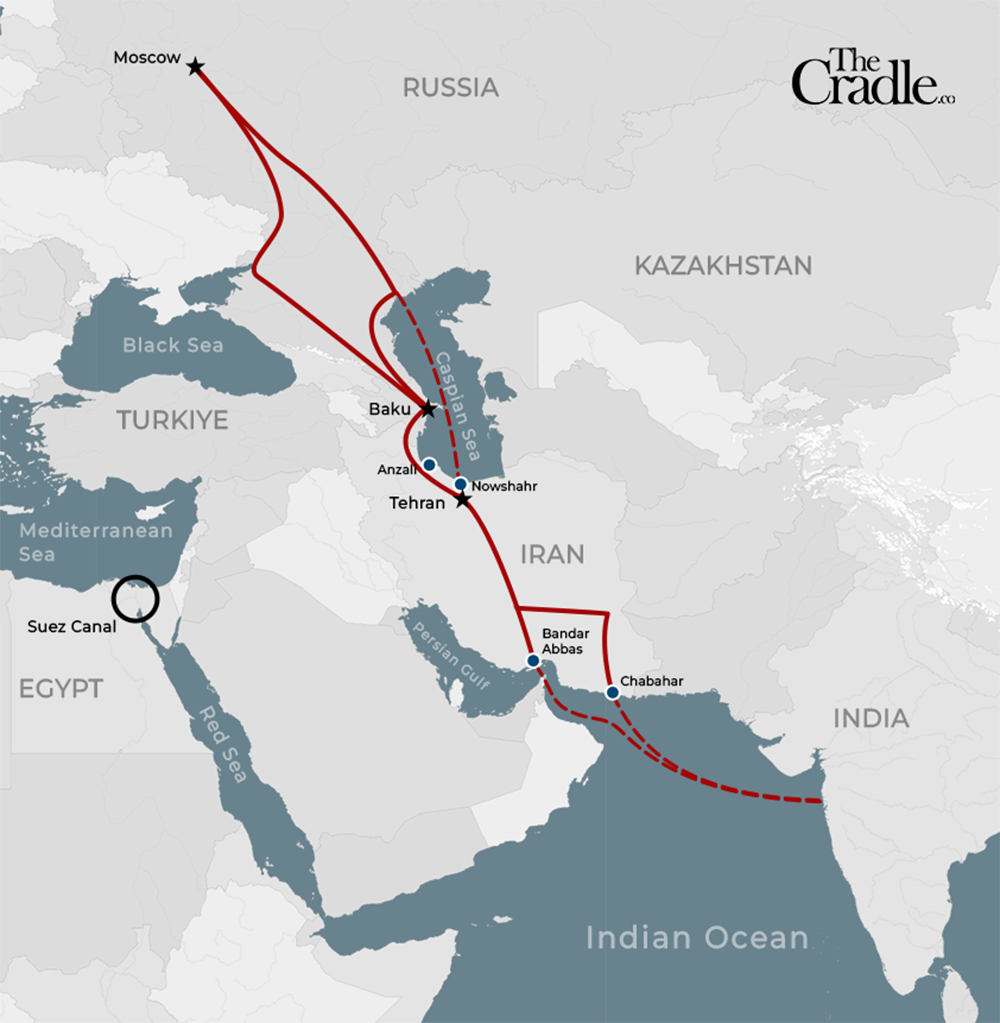
One of its crucial vectors, included in the 25-year, $400 billion China-Iran deal signed in 2021, is the BRI-integrated China-Iran overland corridor. It is essential for bypassing American maritime dominance, the decades-long sanctions barrage on the Islamic Republic, and sensitive chokepoints such as the Strait of Malacca, the Strait of Hormuz, and the Suez Canal.
The first freight train from Xian, China’s former imperial capital, arrived at Aprin’s dry port in Iran, located 20 km from Tehran, which was inaugurated only three years ago in May. This marked the official start of this corridor, cutting transit times from up to 40 days by sea to a maximum of 15 days by land.
Aprin is a dry port: an inland intermodal terminal, directly linked by road/rail to seaports, in the Caspian or in the Persian Gulf. That means massive Chinese shipments can quickly access global maritime routes.
China-Iran fits into the broader east-west corridor, which, before the war, aimed to connect Xinjiang via Central Asia (Kazakhstan, Uzbekistan, Turkmenistan) to Iran, Turkiye, and further on to the Persian Gulf, Africa, and even Europe.
Of course, China could also profit from the rail corridor to receive Iranian oil, instead of relying on the Iranian ghost fleet, although the logistical challenges remain significant.
The China-Iran railway is already recalibrating the importance of the China-Pakistan Economic Corridor (CPEC), the flagship BRI project that connects Xinjiang, via the Karakoram highway, to northern Pakistan and then all the way across Balochistan to the port of Gwadar in the Arabian Sea.
Right up to US President Donald Trump’s war of choice, Beijing was inclined to pay more attention to the Iran corridor, considering Pakistan’s unstable political situation.
Whatever happens next, Iran will still need to carefully navigate the dizzyingly complex interplay between China and India. After all, both BRICS members have deep strategic interest in Iranian ports – considered as essential gateways to Central Asia.
Moreover, the Iranian port of Chabahar, part of what could be considered, at least before the war, as the Indian Silk Road, in Sistan-Balochistan, is in direct competition with the Pakistani/BRI port of Gwadar in the Arabian Sea, only around 80 kilometers away.
That brings us once again to Iran’s unrivaled role in Eurasian connectivity. Iran sits at the privileged intersection of two key transportation corridors: the Chinese-driven east-west vector and the INSTC, which links three BRICS members – Russia, Iran, and India.
What Tehran had been doing, up to the war, was to deftly align its multi-vector policy with both powers, China and India, and both corridors. Considering India’s alignment with Israel right before the decapitation strike on Iran on 28 February, things may radically change further on down the road.
INSTC collides with IMEC
The INSTC can be succinctly described as the north-to-south vector of Eurasia integration, linking Russia, Iran, and India, and crisscrossing the Chinese New Silk Roads, which move from east to west across Central Asia.
In May last year, with a professional crew of five, I shot Golden Corridor: the first documentary in the world, in English, on how the INSTC develops inside Iran, from the Caspian Sea to the Persian Gulf and the Sea of Oman, with a special focus on Chabahar.
Up to the war, India was extremely worried about the potential for Chinese investment in Chabahar – a concern confirmed by the port authorities during my visit. Chabahar is, or at least was, seen by Indian strategists as their crown jewel in Iran: effectively the only viable route for India into Eurasia, reaching Central Asian, Russian, and eventually European markets.
No wonder the Indians were scared about the possibility of China securing a naval presence in the western Indian Ocean.
All Indian investments in Chabahar are now on hold. They were already stalled because of US pressure. China, though, remains relentless. Looking ahead, Beijing has already come up with an investment plan for the Makran coast in Sistan-Balochistan, complete with a massive deployment of Chinese companies connecting Iranian ports to the BRI.
Iran will opt for strategic pragmatism, especially after India de facto ditched its non-alignment and autonomy when facing the US: all that because of shallow, myopic calculations by the government led by Narendra Modi. So India has an uphill struggle if it doesn’t want to lose its Persian “crown jewel.”
Here, we once again the profound interconnection of the key trans-Eurasian corridors. The China-Iran railway, part of the China-Central Asia-Turkiye-Europe corridor, links to the INSTC in Iran, which is crucially backed by Russia.
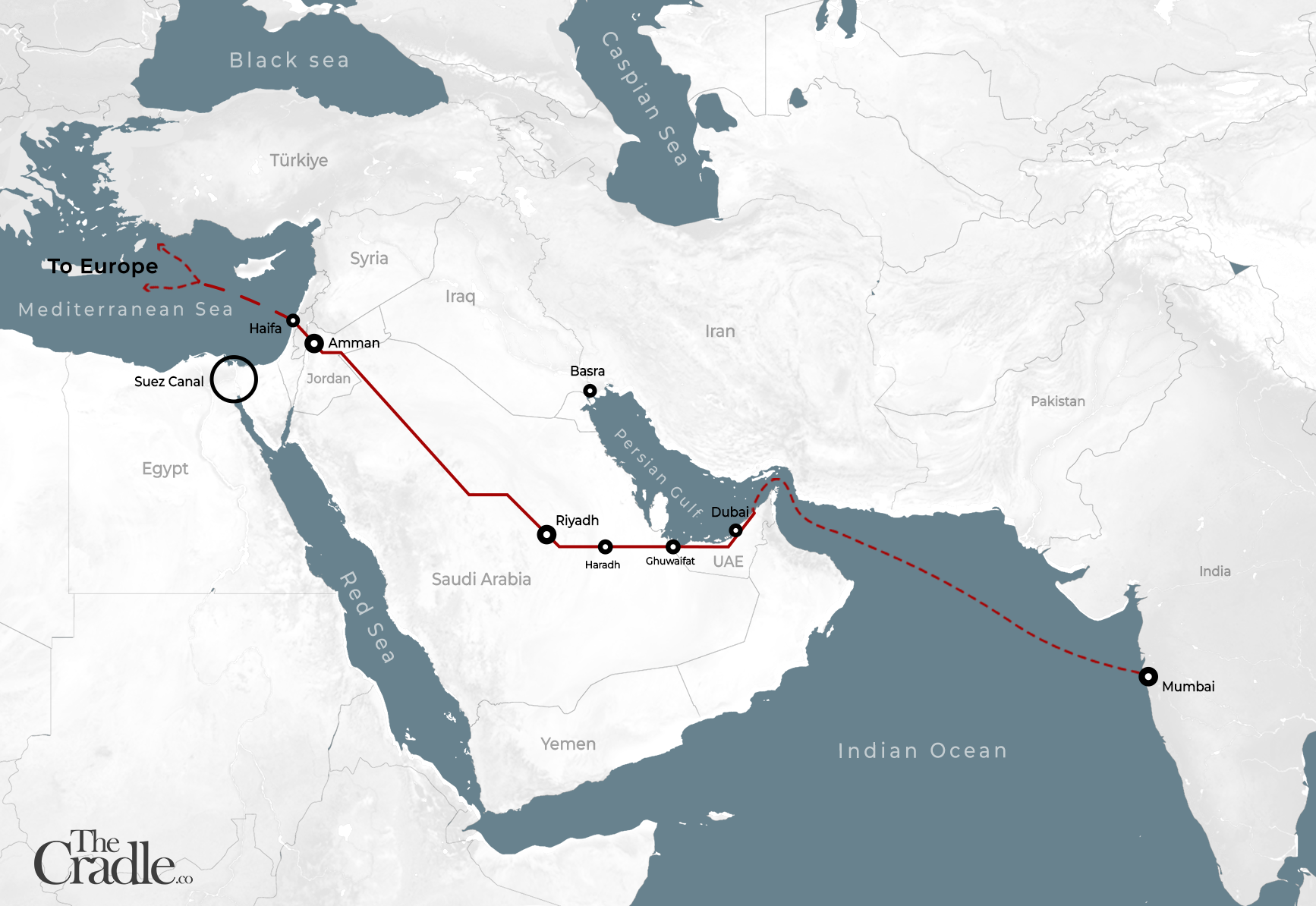
At the same time, both stand in stark opposition to IMEC, the misnamed India-Middle East-Europe corridor, which is actually the Israel-Middle East-India-Europe corridor. The key objective of IMEC, an offspring of Trump 2.0’s Abraham Accords push, is to turn Israel into a strategic hub for trade/energy flows in West Asia.
As first detailed by The Cradle, IMEC has so far been little more than a major PR operation launched at a G20 summit in New Delhi. It should be interpreted as the collective west’s late response to the BRI: yet another American project to “contain” China and, more recently, Iran as a member of the INSTC.
Most of all, IMEC is a transportation corridor designed to bypass the top three vectors of genuine Eurasian integration: BRICS members China, Russia, and Iran.
The war on Iran, however, is inflicting a serious reality check on IMEC. The port of Haifa has been seriously damaged by Iranian missiles. Riyadh and Abu Dhabi are in direct conflict over how to adapt to a post-American Persian Gulf in which Iran will be the dominant power.
As it stands, Saudi Crown Prince Mohammed bin Salman (MbS), although always hedging, appears inclined to find an accommodation. UAE President Mohammed bin Zayed (MbZ), by contrast, is for all practical purposes at war with Tehran.
Europe is actively committing political and economic suicide. And India is puzzled about squaring the circle: how to organize a credible BRICS summit later this year while aligning with the US
For all practical purposes, IMEC is now in deep coma.
Take some provisional results of the war. Nearly 1,100 km of tracks are “missing” from the railway from Fujairah in the UAE to Haifa; 745 km are “missing” from Jebel Ali in Dubai to Haifa; and 630 km are “missing” from the railway from Abu Dhabi to Haifa.
That leaves IMEC looking even more fragile in the aftermath of the war. Several of the corridor’s potential nodes and surrounding infrastructure were also hit by Iranian missile strikes. And that may not be over yet.
Turkiye’s Pipelineistan ambitions
Turkiye, of course, had to develop its own Eurasian integration ideas, especially given how neo-Ottomanism wants to position Ankara as a player capable of rivaling Russia and Iran.
As it stands, Ankara’s gamble is to go for full Pipelineistan, as I defined two decades ago, the ultra-politicized maze of Eurasian energy corridors.
So Pipelineistan includes everything from the Baku-Tblisi-Ceyhan (BTC) oil link, facilitated by the late “Grand Chessboard” Zbigniew Brzezinski, to the Russian-built South Stream and Turk Stream, as well as never-ending gas soap operas such as the Turkmenistan-Afghanistan-Pakistan-India (TAPI) and the Iran-Pakistan-India (IPI), later reduced to IP.
A premier American obsession has long been to prevent an Iran-Pakistan pipeline from being built: an umbilical cord between two powerful Muslim nations linking West Asia to South Asia.
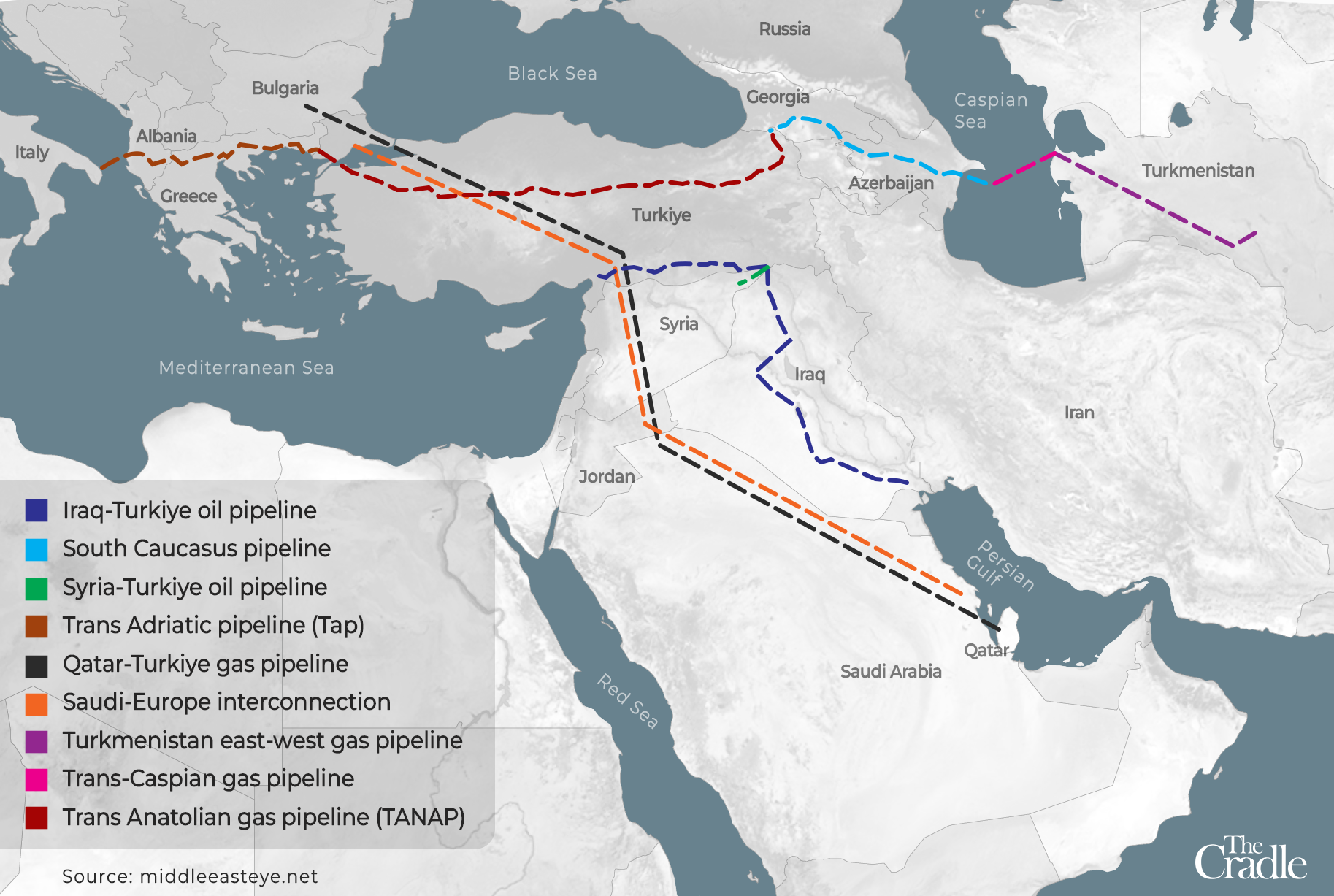
Turkish Energy Minister Alparslan Bayraktar – yes, remember the dones? – is on a roll. His pet idea is to connect Basra – the oil-rich capital of southern Iraq – to the Iraq-Turkiye oil pipeline, which links Kirkuk to Ceyhan, in the Mediterranean (also the terminal for BTC), with a capacity of more than 1.5 million barrels per day. The problem is that the absence of political consensus in Iraq makes it, for now, a pipe dream.
Turkiye is even considering linking Syrian oil fields – hardly lavish production, at a maximum of 300,000 barrels a day – to the Iraq-Turkiye oil pipeline. That is messy territory, considering no one really knows who is running Syria.
Still, Ankara remains relentless. The Holy Grail would be a gas pipeline from Qatar to Turkiye via Saudi Arabia, Jordan, and Syria.
That’s a wacky version of history repeating itself. A pipeline sat at the center of the war on Syria: originally it would have been Iran-Iraq-Syria, before Qatar pushed in 2009 for a route from the North Field through Saudi Arabia and Jordan into Syria – a project vetoed by Damascus.
The war on Iran has once again turned everything upside down after QatarEnergy declared force majeure on a significant portion of its LNG exports, affecting both Europe and Asia.
Qatar still privileges LNG over pipelines. But now enter Turkiye, with the concept of a – still to be built – pipeline from Qatar to supply Europe, spun by Bayraktar as an “alternative export route.” That would cost at least a whopping $15 billion: a 1,500-km pipeline crossing as many as five borders. A certified, costly headache.
More feasible, at least in theory, is the Trans-Caspian Gas Pipeline, which aims to connect Turkmenistan across the Caspian to Azerbaijan and Georgia, most likely parallel to the BTC pipeline and onward to Europe.
Once again, that needs to be built. It would cost at least $2 billion: a 300km-plus underwater pipeline across the Caspian from Turkmenbashi to Baku. That’s long, I made that crossing on an Azeri cargo in the 2000s, and it takes at least 8 hours. Afterward, the still non-existent pipeline would connect with two others, the South Caucasus and the Trans-Anatolian.
Extra costs would be inevitable: on upstream development, compression capacity, and downstream expansion.
And even if the whole thing came to light, Turkmenistan has no spare capacity: virtually all of its production goes to Xinjiang in China via a pipeline built and paid for by China. At best Turkiye imports a small quantity of Turkmen gas through Iran, on a swap basis; Iran also uses this gas.
Make Connectivity Corridors, Not War
What’s clear is that the War of Connectivity Corridors will remain the prime geoeconomic vector from West Asia to Central and South Asia – involving multiple paths towards Eurasia integration.
The war on Iran is accelerating quite a few interconnections. Take, for instance, the National Logistics Corporation (NLC) in Pakistan accessing the Gabd Border Terminal to boost trade with Iran and mostly Uzbekistan in Central Asia, via something called the TIR (International Road Transport) system, bypassing Afghanistan.
NLC is playing it quite strategically, simultaneously activating multiple trade corridors to China, Iran, and Central Asia, and at the same time helping to strengthen Iran’s battered trade and financial front during the war.
And we’re not even talking about the other key connectivity corridor of the future: the Northern Sea Route alongside the Russian coastline in the Arctic all the way to the Barents Sea, which the Chinese poetically refer to as the Arctic Silk Road.
China, India, and South Korea are very much focused on the Northern Sea Route, discussed every year in minute detail at the forums of St. Petersburg and Vladivostok.
It’s not an accident that the U.S. bombed several nodes of the INSTC: the port of Bandar Anzali, Isfahan, the port of Bandar Abbas, the port of Chabahar. As well as one stretch of the China-Iran railway, part of BRI, and financed by China.
This is a war against Iran, against China, against BRICS, against Eurasia integration. Yet Eurasia integration simply refuses to be derailed.
Make Connectivity Corridors, Not War.
BRICS is facing a serious identity crisis, as the crisscrossing connectivity corridors face multi-vector policies based on ideological alignments that run counter to BRICS principles and interests. Pepe described BRICS predicament recently as being “in coma,” and that is the condition in which it will enter its next meeting, held… Read more »
Hey there Jangjo, I’m fixing to do an update on BRICS. Yeah, it is sleeping, but it is not dead. We had such a dead zone when Brazil took over the chair as well, and oh heavens, did I lament – But, at the end of the day, the business… Read more »
Appreciate your reply. Of course, it was easier to line up organizations during the Soviet Union times, as the ideological alignment preceded membership. A lot more difficult nowadays for organizations like BRICS, created around the principle of non-interference in mutual internal affairs. Hopefully it will recover from the “coma” and… Read more »