

Mohsen Rezaei: Iran is ready to strike NATO bases in Europe
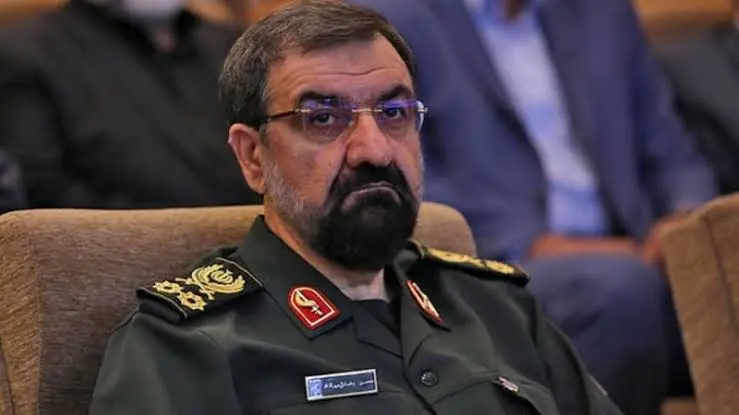
Interview with General Mohsen Rezaei, Secretary of Iran’s Supreme National Security Council.
Al-Mayadeen, 11 November 2026
This is a good translation of this somewhat older interview – 2 weeks old, right after Mohsen Rezaei’s visit to President Putin. Iran has not changed from this up to now. It is good to know from this interview Iran’s exact requirements on ending the war as well as exact actions should Israel or the US or both attack. What has happened is that more tankers are burning.
Interview with General Mohsen Rezaei, Secretary of Iran’s Supreme National Security Council.
Al-Mayadeen, 11 November 2026
Translation: resistancenews.substack.com
“Our goal is to achieve security. We are facing an aggressor, criminal regime: are we going to allow it to escape punishment and let the Americans leave without our having obtained our rights? If that happens, what would stop other countries from believing that attacking Iran carries no cost? They could launch an attack: if it succeeds, no problem, and if it fails, they would pay no price for it. We want to impose on the Americans a cost that makes aggression against Iran costly and becomes a deterrent. And what is that cost? It is the securing of our rights. That is why Iranian negotiations and Iranian diplomacy, whether with other countries or with the Americans, are based on the principle of deterrence and the achievement of regional security. […]
This war has brought very important lessons for national security, both for our country and for the other countries of the region. Before the war, everyone thought that spending billions of dollars on F-35 aircraft, AWACS systems and other equipment was enough to guarantee security. But the confrontation proved the opposite: faith surpasses technology. When fighters stand next to their missiles while drones fly over their heads and fire on them, they keep standing behind the missiles and launching them. Where is such faith to be found in the American army, and where is it to be found in the Israeli army? […]
We defeated the United States and Israel with our own means, with the weapons and missiles that we made ourselves, with our own equipment. […]
If the Americans make a mistake and attack us, we will not content ourselves with targeting the nearby bases: we will strike all the nearby bases and we will also target the distant American bases. By that I mean American military bases located in remote regions, which we have not attacked so far, and we could target some islands which, according to them, our missiles cannot reach. We could even target some American military bases in European countries: if American planes take off from a distant military base and come to bomb Iran, we will strike that base too.”
- Where do the negotiations with the United States stand?
- How Iran withstood the aggressions
- How Iran will respond in the event of a new aggression
- The Axis of Resistance, bulwark of all Muslim countries
- Mohsen Rezaei’s meeting with Vladimir Putin
- Iran’s relations with its neighbours
- The new Leader, Mojtaba Khamenei, and Mohsen Rezaei
Journalist: Dear viewers, peace be upon you, and welcome to this special interview with General Mohsen Rezaei, Secretary of Iran’s Supreme National Security Council. General, welcome, and thank you for your time. I know the circumstances surrounding you, and I am very glad of this meeting. I promise you my pace will be very quick, as your time is limited. Thank you. Welcome to the Al-Mayadeen channel.
Where do the negotiations with the United States stand?
Dear sir, in recent days, and these last two days in particular, we have frankly been facing a veritable festival of information, of contradictory information, about the negotiations. And yesterday, it was as if we had reached a final agreement with Trump, concerning the nuclear deal, the blockade, the Strait of Hormuz. But yesterday you surprised the world by saying: “Stop this nonsense and stop these illusions.” So I would like to ask you what the reality of the negotiations is, between the negotiations and the military option.
Mohsen Rezaei: In the name of God, the Merciful, the Compassionate. About three years ago, the Zionist entity, the illegitimate Israel, began a war in the region: it attacked Gaza, Lebanon, Syria and Iran. And for more than a year and a half, the Americans have entered this war against Iran; previously they had supported Israel, then they too became engaged in the confrontation.
With the entry of the United States and Israel into the war against Iran, we witnessed a major international event. Had they been able to bring Iran down in the first days, this event would not have taken on the scale that has made it influential across the entire world. Today there is not a single family in the United States or in Europe that has not been affected by the American attack on Iran, and there is not a single economic institution in the world, whether it belongs to large or small investors, that has not been affected by this attack; European leaders themselves speak of it. And the cause of all this is the exceptional resistance shown by the Iranian people. The Iranian people showed unprecedented steadfastness, revealed new capabilities, stunned the world, and thwarted and defeated all the calculations of the United States and Israel. The Iranian people have proven that the United States and Israel made grave historical errors, which will remain inscribed in American history for centuries.
I can say that we inflicted a crushing defeat on the enemy that attacked Iran in this war, on the military, diplomatic and political levels. And if the opportunity is given to me in the course of this interview, I will explain the different dimensions of what has been accomplished. Our people have recorded, with pride and dignity, a series of great victories, and we are always ready to pursue these victories in the future in every field, military, economic, political and diplomatic, God willing.
Journalist: Good. A question now, precisely: where do we stand regarding the negotiations? For example, right now, the Qatari Prime Minister is visiting Trump, and the media have begun to say that an agreement has been reached, an agreement on the nuclear issue, on the Strait of Hormuz, on the blockade. What is the truth, General?
Mohsen Rezaei: As I said, we are working and making progress on the four fronts of the war: military, diplomatic, economic and political. One of the main axes that we have planned and directed over the past year and a half is the axis of diplomacy, and we have won great victories there. We have conducted three major diplomatic rounds with the Americans: the first before the twelve-day war, the second before the forty-day war, and the third in Islamabad. In these three rounds, we proved that we do not seek war and that it is the United States that seeks it; it was very important for us to show world public opinion that the United States is the party that wants war.
In the first round, the Americans caused the negotiations to fail, then they entered the war. In the second, in Geneva, they abandoned the negotiations and launched the attack. As for Islamabad, although we reached an agreement that both parties signed, the Americans reneged on their signature. It is rare in history for a head of state to sign an agreement, then tear it up and abandon it less than a month later. Nevertheless, we are pursuing the diplomatic path and treating this file with seriousness, and we have set out seven conditions. If the Americans implement these conditions, we will reopen the Strait of Hormuz. The Americans have sent us answers full of deceit, which we have not accepted. In reality, the Americans must give a clear and frank answer to our seven conditions. Mediators such as Pakistan and Qatar have been the most active in this area, although other countries have also conveyed to us messages from people close to Trump: we received messages from Iraq and the Emirates, for example, and sometimes from other parties, but none of these messages was in line with the conditions we have announced.
As for the nuclear file, it is not the subject under consideration at present. We have announced precise conditions on this subject, the first of which is that we will not let a single atom of enriched material leave Iran. We told our Russian friends that all the enriched material will remain in Iran and that we will use it ourselves, because we have numerous uses for it. We are even working on the design of nuclear-powered ships, as well as nuclear-powered submarines, and we therefore need our enriched material; perhaps we will also wish, at some point, to produce small power plants of the SMR type, and we therefore need this material. Why take it out abroad? Not the slightest atom of enriched material will leave Iran; all this material will remain at our disposal.
The second question concerns the rights we enjoy under the Treaty on the Non-Proliferation of Nuclear Weapons. All countries enjoy rights under this treaty, and we have 22 within its framework. As long as we are a party to the NPT, we have the right to enjoy all our rights in exchange for respecting all our obligations. But past experience has shown that we respected all our obligations, and yet war broke out, we did not obtain all our rights and we did not benefit from our nuclear rights provided for by the NPT; that is why we have changed our diplomatic approach and style.
What is our goal? Our goal is to achieve security. We are facing an aggressor, criminal regime: are we going to allow it to escape punishment and let the Americans leave without our having obtained our rights? If that happens, what would stop other countries from believing that attacking Iran carries no cost? They could launch an attack: if it succeeds, no problem, and if it fails, they would pay no price for it. We want to impose on the Americans a cost that makes aggression against Iran costly and becomes a deterrent. And what is that cost? It is the securing of our rights. That is why Iranian negotiations and Iranian diplomacy, whether with other countries or with the Americans, are based on the principle of deterrence and the achievement of regional security.
This war has proven that relying on the United States brings nothing but insecurity. Before the war, everyone thought that the United States ensured security; but now, who in the region can say that America is not a source of insecurity? We must therefore pursue the diplomatic path in a way that makes it possible to achieve security in Western Asia [the Middle East]. Why is Israel attacking Gaza? You have surely seen in the news the humanitarian catastrophe caused by the latest rains and what people are enduring under tents. And what does Israel want in southern Lebanon, where it is bulldozing the inhabitants’ homes? And what does it want in southern Syria? We must consolidate comprehensive security in this region, so as to allow all Islamic countries to grow, develop and progress. That is why the first point of our diplomacy with the United States is the end of the war on all fronts, in particular in Lebanon. Is this condition not in the interest of all countries? Does it not contribute to establishing security in all the countries of West Asia? We want to put an end, once and for all, to this situation of insecurity in our country, and also in our environment.
How Iran withstood the aggressions
Journalist: General, what is your assessment of this entire war against you? I mean you, now, after all this time, after these years: the twelve-day war [June 2025], as you said, the forty-day war [February–April 2026], then the other campaign [July]. I am speaking to you as a general and not as a civilian. What is your assessment of all these wars, and how were you able, how did you in Iran succeed in holding firm and facing up in this way? Give us a definition, please, an explanation.
Mohsen Rezaei: Yes, that is a good question you are asking. This war has brought very important lessons for national security, both for our country and for the other countries of the region. Before the war, everyone thought that spending billions of dollars on F-35 aircraft, AWACS systems and other equipment was enough to guarantee security. But the confrontation proved the opposite: faith surpasses technology. When fighters stand next to their missiles while drones fly over their heads and fire on them, they keep standing behind the missiles and launching them. Where is such faith to be found in the American army, and where is it to be found in the Israeli army? Israeli army soldiers currently do not come within 20 kilometres of Hezbollah’s lines; they do not even come within 10 kilometres, and the same is true in their clashes with Hamas. It thus became clear that national security must be built on new foundations, and that Iran succeeded in conveying this lesson to the entire world.
The second lesson is that we defeated the United States and Israel with our own means, with the weapons and missiles that we made ourselves, with our own equipment, and that we did not allow them to achieve their objectives. In this war we targeted F-35s and AWACS, and we shot down nearly 200 modern drones. We also targeted F-15s, F-16s and F-18s, and we have recently made great progress, to the point of being able to take control of American drones in the air and make them land; we now hold seven drones captured intact. Taking control of a drone is not comparable to a tank on the battlefield. In our war against Saddam Hussein, we seized many tanks, but they were on the ground. That an army or a military force can bring drones down from the sky and seize them is a different achievement. We have now reached this level in the field of electronic warfare. We have also seized, so far, two extremely advanced underwater drones, capable of diving to depths of up to 6,000 metres in the ocean. Thus, in total, through our own capabilities and without counting on the international powers, we were able to confront modern equipment.
The third matter is the Iranian leadership. We have proven that defensive command in Iran is far stronger than that of the American generals. Hegseth, truly lacking in experience, proved incapable of standing up to the Iranian generals. We demonstrated a superiority in defensive command over the United States and Israel, particularly in the conduct of the defensive battlefield. This is in itself one of the outstanding achievements that this war has revealed. Speaking of the extent of the damage they suffered and the costs they bore could take a long time. But, overall, our defensive victory, at the operational and technical levels, was a very remarkable victory, and the world has recognised it.
How Iran will respond in the event of a new aggression
Journalist: What is your plan for the Strait of Hormuz, with this blockade imposed by American forces, the maritime blockade, to which a land blockade will now also be added? Good. Regarding the Strait of Hormuz specifically, what is your plan? What is your final decision?
Mohsen Rezaei: I think that Trump’s and Netanyahu’s political capacity to continue the war is finished: on the international and legal levels, as well as inside the United States and the [Zionist] entity, they no longer have the political cover necessary to continue the war militarily. That is why, if they want to launch a new attack on Iran, the war will not last, according to their own calculations, more than three to five days. They are currently stuck searching for the important objective they could achieve during those three or five days, but they have not yet managed to find one. Before the elections, they wanted to carry out a spectacular operation that would enable them to win them, but we managed the ground well and mastered the conduct of the fronts, so that they could not launch an attack before the elections and exploit its military effect in the electoral process. Now, after the elections, they do not have the capacity to wage a medium-term war, even if it lasted ten or twelve days, and the maximum they have planned is an operation of three to five days.
What objective can they achieve? They say they want to bomb a mountain on the pretext that it houses a nuclear facility, that its depth is about 500 metres and that they could drop a bomb on it. Such a spectacular move would make no sense for them. But, in any case, if the Americans commit the folly of launching a new attack, what is our policy and what is our plan? If the Americans make a mistake and attack us, we will not content ourselves with targeting the nearby bases: we will strike all the nearby bases and we will also target the distant American bases. By that I mean American military bases located in remote regions, which we have not attacked so far, and we could target some islands which, according to them, our missiles cannot reach. We could even target some American military bases in European countries: if American planes take off from a distant military base and come to bomb Iran, we will strike that base too. Consequently, our defensive and offensive capabilities are now far greater than they were on the first day of the war.
Journalist: Excuse me, General, we would like to be sure of this point: are you really going to strike American, Israeli and other interests again, even in the neighbouring region?
Mohsen Rezaei: Yes, we must defend ourselves. We had imposed certain restrictions on ourselves regarding self-defence during the twelve-day war: our attack was then limited to Israel and we did not attack the American bases in the countries of the region. But we lifted those restrictions during the forty-day war, after seeing that these people were not stopping, that they had launched a violent war, assassinated the Leader of the Revolution and targeted citizens. That is why we lifted the restrictions, and if they launch a new attack, we will lift these restrictions further: in addition to the bases we have targeted so far, we will also strike distant American and Israeli military bases. That is why I recommend to all countries on whose territory American military bases are located not to cooperate in any American military attack on Iran. We are saying this now so that tomorrow they have no pretext: any place from which American planes take off, we will consider a threat to us. That is our right, a natural right that falls within our rights under international law and the Charter of the United Nations.
The Axis of Resistance, bulwark of all Muslim countries
Journalist: General, you mentioned Lebanon and Gaza a moment ago, and so on. Good. Now, how is what you call the Resistance front doing? And with regard to the negotiations, where does Lebanon stand in your essential conditions for ending this war?
Mohsen Rezaei: I think the Resistance front is an oppressed hero of the Islamic world. Without the Resistance, without Iran’s defence, and without Iran having prevented the advent of what is called “Greater Israel,” the United States would have achieved all its objectives in the region, and all the countries of West Asia (the Middle East) would today be under the occupation of the United States and the Israeli army. The Resistance front has helped preserve Syria, Lebanon, Saudi Arabia and Iraq; without the existence of this front, Israel would have taken control of all these countries. Israel now even threatens Turkey and hurls insults and threats at Erdoğan, even though Turkey is a great country. What prevented Turkey, Saudi Arabia, Jordan and Iraq from falling under Israeli occupation? It is the Resistance front and Iran.
The sacrifices made by Iran and the Resistance front to preserve the Islamic countries of the region are unprecedented in history, and so far the Resistance front continues to bear the costs and the sacrifices. Look at what is happening in Gaza: what is this situation? What is the scale of the genocide and the crimes against humanity committed there? The same is true in Lebanon and in southern Syria: although the current Syrian government is allied with the United States, Israel has moved considerable distances closer to Damascus since Mr. Bashar al-Assad’s departure. Why has it moved closer? And why is it not withdrawing? The fighters of the Resistance front sacrifice their lives to defend all the Islamic countries.
Journalist: Do you still maintain your condition: no ceasefire in the war, no peace, no settlement without the total end of the war in Lebanon?
Mohsen Rezaei: It is one of our fundamental conditions for stopping the war on all fronts in West Asia, because the countries of West Asia are like communicating vessels: if insecurity appears in one country, its repercussions spread to the others. The borders between these countries are very close and their economies are interdependent. A large part of the commercial traffic there also passes through the Persian Gulf and the Strait of Hormuz, and, in general, we are linked to one another. It is impossible for insecurity to reign in one country while the others enjoy security. Moreover, the enemy is one: the United States and Israel practise hostility in the region. And when this hostility leads to the destabilisation of one country’s security, another fears that its turn will come next under the “Greater Israel” project. That is why, when we say that the war must end throughout the region, including in Lebanon, we mean restoring security for all countries so that they can develop, progress and move forward.
Mohsen Rezaei’s meeting with Vladimir Putin
Journalist: A moment ago you referred to Russia. You recently visited Russia and met President Putin at the Kremlin. Please, General, what are the things you can share with us about that meeting, about the behind-the-scenes of your discussions, concerning President Putin, that you have not announced before? Yes, you said you conveyed a message from Mr. Mojtaba. Can you tell us what the headlines of this message are? And what was said between you and President Putin?
Mohsen Rezaei: I think it was an important visit. It carried the message of the Leader of the Revolution to President Putin, who received it with great cordiality. I handed him the letter; he rose from his seat, took it himself from the table and showed great respect toward it. While he was speaking, he twice asked me to convey his greetings to the Leader of the Revolution. The content of the message was, essentially, the continuation of previous cooperation, that is, the continuation of the activities and forms of cooperation that existed with Russia in the time of our martyred imam. The Leader of the Revolution affirmed that we will continue this cooperation in the future. With President Putin we addressed the question of communications and trade corridors, in particular the North–South corridor, of great strategic importance. We also discussed the transport of gas, especially since Russian gas is no longer exported to Europe. We discussed the possibility of delivering Russian gas to Iran, in order to meet our gas needs on the one hand and to resell it to neighbouring countries on the other.
We also spoke about the four-party meeting in Tehran, in which three other countries took part: we are currently working on launching a new formula of regional cooperation in the field of security arrangements. Turkey, Pakistan and Saudi Arabia took part in a meeting held in Iran, and President Putin expressed his support for this orientation and said he approves of the countries of the region themselves taking responsibility for ensuring their own security. My deputy had previously travelled to China, and China has likewise expressed its support for this path, affirming that it believes the countries of the region must preserve their own security themselves. We discussed collective cooperation among the countries of the region, and President Putin expressed his agreement and support. We also spoke in general terms about certain economic questions; all in all, I think the visit was positive.
Journalist: Did President Putin speak to you about his assessment and opinion of the way the Islamic Republic defended itself against the greatest imperial military power in history, America, I mean? Did he speak to you about this point?
Mohsen Rezaei: We did not talk much about the United States, because that subject was not, at the outset, at the centre of our visit. But we discussed the fact that the absence of regional security arrangements will lead to the persistence of the insecurity we have known until now. President Putin greatly praised the courage of the Iranian people, and said that the way Iran is viewed in the region has changed, that everyone now understands that it is impossible to ensure security in the region without Iran’s participation. Security cannot be ensured through a regional agreement in which Iran does not take part; on the other hand, if regional cooperation takes place and Iran is part of it, then it is possible to establish security.
Among the other points I raised with him: the Islamic Republic does not depend on individuals. It has become a firmly rooted tree. Despite the martyrdom of our dear Leader, a new Leader of the country was elected immediately and the system continued to perform its functions. President Putin said that he had spoken about this with the Americans and had told them that the Islamic Republic is not a system that can be overthrown.
A delegation of the Russian parliament hands over the sword of victory at the Iranian embassy in Moscow
Iran’s relations with its neighbours
Journalist: You know, General, in your remarks now, in this interview, you have spoken as you usually do, with strength, with firmness, let us say with warning and even with threat toward any party that attacks you: America, Israel, any party, and you have even warned and threatened any place from which aggression originates. But at the same time, I noticed in your speech that you always stress security arrangements. Always, even now, you speak of the diplomatic path, you hold to it. Third, it is clear that you, with Iran, the Islamic Republic, are committed to complete regional security, including with the Gulf countries. Should I understand from you now that your strategic outlook toward the Gulf countries and the Arab countries is one of cooperation for the next phase, an outlook of serious arrangements, together, in security, economic, popular and political terms? Is my understanding accurate?
Mohsen Rezaei: Yes. We are indeed determined to create a Gulf union bringing together the countries bordering the Persian Gulf, namely Oman, the Emirates, Saudi Arabia, Qatar, Bahrain, Kuwait, Iraq and Iran, that is, the eight countries bordering the Persian Gulf. We want this union to include cooperation in the economic and security fields, and to cooperate together on various questions. You and our dear viewers saw that when we targeted the United States, we struck only the American military bases, and no harm was done to the citizens of the Arab countries; that is usually difficult, because an error can occur during wars, but we struck only the American military bases in the region. Our hands remain outstretched, and we are open to cooperation with the brotherly and friendly Arab countries, to uniting and working hand in hand and establishing broad cooperation in the economic and security fields.
The new Leader, Mojtaba Khamenei, and Mohsen Rezaei
Journalist: Those are fine words. General, how is Mr. Mojtaba’s health? And what of his capacity for management and leadership?
Mohsen Rezaei: I would like to speak about my last meeting with him. When I went to meet him and prayed behind him, I wondered, given the current security conditions, whether he was informed of all the news of the country or not. But I found that he has very extensive information, more than I do myself, and that he is perfectly aware of the situation in the country. Admittedly, he is a young man [57 years old…], but he spent more than 30 years at the side of our martyred Leader, following the country’s various affairs, and he even advised the martyred Leader of the Revolution; that is why he is today perfectly familiar with the country’s issues. He understands military matters well, enjoys good leadership capacity and continually gives instructions to the commanders of the armed forces; he also has a very good command of political and diplomatic matters, knows many leaders of countries well, understands their characteristics and behaviour, and even knows how they make their decisions. I think that what happened is a divine miracle for Iran, since there was no leadership vacuum, not even for a moment.
Journalist: General, you were commander of the Islamic Revolutionary Guard Corps. And it so happens that I was here when you decided to withdraw from the command of the Guards, because it is wrongly claimed that you were pushed out. I was here and I know that you withdrew, that you wished to withdraw at the time. But for about 30 years you had not worn this military uniform. Why are you wearing it now? Since the war and until now, you have worn only the military uniform; even when you visited Russia, you did so in military uniform. Why? What is your message? Is it a personal relationship with the military uniform, or a message?
Mohsen Rezaei: Yes. Since the age of 17, I have considered myself a soldier in the service of the Iranian people. During the struggle against the Shah’s regime, we founded the Mansouroun group, which was active in several provinces to resist the Shah’s regime. After the Revolution, many of my friends entered the political arena. As for me, I put on this green uniform of the Revolutionary Guards and withdrew from politics for 17 or 18 years. I swore an oath to Abu Abdullah al-Hussein [grandson of the Prophet] to remain dressed in this green uniform of the Revolutionary Guards and to devote myself to the defence of the Iranian people to the end. There was a period during which I was certain that a war would not take place any time soon. It took more than 30 years for war to break out again. And as I thought that the economy would be the battlefield of Iran’s next war, I turned to political and economic work. But as soon as the war broke out, I put on the uniform of the Revolutionary Guards again, from the first day. And now, in the current conditions of war, I ask you to pray for me, that God, exalted be He, grant me martyrdom while I am wearing this uniform, God willing.
Journalist: I do not know whether I am permitted to wish you martyrdom. May God prolong your life for the Iranian people, but perhaps some do not know that you took command of the Guards at only 27. And what is known of you is that when Imam Khomeini, may his soul be sanctified, appointed you commander of the Guards at 27, it was not only because of your militant and revolutionary history and your courage in combat, but also, from what I have read about you, because you have immense strategic thinking and administrative strength. Perhaps that is why you have returned to lead this battle now as Secretary of the Supreme National Security Council, which is the highest body in Iran, that is, the one that holds political, strategic and military decision-making power. General…
Mohsen Rezaei: I would like to stress one point: given that there is much talk of the Iranians negotiating with the Americans, I affirm that we are conducting no negotiations with the Americans at this time. There are currently no negotiations between us and the United States. We have presented our seven conditions and we are awaiting the American response, but their first response was not sufficient for us. The Americans constantly say, “We are negotiating with Iran, we held a meeting in Qatar,” for example, or “Iranian officials will come to Qatar in the future to meet American officials.” All of this is lies and slander, and its aim is to ease economic pressure and bring down oil prices. We have informed the Americans of our conditions and are awaiting a frank and clear response from them.
Journalist: So there is no plan for a meeting with Vance, the American Vice President?
Mohsen Rezaei: Absolutely not, that has no foundation.
Journalist: Good. General, when you speak, you always say, “We are awaiting a response from the United States of America.” What exactly are you waiting for? A response from the Trump administration? What are you waiting for?
Mohsen Rezaei: We have announced our seven conditions, which are the very rights of the Iranian people, and the Strait of Hormuz will not be opened until these conditions are implemented. The response we received from the Americans was a deceptive response, marked by much ambiguity and confusion. We asked them to give us a frank and clear answer on our conditions, and to this day they have not provided it; they may provide it in the future.
Journalist: Thank you, General Mohsen Rezaei, for this interview. Thank you, dear viewers, for your kind attention, and until we meet again, God willing. May God keep you.