

Israel’s campaign of genocide turned Gaza into ‘toxic wasteland’: Oxfam
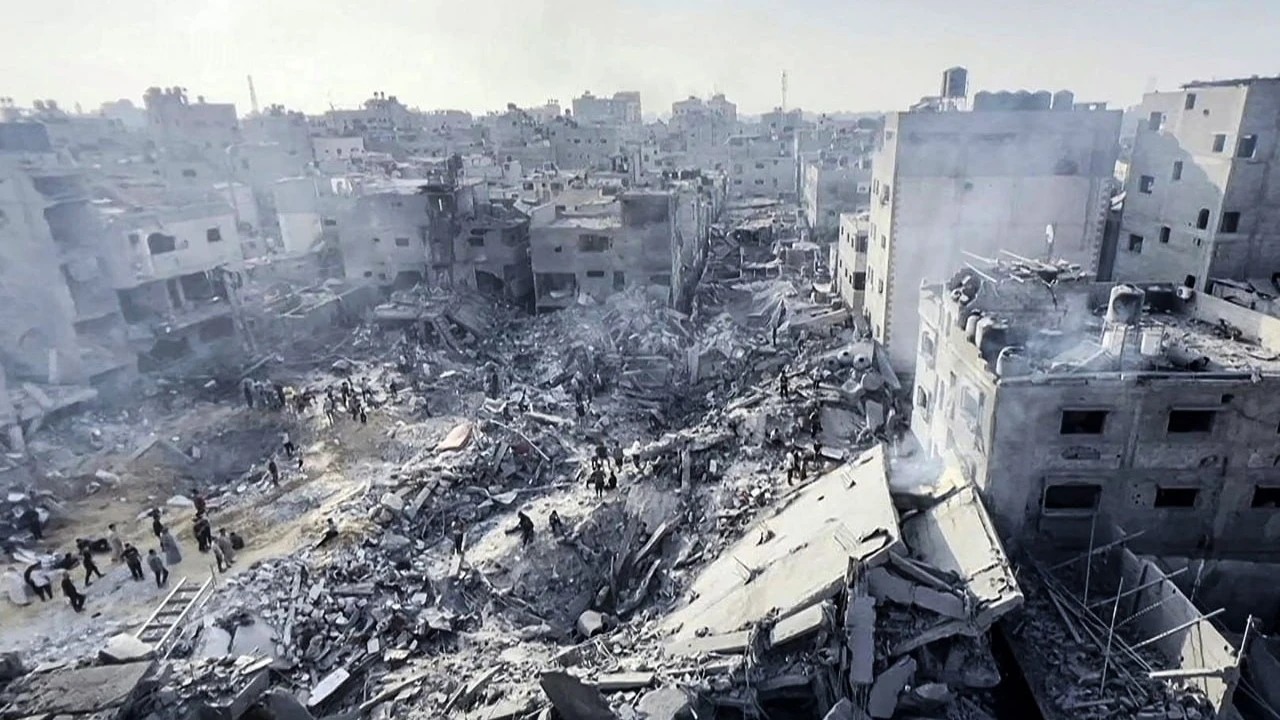
Israel continues to demolish homes and displace Palestinians in Gaza by dropping boxes of explosives on roofs using quadcopters
UK charity Oxfam released a report on 23 November documenting how Israel’s bombing of Gaza during its genocide of Palestinians has turned the occupied enclave into a “toxic wasteland, threatening human survival.”
The report, prepared in collaboration with the UK-based Conflict and Environment Observatory (CEOBS), found Israel’s bombing campaign affected 78 percent of Gaza’s land area, leading to potential contamination across more than 99 percent of the territory.
The report stated that “Israel’s destruction of Gaza through the extensive use of explosive and incendiary weapons has made air, soil and water dangerous to Palestinians now and for decades to come.”
As such, Israeli military actions resulted in “near-total geographical spread of pollution risks,” in a territory where nearly 2 million Palestinians continue to live amid the destruction.
“It is horrifying to realize the scale of toxic contamination facing the population. They have no way to escape and no ability to adequately protect themselves from these dangers,” stated Oxfam International Executive Director Amitabh Behar.
Israel’s destruction of Gaza’s civilian infrastructure has also contributed to the contamination of the enclave’s environment.
“Raw sewage is flowing into the sea and seeping into the ground, while the destruction of Gaza’s sanitation systems has left residents with virtually no protection from the contamination surrounding them,” Behar explained.
He added that “The resulting health consequences will be severe, with children and pregnant women among those most vulnerable to the risks,” in particular, a heightened risk of disease.
A new study finds toxic contamination across 99% of Gaza’s territory, with heavy metals, explosive residues and biological hazards threatening Palestinians’ health and environment for decades. https://t.co/uZWQTb57Rc
— Al Jazeera English (@AJEnglish) November 23, 2026
Oxfam warned that with international attention focusing on Gaza’s reconstruction through US President Donald Trump’s so-called Board of Peace, the strip’s environmental recovery is a vital undertaking that must be carried out in parallel.
The report provides a comprehensive picture of the environmental contamination from Israeli bombing using satellite-derived data, remote sensing analysis, and geolocated conflict incident databases.
Oxfam called for investigators to be allowed to enter Gaza to carry out a full, independent, field-based assessment to establish what contaminants are present, where they are found, and at what concentrations, to determine the risks they pose to people and the environment.
“Israel must end its genocide and siege of Gaza and allow unrestricted access for aid, environmental assessment, and essential equipment,” Oxfam concluded.
Over 75,000 Palestinians have been killed by Israel’s military actions since the start of the genocide in October 2023. Some 90 percent of the strip’s population has been displaced, with hundreds of thousands living in makeshift tent camps.
The United Nations Environment Program (UNEP) estimates that Israeli military operations have generated more than 61 million tonnes of debris throughout Gaza, turning its destroyed homes, neighborhoods, and infrastructure into an enormous repository of potentially hazardous materials.
🚨 DISTURBING: Israeli drones are dropping explosive boxes onto the remaining homes east of Gaza, preparing to demolish them in overnight explosions.
— Gaza Notifications (@gazanotice) November 22, 2026
Meanwhile, Israel’s military continues to displace Palestinians and demolish their homes using boxes of explosives dropped from quadcopter drones, Middle East Eye (MEE) reported on Saturday.
The UK outlet spoke with the family of Jaber Yaseen in the Al-Zaytoon neighborhood of Gaza City. Yaseen stated that as his family was preparing lunch, they heard a loud engine approaching.
“I thought it was an Israeli tank at first. I looked out of the window and was shocked to see a huge quadcopter drone carrying two boxes of explosives, flying low over our neighborhood,” he said.
“I watched the drone move towards us. Without any warning, it dropped the two boxes of explosives onto our roof. I was terrified for my children’s lives.”
As drones dropped explosives onto rooftops across the neighborhood, Yaseen and his family and other residents fled their homes in panic.
Minutes later, the boxes of explosives on the rooftops began detonating. After the initial explosions created openings in the roofs, large quadcopter drones continued to drop nearly 60 boxes of explosives inside each house.
The explosives were subsequently detonated, destroying more than 30 homes and damaging many surrounding buildings in Yaseen’s neighborhood.
MEE wrote that the attack on the Al-Zaytoon neighborhood marked a “new development” in Israel’s campaign to ethnically cleanse Gaza of Palestinians and replace them with Jewish settlers.