

Fueled by Global Far-Right, Anti-Muslim Sentiment Grows in Japan
Abstract: Anti-Muslim sentiment is growing in Japan, fueled in part by the spread of online disinformation. Focusing on opposition to a proposed mosque in the coastal city of Fujisawa, David McNeill examines the growing controversies surrounding mosques, Muslim cemeteries, and religious practices across Japan. He explores how Japan’s far-right activists and politicians have drawn support from transnational networks that amplify Islamophobic fears. As Japan increasingly relies on foreign workers to address labor shortages and population decline, these tensions raise broader questions about immigration, religious freedom, and the place of minority communities in contemporary Japanese society.
Keywords: Islamophobia in Japan, far-right nationalism, immigration, religious freedom, online disinformation.
The coastal city of Fujisawa was once a historic crossroads connecting Edo (old Tokyo) with Japan’s ancient capital, Kyoto. Today it is a flashpoint for growing tensions over competing versions of Japan’s future.
Plans to build a mosque on derelict land in a quiet part of the city have ignited protests by Japanese nationalists. “You won’t find many people around here who support it,” says an elderly woman who lives behind the proposed site.
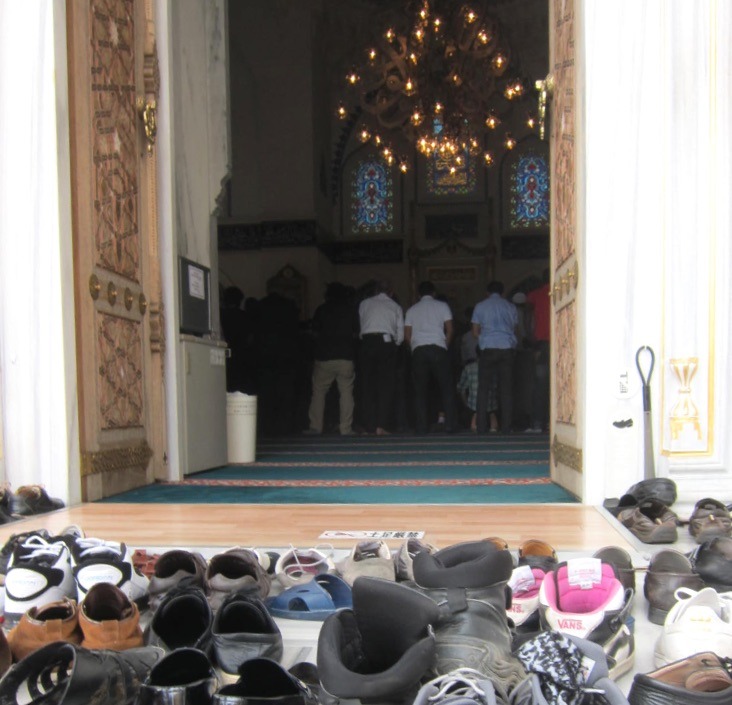
Muslim cultural centers and mosques across Japan have reported a surge in threats, hate mail and online harassment. Right-wing politicians have criticised the growing presence of mosques and Muslims on Japanese streets.
Harassment is stoked by rampant disinformation. Baseless online stories about Muslims in Japan setting fire to pig farms and Shinto shrines have collectively racked up 83 million views, according to a recent probe by public broadcaster NHK.
A local education board in Japan’s south-west was hit last year by protests after an online campaign falsely claiming that schools would serve halal lunches to Muslim children. A proposed Muslim cemetery in the country’s north-east has been abruptly scrapped after protests.
Local disputes over mosques and religious practices in Japan are being amplified abroad, says the Washington DC-based nonprofit, the Center for the Study of Organized Hate. Far-right actors and influencers outside Japan pick up on local controversies, it says, “reframing them as evidence that Japan is facing the threats of Islamization, demographic replacement and cultural displacement that they claim are unfolding across Europe and North America.”
The center cites a parliamentary speech decrying Muslim burial rites by far-right Japanese politician Mizuho Umemura, which racked up millions of global views. Umemura said the practice of burying the dead upends cultural tradition in crowded Japan, where most bodies are cremated.
Politicians have tried to build careers by stirring up scholars call “cultural fear” around Islam, says Shinji Kojima, an associate professor at Ritsumeikan Asia Pacific University. The fear finds fertile ground in conservative rural areas “where the need for foreigners to stem population decline sits uneasily with some.”
Protests in April against the Fujisawa mosque were led by Yusuke Kawai, a small-time politician who also targets Kurds and other foreigners. Before switching to battling immigration, Kawai was known for dressing up in full face paint and a red suit, to resemble the Joker from Batman.
“Japanese politicians have joined the ranks of populist far-right politicians who have openly voiced anti-immigrant sentiments in the U.S., Europe and Latin America,” notes Kojima. “Like many countries, Japan is facing a national identity crisis and that is affecting how people see immigration.”
Growing Muslim Population
The number of Muslims in Japan has more than tripled to 420,000 (about 0.3% of the population) since 2010, largely thanks to a wave of immigration from Indonesia, Bangladesh and Pakistan (Muslims make up about 1.6% of the population in the Republic of Ireland).
But singling out Muslims is unfair and risks turning a policy debate into stigmatization of one religious community, says Vakkas Çolak, a Tokyo-based Kurdish scholar.
“Japan already has churches, temples, shrines and mosques. If there are legitimate concerns about immigration, integration or public policy, those issues should be discussed directly. Focusing selectively on Muslims does not solve the underlying questions.”
Çolak says Japan should also confront the contradiction between relying increasingly on foreign workers to address labor shortages while allowing public debate to repeatedly target particular minority groups.
“Today it may be Kurds or Muslims. Tomorrow it could be Vietnamese, Nepalese or another community. A society cannot invite people to work, live and contribute, and at the same time treat them as a problem simply because of their ethnicity, nationality or religion.”
Opponents of the Muslim influx are currently celebrating a victory over an illegally built mosque in Saitama, north of Tokyo. Building inspectors locked in dispute for two years with the Pakistani owners of the mosque have ordered it to be pulled down. Pakistan’s ambassador to Japan attended the mosque’s opening ceremony in April.
Fujisawa
Local people in Fujisawa cite a string of concerns about the proposed mosque, from heavier traffic to the “noise from prayers”. Few agree to go on the record. “There’s a primary school not far from here so we worry about the safety of children,” said the owner of a machine-hire business next door to the site.
Most of these fears are not based on any real threat, says Kojima.
There is no organized radical Islamic movement in Japan. The last known incident was in 1991, when the Japanese translator of Salman Rushdie’s novel The Satanic Verses was stabbed to death.
“It’s caused by a general sense of fear because most people have no regular contact with foreigners or Muslims,” says Kojima. “People are susceptible to the case of one bad actor and may generalize about criminal behavior by all.”
David McNeill is a professor at the Department of English Language, Communication and Cultures at Sacred Heart University in Tokyo. He was previously a correspondent for ‘The Independent’ and ‘The Economist’ newspapers and for ‘The Chronicle of Higher Education’. He is co-author of the book ‘Strong in the Rain‘ (with Lucy Birmingham) about the 2011 Tohoku disaster and ‘Japanese Rebels‘ (2026) with Stephen McClure. He is an ‘Asia-Pacific Journal’ editor.
Japan is only mimicking Western “values.” But what are these precious Western values in practice? In this case, racism, xenophobia, and Islamophobia–disguised behind the mask of democracy, freedom, rule of law, or similar propaganda. Welcome to the Westoid club. Japan is now an honorary Westoid nation. But that is not… Read more »