

Winter floods displace 100,000 Palestinians in Gaza amid dire humanitarian conditions
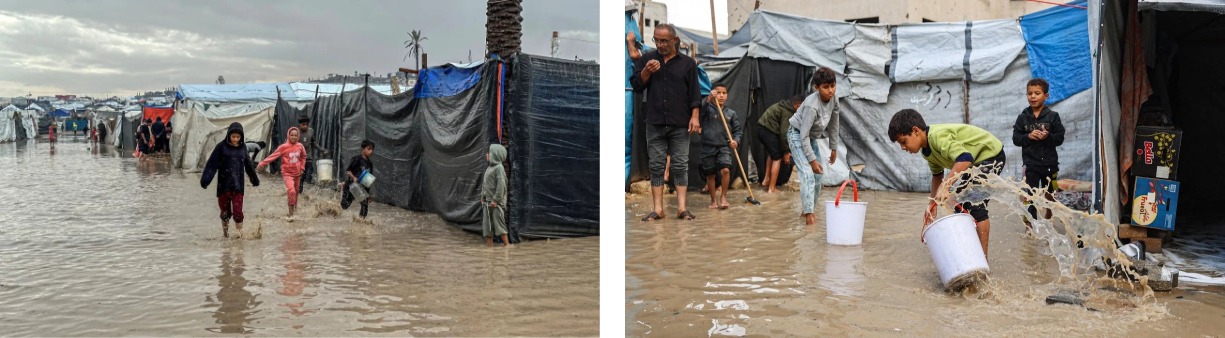
Israel’s destruction of more than 220,000 meters of sewage pipes and around 15,000 meters of stormwater drains has cut Gaza City’s drainage capacity by over 80 percent, leaving floodwater laced with sewage pooling inside tents.
A powerful winter storm swept through Gaza on 7 November, flooding thousands of tents and driving displaced Palestinian families into the cold, while Israel continues to block tents and shelter materials from entering the besieged enclave. Winter floods in the besieged Gaza Strip have displaced at least 100,000 Palestinian civilians, Oxfam’s Gaza representative said on 9 November – as the Israeli siege continues to prevent essential aid and supplies from entering the enclave. Gaza authorities hold Israel fully responsible as 70,000 tents flooded in just 12 hours and war-damaged buildings continue to collapse across the Strip. Oxfam has warned that displaced Palestinians have nowhere to go, as winter storms continue to flood displacement tents.
The Government Media Office held Israel fully responsible for the catastrophe, citing its continued closure of the crossings and its ban on shelter and essential reconstruction materials. In October, the office reported that Israel had allowed in only 72,826 of the 210,600 aid and reconstruction trucks pledged under the so-called “ceasefire,” less than 35 percent, and that around 162,000 of the roughly 270,000 tents sheltering more than 1.5 million displaced Palestinians were no longer usable.
“Severe flooding has displaced around 100,000 people in Gaza. Israel is restricting access to shelter materials and has rendered 65 percent of Gaza off-limits. People have no safe place to go,” said Oxfam’s Wassem Mushtaha on Monday. “Israel’s ongoing genocide has resulted in the near collapse of all functioning systems in Gaza. Governments must insist that Israel allows for unimpeded access to recovery and repair materials to restore essential infrastructure and ensure Palestinian-led reconstruction efforts across Gaza,” he added. He went on to say that urgent access to aid and supplies, including spare parts, engine oil, pipes, and heavy machinery, is needed to “avoid more people killed this winter.”
Heavy rains flood Gaza’s tent camps, thousands exposed to severe cold and collapsing shelters
——
Torrential rain from winter storm Byron has flooded Gaza’s tent camps, submerging tens of thousands of flimsy shelters in mud, rainwater, and sewage after Israel’s destruction of basic infrastructure left displaced families with no protection.Children and the elderly are now exposed to freezing winds, rising water levels, and collapsing sanitation systems as medical points, roads, and temporary water networks fail.
Last night, eight-month-old Palestinian infant, Rahaf Abu Jazar, died from severe cold in a rain-soaked tent in Khan Yunis.
Aid groups warn the conditions are “unlivable,” saying the disaster was preventable but Israel continues to block essential shelter materials.
Gaza authorities say 300,000 tents and housing units are urgently needed, yet only 20,000 have been allowed in by the Israeli blockade.
— The Cradle (@TheCradleMedia) December 11, 2025
Meanwhile, attacks on the strip continue unabated. Several injured Palestinians arrived at the American field hospital west of Jabalia refugee camp on Monday, after Israeli drones targeted a group of civilians near Abu Sharkh Roundabout.
Thousands of tents have been completely flooded, according to Gaza’s Ministry of Social Development. “The shelter crisis has sharply worsened as a result of the Israeli occupation army’s relocation of what it calls the Yellow Line and the narrowing of the areas available for displacement,” it said on 8 November, referring to Israel’s continuous territorial expansion across Gaza. It also called for an immediate end to the siege so that much-needed mobile homes and other supplies can enter Gaza. On Sunday, a sand embankment in central Gaza collapsed, crushing displacement tents and killing five Palestinians, including four children.
“The policies of siege and preventing the entry of aid, tents, and reconstruction materials have exacerbated the humanitarian tragedy and caused repeated disasters affecting civilians,” Hamas said in a statement, adding that Israel bears responsibility for the deaths.
Since the so-called October 2025 ceasefire, 1,613 Palestinians have been killed, according to the Gaza Health Ministry. Additionally, the number of deaths caused by building and sand embankment collapses has risen to 56, the ministry says. Thousands of additional buildings also risk collapse.
UNRWA said its shelter supplies are ready for distribution but cannot reach those in need, as Israel keeps barring tents and mobile housing units in violation of its commitments under the October 2025 ceasefire.
The UN migration agency (IOM) had warned back in early October that Israel’s siege would leave nearly all of Gaza’s population without adequate shelter this winter, with the El Niño weather pattern expected to bring heavy rains and flooding. IOM Director General Amy Pope said at the time that nearly two million Palestinians required shelter assistance, while the supplies aid groups held or had en route could cover only 17 percent of winter needs. About 8,600 IOM shelter kits sat outside the Strip, locked out by Israel’s repeated rejection of shipments at the crossings. “The solutions are known, the supplies are ready, and humanitarian teams are prepared to deliver,” Pope said, four weeks before the first storm of the season battered Gaza.
“Women and children are stuck and can’t get out!” A reporter wades through floodwater more than half a metre deep on al-Jundi al-Majhool Street in Gaza City’s al-Rimal district on November 7, 2026, after the first winter storm hit the Strip. Shops are swamped, cars are submerged, and the tents of displaced families have turned into pools of rainwater mixed with sewage. This is the fourth winter Gaza’s displaced have faced in tents. The Israeli occupation destroyed their homes along with more than 220,000 metres of sewage pipes and around 15,000 metres of stormwater drains, cutting the city’s drainage capacity by over 80 percent. A year into the ceasefire, it still restricts the entry of tents, tarps, caravans and the machinery municipalities need to pump the water away.
khames.hasira anaszeno7 (IG)
— Translating Falasteen (Palestine) (@translatingpal) November 7, 2026