

US pushes militarization of ‘First Island Chain’ during ASEAN defense summit
US pushes militarization of ‘First Island Chain’ during ASEAN defense summit
According to a report by Anadolu Agency, US War Secretary Pete Hegseth met with his counterparts from Australia, Japan, and the Philippines today in Cebu City to expand operational military cooperation along the “First Island Chain.”
Speaking on the sidelines of the 20th ASEAN Defense Ministers’ Meeting, Hegseth declared that Washington is advancing “beyond words to practical cooperation” in order to fortify western military posture and enforcement across the Pacific.
The high-level talks in the Philippines featured intense US diplomatic pressure to institutionalize an “ambitious” defense framework between Washington and the 11-member Association of Southeast Asian Nations (ASEAN).
Addressing regional defense chiefs, Hegseth outlined an aggressive strategy aimed at maintaining a western-dominated “balance of power,” explicitly pitching joint maritime patrols and forward military readiness under the guise of “peace through strength.”
While Hegseth held separate bilateral sessions with defense officials from South Korea, India, Singapore, Malaysia, and Vietnam, Chinese Defense Minister Dong Jun notably skipped the Cebu gathering.
The absence of Beijing’s top military official underscores mounting regional resistance against US efforts to draw Southeast Asian states into multilateral containment alliances targeting China.
—
This is however not coming from nowhere. These planning graphs were published by Geopolitics Prime on their substack.
Iran war prompts US strategists to propose scaling back Indo-Pacific military presence
US security analysts are now weighing a once-unthinkable shift: pulling forces from the first island chain in the Western Pacific Ocean to the second.
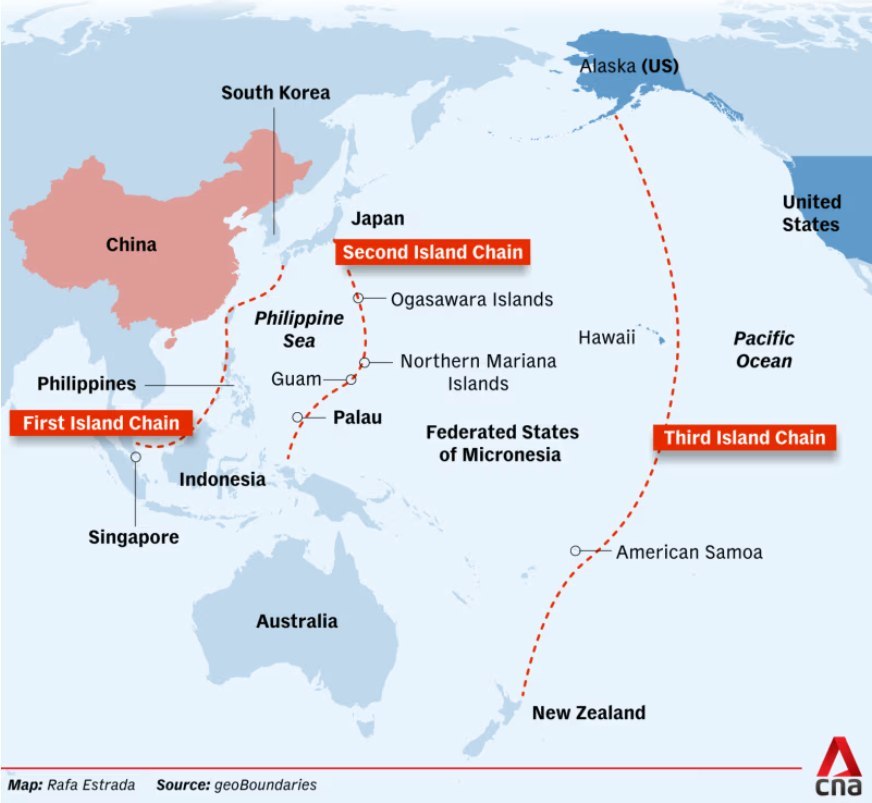
The First and Second Island Chains are strategic island arcs in the Pacific, running from Japan through Taiwan and the Philippines, and farther east through Guam and Micronesia, respectively.
The Quincy Institute’s scholars argued on October 23 that withdrawing US forces to the Second Island Chain would be a strategic folly. More intriguing, however, is that the opposing view is backed by Jennifer Kavanagh, former director of RAND’s Army Strategy program.
In an extensive report for Defense Priorities, Kavanagh outlined a US military strategy centered on the Second Island Chain in Asia, proposing to:
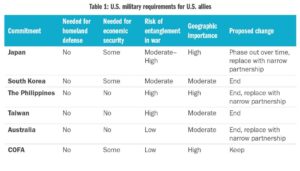
➡️ Withdraw most US forces from Taiwan, South Korea, the Philippines and Japan, where they remain vulnerable in a potential conflict with China
➡️ Replace treaty alliances with South Korea, the Philippines and Australia with ad hoc partnerships, and end the US commitment to Taiwan
➡️ Scale back nuclear guarantees, including protection under the US nuclear umbrella
➡️ Shift the strategic focus to the Compact of Free Association (COFA) states – Palau, Micronesia and the Marshall Islands – and Guam
➡️ Deploy unmanned aerial and maritime vehicles
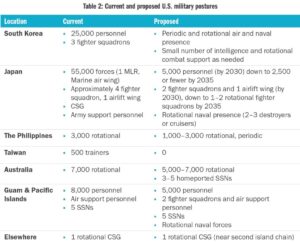
➡️ Phase in the changes over three to eight years, completing most by 2030 and all by 2035
Kavanagh argued that US interests require only a modest regional air and naval presence, viewing the 90,000 troops stationed near China – including 55,000 in Japan and 25,000 in South Korea – as a costly vulnerability.
Given her longstanding ties to RAND and the US foreign policy establishment, her proposal may reflect an emerging strategic rethink following the Iran war, which devastated US military bases in the Gulf.
In combination with Brian Berletic’s article posted today, it is clear that the posture of Global Dominance is not neglected for one moment in the US. In fact it is becoming clear that the US and Israeli elites are fully involved in the project of primacy despite the wishes of their own populations. We saw this in the recent Brazilian election, and now we have some information a to what is happening in South Asia. As you go through the news of the day and the many videos and writings, this is the only litmus test. Is it a project for primacy and global dominance, or is it not. Jangjo, our valued contributor expressed that he is unsure of the objectives or even the reason for the agreements standing up in West Asia combined with countries from South Asia countries. I will go out on a limb and state that these agreements and outlining the piece of primacy that these agreements want to grab, but mostly everything is stated as if it is a project of sovereignty. This is true also of the new proposal given to Iran, by Pakistan and Qatar. We have a long way to go unless a friendly Black Swan event lands in our chaos swamp.
—
There is some more news coming out of the ASEAN Defense Ministers’ Meeting
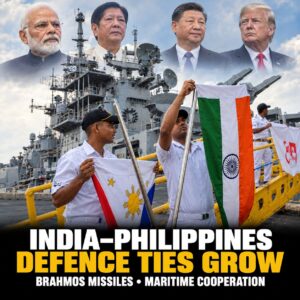 India-Philippines Defence Ties Strengthen Amid South China Sea Tensions
India is expanding defence and maritime cooperation with the Philippines as tensions continue in the South China Sea. As part of this partnership, India has supplied BrahMos supersonic anti-ship missiles to the Philippines, while both countries are increasing maritime information-sharing and naval cooperation.
According to Asia Times, the partnership strengthens the Philippines’ ability to monitor maritime activity and deter potential threats, while also supporting US strategic objectives in the Indo-Pacific.
For India, the relationship creates opportunities to expand defence exports and advance its Act East Policy. For the Philippines, it provides an additional source of military capability and strategic support.
The bigger picture: As strategic competition between China and the United States intensifies, regional countries are diversifying their defence partnerships.
Source: Asia Times