

Ben Norton : Lula’s reelection in Brazil is win for BRICS & Palestine, loss for US, Israel, & dollar
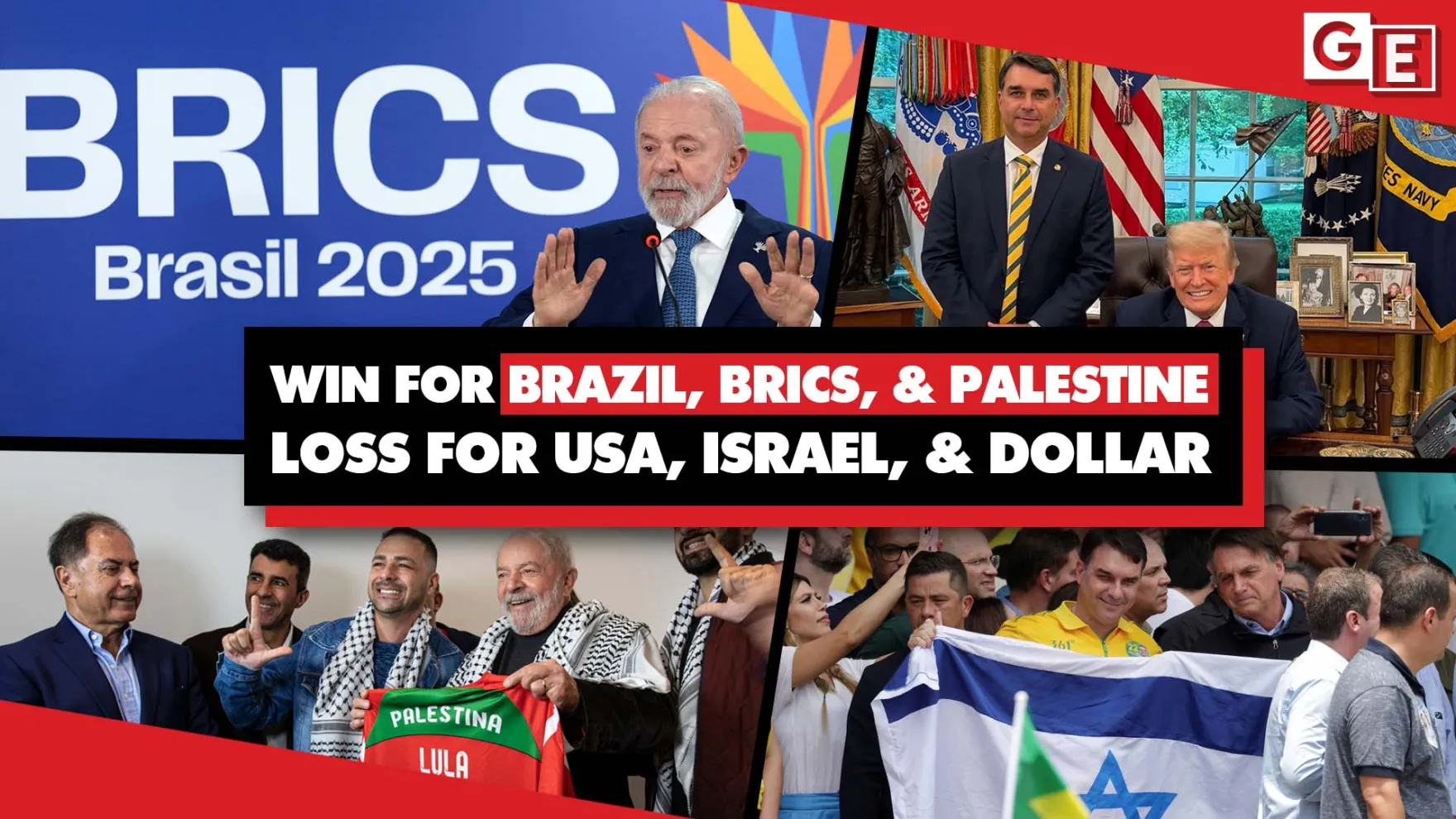
The historic re-election of Lula da Silva in Brazil is a victory for BRICS, Palestine, Latin America, and the Global South, and a blow to the United States, Israel, oligarchs, and dollar hegemony.
The historic re-election of President Lula da Silva in Brazil is a victory for BRICS, Palestine, the Brazilian working class, the project of Latin American integration, and the Global South.
It is a significant blow to Israel, US dollar hegemony, and the US government’s attempt to impose its control over Latin America — in what the Donald Trump administration calls the Donroe Doctrine.
It also severely undermines Washington’s plan to exploit Brazil’s critical minerals and rare earths, which the US sought to use to create a new global supply chain that excludes China.
In Brazil’s presidential runoff on 25 October, Lula won with nearly 52% of votes, compared to a bit over 48% for far-right candidate Flávio Bolsonaro.
The 2026 presidential election in Brazil has major implications not only for Latin America, but for the entire world.
Brazil is the seventh-most populous country on Earth, with a population of more than 213 million people.
Brazil also has the world’s eighth-biggest economy — larger than the economies of the United Kingdom and France.
Brazil plays an important role in international politics, as a powerful diplomatic force. And it is a top 10 global producer of oil, agricultural goods, and critical minerals.
Lula advocates for BRICS, Latin American integration, Global South unity, and Palestine
What was striking about Brazil’s 2026 election was how the two main presidential candidates represented completely opposing political projects.
Lula is a left-wing politician from the Workers’ Party. He comes from a poor background and worked for years as a labor organizer. In fact, he lost a finger in a factory accident when he was 17 years old.
Lula is also a strong supporter of the project of Latin American regional integration, advocating for organizations like the Community of Latin American and Caribbean States (CELAC), Unasur, and Mercosur. Brazil is absolutely integral in this process, as the biggest country in the region.
Lula has long promoted a non-aligned foreign policy, and he wants Brazil to deepen its collaboration with other countries in the Global South.

In the spirit of Global South solidarity, Lula has staunchly supported Palestine. The Brazilian president has accused Israel of committing genocide against the Palestinian people in Gaza (a charge supported by a UN independent international commission). He even compared the Israeli regime to Nazi Germany.
Back in 2009, during his first term as Brazilian president, Lula played a crucial role in co-founding BRICS. (It was originally called BRIC, before South Africa joined in 2010.) He has since pushed for the expansion of the organization.

Lula was a co-founder of BRICS in 2009
Lula has also openly challenged US hegemony. He has publicly called for Global South countries to work together to oppose the dominance of the US dollar. He even proposed that BRICS should create a new, neutral international trading currency.
Lula likewise advocated for a regional currency in South America, to end the region’s dependence on the US dollar.
In short, Lula’s leadership has been indispensable in promoting a more multipolar world, in which Global South countries have more representation, resources, and dignity.
The Bolsonaros serve the interests of the United States and Brazilian oligarchs
The other major candidate in Brazil’s presidential election could hardly have been more different.
Flávio Bolsonaro is the son of Brazil’s far-right former leader Jair Bolsonaro. Jair could not run for president again, because he organized a military coup after refusing to accept his loss to Lula in the 2022 election.
Jair Bolsonaro, a former military officer, admitted in court that he conspired with the military to try to hold on to power. However, his coup attempt failed, and he was sentenced to 27 years in prison. (Although he has not actually been sent to prison, and has instead been allowed to live under house arrest, from which he has tried to flee.)
The Bolsonaro political dynasty is as pro-US as possible. When he was president, Jair Bolsonaro served Washington’s interests above those of his own country.
Flávio is also very closely allied with Donald Trump. He even traveled to Washington during his campaign in order to pose for a photo op with the US president at the White House.

Flávio Bolsonaro pledged to sabotage the project of Latin American regional integration, subordinating Brazil to the United States.
He also sought to limit Brazil’s engagement in BRICS and destabilize the Global South-led organization.
Inside Brazil, the main support base for the Bolsonaro political dynasty are the country’s enormous landlords.
Brazil is a commodity powerhouse that exports many food stables, like soy beans, coffee, beef, sugar, and corn.
Brazil’s agriculture sector is dominated by massive corporations, which are led by oligarchic landowners who are overwhelmingly right-wing.
These landlord oligarchs have funded the Bolsonaro family for years.
The Bolsonaro dynasty is also deeply implicated in corruption. Between 1990 and 2022, the family bought at least 107 properties, 51 of which they purchased with cash.
Israel backs Brazil’s Bolsonaro dynasty
Another major patron of the Bolsonaro dynasty has been Israel.
When Jair Bolsonaro was president, he would regularly appear at political events surrounded by the US and Israeli flags. Flávio and his supporters have done the same.

In January, Flávio Bolsonaro traveled to Israel, where he met with the regime’s leader Benjamin Netanyahu — who faces an outstanding arrest warrant from the International Criminal Court, which charged him with carrying out crimes against humanity against the Palestinian people in Gaza.
Flávio Bolsonaro is so close to Israel that, when he launched his presidential campaign in Brazil in July 2026, Netanyahu spoke in a video message on a giant screen behind him.
During his trip to Israel in January, Flávio and his brother Eduardo traveled with Israeli settler-colonialists to the West Bank, which according to international is Palestinian territory that has been illegally occupied by Israel for decades.
While there, Flávio Bolsonaro said he supports Israel annexing the West Bank. He even posed for a photo with a map showing Israel colonizing all of historic Palestine, including the West Bank and Gaza.

The Bolsonaros flee to the United States, evading justice for their crimes
After losing the election to Lula this October, Flávio Bolsonaro fled Brazil and traveled to the United States. The Trump administration confirmed that it arranged a visa for him and his family.
Flávio was under criminal investigation in Brazil, based on well substantiated charges of money laundering and corruption.
His brother Eduardo, a far-right former politician, also fled to the US. Eduardo is a fugitive from justice who faced legal consequences after assisting his father in his failed coup attempt against Lula.
While living in the United States, Eduardo Bolsonaro has been working closely with Trump’s far-right MAGA political movement.
In fact, when Flávio met with Trump at the White House, he was joined by Eduardo.

After Jair Bolsonaro’s coup attempt failed, he also fled to the United States. He lived for several months in Florida.
Jair Bolsonaro said his son Eduardo is even seeking US citizenship.
The United States meddled in Brazil’s election to hurt Lula, but failed
The United States blatantly meddled in Brazil’s 2026 election, in an attempt to prevent Lula from staying in power.
Employees of Meta, the US Big Tech corporation that owns Facebook, Instagram, and WhatsApp, admitted that the company censored Lula’s accounts in the lead-up to the first round of the October election, while simultaneously promoting Flávio Bolsonaro.
The media outlet Intercept Brasil reported that Flávio Bolsonaro and his right-wing party contracted a US company that sought to manipulate the election by using AI technology to create false accounts on social media, spreading disinformation demonizing Lula, the Workers’ Party, and left-wing politicians.
Donald Trump also put his thumb on the scale. He hit Brazil with punitive tariffs of as high as 50%. The US leader admitted that these measures were not due to a trade dispute, but were rather politically motivated, aimed at supporting the Bolsonaro family. (Ironically, the US has a chronic trade surplus with Brazil, not a deficit.)
Nevertheless, the overt US interference may have backfired, because Lula repeatedly condemned it during the presidential campaign, insisting that voters should back him in order to defend Brazil’s sovereignty.
Lula warned that the United States was trying to “colonize” Brazil.
The Bolsonaros sought to privatize Brazil’s oil industry and give its rare earth minerals to the US
It was not just Brazil’s political system that the United States wanted to control, but also its natural resources.
Brazil has consistently been among the world’s top 10 oil-producing countries. It has enormous reserves of petroleum.
When Jair Bolsonaro was president, he said he wanted to privatize Brazil’s state-owned oil giant Petrobras. He would likely have done so, if he had won the 2022 election.
Flávio Bolsonaro similarly pledged to deregulate Brazil’s state-dominated oil sector, offering US corporations access to his country’s natural resources.
Moreover, Brazil is home to huge supplies of critical minerals. It is the second-biggest producer of iron ore on Earth (after Australia).
Brazil also has the world’s second-largest reserves of rare earths, representing 23% of the known global supply.

The United States is especially interested in exploiting Brazil’s rare earths, because it is dependent on China for the materials.
China holds half of the world’s reserves of rare earths, and processes nearly 70%.
The US government has sought to create a new supply chain for critical minerals, cutting out China. Brazil was in its sights as the potential alternative.
The CEO of an Australian mining corporation told German news outlet DW this May, “The next big, rare earth projects in the world will be in Brazil”.
DW noted that, this April, a Brazilian mining company sold Brazil’s sole active rare earth mine to the corporation USA Rare Earths for $2.8 billion.
What DW did not mention is that USA Rare Earths is partially owned by the US government. The Trump administration took a 10% equity stake in the company.
In other words, a US government-backed company is already exploiting Brazil’s rare earth minerals. And it wanted much more.
Flávio Bolsonaro publicly pledged that he would give Brazil’s rare earths to the United States.
In a speech at the Conservative Political Action Conference (CPAC) in the US this March, he declared, “Brazil is the solution for the United States to no longer depend on China for rare earths and critical minerals”.
Lula, on the other hand, wants Brazil to use its natural resources to benefit its own development, not US corporations and shareholders.
The New York Times reported that the Trump administration has pressured Brazil to join its efforts to create a new anti-China supply chain for rare earths, but Lula is not interested.
Related Posts
-

Iran, Israel, Islam, Judaism – a Chinese history
March 8, 2026 -
Alastair Crooke & Judge Napolitano : Israel Losing US Support Fast
September 29, 2025 -

The War & Genocide Thread
August 13, 2025 -

Strategic Miscalculations and Moral Reckoning: The Iran-Israel Conflict and the Path to Peace.
July 4, 2025 -
“Phony War” in the Middle East: Some Conclusions
June 24, 2025 -

Israel / Iran war update
June 20, 2025 -

‘Israeli’ Censorship Regime Immediately Blows Up
June 19, 2025 -

Israel / Iran war update (Russia and China – Victor Gao – view)
June 19, 2025 -

Israel Strikes Iran: Iran strikes back spectacularly
June 14, 2025 -

Netanyahu’s coalition is about to collapse
June 6, 2025