

H.E. Wang Yi : The 2026 Global Governance Forum
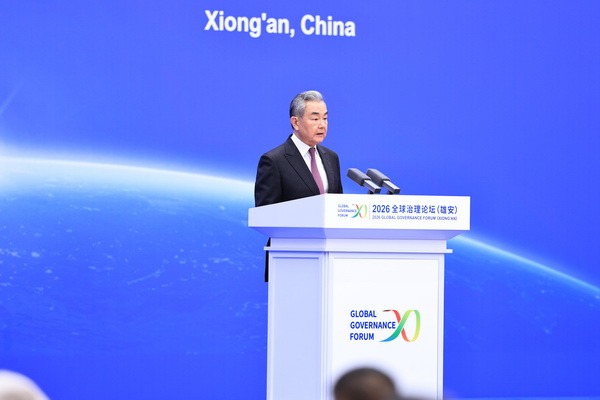
Keynote Address by H.E. Wang Yi at the Opening Ceremony of The 2026 Global Governance Forum (Xiong’an)
Pooling Wisdom and Efforts for Global Governance
To Build Stability and Capacity in a Volatile and Changing World
Keynote Address by H.E. Wang Yi
Member of the Political Bureau of the CPC Central Committee and
Minister of Foreign Affairs
At the Opening Ceremony of
The 2026 Global Governance Forum (Xiong’an)
Xiong’an, October 23, 2026
Distinguished Guests,
Dear Friends,
Good evening. As we mark the one-year anniversary of the Global Governance Initiative (GGI), I am delighted to meet friends from across the world in Xiong’an New Area to talk about global governance and the vision of building a community with a shared future for humanity. At the outset, I wish to extend, on behalf of the Chinese government, a hearty welcome to all the guests, and warm congratulations on the opening of the inaugural Xiong’an forum.
President Xi Jinping attaches great importance to this forum, and sends a message. President Xi’s message further outlines the great significance of reforming and improving the global governance system, sets the direction for the GGI’s implementation, and states China’s commitment and readiness to work with all countries for a more just and equitable world. It also provides valuable impetus for the international community to pool wisdom and efforts for tackling the problems and challenges confronting us.
At a crucial moment a year ago, when the postwar international order faced serious challenges and global governance risked falling behind, President Xi launched the GGI—a much-needed initiative that offers solutions to bridge the governance deficit and build a better future. Since the launch of this historic initiative, its core tenets have gained traction, its implementation progressed steadily, and its appeal and impact kept growing. The GGI has become an important public good warmly embraced by the international community.
The past year has underscored the great contemporary value of the GGI. It has been endorsed by more than 160 countries and international organizations. Over 60 countries have joined the Group of Friends of Global Governance. Its core elements have been incorporated into the documents of multilateral fora such the G20, the Shanghai Cooperation Organization, and BRICS. Inspired by the GGI, more than 100 countries sent their representatives to the U.N. Security Council high-level meeting on global governance, and agreed to revitalize, reactivate and strengthen the United Nations. The international community regards the GGI as a stalwart for multilateralism as the international landscape is undergoing profound shift, and a safeguard for fairness and justice as the law of the jungle makes a comeback. To many in the world, the GGI provides a clear pathway to shared development and security and much-needed certainty for a turbulent world.
The past year has recorded China’s growing contribution to global governance. We actively applied a Chinese approach to settling hotspot issues. President Xi Jinping laid out a series of proposals for safeguarding and promoting peace and stability in the Middle East. China always stands for fairness and justice in international and regional issues, and supports ceasefire and cessation of hostilities. We stayed committed to open and common development. China has foregone new special and differential treatment in ongoing and future WTO negotiations. China has also provided comprehensive zero-tariff access for all African countries and least developed countries having diplomatic ties with China, leading to a significant increase in African exports to China. We actively provided new public goods. The International Organization for Mediation has successfully settled international disputes. The World Artificial Intelligence Cooperation Organization initiated by China has taken a clear stand to advance AI for good and for all humanity.
The past year has seen rising international expectations for China to play a bigger role. Regarding the future of the global governance system, the world faces two stark choices: the one exalts strength, favors self-interest, monopolizes power, and practices double standards, while the other champions multilateralism, and upholds sovereign equality, mutual respect and international law. The GGI launched by President Xi is widely regarded by people of foresight around the world as a remedy for and improvement on the existing international system, and a crystallization of Chinese wisdom that will shape a fairer, more inclusive and more sustainable world. Various polls indicate that international public perception of China has risen significantly over the past year. The rise is partly driven by a strong recognition of China as a force for stability and progress, and a high regard for the GGI that China has launched and acted on.
Dear Friends,
Momentous transformations not seen in a century are unfolding before our eyes at a faster pace. While unilateralism and bullying resurge and the governance deficit widens, our world is decidedly moving toward multipolarity and greater democracy in international relations. This is the trend of our times and the trajectory of history, overwhelming and unstoppable. Humanity is woven together by intertwined interests and a shared future. We should unite as one, rise to the challenges, and take proactive, strong and persistent steps to make the GGI a full reality.
Together, we should uphold the central role of the United Nations. Eighty-one years ago, the U.N. Charter officially came into force. Since then, the U.N. has traveled an extraordinary journey of safeguarding international peace and development, and become an indispensable platform at the center of global governance. The more turbulent our world becomes, the more important it is to recommit to the founding mission of the U.N. Charter, hold high the torch of multilateralism, and defend the authority of the U.N. We should rally under the U.N. flag to build greater global consensus, better mobilize global resources, and coordinate global actions more actively. We should also work in unison to implement the U.N.80 Initiative, enhance the rapid response capacity of the Security Council, and respond to the legitimate concerns of developing countries, so that the U.N. will be reinvigorated through self-reform.
Together, we should practice the values of fairness and justice. Fairness and justice underpins lasting security, and mutual respect makes for harmonious coexistence. Every country, regardless of its size or strength, has the right to independently choose a social system and development path that suits its national conditions and meets the needs of its people—they also have the right to participate as equals, make decisions as equals, and benefit as equals in the process of global governance. All countries should stand for fairness and justice, and major countries must set an example in upholding equality, credibility, moral principles and cooperation: this is the only way to bring about a world where all countries coexist in harmony and all nations thrive in mutual appreciation. All parties should embrace the vision of common, comprehensive, cooperative and sustainable security, and settle disputes peacefully: this is the only way to safeguard international peace and protect our common home.
Together, we should bolster the strength of the Global South for better global governance. The rise of the Global South is the most momentous shift the world has seen since WWII; it reinforces and expands the force for good on the international stage. In keeping with this shift, the Global South must enjoy greater representation and say in international affairs. This will not only correct a historical injustice, but also provide a wealth of ideas for improving global governance. The reform of the international financial system should not remain stagnant; the democracy deficit in global financial governance must be narrowed in line with the agreed time frame and road map. The reform of the U.N. Security Council should move in the right direction, namely increasing the representation of developing countries, making it a priority to meet Africa’s aspiration through special arrangements, and involving more small and medium-sized countries in global decision-making. The role of Global South cooperation mechanisms, such as BRICS and the Shanghai Cooperation Organization, will be harnessed to inject more dynamism into the process of global governance reform.
Together, we should advance in the direction of openness and development. In today’s world, countries have been integrated into a community of intertwined interests. The imbalances brought by economic globalization can only be resolved through development; protectionism will only make matters worse, while openness and cooperation lead to a better future. International trade is a key engine of global growth; the WTO-centered multilateral trading system must be firmly safeguarded, and a fairer and more open economic and trade order must be fostered. For development to be genuine and lasting, it must be shared; to narrow the yawning North-South gap, we should put development firmly at the center of the international agenda, stay focused, and fully implement the 2030 Agenda for Sustainable Development.
Together, we should improve the rules of governance in emerging fields. Global governance must keep pace with the rapid evolution of human society. The new frontiers—such as the deep sea, polar regions, and outer space—are the common heritage of humanity and represent the forefront of future development, yet there is a lack of governance and rules that must be addressed. We should embrace the principle of peace, sovereignty, inclusiveness and joint governance, and transform the new frontiers from arenas of zero-sum competition into areas of international cooperation. AI is advancing by leaps and bounds. We should take a people-centered approach and develop AI for the good of humanity, and evolve a governance structure based on general consensus soon, so as to make sure this frontier technology is kept under human control and benefits humanity.
Dear Friends,
Global governance serves the common interests of all nations, and requires the collective effort of the international community. This year marks the 55th anniversary of the restoration of the People’s Republic of China’s lawful seat in the United Nations. As a founding member of the U.N. and a permanent member of its Security Council, China asks all countries to work together and make relentless efforts to build a more just and equitable global governance system. In support of this goal, I wish to announce the following practical actions to be taken by China:
First, China will deliver a successful APEC Economic Leaders’ Meeting in November. We will push for more outcomes around the three priorities of openness, innovation and cooperation, and work with other APEC economies toward building an Asia Pacific community and the Free Trade Area of the Asia Pacific.
Second, China will remain deeply engaged in advancing U.N. reform. We support efforts of the U.N. to streamline itself, improve efficiency and deliver more results, so as to better fulfill its mandate, serve the Member States, and rise to global challenges.
Third, China will encourage the Group of Friends of Global Governance to play a bigger role. We will organize more activities focusing on the nine priorities of global governance reform. We welcome more like-minded countries to join the Group and participate in its activities.
Fourth, China will work for the full and effective implementation of the BBNJ Agreement. As one of the first States Parties to the Agreement on the Conservation and Sustainable Use of Marine Biological Diversity of Areas Beyond National Jurisdiction, China fully supports Xiamen’s bid to host the BBNJ Secretariat, which speaks to our desire to make new and important contributions to the conservation and sustainable use of the ocean and the advancement of global maritime governance.
Fifth, China will promote the recalibration of global human rights governance. The goal is to place the right to development high on the multilateral human rights agenda. China will hold a Workshop on Economic, Social and Cultural Rights to support other developing countries in building capacity.
Sixth, China will issue a Position Paper on Strengthening Outer Space Governance. We would like to see the rules of outer space governance keep pace with exploration, reflect broad participation, and benefit all countries.
Seventh, China will issue a Progress Report on the AI Capacity-Building Action Plan for Good and for All. We will systematically review the cooperation outcomes, practical experience and specific cases since the Action Plan was launched two years ago, and push for deeper and more substantive international cooperation on AI.
Eighth, China will establish a Global Governance Research Center. With a focus on the major theoretical and practical issues in global governance, it will become a platform for high-quality research, release the Global Governance Index, and compile annual reports, so as to provide academic insights and intellectual support for the reform and improvement of global governance.
Dear Friends,
The establishment of Xiong’an New Area in Hebei Province is a project of millennial significance for China’s national development, and a brand-new endeavor in exploring modernized governance. In just nine years, Xiong’an has risen from the ground, and undergone a magnificent transformation. A city of the future is unfolding before our eyes. Guided by a long-term vision, a commitment to people’s well-being, a philosophy of green development, systematic and comprehensive plans, and a pragmatic and can-do spirit, we are working steadily to make Xiong’an an innovation hub in the new era and an exemplar of high-quality development. As you can see, a lot has been accomplished.
With the blueprint drawn, now we must build the future—with concrete action. By holding the Global Governance Forum in Xiong’an, we hope all participants will think about the shared future of humanity, take a long view, build on what works, break new ground, and pool collective wisdom. We encourage you to think deeply about tackling the problems and challenges facing us, map out a pathway to global governance reform, and work toward building a more just and equitable global governance system. In closing, I wish the Global Governance Forum a great success! Thank you.