

Brazil – Two Roads, One Sovereignty
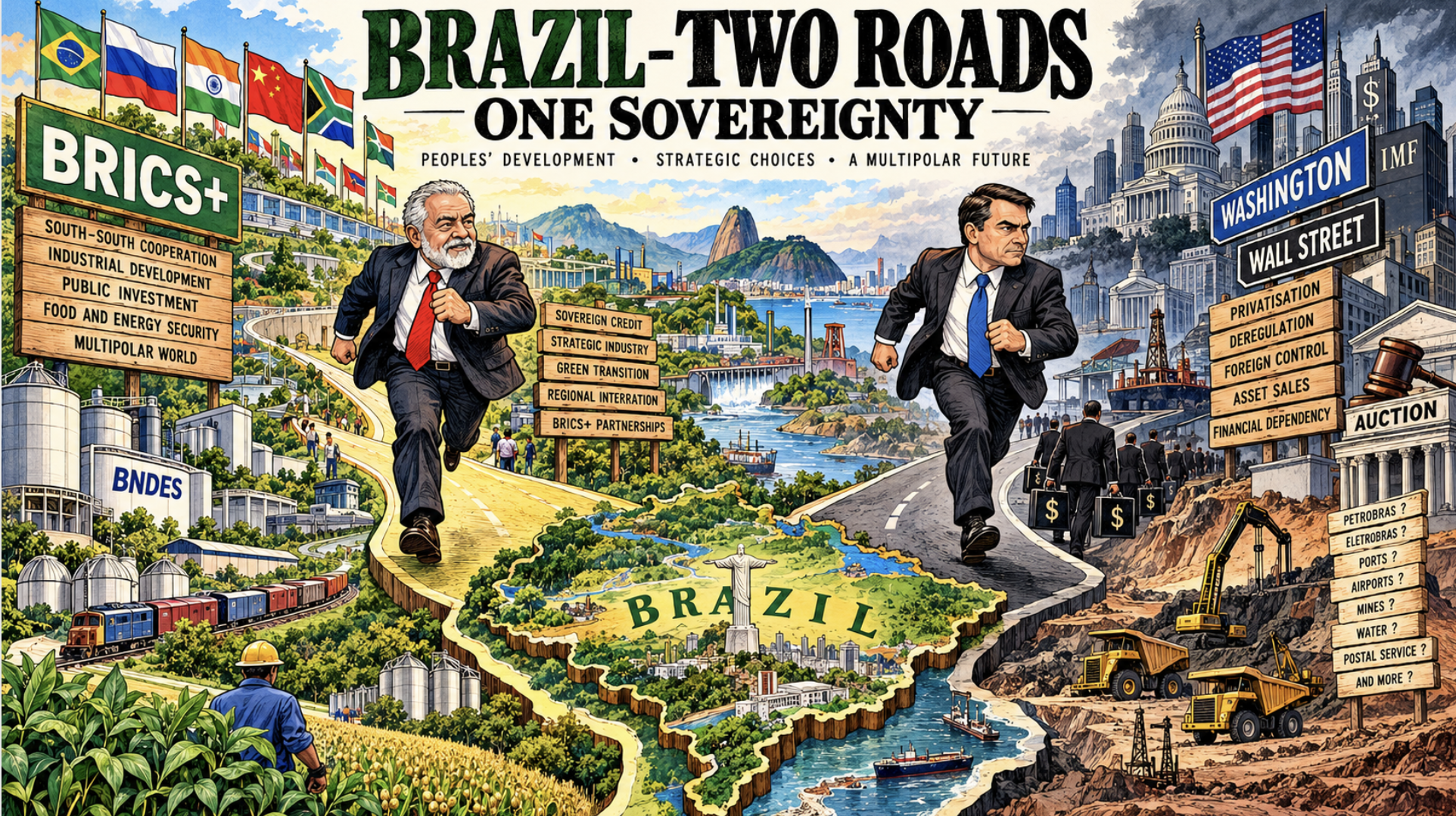
The Donroe Doctrine, the Bolsonaro privatisation legacy, BRICS and the battle for Brazil’s economic future
By Colin Maxwell
There are elections that change governments. And there are elections whose consequences may reach far beyond national borders, shaping economic and geopolitical relationships for decades.
Brazil’s presidential runoff on 25 October has the potential to belong to the second category.
With Luiz Inácio Lula da Silva and Flávio Bolsonaro separated by remarkably narrow polling margins, more than 200 million Brazilians face a contest taking place against an extraordinary international backdrop.
Washington is reasserting its ambitions across the Western Hemisphere. China and Russia are deepening their relationships with the Global South. BRICS is expanding its economic and diplomatic reach. And the American intervention in Venezuela has demonstrated just how dangerous the struggle over regional sovereignty has become.
Brazil is no minor player in this confrontation. It is an agricultural powerhouse, a major energy producer, a mineral-rich industrial economy, and one of the most important members of BRICS.
Its future matters enormously to Latin America, to the emerging multipolar architecture, and to the international financial interests competing for influence over its resources.
But there is another elephant in the room.
Who will control Brazil’s productive economy – and, even more importantly, who will control the financial machinery that determines how it develops?
A NATION DIVIDED ALMOST DOWN THE MIDDLE
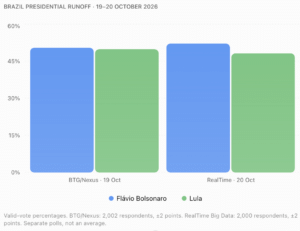
Source: Nexus’s original 19 October release and RealTime Big Data’s 20 October survey. Both polls indicate a statistical tie within their margins of error.
The latest second-round polling illustrates just how finely balanced this election has become. BTG/Nexus, surveying voters between 16 and 18 October, reported Flávio Bolsonaro on 50.3% of valid votes and Lula on 49.7%.
RealTime Big Data, surveying between 15 and 19 October, recorded 52% and 48% respectively. Both results fall within their respective statistical margins of error.
These are surveys, not election results. They cannot tell us what will happen on Sunday, but they demonstrate something remarkable. An election with potentially enormous consequences for Brazil’s international relationships and economic direction remains extraordinarily close.
And whichever candidate emerges victorious will inherit a deeply divided electorate, a complicated Congress, entrenched financial interests and a difficult international environment.
THE DONROE DOCTRINE COMES TO SOUTH AMERICA
Donald Trump’s revived interpretation of the Monroe Doctrine – now widely described as the Donroe Doctrine – is much more than an exercise in historical nostalgia.
It represents an attempt to reassert American primacy throughout the Western Hemisphere at precisely the moment when the international balance of economic and political power is changing.
Washington’s intervention in Venezuela has given the doctrine a particularly alarming contemporary dimension. The implications extend far beyond Caracas.
For Brazil, the central issue is whether relations with the United States remain those of independent states pursuing their respective interests, or move towards a more subordinate economic and geopolitical relationship.
That distinction is critical because Brazil’s productive resources are immense. Its agriculture, energy, mining, manufacturing, transport infrastructure and domestic market give it considerable potential to shape its own development.
But natural resources and productive capacity are only part of the equation. The other part is ownership, finance and control.
And here the historical record of the Bolsonaro administration deserves particularly close attention.
JAIR BOLSONARO – THE PRIVATISATION PRECEDENT
The economic direction of Jair Bolsonaro’s (AKA Tropical Trump) presidency was never a mystery.
Under Economy Minister Paulo Guedes, the administration pursued privatisation, concessions, deregulation, spending restraint and a reduced direct role for the state.
The most revealing example was Eletrobras.
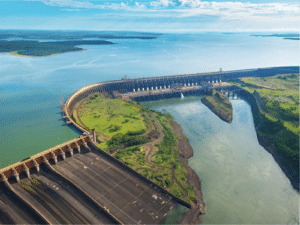
In June 2022, Brazil completed the privatisation of the electricity giant through a share offering that diluted the federal government’s controlling stake.
This was no ordinary commercial enterprise. Electricity generation and transmission sit at the very foundation of a modern productive economy.
The ownership and governance of such infrastructure affect industrial costs, investment priorities, energy security and long-term national development.
The Bolsonaro administration also pursued the privatisation of Correios, Brazil’s postal service, although the sale was not completed. Petrobras was another subject of privatisation discussions, but it was not sold.
These distinctions are huge – we should judge the historical record by what actually happened, as well as by what was proposed.
And the Eletrobras transaction provides a concrete example of the larger economic argument.
A government receives the proceeds of a sale once. The ownership rights, future earnings and strategic influence surrendered may be lost for generations.
Supporters of privatisation argue that private investment and management can improve efficiency, expand infrastructure and reduce the fiscal burden on governments – it is extremely rare for those lauded benefits actually materialise.
Of course, the proper national accounting must extend beyond the immediate proceeds and include the long-term consequences for prices, investment, strategic control and the distribution of income.
The crucial issue is whether a particular transaction strengthens the productive economy and the public interest over time. That is a much more demanding test than simply celebrating the cash received on the day of sale.
FLÁVIO BOLSONARO – THE FAMILY ECONOMIC BLUEPRINT
The continuity between father and son is not merely a matter of speculation.
Flávio Bolsonaro’s published 2026 economic programme proposes a renewed National Privatisation Program, accelerated concessions, a new fiscal spending ceiling, tax reductions and a substantial reduction in the size of the federal administration.
It calls for cutting at least ten ministries. It also proposes reforms to the management of remaining state enterprises and greater reliance on private-sector investment.
The program does not identify every enterprise that might be privatised, nor does it publish a comprehensive timetable of asset sales. It also pledges to maintain existing social program and envisages a continuing role for Caixa in credit, housing and entrepreneurship.
The overall direction is unmistakably related to the economic program pursued under Jair Bolsonaro and Paulo Guedes, and there is also a fundamental question of fiscal arithmetic.
Tax reductions, tighter spending ceilings, administrative cuts and ambitious growth targets may be individually attractive propositions to different constituencies – but how do they interact?
Which expenditure program would absorb the pressure of tighter limits? How much revenue would be forgone? What investment would be displaced, and what additional productive investment would the private sector actually deliver?
Flávio’s program targets sustained annual economic growth of 4%, yet published assessments have identified a lack of consolidated fiscal costings and quantified contributions from individual measures.
For a country of Brazil’s size and complexity, those omissions deserve some serious scrutiny.
LULA – A DIFFERENT DEVELOPMENT MODEL
Lula’s published economic program takes a different approach.
It emphasises public investment, infrastructure, industrial development and the state’s role in supporting productivity. It proposes continuing the existing fiscal framework, expanding development program and encouraging investment in strategic sectors.
The distinction is massive.
Under this approach, public institutions can play a coordinating role in directing resources towards long-term development, rather than relying predominantly on private investors to determine where capital should flow.
Neither is Lula’s model free of contradictions.
His administration still operates within a financial system characterised by powerful commercial banks, substantial public debt and monetary-policy constraints – nor does public investment automatically guarantee efficient investment.
But the real test is whether financing reaches productive enterprises, improves infrastructure, expands technological capacity and raises living standards – that brings us to a distinction too often overlooked in conventional economic debate.
The difference between financing the productive economy and financing the churn of the FIRE economy – Finance, Insurance and Real Estate.
THE FINANCIAL ELEPHANT IN THE ROOM
Brazil’s considerable economic potential cannot be understood simply by examining conventional GDP. Raw GDP combines activities that contribute very differently to a nation’s productive strength.
Agricultural output, manufacturing, energy production, essential services and infrastructure development are not economically equivalent to speculative asset turnover or financial rent extraction.
A Productive GDP, or PGDP, framework would help distinguish the capacity of the real economy from the much larger universe of financial transactions and associated claims upon future income.
But even that is only the beginning – the deeper issue concerns money, credit and financial sovereignty.
Commercial banks create and allocate credit within the monetary system, while the sovereign state possesses distinct monetary and institutional powers.
Credit directed towards productive enterprises, new machinery, technology, infrastructure and small businesses can expand real economic capacity.
Credit overwhelmingly directed towards existing assets, speculation and rent extraction can inflate asset values without producing a comparable expansion in goods and services.
This is why Brazil’s public financial institutions deserve particular attention.
BNDES, the national development bank, has historically played a major role in financing industry and infrastructure.
Banco do Brasil and Caixa also occupy important positions in the country’s financial architecture – their existence does not, by itself, guarantee sound development policy – but their public mandates create possibilities for directing finance towards national priorities that purely profit-driven institutions may not pursue.
Who creates the credit, who decides its destination, and who collects the returns? – those are the questions at the heart of genuine financial sovereignty.
And they are questions that neither campaign’s conventional fiscal slogans can adequately answer.
VENEZUELA – THE WAKE-UP CALL
The American intervention in Venezuela has added a new urgency to Brazil’s strategic calculations.
Whatever one’s assessment of Nicolás Maduro or Venezuela’s domestic political system, the use of American military power to intervene in a neighbouring sovereign state raises profound questions about the future of international law and regional independence.
For Brazil and the RoW, this is not an abstract controversy. It concerns the security of South America and the ability of countries within the region to determine their own political and economic relationships.
Lula has condemned the intervention and emphasised respect for sovereignty and international law.
Flávio Bolsonaro has adopted a substantially more sympathetic position towards Washington’s actions and proposes closer relationships with the United States, Israel and Argentina.
This foreign-policy divergence is documented in the candidates’ program, and it takes us directly into the emerging multipolar world.
BRICS+ – AN ALTERNATIVE STRATEGIC HORIZON
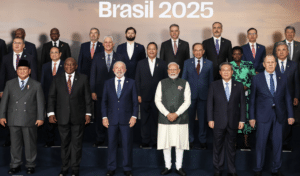 Brazil is a founding member of BRICS.
The organisation has expanded considerably beyond its original membership and now provides a forum for countries seeking greater influence over international trade, development finance and global governance.
Brazil chaired BRICS in 2025, with India assuming the chairmanship in 2026.
China’s industrial and financial scale, Russia’s energy and strategic relationships, India’s expanding productive economy and the growing participation of countries across the Global South have altered the possibilities available to Brazil.
BRICS is not a unified political bloc – its members have different interests, different monetary systems and sometimes substantial disagreements.
Nevertheless, it offers opportunities to diversify markets, financing relationships, settlement arrangements and diplomatic partnerships.
Lula’s 2026 program explicitly commits to strengthening relations with BRICS and the Global South while maintaining relations with other regions.
Flávio Bolsonaro’s program places greater emphasis on repairing and deepening relationships with Washington and its principal regional partners.
That does not mean Brazil must choose between trading with the United States and trading with China. A genuinely sovereign foreign policy can maintain relationships with both.
The deeper distinction concerns whether Brazil preserves the freedom to make those decisions independently.
THE PROBLEM WITH FINANCIAL DEPENDENCY
There is a reason John Perkins’ Confessions of an Economic Hit Man continues to resonate with readers concerned about national sovereignty.
The central warning concerns the ways in which debt, financial institutions, infrastructure contracts and political influence can create enduring relationships of dependency.
Brazil’s circumstances are not identical to the countries Perkins described – nor does every foreign investment represent exploitation.
Foreign capital can finance valuable productive development when the terms serve national interests – but there is a substantial difference between attracting investment into the productive economy and surrendering strategic control over the assets on which that economy depends.
A country can possess enormous natural wealth while much of the associated financial income ultimately flows elsewhere.
And a government can celebrate a temporary improvement in its fiscal accounts while weakening the public institutions capable of supporting long-term national development.
This is why the ownership of strategic infrastructure and the destination of credit deserve to be examined together. The productive economy and the financial architecture governing it are inseparable.
THE COALITION MINEFIELD
Whatever Sunday’s result, Brazil will not suddenly become a politically unified nation.
The next president must deal with Congress, regional interests, agribusiness, industrial constituencies, religious organisations, organised labour, commercial banks and international investors.
The tensions between these interests are considerable.
Lula would still confront the financial and institutional constraints that have complicated previous efforts to pursue a more development-oriented economic program.
Flávio Bolsonaro would face his own parliamentary and political limitations in implementing deregulation, spending restraint and privatisation.
Neither candidate can simply impose an entire economic program by presidential declaration, and the long-term effects of either program would depend upon legislation, implementation, investment decisions and the wider international environment.
This is can be a stark reminder that elections can determine political direction without resolving the deeper structural contradictions of an economy.
THE ROAD BEYOND SUNDAY
Brazil’s election is taking place at a remarkable moment in world history.
Washington is attempting to reassert hemispheric influence while its global financial and geopolitical position faces increasing challenges.
China, Russia, India and other emerging economies are expanding the possibilities for international relationships outside the traditional Western-centred architecture.
The consequences for Latin America could be profound. Brazil’s importance is not simply that it possesses immense resources – it is that the country has the scale, industrial foundations, institutions and international relationships to play a substantial role in shaping the emerging order.
But genuine sovereignty requires more than diplomatic independence – it requires the capacity to preserve strategic assets, develop productive industries, direct credit towards the real economy and retain meaningful control over the distribution of national wealth.
Those questions will remain long after the election campaign is forgotten.
A nation can change its president in a single election. Rebuilding the productive and financial foundations of sovereignty may take generations, and that is why, IMO, Brazil’s two roads deserve the attention of the entire world.