

Orange Wrecking Ball at UNGA
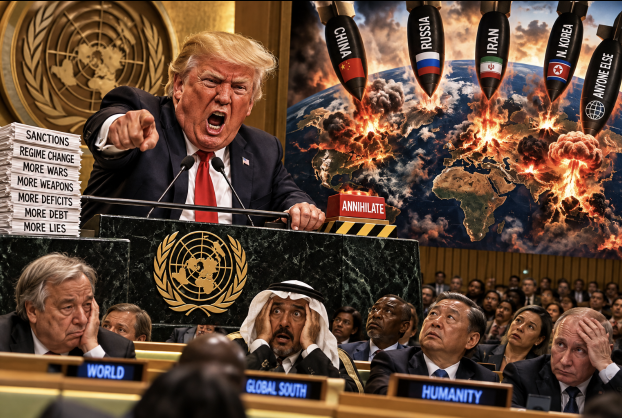
From Colin Maxwell
SELL — When the World Finally Asks Why It Is Financing This Circus
Donald Trump’s extraordinary performance at the United Nations may eventually be remembered for something considerably more important than the usual geopolitical theatre, because somewhere beneath the threats, bluster, exceptionalism and increasingly surreal spectacle of Washington lecturing the rest of humanity about how the world should behave, there was another message being broadcast to every finance ministry, central bank and sovereign wealth fund on the planet.
Why in God’s name are we still financing these people?
For decades the United States has enjoyed what is arguably the greatest financial privilege ever bestowed upon a sovereign nation. It purchases real goods, real energy, real commodities and the productive output of other people’s economies and, in return, much of the world accepts financial claims denominated in a currency Washington itself creates.
Better still, a substantial proportion of those dollars eventually finds their way back into US markets, financing the very Treasury deficits required to keep the entire machine running. The world produces, America consumes, and then a large chunk of the resulting foreign savings gets recycled back into Washington’s debt market.
It is an absolutely magnificent arrangement – provided, of course, that everybody continues believing in it, and therein lies the problem, because the whole bloody thing ultimately rests upon confidence.
The Numbers Are Not Calm and the Structure Is Crumbling
This is where staring at today’s Treasury yield and declaring everything fine completely misses the point. Financial systems almost never advertise their breaking point in advance. Markets can absorb deteriorating fundamentals for years while appearing remarkably tranquil, until something changes – not necessarily because investors suddenly discover that the debt exists, but because enough of them begin wondering whether everybody else still wants to own it at the present price.
America doesn’t require China to dump its Treasuries, Japan to abandon the dollar, Saudi Arabia to start selling every barrel of oil (if they can sell any at all) in yuan, or BRICS to unveil some miraculous gold-backed super-currency next Tuesday morning. The Treasury market merely requires one increasingly uncomfortable development – the marginal buyer starts backing away.
That distinction is enormously important because markets price at the margin. Washington can have twenty or thirty trillion dollars of existing debt happily sitting on balance sheets around the world, but tomorrow morning it still has to sell the next bond.
If the traditional buyers decide they already own quite enough American sovereign paper, Treasury doesn’t get to shrug its shoulders and cancel the auction. It has to find another buyer, and there is a beautifully simple mechanism for accomplishing that – lower the price – which means raising the yield.
Higher yields then increase Washington’s refinancing costs, which increases government interest expenditure, which enlarges future deficits, which requires still more borrowing, which requires still more buyers, who may themselves be becoming progressively less enthusiastic about accumulating US sovereign claims. Suddenly the supposed solution to the problem starts feeding the problem itself.
That is the point where sovereign debt dynamics can become decidedly nonlinear.
Bond Markets Don’t Blow Up Politely – (the curious case of “Miss Trust” (-:)
Anyone imagining that this necessarily unfolds over several decades should probably revisit Britain in September 2022. The UK hadn’t defaulted, sterling hadn’t ceased functioning and Britain hadn’t suddenly transformed itself into some banana republic, yet thirty-year gilt yields exploded approximately 130 basis points higher in only three trading days – a move the Bank of England described as unprecedented in modern experience.
That smashed bond prices, which triggered collateral calls against leveraged pension strategies, which forced those funds to sell gilts to raise cash, which pushed gilt prices lower again, which generated still more collateral calls and therefore still more selling.
Within days, one of the oldest and supposedly most sophisticated sovereign bond markets on planet Earth had constructed its own financial circular saw, eventually forcing the Bank of England to intervene because the dysfunction threatened financial stability.
The lesson isn’t that America today is Britain in 2022 any more than it is Greece in 2010, Russia in 1998 or Asia in 1997. The lesson is that leverage, collateral and confidence interact considerably faster than government debt projections do.
Economists model sovereign deterioration in years – margin desks operate in minutes – and once leveraged investors are being forced to sell because the value of their collateral is collapsing, nobody particularly cares what the IMF thinks GDP will be in 2035.
What Happens When the Safe Haven Is the Problem? – IOWs the 3-Ds – (the Default Dollar Demise)
This is where a serious US Treasury dislocation becomes fundamentally different from almost every sovereign crisis that preceded it, because whenever something else breaks, the world traditionally runs towards Treasuries.
When emerging markets collapse, investors buy Treasuries. When equities collapse, they buy Treasuries. When banks become questionable, Treasuries provide collateral. When liquidity disappears, Treasuries are supposed to be the liquidity.
But where exactly does the global financial system hide when the problem originates inside the asset everybody normally hides in?
That is when things become extremely interesting, because Treasuries aren’t merely another investment sitting beside equities, property and corporate bonds. They form part of the plumbing underneath the entire Western financial system. They provide collateral throughout repo markets, sit on bank and pension balance sheets, underpin enormous derivatives positions and supply the supposedly “risk-free” rate against which practically everything else is valued.
Start violently repricing that rate and you don’t merely reprice Treasury bonds – you start repricing the world.
Long-duration bondholders immediately suffer mark-to-market losses. Leveraged funds receive margin calls. Repo collateral is repriced. Institutions requiring cash sell whatever they can sell, which means perfectly healthy assets can suddenly collapse because their owners need liquidity to cover losses somewhere completely different.
Equities fall, corporate spreads widen, mortgage rates rise, commercial property gets hammered and foreign holders of US securities can potentially suffer both bond losses and currency losses simultaneously if confidence begins spilling into the dollar itself.
This is how financial contagion actually happens. Not because every asset suddenly becomes worthless, but because the financial system becomes desperately short of liquidity at precisely the moment everybody wants it. And then the Federal Reserve gets handed one hell of a choice -Two Fire Extinguishers – both Filled With Petrol.
The Fed can allow Treasury yields to rise sufficiently to attract genuine private capital back into the market, which sounds wonderfully orthodox until those same yields start ripping through mortgages, commercial property, corporate refinancing, leveraged funds, banks and ultimately the productive economy.
Or it can create reserves and become the buyer required to try to stabilise the Treasury market.
Washington can call that QE, emergency liquidity provision, market-function restoration, yield-curve stabilisation or “Operation Everything Is Completely Fine”, whatever they like, but the terminology doesn’t alter the underlying transaction. If private capital will not clear the Treasury market at yields Washington can economically tolerate, the entity with the unlimited cheque book eventually becomes the buyer – and that is dah Federal Reserve.
At which point foreign investors confronting doubts about America’s sovereign balance sheet are being reassured by watching America’s central bank create money to support America’s sovereign balance sheet – I’m sure that will settle everyone’s nerves beautifully…. not.
This is also where America’s obsession with interest rates becomes particularly dangerous, because increasing yields may attract capital while simultaneously worsening the fiscal position they are supposed to protect. A heavily indebted sovereign cannot indefinitely behave as though a higher interest rate is some costless monetary-policy lever.
Interest expense is itself an input cost, and when the borrower happens to be the federal government carrying tens of trillions of dollars of debt, eventually the arithmetic becomes rather difficult to disguise.
Does the Dollar Have to Die?
This is another point that gets mangled continuously in discussions about de-dollarisation. People imagine some binary event where the dollar is the world’s reserve currency on Monday and nobody wants it on Tuesday – maybe that’s not necessary.
The dollar could remain one of the world’s dominant invoicing, transactional and settlement currencies for decades while simultaneously losing part of its extraordinary role as the place where foreign countries store their accumulated national wealth. Those are completely different functions.
A Chinese exporter can accept dollars from an American customer without Beijing deciding that China’s national savings should therefore be recycled into thirty-year Treasury bonds. Saudi Arabia can continue pricing oil in dollars while diversifying reserves into gold and other assets. India can conduct dollar trade while expanding bilateral settlement arrangements. Central banks can continue owning Treasuries while gradually shortening duration or increasing their allocation to physical gold.
The dollar doesn’t have to disappear – the recycling mechanism merely has to weaken.
And that is potentially much more dangerous for Washington than the endless theatrical announcements about replacing the dollar with some shiny new BRICS currency, because it can happen quietly, incrementally and entirely rationally. Nobody has to declare economic war on America. Countries merely have to decide that putting quite so many of their national savings into the liabilities of an increasingly indebted, politically erratic and militarily hyperactive foreign power might not be the wisest portfolio allocation ever devised.
Then the World Rediscovers the Balance Sheet
This is where the story becomes considerably more interesting for everybody else, because capital leaving one sovereign balance sheet doesn’t disappear into outer space – it relocates.
And if confidence in US sovereign assets genuinely begins weakening, one of the most fascinating consequences could be a wholesale reassessment of what constitutes a genuinely strong currency.
For decades the answer has effectively been circular – the dollar is strong because everybody uses it, and everybody uses it because the dollar is strong. But once capital begins seriously differentiating between sovereign balance sheets, much more primitive considerations suddenly return to centre stage.
This is where I believe that my distinction between headline GDP and productive GDP (PGDP), that I continually harp on about, becomes critical.
An economy can generate spectacular headline GDP through healthcare rents, financial intermediation, government spending, property transactions, litigation, asset-management fees and an ever-expanding service bureaucracy, but ultimately debt is serviced by real economic capacity.
Somebody somewhere still has to produce the energy, machinery, food, technology, minerals, infrastructure and exportable goods that the rest of humanity actually wants.
The countries that could benefit enormously from a genuine diversification away from US sovereign assets may be precisely those countries Western finance spent decades regarding as terribly boring – creditor nations with strong external positions, high domestic savings, substantial productive capacity, manageable government liabilities, and large holdings of real assets.
Credibility can emerge organically from the national balance sheet beneath it.
A country sitting on enormous commodity resources, productive industry, energy, food, precious metals, foreign assets and a positive net international investment position already possesses something far more meaningful than a politician standing behind a podium promising that his fiat currency is sound.
It possesses stuff – useful stuff – stuff other countries actually need.
And if the existing monetary/military hegemon simultaneously possesses enormous debts, structural external deficits, rapidly deteriorating fiscal mathematics and an apparently inexhaustible enthusiasm for expensive foreign wars, global capital may eventually decide that boring isn’t such a terrible investment strategy after all.
No New Hegemony Required
This is also why I don’t believe China, or anybody else, necessarily needs to “replace America”. That assumes the next monetary architecture must replicate the structure of the previous one, with another country sitting at the centre issuing liabilities everybody else is obliged to accumulate.
A genuinely multipolar monetary system could operate through several major currencies, bilateral settlement, regional payment systems, gold as neutral reserve collateral and commodity-linked trade, with market arbitrage continuously establishing cross-rates between them.
Creditor countries could issue high-quality sovereign assets. Commodity exporters could increasingly settle trade against currencies representing claims upon genuinely productive economies. Gold could provide a politically neutral reserve asset that is nobody else’s liability.
No monetary emperor required – no country running perpetual deficits simply to provide everybody else with reserves, and no requirement that the savings of the entire planet be recycled through Wall Street before they can be considered legitimate money.
Washington’s Magnificent Own Goal
Which brings us straight back to Trump’s woeful performance at the United Nations.
America’s greatest strategic asset was never really its aircraft carriers, 800+ overseas bases, or nuclear arsenal. It was the extraordinary willingness of foreigners to store an enormous portion of their accumulated wealth inside the American financial system.
That gave Washington something military power alone could never provide – the ability to consume more than it produced, finance enormous fiscal and external deficits, sanction adversaries through control of financial infrastructure, and borrow in a currency it creates itself, all while much of the rest of the world voluntarily recycled its savings back into the same system.
You would imagine that any remotely rational American administration would guard that privilege with a profound almost religious fervor. Instead Washington increasingly appears to believe reserve-currency status was handed down by God.
It sanctions countries, freezes sovereign reserves, weaponises financial infrastructure, runs enormous structural deficits, piles debt upon debt, fights or finances ruinously expensive foreign conflicts, and then off trots its President to the United Nations to threaten other countries with annihilation, while effectively asking those very same countries to continue financing the whole crazed circus.
The great danger to America’s monetary privilege isn’t necessarily that one morning the world collectively decides the dollar is worthless – it is that enough investors gradually decide that there are safer places to store their wealth.
Then Washington discovers the question that really matters, isn’t whether the world will continue accepting dollars, it is what yield will we have to pay them to continue saving in them? And if that answer ever starts rising rapidly, history suggests the transition from “nothing to worry about” to “emergency central-bank intervention” can be frighteningly short.
After several decades of casino-fiat economics, leverage, financial engineering and the increasingly bizarre proposition that a nation’s balance sheet somehow ceased to matter, the ultimate punchline may therefore be wonderfully simple.
It was simply a microphone in front of a pathological, warmongering liar.
Does the economy underneath the currency actually produce enough real output to justify the financial claims sitting on top of it?
This is where I believe that my distinction between headline GDP and productive GDP (PGDP), that I continually harp on about, becomes critical.
An economy can generate spectacular headline GDP through healthcare rents, financial intermediation, government spending, property transactions, litigation, asset-management fees and an ever-expanding service bureaucracy, but ultimately debt is serviced by real economic capacity.
Somebody somewhere still has to produce the energy, machinery, food, technology, minerals, infrastructure and exportable goods that the rest of humanity actually wants.
Credibility can emerge organically from the national balance sheet beneath it.
A country sitting on enormous commodity resources, productive industry, energy, food, precious metals, foreign assets and a positive net international investment position already possesses something far more meaningful than a politician standing behind a podium promising that his fiat currency is sound.
A genuinely multipolar monetary system could operate through several major currencies, bilateral settlement, regional payment systems, gold as neutral reserve collateral and commodity-linked trade, with market arbitrage continuously establishing cross-rates between them.
Creditor countries could issue high-quality sovereign assets. Commodity exporters could increasingly settle trade against currencies representing claims upon genuinely productive economies. Gold could provide a politically neutral reserve asset that is nobody else’s liability.
No monetary emperor required – no country running perpetual deficits simply to provide everybody else with reserves, and no requirement that the savings of the entire planet be recycled through Wall Street before they can be considered legitimate money.
Washington’s Magnificent Own Goal
Which brings us straight back to Trump’s woeful performance at the United Nations.
>America’s greatest strategic asset was never really its aircraft carriers, 800+ overseas bases, or nuclear arsenal. It was the extraordinary willingness of foreigners to store an enormous portion of their accumulated wealth inside the American financial system.
That gave Washington something military power alone could never provide – the ability to consume more than it produced, finance enormous fiscal and external deficits, sanction adversaries through control of financial infrastructure, and borrow in a currency it creates itself, all while much of the rest of the world voluntarily recycled its savings back into the same system.
You would imagine that any remotely rational American administration would guard that privilege with a profound almost religious fervor. Instead Washington increasingly appears to believe reserve-currency status was handed down by God.
It sanctions countries, freezes sovereign reserves, weaponises financial infrastructure, runs enormous structural deficits, piles debt upon debt, fights or finances ruinously expensive foreign conflicts, and then off trots its President to the United Nations to threaten other countries with annihilation, while effectively asking those very same countries to continue financing the whole crazed circus.
The great danger to America’s monetary privilege isn’t necessarily that one morning the world collectively decides the dollar is worthless – it is that enough investors gradually decide that there are safer places to store their wealth.
Then Washington discovers the question that really matters, isn’t whether the world will continue accepting dollars, it is what yield will we have to pay them to continue saving in them? And if that answer ever starts rising rapidly, history suggests the transition from “nothing to worry about” to “emergency central-bank intervention” can be frighteningly short.
After several decades of casino-fiat economics, leverage, financial engineering and the increasingly bizarre proposition that a nation’s balance sheet somehow ceased to matter, the ultimate punchline may therefore be wonderfully simple.
The world rediscovers productive economies.
If Trump’s UNGA performance accelerated that realisation by even a fraction, Washington may soon discover that the most expensive weapon it ever turned against itself wasn’t manufactured by Lockheed Martin.
It was simply a microphone in front of a pathological, warmongering liar.
Hi amarynth – I notice that there is a double up in the article – my fault as it was obviously me not checking the file I sent. The first part is a draft that should have been deleted and so the corrected file begins half way down at… SELL… Read more »
Do we have it right now Col? I thought you were being creative!
(Hang on folks, we will get our ducks in a row).
Just the one heading spacing needed – but no biggy – thanks Amarynth.