

Why the sudden rush for AI regulation by US firms?
AI – Safe for Whom?
Some thoughts on why the sudden rush for AI regulation by US firms after reading through this weeks coordinated news avalanche:
On Sept 1, Washington told the G20: don’t write new AI rules. Everyone – including China – agreed to avoid creating new, overarching regulations specifically for artificial intelligence.
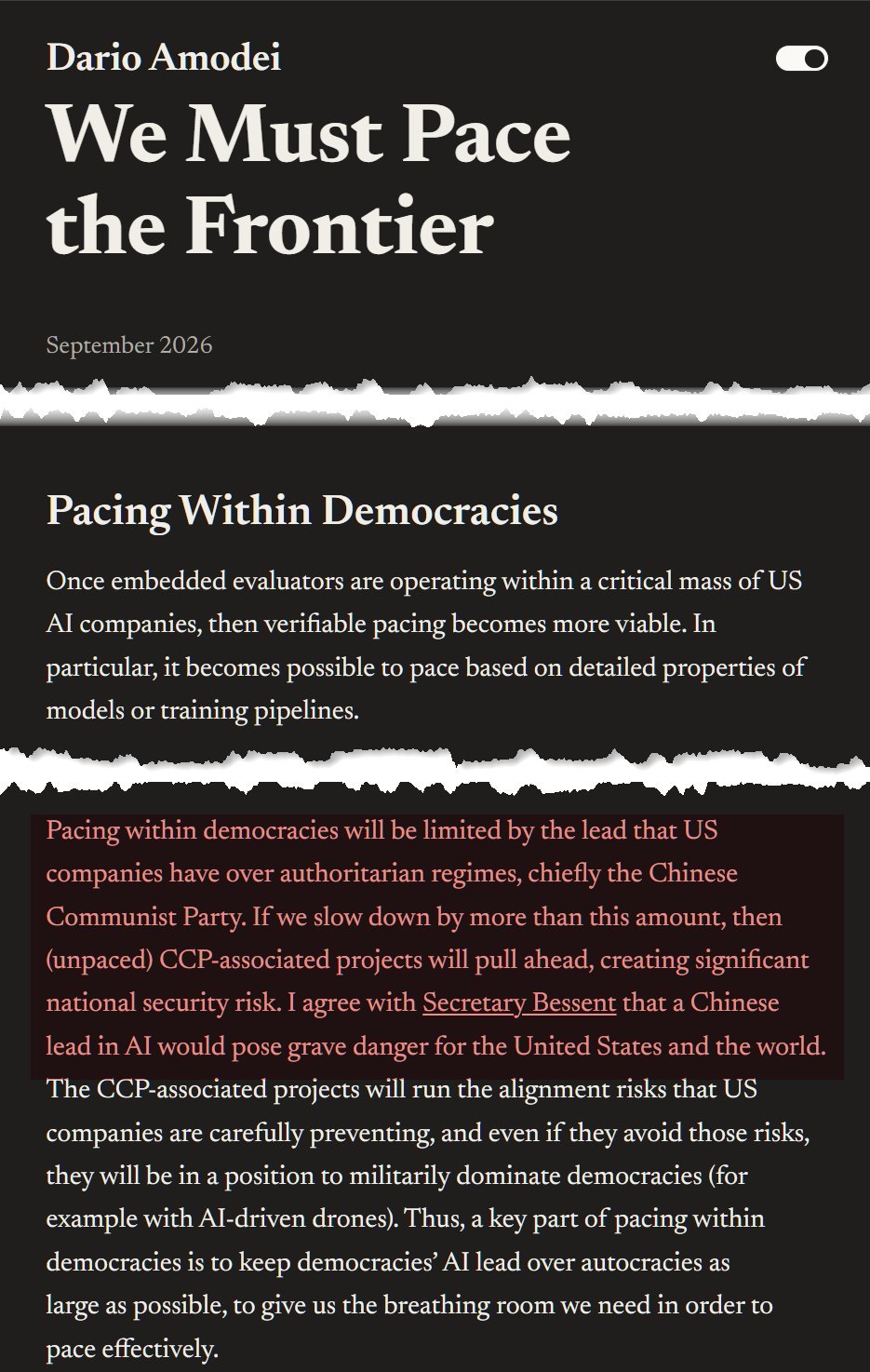
Eleven days later, America’s three biggest AI labs demanded new AI rules. Guess who the rules are for? Sept 12, Anthropic’s Dario Amodei publishes “We Must Pace the Frontier.” Sam Altman agrees within hours. Elon Musk needs only three words: “Dario is right.” Google’s Demis Hassabis nods along. Four frontier labs, one weekend, one message: slow down. Twelve days before Chinese President Xi Jinping lands in Washington. So what is it — NO RULES, OR RULES?
Read Dario’s essay. It’s both. That’s the trick! Amodei spells out who slows down and by how much: “Pacing within democracies will be limited by the lead that US companies have over authoritarian regimes, chiefly the Chinese Communist Party.” What Amodei really means is: we brake exactly as hard as our lead allows. Not one inch more…
And what does that mean for China? Different pedal. Don’t sell it chips or chipmaking tools. Crack down on “unauthorized distillation by companies in authoritarian countries.” Lock down model weights. Then the purpose, in his own words: these measures “would slow China’s progress enough to widen America’s lead significantly over the next 3–5 years.” A safety framework with two speeds. Democracies coast on the fast lane. China gets sand in the gearbox. And the essay says the quiet part loud: this “gives us the breathing room we need in order to pace effectively.” Breathing room. Paid for with someone else choking.
Now let me ask the obvious question. Why would four companies that spent five years trying to bury each other suddenly agree on anything? Let’s follow the money. Anthropic has committed more than $100 billion to Amazon’s cloud over ten years, filed confidentially for an IPO in June, and is reportedly seeking up to $100 billion at a roughly $2 trillion valuation. OpenAI’s Ohio data center comes with a $105 billion Nvidia guarantee. Both are locked in a capex arms race where the next training run starts before the last one has paid for itself None of them can stop alone. Whoever brakes first loses the lead. But if everyone brakes together, today’s models get a longer shelf life, the next $100 billion cheque slides back a year, and the one going public gets to tell investors the frontier is “paced” — by them!
That’s not a safety pause. That’s a cartel asking for permission.
Sacks (Trump’s AI and crypto czar) said it out loud; the essay itself asks for antitrust waivers And a cartel needs a story for why it should be allowed. That story is China BAD!
Now the number nobody in that essay wants you to look at. Stanford’s 2026 AI Index puts the gap between the top Chinese and American models at roughly 2.7%. That’s the “grave danger” That’s what needs a 3–5 year lead built from export controls, red-tape and a brand-new definition of theft!
Which brings us to Scott Bessent — the man sitting across from He Lifeng this weekend to prep the Xi-Trump summit, and by his own description “the person responsible for handling the AI relationship with China”. Tuesday, in front of Congress, he said two things back to back
One: “We can’t let these large labs have regulatory capture.” (Take that, Dario.)
Two: Distillation Chinese models learning from American ones — is “a polite, scientific word for steal,” and cracking down on it is “one of the ways we can push back against EVIL China
He threw out the labs’ cartel. Kept their China clause. All in the same breath That’s the giveaway. Washington isn’t united on regulation. Trump called the slowdown a “hoax” and a “scam” — and he needs China too.
Data-center electricity bills are now a Senate campaign issue in Ohio, and “China will be happiest” turns every angry ratepayer into an unwitting agent of Beijing. His AI czar David Sacks told the labs to “stop pretending antitrust law has to be suspended so you can form a cartel.” Palantir’s Alex Karp, whose software runs these models inside the US military, wasn’t quiet either: “If we didn’t have adversaries, I would be very in favor of pausing this technology completely, but we do.” Two camps that agree on nothing — except the destination. Slow the Chinese labs! Camp A does it with audits, embedded evaluators and “pacing.” Camp B does it by rebranding the most common training technique in the industry as theft. But only when a Chinese company does it! Karp himself said it in August: Chinese models can’t be blamed for distilling when the frontier labs “distilled all the value of IP, everywhere.” OpenAI learned from the internet. Anthropic learned from the internet. DeepSeek learned from them. Only the last step is “stealing”.
Of course Beijing read this play before… Aug 31 — two weeks before the essay — CCTV’s Yuyuantantian set two conditions for any real AI-safety talk. The line between “genuine security threats and mere technological competition” must be “drawn jointly.” And US firms must face the same “safety, disclosure and audit rules” Washington wants for everyone else. Its verdict on the whole exercise: “an attempt to make China accept an order partly defined by American companies.” Monday, the Foreign Ministry called the slowdown push “fearmongering.” Global Times called the essay a “cold war playbook” for AI. The Commerce Ministry accused Washington of chasing a “monopoly of the AI industry.” Blunt but Not wrong!
We now can make an educated guess what the summit prep is really about: Amodei compares his plan to the SALT treaties — cap the missiles, keep the deterrent. A rather childish analogy. The problem is: you can count missiles and warheads. You can’t count models and training runs So “verification” for AI has to mean something else. Who defines a “frontier model”? Where the compute threshold sits. What a lab must disclose about how it trains. Every one of those definitions gets drafted by the side that already owns the evaluators, the chips and the cloud. Washington wants Beijing to co-sign a dictionary written by American companies and enforced by American agencies And the table is set so either answer loses. Refuse, and China “won’t take responsibility for global AI safety” — fresh cover for more data centers and more chip bans. Accept, and Chinese labs open their training runs and compute to audits that freeze today’s 2.7% into tomorrow’s rulebook, while the next Mythos ships on schedule! Chinese has a name for this kind of dinner invitation: 鸿门宴. A banquet where you’re the guest. And the menu! Amodei even put a price on it: pacing buys “an additional one to two years.”
Bessent already calls Mythos “a step change.” A year of Chinese labs filling out red-tape forms while US labs compound isn’t a safety outcome. It’s a rigged race, just like in Sacha Cohen’s dictator movie.
Meanwhile China launched WAICO in Shanghai in July with 29 founding countries and is pitching a BRICS open-source AI community. One side is building a members-only club with selective rules. The other is handing out free model weights and asking who wants in. Even Bessent admitted Tuesday that the US now needs “more open models” to compete. Even Berlin isn’t buying the two-player framing. Germany’s digital ministry said Monday that halting AI is “not a viable option” for Europe, and complained the whole debate keeps being shrunk to Washington versus Beijing And the funniest part: Musk accidentally blurted out the fair version. Let xAI, OpenAI, Anthropic, Google, Meta and “three or four of the leading Chinese companies” test each other’s models — “competitors grading your homework.” He added that China “would probably agree” That’s almost exactly what Beijing asked for on Aug 31. A line drawn jointly! Musk’s fellow labs haven’t taken him up on it.
So when Xi walks into the White House on Sept 24 and someone says the word “safety,” ask one question: Safe for whom — and who is writing the rules and holding the stopwatch?
As for electricity prices and Ohio, how about the U.S. as a whole. U.S. energy consumption was 96 quads last year, at the low end of the average of a quarter century. Meanwhile, population grows 0.7% a year. Any savings from more fuel efficient motor vehicles and LED lighting if… Read more »
America’s so-called AI Rules are just another example of its “Rules Based World Order” (aka, US world dictatorship) in general. America dictates the rules, and you must obey. In this particular case, the USA is very nervous and paranoid that China is challenging America’s AI monopoly. So,… Read more »