

A serious read : China and the next Global Order – Henry Huiyao Wang
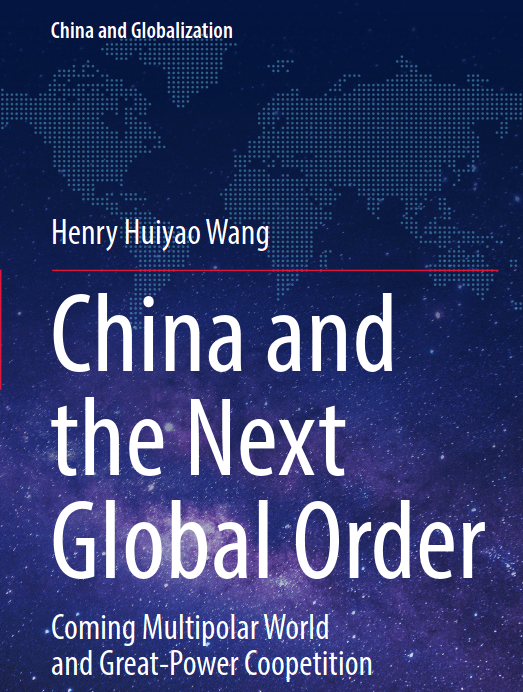
Below is a pdf for those who want to dive into this. Thanks to Wei Ling Chua from our China Writers Group for the document.
Preface
Change is the only constant. The forces reshaping our world never cease. Over the last two millennia, globalization has surged and receded in waves—driven by war and peace, the ascent and decline of empires, and the diffusion of transformative technologies, pandemics, and economic systems.
In response, humanity has continually sought order through global governance: from the informal early arrangements such as the Concert of Europe to the League of Nations, and eventually the post-war foundations of the liberal international order conceived at Bretton Woods and the creation of the United Nations, as well as
subsequent institutions ranging from the WTO, G20, and COP summits.
Yet today’s world appears increasingly divided. Since the early 2020s, we have entered an era of “polycrisis”—where multiple, interconnected global shocks amplify each other—underscoring a central dilemma: global governance now struggles to keep pace with the accelerating velocity and complexity of globalization itself. There
is no turning back either; globalization is not a choice we can simply choose to put aside, but an irreversible reality, woven into the fabric of technological development and human advancement.
As president of the Center for China and Globalization (CCG), a think tank with special consultative status with the United Nations, I have had the privilege of collaborating with some of the world’s foremost minds on globalization, global gover-nance, geopolitics, and geoeconomics, engaging in policy dialogues with governments, exchanges with industry, and collaboration with academic institutions and researchers across China and around the world. This collection of op-ed articles is both a meditation and reflection on my own evolving views and inspired by the many dialogues that have shaped them.
As part of our mission to serve as a bridge between China and the rest of the world, CCG hosted a wide range of international speakers in recent years, I also engaged with more than one hundred leading global thinkers and experts as a part of the CCG Global Dialogues, including Ravi Agrawal, Graham Allison, C. Fred Berg-sten, Ray Dalio, Niall Ferguson, Richard Hass, Wolfgang Ischinger, Pascal Lamy, Arancha González Laya, Kishore Mahbubani, Joseph Nye, Hank Paulson, Gordan Grlić Radman, Stephen Roach, Jeffrey Sachs, Lawrence Summers, Adam Tooze, Martin Wolf, to name just a few.
I have long been a firm believer in the power of dialogue to improve understanding and to solve global problems. During COVID-19-related travel restrictions, CCG became the first think tank in China to resume global travel with delegations visiting dozens of countries. Since then, I have personally had the honor of speaking at major international events such as the Paris Peace Forum, the Munich Security Conference, the World Economic Forum, the Athens Democracy Forum, the Bled Strategic Forum, the Trilogue Salzburg, the WTO Public Forum, the Boao Forum for Asia, and the Global Solutions Summit. I have witnessed global change and development with my own eyes, and heard the thoughts of the elites and the people in other countries firsthand. I feel that this has inspired me to consider the perspectives of others first when considering solutions to issues in global governance, balancing
the needs of China with those of other countries.
This book brings together a selection of my writings published between 2022 and 2026 for a number of global mainstream media and well-known institutions, such as Arab News, Bloomberg, China Daily, The Economist, The Financial Times, Global Solutions Journal, Munich Security Conference, The New York Times, Nikkei, People’s Daily, South China Morning Post, the Wilson Center, the World Economic Forum, and Xinhua, to name just a few, as well as my speeches at Harvard Kennedy School, Princeton University, the Oxford Union, becoming the first Chinese think tank representative to speak there, and the UN Security Council, where I was the only Chinese speaker at the meeting.
The three core themes of this book are as follows: first, the shifting nature in global interactions; second, perspectives on the pursuit of genuine multilateralism, and efforts to establish a new global equilibrium; and third, an exploration of the symbiotic relationship between globalization and economics. At the heart of these themes lies China’s evolving role in global governance and world affairs, particularly in responding to a series of systemic transformations, including the shifting center of global power, climate change and the green transition, and the emerging domain of AI governance, while also helping to shape the forthcoming global order.
Part I: Interaction and Exchange: Re-examining Tenuous Relations in a Transitional World opens with an analysis of the complex relationship between China and the United States. The opening chapters, with the headline “Reluctant Rivals,” examine the China-US bilateral relationship starting under President Trump with a particular focus on tariffs, trade barriers, and the opportunities for improvement presented by his transactional approach. This is then compared with the relationship under the Biden administration, during which the US was in the process of assembling an ideological coalition, even as the administration played a gentler hand in terms of economic
policy and trade.
The next chapter explores China-European relations, assessing the potential for deeper cooperation amidst an increasingly multilateral global order, especially as fractures in transatlantic ties—particularly under Trump—have created space for a recalibrated partnership. This could potentially see Europe positioned to act as a
balancing force between China and the US.
Chapter 5 moves beyond the state, exploring people-to-people ties and how academic exchange, student mobility, and cultural diplomacy can bridge gaps where official channels fall short.
Chapter 6 turns closer to home, returning to China’s regional diplomacy. Though often misunderstood, China’s positions have been consistent. This chapter analyzes the sources of misunderstanding and offers practical suggestions for improving clarity and trust.
Chapter 7 addresses global governance, from consequential global issues to the debate over the very definitions of democracy and autocracy down to the function and reform of global institutions in an increasingly complex world.
Part II: “Geopolitics and Multilateralism: Finding a Salient Solution to Geopolitical Tension” delves into modern geopolitical dynamics and the need for renewed multilateralism.
Chapter 8 discusses China’s role as a global mediator and its relationship with the Global South, from its peace efforts in the Middle East, to its measured approach to the Russo-Ukrainian war, in which shared historical experiences make China uniquely positioned to promote mutually acceptable solutions.
Chapter 9 focuses on geopolitical tensions and frameworks for cooperation, from a positive-sum US-China soft-power rivalry to the evolution of organizations like BRICS and NATO in a changing world. The world has changed and we are witnessing a rising Global South and a consequential rebalancing of the global distribution of power and global governance must come to reflect that.
My article “How to Fix the Security Council” published by Foreign Policy, focuses on the crises facing the
UN Security Council and, by extension, the United Nations system overall, and the urgent necessity in once again making them “fit for purpose”. To achieve this goal, we must engage the world, especially the Global South, to proactively find solutions rather than act divisively or retreat into regionalism. In this process China can act as a
bridge connecting the Global South to the Global North. This chapter also touches on improvements to China’s own Belt and Road Initiative and a G3 Model for managing the China-EU-US relationship.
Part III: “Globalization and Economics: Tweaking the Sputtering Engine of Global Growth” reflects on globalization’s transformation, the green transition, and global governance on new technologies such as AI, as well as China’s central role to play, by exploring the foundation upon which a new era of global peace and
prosperity can be built.
Chapter 10 affirms globalization as a driver of prosperity, and closer economic, diplomatic, and cultural ties to foster a stable and prosperous world. The transition from a Western-centric model does not signal de-globalization but rather a broader, more plural model of the same system. Small, gradual efforts to maintain trade and connectivity remain vital as global trade continues to play a positive role in maintaining global stability and peace.
Chapter 11 examines China’s role as a driver of global growth and trade. It examines the Chinese goal of creating a vibrant and welcoming global economic environment, including economic diversification in the Middle East where we explore how China is helping economies pivot away from oil-based economies.
Chapter 12 offers solutions to pressing economic challenges. Topics include China’s leadership in the green transition, the future of the Belt and Road (BRI), China’s interest in the Comprehensive and Progressive Agreement for Trans-Pacific Partnership (CPTPP), and reforms to global talent mobility. The chapter argues for
China’s constructive role in resolving global bottlenecks.
Chapter 13 is a compilation of speeches that I have given at Harvard University, Princeton University, the Oxford Union, and a UN Security Council session, which I have found vital in establishing relationships, and ultimately friendships. This chapter also contains my memorials to Professor Joseph Nye Jr. and Edwin J. Feulner,
respectively, who both passed away in 2025.
Chapter 14 covers the forewords I have written for Chinese-language editions of works by Joseph Nye, Kishore Mahbubani, and Kerry Brown, as well as a commentary on Henry Kissinger’s Leadership. These forewords and article range from views on the rise of the Asian Century to the lessons left by some of the greatest thinkers of the 20th and 21st centuries.
Chapter 15 is a collection of interviews that I have done with a range of media outlets from around the world, focusing on China’s growing participation in regional and global geopolitics, its position on key issues as well as its potential contribution to global peace and stability. This chapter also includes an interview that provides a bit more insight into my personal growth experience and how I have shaped a global view and come to emphasize the importance of a global perspective, not only in my personal life, but also on a professional and national level.
The four-year span that this book covers was book-ended by two major events of global impact: the outbreak of Russia-Ukraine war and the largest shock to international trade in half a century—the mass imposition of tariffs under the second Trump administration. While the end of the COVID-19 pandemic gave us hope for the recovery of the world economy, new conflicts and a rising tide of tariffs and protectionism fuel economic uncertainty. These trends are reflected in the profound structural changes in geopolitical and economic interdependence.
The last four years have seen renewed conflict in Gaza, open warfare between India and Pakistan, and direct ttacks between Israel and Iran. At the same time, the US-China rivalry has deepened, while inflation, supply chain disruptions, and energy shifts have moved markets and shifted economies. Yet despite conflicts and turmoil, AI advancements, space exploration, and green industries offer silver linings—seeds of hope in a fractured but resilient world.
By any measure, the past four years have been a remarkable period for China and global affairs. While navigating post-pandemic recovery and advancing domestic reforms aimed at sustainable growth, China has strengthened its global influence through economic resilience, technological innovation, and diplomatic engagement.
It has expanded the Belt and Road Initiative (BRI), played a mediating role in regional conflicts, and deepened BRICS+ cooperation while advocating multipolarity and advancing climate action. This period also witnessed China’s landmark 20th Party Congress, which committed to achieve a great rejuvenation of the Chinese nation
and peace and development for all humanity.
We also worked to build various bespoke channels and platforms to foster dialogue and communication between scholars, business leaders, policymakers, and young leaders from China and abroad. This includes an annual program of seminars, workshops, and flagship events such as the China and Globalization Forum,China Global Think Tank Innovation Forum, China Inbound-Outbound Forum, and Global Young Leaders Dialogue Forum. CCG Representatives also regularly participate in international events to exchange views with international stakeholders and scholars.
My first collection of writings, The Ebb and Flow of Globalization, was published by Springer in 2022 as a part of the “China and Globalization” series, which focuses on globalization and China’s evolving role in the world. As I write this foreword, the need to strengthen global governance has become more urgent than ever in addressing the current global polycrisis, a major aspect of which is the threat of climate change looming over the entire planet. In the face of these crises, I hope this book can offer some useful suggestions for evoking “polysolutions” to bring us to a better and prosperous world.
Beijing, China
July 2026
Henry Huiyao Wang, Ph.D.
Founder and President of Center for
China and Globalization (CCG)
Former Counselor, China State Council
Download PDF