Why is Latin America becoming a breeding ground for ‘fanatics of Israel’?
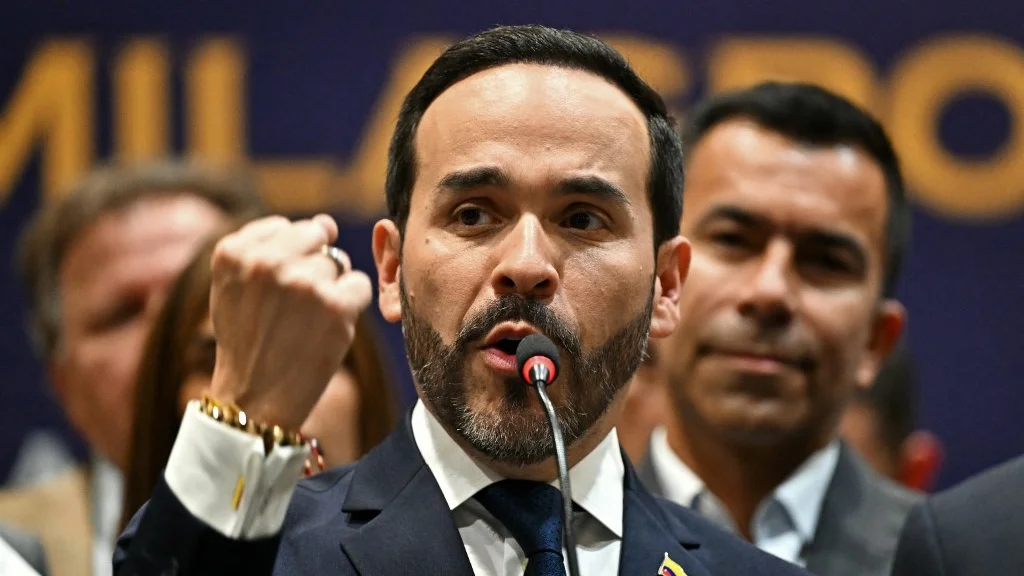
Middle East Eye Colombian president-elect Abelardo de la Espriella speaks in Bogota on 30 July 2026 (Luis Acosta/AFP)
Propelled by disinformation, arms deals and surveillance tech, right-wing governments have helped to increase Netanyahu’s reach, undermining the region’s historical alliance with Palestine
A split is happening across Latin America. Poll after poll shows the region’s publics turning against Israel, whose three-year assault on Gaza is widely considered a genocide by leading scholars and human rights groups.
Yet a wave of new right-wing governments – in El Salvador, Argentina, Chile, Ecuador, Peru, Bolivia, Honduras, Costa Rica and now Colombia – signals a shift in the opposite direction, deepening the region’s security, diplomatic and technological ties with Israel, while denying Palestinians the most basic right to self-determination.
The clearest illustration came last month in Colombia. Gustavo Petro, the former guerrilla and outgoing leftist president who addressed a pro-Palestine rally in New York last year before Washington revoked his visa, lost power to Abelardo de la Espriella, a lawyer who has defended paramilitary groups and has ties to military dictatorships and US President Donald Trump.
Petro has accused the Israeli cyber-intelligence firm BlackCore of deploying half a million bot accounts to flood Colombian voters with disinformation ahead of the June run-off, which De la Espriella won by less than a single percentage point.
Israeli Prime Minister Benjamin Netanyahu didn’t wait for that dispute to settle before celebrating online, congratulating the president-elect and declaring that “Israel’s friends continue to win”. The region is home to some 700,000 Palestinians and 500,000 Jews.
De la Espriella has already signalled that he will suspend plans for Colombia’s embassy to Palestine, and pledged to restore relations with Israel, including by moving Colombia’s mission to Jerusalem, thus stripping Bogota of its role as one of the more forceful voices behind South Africa’s genocide case against Israel at the International Court of Justice.
Colombia is just the latest domino to fall. Bolivia, the first Latin American country to sever ties with Israel after the 7 October 2023 attacks,restored full diplomatic relations in December under new centre-right President Rodrigo Paz, a rapprochement Netanyahu personally sealed by phone shortly after Paz’s election.
Washington’s puppet in Caracas
Venezuela’s nominally socialist government – under sustained American pressure, and effectively operating as a US-backed colonial regime – has hosted American congressional delegations, while keeping Israeli humanitarian and diplomatic channels open, and it recently announced plans to leave the International Criminal Court. Caracas has become a de facto puppet of Washington’s interests in the region, tilting ever-further right.
Cuba, destroyed by decades of US suffocation and now pursuing American-promoted economic reforms (met with even more sanctions), may not be far behind.
Mossad once operated out of Havana, helping the CIA track leftists and Soviet operatives across the region during the Cold War – a legacy ofIsraeli entanglement in Latin America that long predates Gaza.
Underpinning all of this is a security relationship in which Latin American electorates don’t get a say. Pegasus, the intrusive Israeli spyware sold to governments across the region, has repeatedly been used to target journalists and opposition figures, rather than terrorists and criminals.
Brazilian police, among the most lethal in the region, use a plethora of Israeli weapons in the favelas. Police violence across the country results in thousands of deaths annually. And in recent years, Israeli intelligence operatives have worked alongside Brazilian authorities to investigate an alleged Hezbollah presence in the country.
Israeli tourists in the region have become a flashpoint in their own right: blamed by Argentine officials for wildfires in Patagonia, detained by Brazilian police after violence against pro-Palestine protesters, and courted at tourism fairs in Sao Paulo that marketed occupied Palestinian land as Israeli destinations.
Crucial test ahead
There is a clear test ahead with Brazil’s October election. Flavio Bolsonaro, son of the convicted former president, launched his campaign against incumbent Luiz Inacio Lula da Silva with a video endorsement from Netanyahu and fiery support from Argentinian leader Javier Milei, who has called himself a “fanatic of Israel” and plans to move Argentina’s embassy to Jerusalem. Every right-wing candidate in the race has competed over being more pro-Israel and anti “terrorist” than the next.
Lula, the sitting president, remains by contrast one of the last major heads of state in Latin America still willing to call Israel’s campaign in Gaza a genocide. He has even compared it to the Holocaust, drawing public outrage in some quarters.
Both Brazil and Mexico, the latter now governed by a leftist president of Jewish heritage, Claudia Sheinbaum, face mounting pressure from Washington over their posture – including economic warfare, threats of strikes, sanctions, and terrorist designations that open the door to incursions.
Ironically, Nayib Bukele, El Salvador’s Maga darling dictator, is himself of Palestinian descent – but he has nonetheless built his repressive security state partly on Israeli weapons and surveillance equipment, now turbo-charging repression across Latin America.
The new president of Honduras, Nasry Asfura, who was pushed to power with Trump’s intervention, is also a deep ally of Israel, despite being of Palestinian descent. He has visited Israel and met Netanyahu.
Leaked audio recordings dubbed “Hondurasgate” allegedly captured former president Juan Orlando Hernandez, Asfura and Milei discussing plans to use Honduras as a staging ground to target leftist governments across the region – a plot that reportedly involved Netanyahu’s assistance in securing Hernandez a pardon from Trump after a drug trafficking conviction.
These new right-wing, mostly populist governments have helped to increase Israel’s reach, propelled by surveillance firms, arms deals and disinformation campaigns, despite the region’s populace growing increasingly wary of Israel.
This issue has become another front for elite-citizen divides in the region. The Brazilian election may help bridge, or deepen, that rift.
Joseph Bouchard is a journalist and researcher from Québec. He is currently a PhD student in Politics at the University of Virginia, and a Doctoral Fellow in Latin American Politics at the Social Sciences and Humanities Research Council of Canada.
A image of the leaders in Latin America who are Zionist friendly.