

FM Lavrov from the SCO Council of Ministers of Foreign Affairs
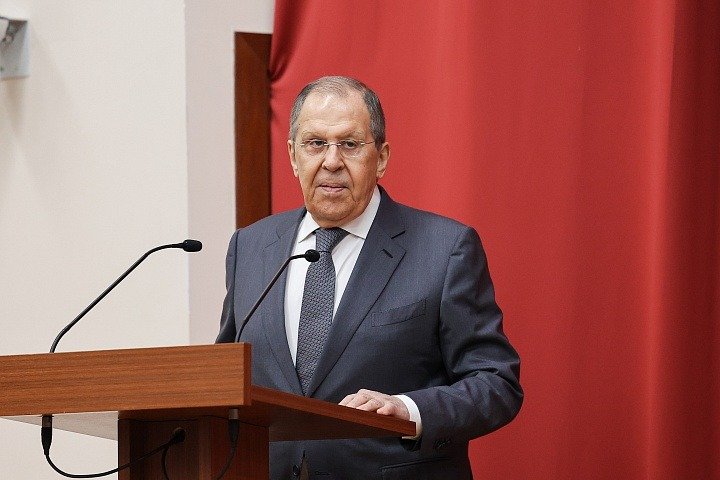
Foreign Minister Sergey Lavrov’s remarks and answers to media questions following a meeting of the SCO Council of Ministers of Foreign Affairs, Cholpon-Ata, July 24, 2026
https://www.mid.ru/en/foreign_policy/news/2128945/
Colleagues,
The meeting of the SCO Council of Ministers of Foreign Affairs has concluded. It was a productive meeting and an important part of the preparations for the SCO Summit in Bishkek this autumn.
The draft documents to be submitted for consideration by the leaders provide for the creation of a Universal Centre for Countering New Challenges and Threats and a Centre for Combatting Drug-Related Crime to be formalised through the adoption of the statutes governing each of these centres.
An announcement will also be made to the effect that the existing categories of Dialogue Partners and Observers will be replaced by a single SCO Partners category. In addition to the ten member states of the Shanghai Cooperation Organisation, the SCO currently has 15 partner countries and two observers. All 17 of these countries will be renamed (I hope they will have no objection to that) and called “Partners.”
The foreign ministers adopted a joint statement which offers a clear and principled assessment of the international situation and lays out the tasks to be pursued in accordance with previous decisions of the Heads of State and the Heads of Government. There is no doubt that additional documents covering sector-specific areas of cooperation will be drafted for the SCO Summit in Bishkek. We discussed energy, artificial intelligence, healthcare, and a number of other areas.
I believe we did quite well.
Question: This year marks the 35th anniversary of independence of Kyrgyzstan. It has been a challenging journey starting from hard early years of building the statehood of our respective republics to today’s strategic partnership and alliance. How do you see the next stage of bilateral relations?
Sergey Lavrov: I see our alliance and strategic partnership expanding across all areas. That is precisely the objective our respective presidents have set for us. Over the past year, they have created a fairly strong foundation that will provide guidance for our ministries and agencies in defence cooperation, the defence industrial complex, security, political coordination through our foreign ministries, as well as various sector-specific areas of economic and investment cooperation. So, I see us moving forward in a steady manner.
Question: Is the SCO a centre of the multipolar world?
Sergey Lavrov: Yes, it is. Did you doubt it? It is growing stronger, that much is true. Interest is increasing among countries outside the SCO family that seek to obtain an appropriate status within the SCO. From now on, the status will be that of a Partner. Today, the SCO family comprises 27 countries representing over 40 percent of the global population and over one-third of the global economy. I have no doubt that these figures will continue to grow.
Question: Back to your meeting with US Secretary of State Marco Rubio yesterday. The State Secretary said that the Anchorage agreements had failed and no agreement can be reached unless the Ukrainians are on board. What do you say to that? Did you discuss a possible visit by US Presidential Special Envoy Steve Witkoff and Jared Kushner? More broadly, what diplomatic or mediation track remains possible going forward?
Sergey Lavrov: As for the claim that the Anchorage agreements have failed, first we need to do is understand who exactly failed. We came to Anchorage with the proposals that had been put forward in advance by the United States and approved by US President Donald Trump. We agreed to work on them. Not long ago, President Vladimir Putin reiterated at a news conference, “We had doubts. Not right away, but we considered them and agreed to them.”
If there is a proposal and there is a consent that means there were agreed outcomes in Anchorage, were there not? There certainly were.
President Trump has repeatedly said, including in Anchorage, and I am not revealing a great secret here, that part of this proposal was built on a compromise. We accepted it because a compromise proposal, just like any agreement, must inevitably contain an element of compromise. However, he added that Zelensky would do as he had proposed. Well, as it turned out, that failed to happen.
Have a read. I’ve provided some quotes on an earlier occasion. Yesterday, I gave US Secretary of State Marco Rubio a transcript of what President Trump had to say in Alaska on the day of the news conference. Upon returning to Washington, he spent the next three days speaking enthusiastically about the Anchorage agreements saying we had practically settled almost everything with just one issue to go, but a robust foundation had been laid.
That is our assessment. We approached the matter believing that accepting the US proposal would stop the hostilities and we would sit down to discuss a settlement. There are, of course, a host of details that are part of the political aspects of the issue.
Did President Trump’s proposal fall through because Ukraine said it would not do anything? Is it because the EU said it was not ready? They went to Washington and spent a considerable amount of time engaging with the US Administration shortly after the meeting in Alaska. At the G7 Summit in June, they adopted a declaration in which the Western countries expressed full support for Ukraine, including its territorial integrity, while completely ignoring the fact that a vast portion of Ukrainian territory is home to the people who have been labelled “terrorists,” and whom the newly appointed Commander-in-Chief of the Armed Forces of Ukraine, Mikhail Drapaty, has described as “subhuman.” Yet the G7 believes those territories should remain under the control of that regime, thereby enabling it to continue committing abuses against Russian people who now live in the Russian Federation, in Crimea, Donbass, and Novorossiya.
But if we take a closer look, French President Emmanuel Macron publicly stated that Anchorage was over, and there were no longer any understandings, and that America was once again on their side. Meanwhile, Ukraine’s Acting Foreign Minister Andrey Sibiga said they had buried the Anchorage agreements. If the Americans share these assessments, what can we do about it? We have spoken about this many times. Naturally, we favour a political and diplomatic settlement. However, we will achieve our objectives no matter what.
One final point. The arrogant and, I would even say contemptuous, way the US proposals have been spurned is due in no small measure to the fact that Vladimir Zelensky continues to be flooded with weapons. He is being supplied with enormous quantities of drones, which he uses to try to undermine the stability of the Russian Federation by attacking civilians and civilian targets. A significant portion of the support provided to Vladimir Zelensky comes from the United States.
This is not only because the Americans sell weapons to the EU, which then transfers them to Ukraine, but also because the United States provides intelligence and reconnaissance, Starlink remains operational, and advanced technologies that require specialist expertise on the battlefield do not find their way there by accident. That is the way things are.
To reiterate, our conscience is clear. As the saying goes, a man’s word is his bond. We said we were ready, and we remain ready. The other side, however, appears to have modified its position, judging by US Secretary of State Marco Rubio’s remarks. However, the objectives set by President Vladimir Putin in June 2024, as he has repeatedly emphasised, will be achieved.
Just minutes after Mr Lavrov said that the US provides weapons and ISR to Kiev, Trump plays innocent. But, Lavrov set the trap yesterday with Rubio and Trump fell into it. Don’t ever underestimate Lavrov.
Lavrov:
A significant portion of the support provided to Vladimir Zelensky comes from the United States.
This is not only because the Americans sell weapons to the EU, which then transfers them to Ukraine, but also because the United States provides intelligence and reconnaissance, Starlink remains operational, and advanced technologies that require specialist expertise on the battlefield do not find their way there by accident. That is the way things are.
Donald J. Trump@realDonaldTrump
President Xi, at our recent meeting in Beijing, China, told me that he would not, under any circumstances, give or sell Weapons to the Islamic Republic of Iran — And that statement included Chinese Companies. Considering our relationship, I take him at his word and, besides, l am doing him very big favors, also. Likewise, President Putin, despite the horrible War going on in Ukraine (The relationship remains, as it does with President Zelenskyy), told me that he would not sell Weapons to Iran. He understands that I do not sell Weapons to Ukraine, but to NATO Countries. They pay full price, and how those Weapons are distributed, I have no idea. Therefore, two major Countries that people speak of often in terms of Iran are, in my opinion, not participating. If they did, it would be very bad for them — Certainly not in their best interests. Thank you for your attention to this matter! President DONALD J. TRUMP
https://truthsocial.com/@realDonaldTrump/posts/116975606621428184
Lavrov can tell President Trumptard: Russia and China are not aiding Iran’s war effort against America’s/Israel’s war of aggression against that country in the same way that America is not aiding Ukraine’s war effort against Russia or the war preparations of Taiwan, Philippines, Japan, Australia, etc. against China. It would… Read more »