

China’ Long March 10B Rocket Closes Gap on Space Launch Capabilities
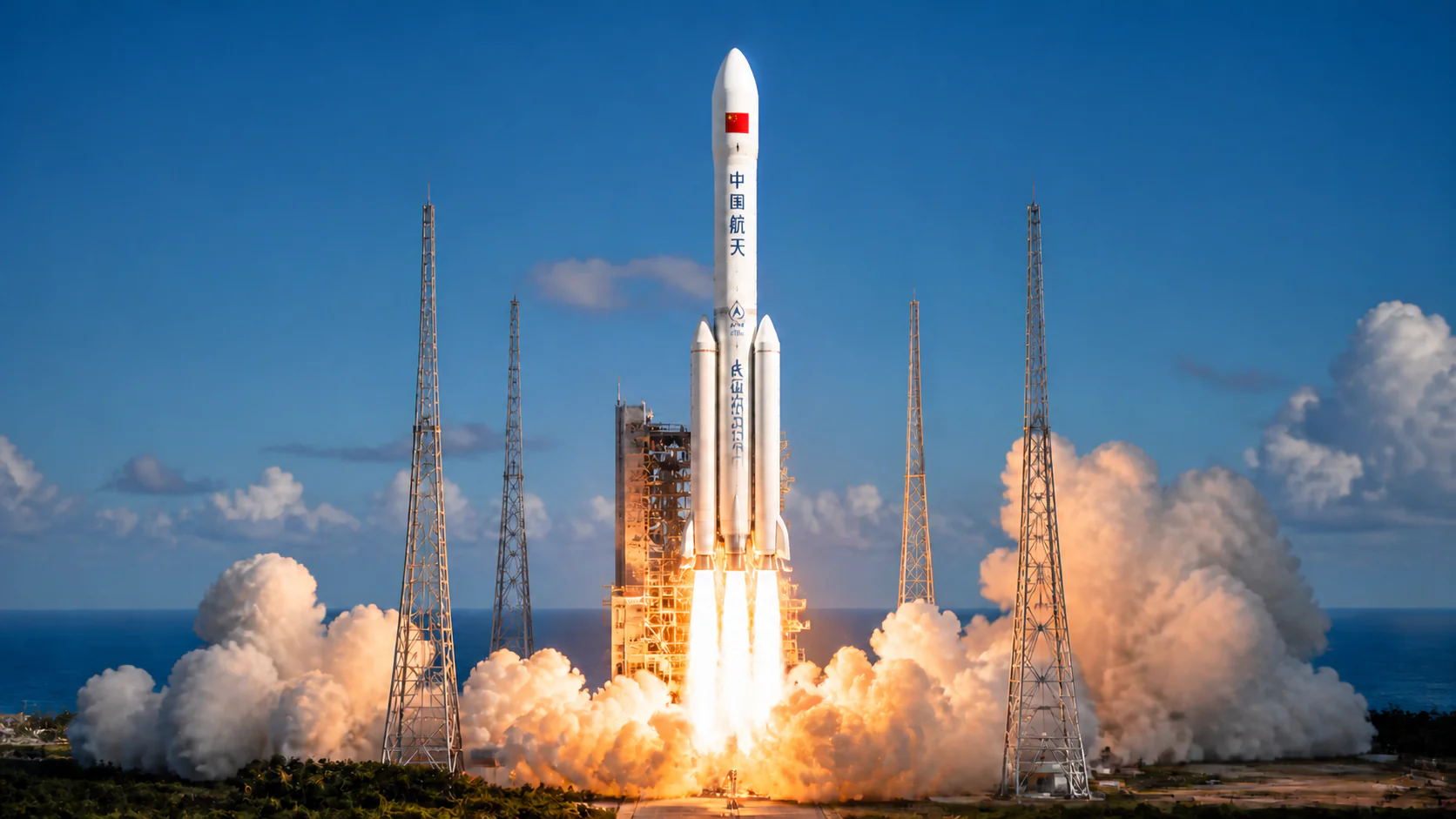
On July 10, 2026, China successfully launched a payload to orbit and recovered the first stage booster of its Long March 10B rocket system, making China only the second nation after the US to do so.
By Brian Berletic at NEO
In function, it is similar to the US-based SpaceX’s Falcon 9, which can return to landing pads on shore or land on recovery ships at sea using deployable legs. By eliminating the legs from the first stage booster and using the cable net system, the Long March 10B saves weight that can be used instead for additional fuel.
Both the Long March 10B and the Falcon 9 use kerosene and LOX (liquid oxygen) fueled engines — though each system uses different types of engines. The Long March 10B has 7 engines, while Falcon 9 has 9.
The Long March 10B can carry 16 metric tons into orbit in reusable configuration, while the Falcon 9 can carry 17.5 metric tons into orbit—fairly comparable.
China seeks to examine, refurbish, and relaunch this recovered booster a second time by the end of 2026.
This was only the second test of the Long March 10B — the first occurred in February this year, featuring a planned soft landing at sea next to the recovery ship after propelling China’s new manned spacecraft — the Mengzhou — to maximum dynamic pressure (the highest speed and pressures within the Earth’s atmosphere) before conducting a launch abort test, which was also successful.
To have successfully designed, tested, and successfully recovered a first-stage booster with capabilities on par with SpaceX’s Falcon 9 in just 2 attempts is a monumental achievement considering the multiple failures that took place when developing the Falcon 9 itself.
Why China’s Success is Important
In 2020 and 2021, China was outpacing the US in space launches. By 2022 the US had surpassed China, and every year since the US has surpassed China solely because of SpaceX’s ability to launch, recover, and reuse its rocket fleet — where China — until now — has been forced to fully expend every rocket it launches.
Over the years, SpaceX has launched and recovered its Falcon 9 rockets over 600 times.
In 2025 — last year — the US launched a total of 181 rockets — China 92-93 and Russia 17 — meaning the US launched more rockets than both China and Russia combined.
The US has exploited this advantage in launch cadence by building the Starlink (approximately 10,000 active satellites) and now the Starshield (approximately 200 active satellites) low earth orbit satellite constellations used to wage war around the globe — from Russia to Iran and eventually against China itself.
Russia and China have been deploying their own versions of these low earth orbit satellite constellations for low latency communication for both civilian and military applications — but because of their lower launch cadence — they have many times fewer satellites of this kind in orbit — thus coverage and resolution lags behind their US counterparts.
Reusability is the only way to achieve such large constellations and reach parity with the US in this regard — a capability China is now in the process of fully implementing.
In the December 2025 article, “A New Space Race Above Earth May Determine Who Prevails Upon It,” it was explained that:
The lopsided access to space afforded by reusable launch systems means placing not only larger and more capable satellite constellations into orbit; it also means being able to target and remove the constellations of others from orbit.
This includes the use of co-orbital satellites (sometimes called “killer satellites” or “inspector satellites”) able to approach the satellites of other nations. Nations like the US with a high launch cadence can quickly put new, more advanced co-orbital satellites into orbit or replace any losses from an adversary’s co-orbital or anti-satellite capabilities.
This represents a lopsided balance of power in orbit, creating a potentially lopsided balance of power back on Earth.
Only time will tell whether or not China’s ability to match the US in all matters on Earth can be extended over this new space race above it.
We can now see that just halfway through 2026, the Long March 10B has carried out 2 incredibly successful tests, which also included functional missions: the first tested the launch abort capabilities of the Mengzhou spacecraft, and the second launched a functional communication satellite into orbit.
China is Eliminating Washington’s Remaining Advantages On and Above Earth
China is reaching parity with the US in one of the few remaining areas of advantage the US has, which will likely only accelerate Washington’s desire to undermine China’s continued rise — both across information space and also economically, geopolitically, and militarily.
As part of this, the US government and its vast network of propaganda, including those of its proxies, including the UK via BBC, have already worked to diminish, downplay, and even just outright lie about China’s recent success.
The BBC, in its article, “China lands reusable rocket for first time, state media says,” in its headline alone attempts to suggest Chinese “state media” has claimed success that may or may not be true — the BBC itself being state media. This is despite extensive video footage from the launch being available online, including live video of the launch streaming on YouTube hours before the BBC published its article. .
Attempts to undermine China’s success in terms of space launches have been continuous and had already targeted the first Long March 10B launch this year back in February.
China Observer, operated by Vision Times, a US government-backed anti-China media project maintained by the mostly US-based Falun Gong UFO cult, published a video titled, “Long March 10 Rocket Recovery Fails, China Denies It, Spends $100B Copying SpaceX for Nothing,” which deliberately misrepresented the mission profile for the launch, claiming the planned soft landing at sea next to the recovery ship was in fact a mishap the Chinese government was maliciously attempting to cover up.
Not only did the video attempt to misrepresent the test launch and undermine its success, it repeated the popular myth that all of China’s successes are merely “copied” or “stolen” from the West — and in this case — lifted from SpaceX’s Falcon 9 system — despite the rockets being entirely different in size, engine type, and configuration, and despite China’s Long March 10B using a recovery system literally having never been used by any other launch system in human history.
Accusing China’s Long March 10B of being a “copy” of SpaceX’s Falcon 9 would be like accusing a Ford Mustang of being a copy of a Ferrari 962 because they both have 4 wheels and engines.
After long claiming China’s inability to successfully recover the first stage of an orbital launch system, these same anti-China voices are now insisting it will take 10 years or longer for China to match SpaceX’ launch cadence.
These claims are based on the amount of time it has taken China to match these capabilities in the first place, and how long it took SpaceX itself to scale up its production, launch, recovery, and reuse of its Falcon 9 launch system. However, these claims ignore the reality of the vast differences between the US and China.
China’s industrial base — which will create the supply chains required to scale up its ability to launch/recover/reuse rockets — is the largest, most advanced industrial base on Earth. China produces millions more STEM (science, technology, engineering, and mathematics) graduates each year than the US.
These advantages have already allowed China to not only match the scale and complexity of US-based electric vehicle company Tesla but also surpass it to the point Tesla itself is putting superior Chinese-designed and made batteries into cars it sells overseas — China having achieved this in just a few years.
These advantages have also allowed China to surpass the US in traditional shipbuilding by a factor of 200. What would prevent China from repeating this success in terms of aerospace engineering — a field China has already been closing in on the existing US lead in recent years, including in both 5th generation and even 6th generation warplanes?
All factors being equal, China’s surpassing the US in terms of space launch capabilities and cadence is inevitable. This is why the US is attempting to skew factors in its favor — not only through its use of information warfare, and trade and economic measures, but also through warfare expanding worldwide, seeking to disrupt and destabilize the entirety of the multipolar world China is helping shape and use to displace US-led unipolarism as an alternative.
As Chinese successes continue to accelerate and multiply, both here on Earth and above it, it should be expected that US desperation and aggression accelerate dangerously with it. Only time will tell if China’s ability to innovate, build, and scale up its successes can outpace the US in the one area it still maintains an uncontested monopoly over — destroying.