

The Human Mosaic as a Civilisational Approach for a Multipolar World
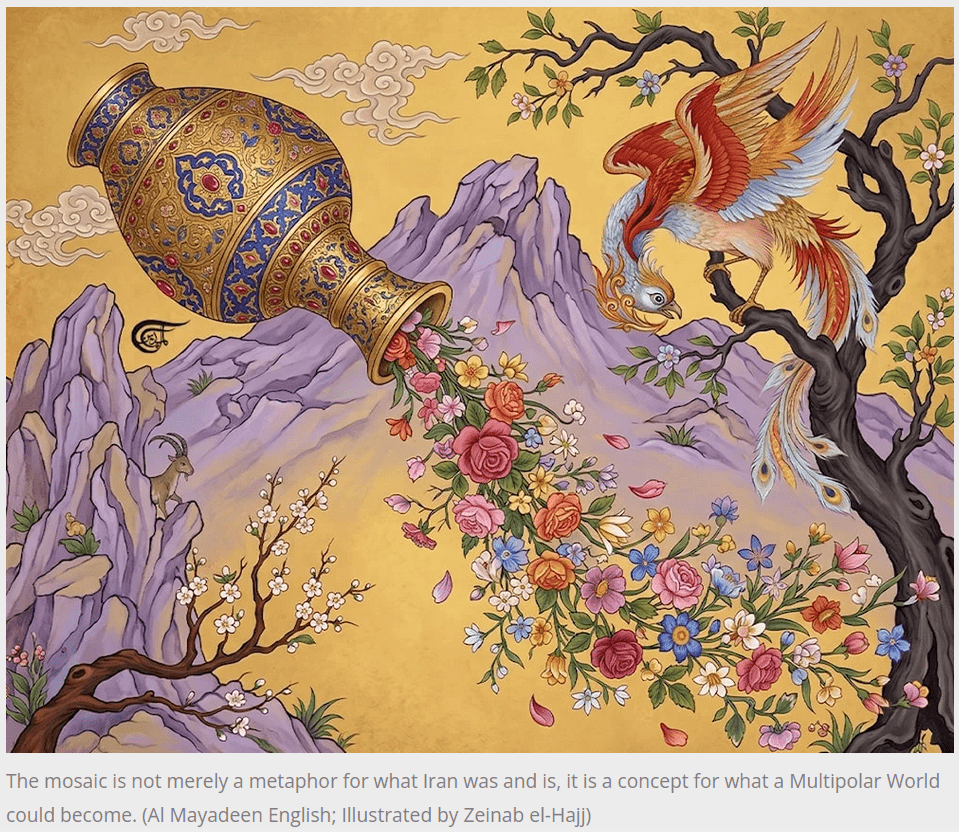
The Global Mosaic: “The diversity of world civilisations and values” – honoured and sealed by both ink… and blood…
by Nora Hoppe and first posted at Al Mayadeen English
Leaders and Ink
The Joint Declaration on the Emergence of a Multipolar World and International Relations of a New Type – signed at the May 2026 Beijing summit – marks a decisive historical turning point: a blueprint to dismantle Western global hegemony and replace it with a non-Western order. Among its four core principles, one stands out: “The diversity of world civilisations and values.” The world is reframed not as a single global community, but as an aggregate of distinct civilisations. Nor will these inked words remain on paper: Moscow and Beijing intend to implement them through BRICS and the SCO.
People and Blood
If the two sovereign powers of the Global Majority have drawn a new geopolitical map “with leaders and ink”, the People of Iran have reshaped the international order “with blood” – through human sacrifice in a brutal war imposed on them by the Hegemon. Iran’s triumph has altered the global power equation in a way no declaration could. Nor is Iran alone: the sacrifices of the entire Axis of Resistance and the Russian soldiers (both fighting the Axis of Barbarism), demand honour. Yet it is the People of the Islamic Republic of Iran who have ultimately delivered the unequivocal blow that changed the very architecture of power.
As Imam Sayyid Mojtaba Khamenei put it, Iran’s “chain of victories in the Persian Gulf” has ushered in “the dawn of a new regional and global order”… to the great advantage of the Global Majority. These victories are more than military ones. Iran has defeated the world’s Hegemon and achieved total psychological decolonisation. Every nation that refuses to be a client state can now become a tessera in a Multipolar Mosaic.
از کوزه همان برون تراود که در اوست
“What pours out of the jug is what was in it.”
Iran is a multipolar world in itself: it is a historical synthesis of diverse ethnicities (Persians, Azeris, Kurds, Lurs, Baluchis, Gilaks, Turkmen, Arabs and many more). While other ancient empires crumbled under the weight of foreign conquests, Iran survived by absorbing its invaders into its civilisational mosaic. It did not break; it simply rearranged its assorted shards into a strong whole, proving that a mosaic is far more resilient to the shocks of history than a monolithic stone.
From the Achaemenid Empire onward, Iranian civilisation faced a persistent question: how to govern a land of many peoples, languages, and faiths?” The answer was not assimilation, not Gleichschaltung… but “mosaic governance”. The Cyrus Cylinder (539–538 BC) – now in colonial possession – records Cyrus’s order to return captive peoples and his respect for local laws, traditions, and religious practices. The Safavid era (1501–1736) offers another mosaic: a Shia imperial state governing over Sunni Muslim populations, Armenian Christian communities (with autonomy), Jewish and Zoroastrian minorities and various Sufi orders.
The state was the “frame”; the communities were the “tesserae”. Power derived from distinct colours, not erasure.
None of this is to say Iran’s mosaic was bloodless – but the pattern of “absorption over annihilation” left a mark to be drawn upon as a source of compassion.
Two anecdotes on two “accidents” and their revelations
Accident 1
Beyond revealing character under pressure, the “jug and its contents” appears in historical “accidents”.
In the late 16th century, during the Safavid Dynasty, Iran imported fragile mirrors from Venetian glassmakers. Many broke during the long and arduous sea-and-land transit. Recognising the essence of the mirror regardless of form, Iranian artisans repurposed the shards into intricate geometric mosaics – giving rise to the art of “aina-kari“ (“mirror-work”) seen in such iconic structures as the Chehel Sotoun Palace in Isfahan and the Golestan Palace in Tehran.
The Aina-kari represents the metamorphosis of a uniform substance into a recomposed “multiform unity”, catching, breaking and dispersing light from diverse angles. A single flat mirror can only reflect what stands directly before it. A mosaic of broken mirrors reflects “light from every angle simultaneously”. The One Divine Light manifests as myriad facets without losing its original source.
Accident 2
A second revealing “accident” in connection to the chronicles of Iran’s aina-kari occurred on 2nd March 2026 when Tehran’s Golestan Palace was struck by shockwaves from US-Israeli bombings. Countless centuries-old “tesserae of light” were torn from their beds and shattered across the palace floors … to lie darkened as grey shards and dust amongst the debris.
Minister Reza Salehi Amiri, Iran’s minister for culture and tourism, described this crime and the damage to 55 other historical sites not as collateral damage but as “a deliberate and conscious attack on Iranian identity”: “We are not talking about stone and mortar, but the memory of a people.”
The Cosmic Mosaic: Shards as the Architecture of Grammar and the Universe
The Sufi concept of wahdat al-wujud (the Unity of Being) teaches that the universe is a fragmented reflection of a singular Divine Truth (“Al-Haqq”).
Persian literature functions as a linguistic mosaic: from Ferdausi’s epic fragments to Hafez’s discrete ghazals, Iranian poetry places autonomous shards of imagery side-by-side until meaning becomes apparent. A single ghazal by masters such as Jalal al-Din Balkhi (Rumi and Hafez presents fractured mystical states, unified by the radif (a repeating refrain).
Birds of different feathers flock together
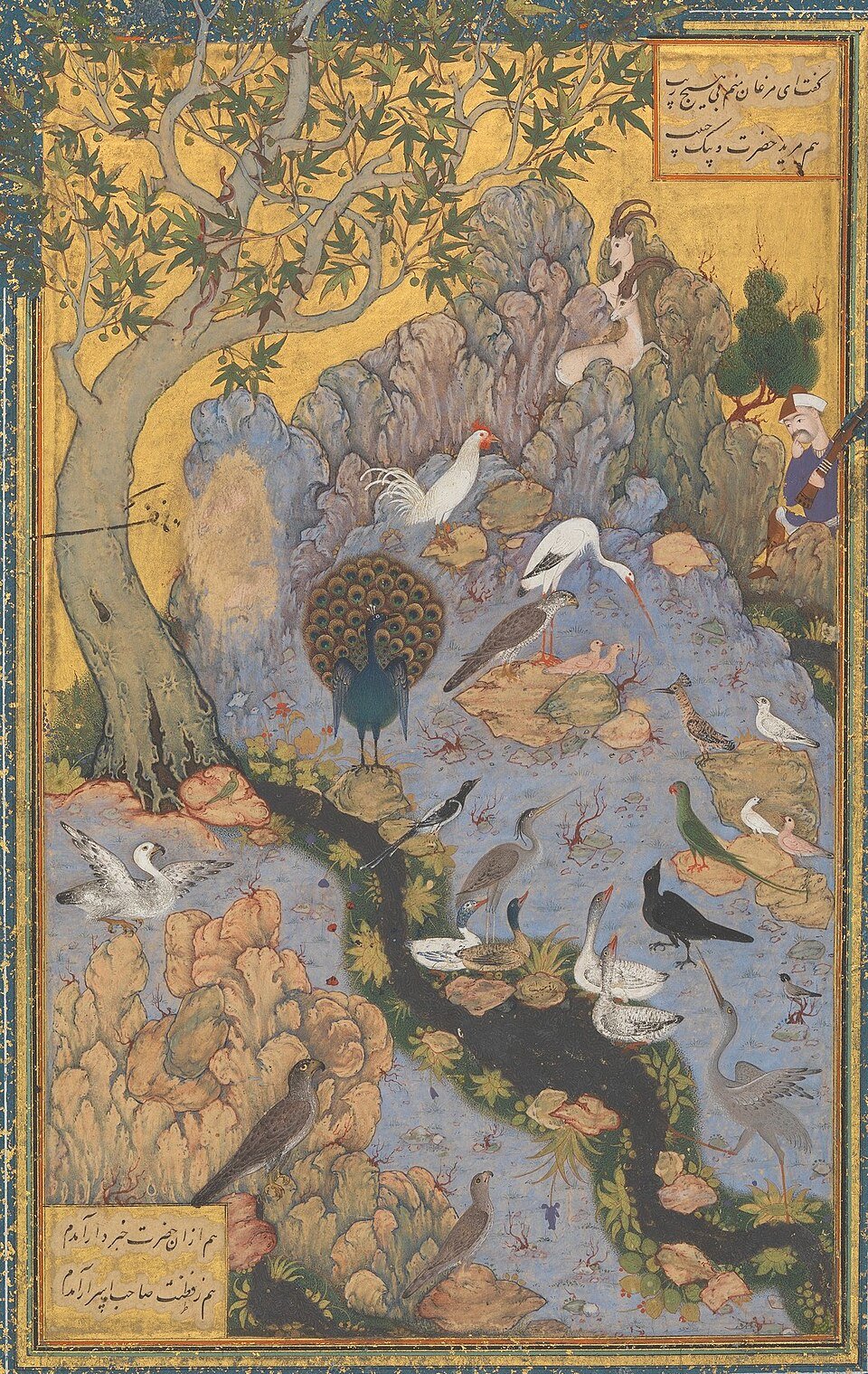
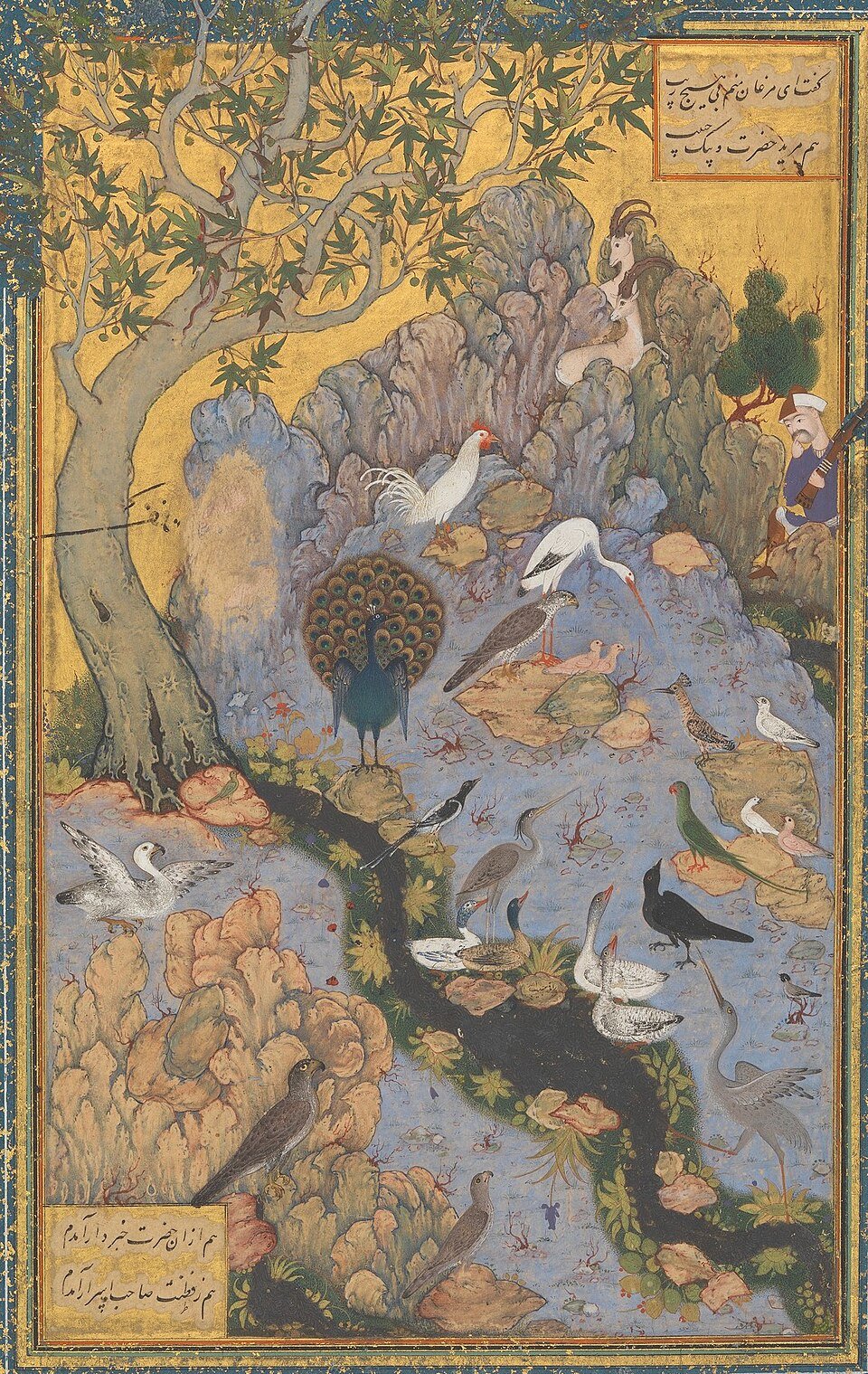
Farid ud-Din Attar’s masterpiece “The Conference of the Birds” (Mantiq al-Tayr) tells of a mosaic in the form of birds. In search of a sovereign, the birds of the world seek the legendary “Simorgh”. After a long, arduous journey through seven valleys, only thirty birds end up reaching the habitat of this being, where they are directed to gaze into a pool of water… Looking at their reflection in the water, the birds do not see themselves individually; they see thirty birds. Lo and behold. The name “Simorgh” in Persian means thirty (si) birds (morgh). The divine being they sought is a collective realisation of their own interconnectedness. The seven valleys – Quest, Love, Gnosis, Detachment, Unity, Bewilderment, Annihilation – are not linear; the seeker fragments and reassembles. The psyche itself is the mosaic being constructed through spiritual labour.
Unity without uniformity
On the occasion of the remembrance day of Ferdausi, Imam Sayyid Mojtaba Khamenei said of the Shâhnâmah: its “valiant and Qor’anic concepts unite all ethnic groups and social strata of Iran in preserving their identity, independence and in the battle against the ‘Zahhâk-like’ aggressors”. [Zahhâk is a demon of greed.] The Shâhnâmah – a mosaic of warriors, lovers, sages, and rebels – is a blueprint of “resistant multiplicity”: unity without uniformity.
Toward an Insaniyya of a Multipolar World…
Today the Islamic Republic of Iran is the sum of its motley history and its diverse peoples, displaying unbreakable unity through compassion. MFA Spokesman Esmaeil Baqaei stated: “To every decent human being – regardless of religion, ethnicity, nationality, race, or any other distinction – to Muslims, Jews, Christians, Sikhs, Hindus, Buddhists, and all others of faith, and to those who follow no formal religion but hold deeply to the universal values of peace, justice, and human dignity […] this is a war that will determine the very meaning of ‘good’ and ‘evil’ in our time and for future.”
Philosopher, politician and father-in-law to Imam Sayyid Mojtaba Khamenei, Professor Gholam Ali Haddad Adel says Iranians are writing a new chapter of unity and resilience as they defend their homeland and identity: “Forget the mythical 1001 Nights. Come and see the real 1001 Nights of the Iranian people.”
On 1st June, Iran chose to suspend dialogue with the United States not for national gain, but in defence of Gaza and Lebanon against the war crimes of the Zionist regime. Might this echo Khomeini’s vision of empathy with the “mustaz‘afin” (the oppressed) as a civilisational duty – a recognition arising from Iran’s mosaic that the suffering of one people is a fracture in the whole?
Is Iran perhaps not teaching the world a precious lesson here? Not a prescription, but a provocation: that unity through multiplicity, harmony amongst diverse peoples, and compassion beyond one’s own geography could become the tesserae of a future worth building.
So the mosaic is not merely a metaphor for what Iran was and is. It is a concept for what a Multipolar World could become: not a single flat mirror reflecting one empire’s light, but a field of broken shards, each catching the same divine light from a different angle. The question is not whether the world will adopt this image – but whether we can learn to see ourselves in the reflection of thirty birds, and recognise that our wholeness was never ours alone.
… and blood…
Leaders and Ink
The Joint Declaration on the Emergence of a Multipolar World and International Relations of a New Type – signed at the May 2026 Beijing summit – marks a decisive historical turning point: a blueprint to dismantle Western global hegemony and replace it with a non-Western order. Among its four core principles, one stands out: “The diversity of world civilisations and values.” The world is reframed not as a single global community, but as an aggregate of distinct civilisations. Nor will these inked words remain on paper: Moscow and Beijing intend to implement them through BRICS and the SCO.
People and Blood
If the two sovereign powers of the Global Majority have drawn a new geopolitical map “with leaders and ink”, the People of Iran have reshaped the international order “with blood” – through human sacrifice in a brutal war imposed on them by the Hegemon. Iran’s triumph has altered the global power equation in a way no declaration could. Nor is Iran alone: the sacrifices of the entire Axis of Resistance and the Russian soldiers (both fighting the Axis of Barbarism), demand honour. Yet it is the People of the Islamic Republic of Iran who have ultimately delivered the unequivocal blow that changed the very architecture of power.
As Imam Sayyid Mojtaba Khamenei put it, Iran’s “chain of victories in the Persian Gulf” has ushered in “the dawn of a new regional and global order”… to the great advantage of the Global Majority. These victories are more than military ones. Iran has defeated the world’s Hegemon and achieved total psychological decolonisation. Every nation that refuses to be a client state can now become a tessera in a Multipolar Mosaic.
از کوزه همان برون تراود که در اوست
“What pours out of the jug is what was in it.”
Iran is a multipolar world in itself: it is a historical synthesis of diverse ethnicities (Persians, Azeris, Kurds, Lurs, Baluchis, Gilaks, Turkmen, Arabs and many more). While other ancient empires crumbled under the weight of foreign conquests, Iran survived by absorbing its invaders into its civilisational mosaic. It did not break; it simply rearranged its assorted shards into a strong whole, proving that a mosaic is far more resilient to the shocks of history than a monolithic stone.
From the Achaemenid Empire onward, Iranian civilisation faced a persistent question: how to govern a land of many peoples, languages, and faiths?” The answer was not assimilation, not Gleichschaltung… but “mosaic governance”. The Cyrus Cylinder (539–538 BC) – now in colonial possession – records Cyrus’s order to return captive peoples and his respect for local laws, traditions, and religious practices. The Safavid era (1501–1736) offers another mosaic: a Shia imperial state governing over Sunni Muslim populations, Armenian Christian communities (with autonomy), Jewish and Zoroastrian minorities and various Sufi orders.
The state was the “frame”; the communities were the “tesserae”. Power derived from distinct colours, not erasure.
None of this is to say Iran’s mosaic was bloodless – but the pattern of “absorption over annihilation” left a mark to be drawn upon as a source of compassion.
Two anecdotes on two “accidents” and their revelations
Accident 1
Beyond revealing character under pressure, the “jug and its contents” appears in historical “accidents”.
In the late 16th century, during the Safavid Dynasty, Iran imported fragile mirrors from Venetian glassmakers. Many broke during the long and arduous sea-and-land transit. Recognising the essence of the mirror regardless of form, Iranian artisans repurposed the shards into intricate geometric mosaics – giving rise to the art of “aina-kari“ (“mirror-work”) seen in such iconic structures as the Chehel Sotoun Palace in Isfahan and the Golestan Palace in Tehran.
The Aina-kari represents the metamorphosis of a uniform substance into a recomposed “multiform unity”, catching, breaking and dispersing light from diverse angles. A single flat mirror can only reflect what stands directly before it. A mosaic of broken mirrors reflects “light from every angle simultaneously”. The One Divine Light manifests as myriad facets without losing its original source.
Accident 2
A second revealing “accident” in connection to the chronicles of Iran’s aina-kari occurred on 2nd March 2026 when Tehran’s Golestan Palace was struck by shockwaves from US-Israeli bombings. Countless centuries-old “tesserae of light” were torn from their beds and shattered across the palace floors … to lie darkened as grey shards and dust amongst the debris.
Minister Reza Salehi Amiri, Iran’s minister for culture and tourism, described this crime and the damage to 55 other historical sites not as collateral damage but as “a deliberate and conscious attack on Iranian identity”: “We are not talking about stone and mortar, but the memory of a people.”
The Cosmic Mosaic: Shards as the Architecture of Grammar and the Universe
The Sufi concept of wahdat al-wujud (the Unity of Being) teaches that the universe is a fragmented reflection of a singular Divine Truth (“Al-Haqq”).
Persian literature functions as a linguistic mosaic: from Ferdausi’s epic fragments to Hafez’s discrete ghazals, Iranian poetry places autonomous shards of imagery side-by-side until meaning becomes apparent. A single ghazal by masters such as Jalal al-Din Balkhi (Rumi and Hafez presents fractured mystical states, unified by the radif (a repeating refrain).
Birds of different feathers flock together
Farid ud-Din Attar’s masterpiece “The Conference of the Birds” (Mantiq al-Tayr) tells of a mosaic in the form of birds. In search of a sovereign, the birds of the world seek the legendary “Simorgh”. After a long, arduous journey through seven valleys, only thirty birds end up reaching the habitat of this being, where they are directed to gaze into a pool of water… Looking at their reflection in the water, the birds do not see themselves individually; they see thirty birds. Lo and behold. The name “Simorgh” in Persian means thirty (si) birds (morgh). The divine being they sought is a collective realisation of their own interconnectedness. The seven valleys – Quest, Love, Gnosis, Detachment, Unity, Bewilderment, Annihilation – are not linear; the seeker fragments and reassembles. The psyche itself is the mosaic being constructed through spiritual labour.
Unity without uniformity
On the occasion of the remembrance day of Ferdausi, Imam Sayyid Mojtaba Khamenei said of the Shâhnâmah: its “valiant and Qor’anic concepts unite all ethnic groups and social strata of Iran in preserving their identity, independence and in the battle against the ‘Zahhâk-like’ aggressors”. [Zahhâk is a demon of greed.] The Shâhnâmah – a mosaic of warriors, lovers, sages, and rebels – is a blueprint of “resistant multiplicity”: unity without uniformity.
Toward an Insaniyya of a Multipolar World…
Today the Islamic Republic of Iran is the sum of its motley history and its diverse peoples, displaying unbreakable unity through compassion. MFA Spokesman Esmaeil Baqaei stated: “To every decent human being – regardless of religion, ethnicity, nationality, race, or any other distinction – to Muslims, Jews, Christians, Sikhs, Hindus, Buddhists, and all others of faith, and to those who follow no formal religion but hold deeply to the universal values of peace, justice, and human dignity […] this is a war that will determine the very meaning of ‘good’ and ‘evil’ in our time and for future.”
Philosopher, politician and father-in-law to Imam Sayyid Mojtaba Khamenei, Professor Gholam Ali Haddad Adel says Iranians are writing a new chapter of unity and resilience as they defend their homeland and identity: “Forget the mythical 1001 Nights. Come and see the real 1001 Nights of the Iranian people.”
On 1st June, Iran chose to suspend dialogue with the United States not for national gain, but in defence of Gaza and Lebanon against the war crimes of the Zionist regime. Might this echo Khomeini’s vision of empathy with the “mustaz‘afin” (the oppressed) as a civilisational duty – a recognition arising from Iran’s mosaic that the suffering of one people is a fracture in the whole?
Is Iran perhaps not teaching the world a precious lesson here? Not a prescription, but a provocation: that unity through multiplicity, harmony amongst diverse peoples, and compassion beyond one’s own geography could become the tesserae of a future worth building.
So the mosaic is not merely a metaphor for what Iran was and is. It is a concept for what a Multipolar World could become: not a single flat mirror reflecting one empire’s light, but a field of broken shards, each catching the same divine light from a different angle. The question is not whether the world will adopt this image – but whether we can learn to see ourselves in the reflection of thirty birds, and recognise that our wholeness was never ours alone.
Thank you once again Nora: An excellent combination of living art and recognition of the depths that inspire it. “Mosaic” so well captures the deeper reality of unity within difference. I particularly appreciate your bringing forward the Sufi understanding that all shards of seemingly different articulations derive from the same… Read more »