

Venezuela healthcare in dire straits as US forces Cuban doctors exit
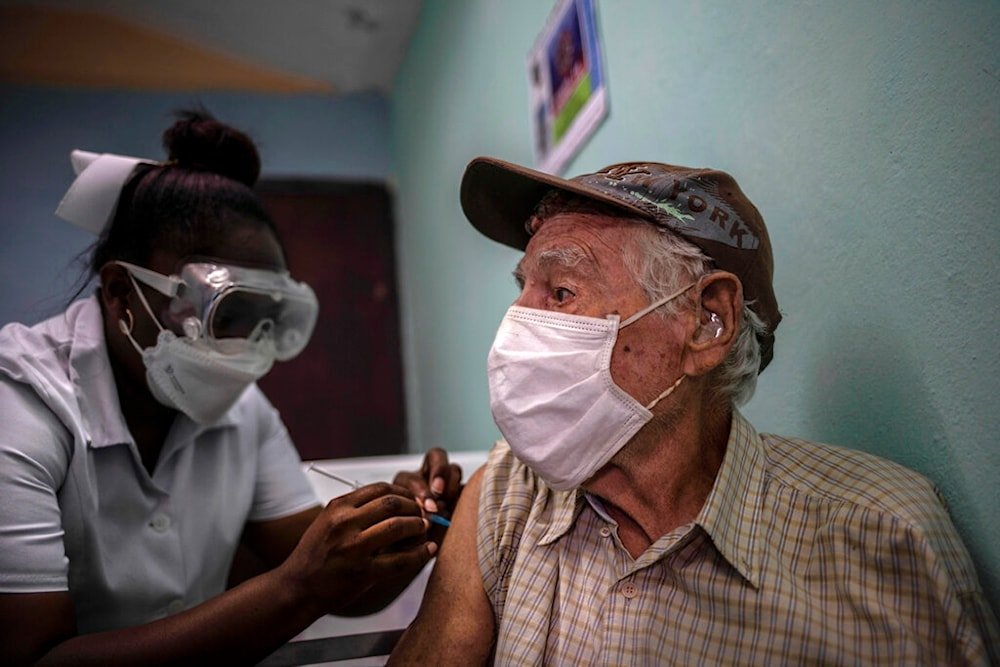
A man gets a shot of the Cuban Abdala vaccine for COVID-19 at a doctor’s office in Alamar on the outskirts of Havana, Cuba, Friday, May 14, 2021 (AP)
The departure of Cuban doctors from Venezuela, driven by growing US pressure on Havana’s overseas medical missions, is deepening healthcare shortages.
Venezuela’s public healthcare system is facing mounting pressure as Cuban medical personnel continue to leave the country, Bloomberg reported on Tuesday, raising concerns about the future of a healthcare partnership that has for decades been a cornerstone of relations between Caracas and Havana.
According to the report, Cuban doctors, specialists, and other healthcare workers have been departing medical facilities across Venezuela amid growing US efforts to curtail Cuba’s overseas medical missions, which Washington argues generate significant revenue for the Cuban government.
The developments are reportedly being felt acutely in public healthcare centers serving low-income communities. At the Salvador Allende medical center in eastern Caracas, patients seeking specialized treatment have increasingly found services unavailable following the departure of Cuban staff members, including pediatricians, gynecologists, ophthalmologists, and physiotherapists.
“Expelling Cuban doctors will not lead to political change in Cuba, but it will set back healthcare in Venezuela,” said Miguel Tinker Salas, a historian at Pomona College in California. “The populations that depended on those services will bear the brunt.”
Cuban doctors depart
The healthcare mission has long been one of Cuba’s largest international programs. By the end of last year, approximately 13,000 Cuban health workers were operating in Venezuela, providing services ranging from primary care and dental treatment to eye surgeries and diabetes management, including in remote and Indigenous communities where access to healthcare remains limited.
Bloomberg reported that Cuban authorities are considering reforms to retain medical personnel, including a proposal that would allow doctors to keep up to 95% of the compensation paid by host countries, compared with roughly 30% under the current system. The move is reportedly being examined as Havana seeks to stem the outflow of personnel.
The departures come as Venezuela’s healthcare sector continues to struggle with the consequences of years of economic turmoil. The report noted that more than 22,000 Venezuelan doctors left the country between 2012 and 2017, while hospitals and clinics continue to contend with equipment shortages, insufficient funding, and growing healthcare demands.
International organizations have also warned of worsening humanitarian conditions. The United Nations Children’s Fund said earlier this year that millions of Venezuelan children require assistance, citing concerns related to malnutrition, preventable illnesses, and maternal health. The country also continues to face recurrent outbreaks of mosquito-borne diseases, including dengue fever.
Alliance faces growing strains
Beyond healthcare, Bloomberg described the withdrawal of Cuban personnel as reflecting broader changes in the relationship between the two countries. The alliance, established under former Venezuelan President Hugo Chávez and former Cuban leader Fidel Castro, was built on extensive cooperation agreements that exchanged Venezuelan oil for Cuban services, particularly in healthcare.
The report said the partnership has weakened significantly in recent months amid political developments in Venezuela and growing US pressure on countries hosting Cuban medical missions. Washington has also sought to persuade other governments to end similar programs, arguing that they constitute a form of forced labor and provide critical income to the Cuban state.
US Secretary of State Marco Rubio has repeatedly criticized the initiative. “This scheme enriches the corrupt Cuban regime and deprives the Cuban people of essential medical care,” Rubio said last year while announcing visa restrictions targeting officials involved in the medical missions.
Meanwhile, Venezuelan authorities have attempted to address growing shortages through new healthcare initiatives and the expansion of domestic medical training programs. Bloomberg reported that officials recently graduated more than 1,600 new doctors and said tens of thousands of students remain enrolled in medical studies.
Uncertain future
Despite those efforts, healthcare workers interviewed by the outlet expressed skepticism that new measures will compensate for the loss of Cuban personnel, particularly in underserved communities where public healthcare facilities have long relied on their presence.
According to Bloomberg, the decline of Cuba’s medical mission in Venezuela represents both a healthcare challenge and a symbol of the broader transformation of a bilateral relationship that once stood among the most significant political alliances in Latin America.