

Pepe Escobar : How China and Pakistan may deliver the real deal
Pepe Escobar writing for Geopolitics Prime
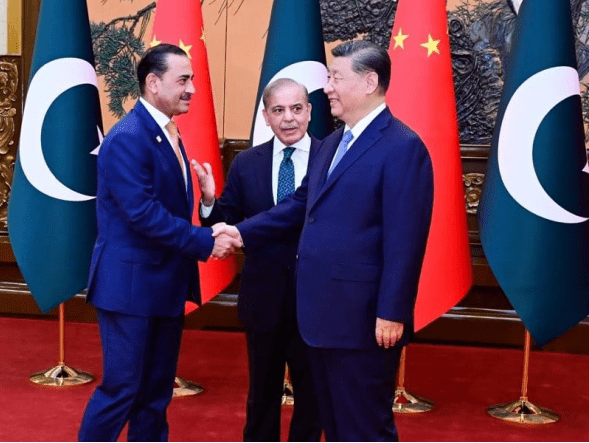
President Xi receives President Trump in Beijing. Less than a week later, he receives President Putin: they both sign a strategic joint declaration pointing to a de facto restructuring of the system of international relations. Earlier this week, President Xi receives a high-level Pakistani delegation, including Field Marshal Asim Munir, the top mediator between Iran and the US.
All that is deeply interconnected. Apart from deals related to the China-Pakistan Economic Corridor (CPEC), the flagship project of the New Silk Roads, and Islamabad striking deals with Alibaba, the fact is the silent guarantor of the feverish Pakistani mediation efforts between Washington and Tehran is China.
So the top Pakistani leadership had to go to Beijing to explain all the twists and turns in detail.
Diplomatic sources confirm that Asim Munir, fresh from a working trip to Tehran, reaffirmed to President Xi that from Iran’s perspective, US commitments hold no value whatsoever. That is constantly reiterated by Iranian Foreign Ministry spokesman Esmaeil Baqae.
So if an agreement would ever be signed – following possible progress on the current stalled memorandum of understanding (MoU) – China’s signature is an absolute imperative. The same applies to Russia.
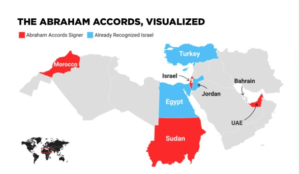
Meanwhile, in the frantic “twist and turn” department, President Trump has issued an absurd ultimatum to several Islamic nations, threatening to cut them out of “his” Iran deal – as if he owned it – if they do not simultaneously sign the Abraham Accords.
Translation: the whole, entire war on Iran may have been conducted to in the end force West Asia to normalize Israel. Pakistan’s Ministry of Defense has already refused Trump’s diktat.
An ongoing diplomatic investigation – from West and South Asia to China – has revealed that a possible Iran-US deal, against all odds, is not dead. But it is entering the most delicate and dangerous phase.
Essentially, a quite substantial agreement has been reached between Iran, US, Saudi Arabia and Qatar – but not necessarily the UAE – with Pakistan as the key mediator and China providing solid backing, accepted by all.
Diplomats expect a formal announcement as early as the celebrations of Eid, which in 2026 falls on this coming Sunday, May 31. That would include: an all-around ceasefire; a still not detailed reopening of the Strait of Hormuz; no tollbooth or fees applied in the Strait (yet Tehran will never agree to it); and the end of the US naval blockade.
Diplomats then expect an additional 30 to 60 days of frantic negotiations, leading to a much broader long-term arrangement including removal of sanctions, frozen assets and final clarification of the nuclear file.
A matter of trust
All that may all sound like wishful thinking, but it comes from people active in the current negotiations. These are realpolitik practitioners – who fully expect Israel and all strands of the Zionist lobby in Washington to apply immeasurable pressure to derail and sabotage the process: that is already happening, reflecting how terrified the Zionist axis is by the inexorable, incoming structural geopolitical realignment all across West Asia.
These players, for instance, detailed how Pakistan and China were – very quietly – building the diplomatic framework long before Trump, on trademark Truth Social vociferation mode, acknowledged negotiations.
They were also pointing to how Saudi Arabia and Qatar were forcefully convincing Trump to move away from the escalation trap while US mainstream media was still obsessed with bombing scenarios.
By now we all know that Trump announced “his” deal only after speaking with the leaders of Pakistan, Saudi Arabia, Qatar, Turkey, Egypt, Jordan, Bahrain and even the quite reticent UAE, a de facto ally of Israel: “Final aspects and details of the deal are currently being discussed and will be announced shortly” (Trump on Truth Social, May 23).
On the other side, we have Iran strategically supported by Pakistan, China and Russia and averse to theatrical Hollywoodish outbursts, only focused on deliverable facts.
The Iranian leadership – especially the very tight circle in direct communication with Leader Mojtaba Khamenei – really wants a negotiated settlement, even willing to compromise along the process, but never willing to surrender sovereignty.
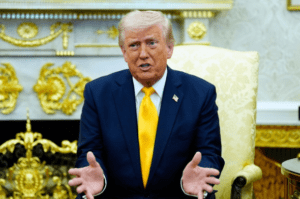
Predictably, the key obstacle is trust: no one, in his right mind, can possibly trust Trump personally, regarded – to put it mildly – as impulsive, volatile, and totally unreliable on an institutional level.
Tehran, once again, is not interested in another JCPOA-style deal where all promises were broken.
On deliverables, at least some movement is already in effect regarding Iran’s frozen assets. Tehran’s imperative: without meaningful mechanisms, no signing of a MoU. Cue to frantic multilateral diplomacy in Doha leading to the imminent release of $12 billion in Iran’s assets.
Saudi leaks of the possible deal – nothing 100% confirmed – include the lifting of sanctions on Iran’s oil and Tehran agreeing to stop enriching uranium past the very same 3.67% set by the JCPOA (destroyed by Trump). Additionally, Tehran would allow the removal abroad of 400 kg of its current 60% HEU (could be to China, Russia or even Pakistan), keeping about 10% of the current near-weapon grade stockpile.
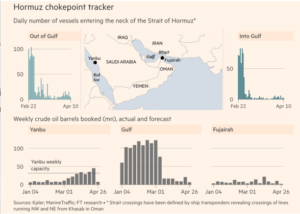
Meanwhile, in real life, Tehran continues to bypass the American blockade, actually exporting 100,000 more barrels of oil – mostly to China – a day compared to pre-war levels. In a matter of 72 hours, the IRGC Navy waved over 100 tankers through the Strait of Hormuz, subjected to the rules of the new Persian Gulf Strait Authority (PGSA). Nobody is complaining, paying the toll which can reach $2 million for super-tankers. In bitcoin. No petrodollar involved.
West Asia enters a new era
The stakes could not be higher. But if the current framework survives the next several days, the whole geopolitical architecture of West Asia completely shifts. And not by accident, totally aligned with the priorities outlined by the Russia-China joint declaration.
So let’s look at the key takeaways:
- China is definitely positioned as the new, long-term geoeconomic anchor of West Asia.
- Pakistan emerges as a key diplomatic-security mediator, exercizing an active “security umbrella” role, a direct consequence of their military pact with Saudi Arabia.
- The Gulf petro-monarchies de facto achieve greater strategic independence from Washington.
- Iran not only does not capitulate but collects the spoils of applying the decentralized mosaic military strategy and re-calibrating all aspects of its sovereign resistance, emerging as a key regional power and one of the big powers in Eurasia.
- That death cult in West Asia addicted to genocide and ever-expanding borders loses its ability to dictate escalation dynamics.
All of the above explains why the absolutely fierce struggle concerning the deal, on every aspect, will be no holds barred especially in the next few days.
An auspicious, provisional outcome points to a phased MoU designed to halt escalation immediately – and postponing the nearly intractable nuclear and sanctions questions into further negotiations.
So to get to this Holy Grail, an “Islamabad Accord”, Pakistan has a Sysyphean task.
It needs to pull no punches connecting direct military and intelligence-linked engagement with the top Iranian leadership; coordinate strategically with China – that’s the purpose of this crucial visit to Beijing on Monday – on guarantees, energy supply chains; and post-conflict architecture; and keep consulting non-stop with the Gulf petro-monarchies.
China will inevitably be the big winner in case there’s an Islamabad Accord. Beijing secures strategic energy supply; preserves and enhances Iran as a key strategic partner; and consolidates itself as West Asia’s long-term geoeconomic power center. All that without firing a shot.
Trump will at least be presented with an off-ramp with some amount of dignity – which he will inevitably seel as “Victory”. As for hegemonic influence across West Asia, talk about a deep renegotiation of the post-war unipolar order – to put it mildly.
It’s fair to argue that Iran, China and Pakistan – a West Asia/South Asia/East Asia connection – is investing everything on the possiblity of a “Islamabad Accord” coming to fruition.
That will, in effect, mark the definitive transition from the post-Cold War order to a really multipolar, Russia-China-aligned geopolitical and “indivisibility of security” architecture across West Asia, with vast, tentacular ramifications all across Eurasia.
this moment—as historical as the recent historical tea—signals the proclamation of war. empire has been cornered, a rat de-fanged, there is no choice but as marie Z has so eloquently told us, so eloquently parsed for us by amarynth—the war is on. finally out in the open for all who… Read more »