

Survival outside Gaza was a lie
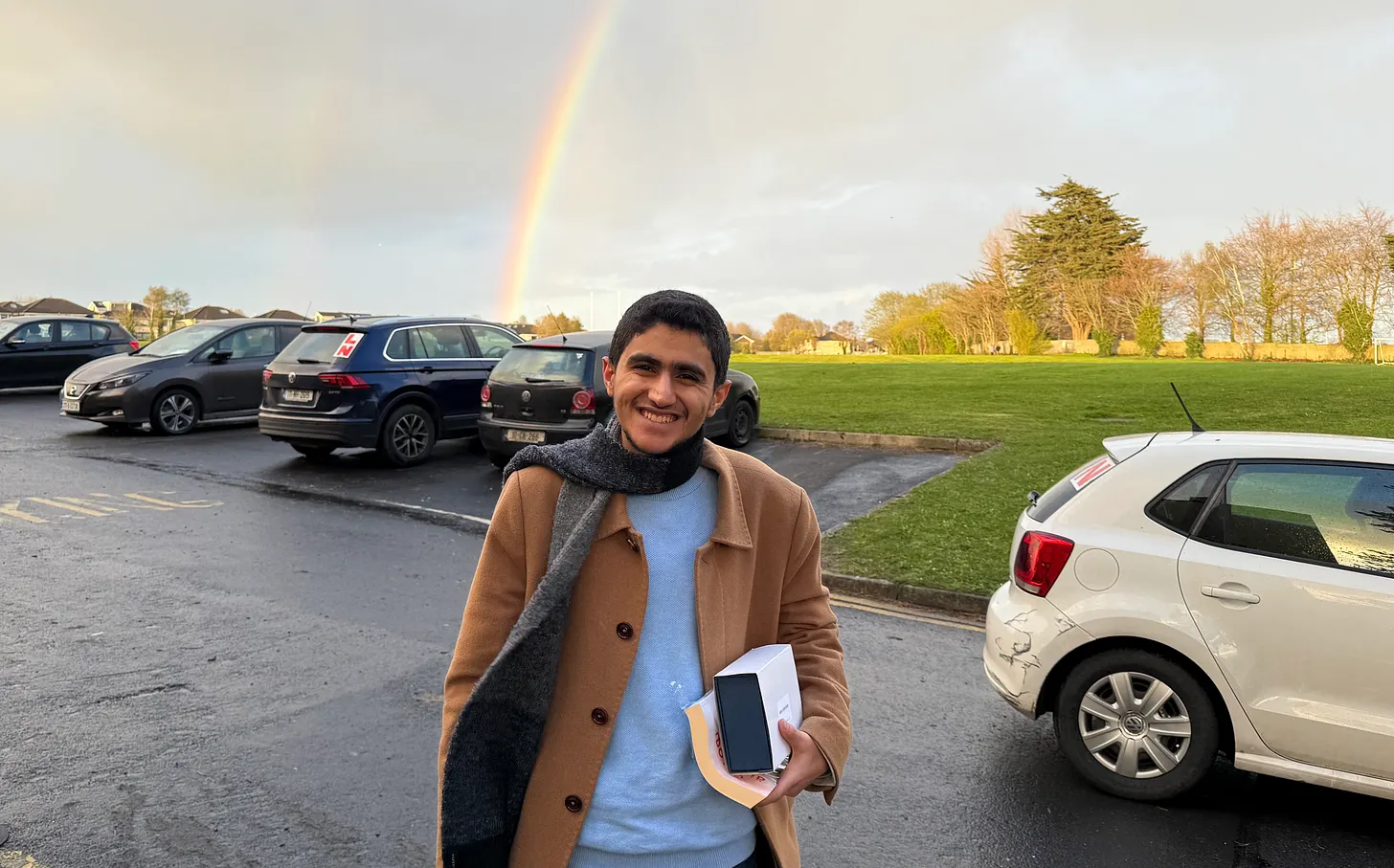
A year since I left Gaza for survival and freedom, I am now, however, trying to survive a mental occupation and emotional death.
Abubaker Abed in Dublin, Ireland.
Lying with my shaking, fragile body on a dilapidated mattress under my favourite blue blanket in our house’s guest room, I video-called my friend Abdul-Ruhman Ismail to bid farewell and make some final memories before I set foot outside Gaza for the first time in my life. He was inconsolable. Behind his cheerful façade lay an ocean of pain and loss: this was the first time we would be apart in over 12 years.
“I’ll see you in an hour and a half at the roundabout [in Deir al-Balah], from where we will head off. For now, I’ll spend some time with my family and pack up my belongings,” I told him before hanging up.
My mother came to sit beside me, trying to lighten the hardship of leaving. Her face blanched; her eyes burned with sadness and agony. She was no longer the same mother I had known my entire life. I held her hand tightly and said, choking with sorrow, “I am leaving because I want to see you safe and happy all the time. I don’t want to endanger you anymore. I am going to be fine and I promise we’ll meet sooner than we imagine. Please don’t shed a tear because if you do, I will stay.”
She replied, with a broken expression, “May you find peace and joy in your next journey.”
Minutes later, the sounds of explosions reverberated through the calls to the dawn prayers. I paused at the window, breathing in the gunpowder-polluted dawn breeze. I knew this would be the last time I’d hear these ugly sounds of death in Gaza for a while.
The clock was ticking. My mother was rushing me to hurry up and get ready. I took my four pens, my journalistic notebook, two sets of clothes, and my personal documentation and squeezed them into my travel bag. We were only permitted to bring one small bag, although I wish I could have brought much more. I felt that possessions from home could soften the impact of this imposed exile. But the occupation wanted us stripped of everything.
Saying Goodbye
I dressed, performed the dawn prayers, and took photos with each member of my family and of every room of our home. I had no idea what would happen next, but I stayed hopeful. My home was pregnant with a heavy silence before we made our last, but hopefully not final, goodbye.
The fear that I would be detained by the occupation ate at our hearts as I hugged everyone tight. A taxi we had reserved days in advance was waiting outside to take me to the assembly point downtown. My father, two brothers, and my two friends Khalid and Ismail came with me. I took a long, hard look at my house, my neighbourhood, and the olive and palm trees. I wanted the images fixed in my brain. I whispered to myself, “I will return. I definitely will.”
My mother came downstairs barefoot, her headscarf barely hanging on her head and tears filling up her eyes. I looked at her and reiterated my promise to her: “I will return. I will see you in a short time. I want you to smile, mommy.” But I doubt she could make out my attempt at a smile with her tearful eyes peering through the cracked car windows.
We met Ismail at the assembly point and took more photos. We exchanged laughs and smiles as we tried to lighten the mood and deny the enormity of what was happening. Then I boarded the bus that would take me outside Gaza for the first time in my 22 years.
We travelled through historic Palestine, the first time I had seen my occupied and defiled homeland with my own eyes, to the Israeli-controlled Karm Abu-Salem border with Jordan. There, I spent the night with other Palestinians from Gaza, mostly students, who had been given the same opportunity as me to escape the genocide. The next day, I took a plane to Turkey for a layover before arriving at my final destination of Dublin, Ireland. It was 18 April 2025.
Forced Adaptation
The genocide was continuing at the time. I had experienced the whole horror from the beginning – and at some point I stopped feeling sane. The only time I felt my old self was for a brief moment when the October 2025 ceasefire was announced.
But the process of adapting to Ireland has not been easy. In fact, adjusting to my new existence has been utterly tortuous. Speaking a foreign language all the time, meeting and trying to connect with new people, and endeavouring to understand a new and alien culture, have exhausted my emotional energy. In normal times, this would have been exciting, but with the weight of my trauma-marked brain and fears of what might happen to my family and friends still in Gaza, it has been a struggle, to say the least.
In reality, my mind and my soul never left Gaza. It was just my physical body that moved. There was a brief moment at the start when I felt like I had been taken from hell to heaven, but the initial euphoria quickly dissipated.
One thing that kept me going through this all was that I knew I had to continue advocating for my homeland and amplifying my people’s voices despite the innumerable obstacles. I felt this responsibility heavy on me, and there was no time to rest.
But, despite throwing myself into work and immersing myself in the pro-Palestine movement in Ireland, I still always feel like an alien. In many ways I am. I am away from my family and navigating a totally new, different life. At the same time, my mission is to prove to people composed of the same blood and skin as me that my people deserve to live like them, with dignity and basic rights. This mission has never felt normal – and, of course, it should not be.
Walking in the streets of Dublin, pausing by the winding Liffey river, beholding the gorgeous scenery of the city—none of it moved me or took me away from the continuing genocide of my people. I was striving to steal a moment of joy or happiness, but my heart was turned off. The overriding emotion was, and is, numbness. What I have seen in Gaza seems to have frozen the blood in my veins.
But what hurt the most was observing the people around me. I couldn’t comprehend how friends would walk and laugh in the street, drinking a Coke, while tens of thousands of people were murdered in Gaza. I couldn’t understand how people went out to a McDonald’s to enjoy a meal while kids were starving to death in my hometown, or how university students would walk happily back home from their classes while all universities in the Strip were reduced to rubble. How was everyone getting on with their lives as if nothing was happening?
I asked myself, “How and why can people do this? Are all the protests for Palestine on TV and social media just a façade? What if, God forbid, one of their loved ones was killed or injured? Would they be able to carry on living in such a way?”
Alien Life
I couldn’t answer these questions, but I was intent on understanding. As my advocacy for Gaza intensified, I was speaking at the huge Palestine marches in Dublin as well as solidarity conferences in different Irish towns. I even visited the UK and Greece while giving various addresses to people online, including Americans and Canadians.
Gaza is in me – and I cannot help comparing the outside world to home. In Dublin, every morning, the streets are inundated with people rubbing the sleep from their eyes and dashing to their workplaces. There are buses and trains transporting students to their universities and schools, and seagulls screeching across the waters.
Not once did I see an old man or woman carrying heavy things and someone come to help them. Never did someone in their car stop to take me back home as I was drowning in a downpour. Rarely have I observed youngsters taking care of or accompanying their parents. I haven’t witnessed parents playing with their kids or spending enough time with them either. Everyone is busy with their phones instead.
The elderly are like autumn leaves here, fragile and breakable. Adults are hamsters in a wheel. Youths are exploited as robots. Children raised by screens. Everyone seemed busy surviving, but not living.
All that I saw was a favour or a service in return for money. Nothing is free. These scenes broke my heart and opened my eyes to the shackles imposed by capitalism which turns people into individualistic and materialistic machines. I realised that people in the West are physically free but mentally occupied. They can’t think beyond survival and making more money.
Real survival
The idea of “survival” I had imagined in Gaza was incomplete. No one told me how people must work ten hours a day to survive, how they must spend years paying off their debts, how they are ensnared in invisible slavery, or how they are being dragged off to prison for criticising Israel or speaking their mind.
In Gaza, I always spoke my mind: I excoriated my killers and their partners and supported my people’s right to self-defence and the resistance fighters every chance I could. I never thought twice about that despite the constant bombardment overhead. Outside Gaza, I was being warned not once or twice but countless times about what I should say or how I should act. In pre-genocide Gaza, despite the crippling blockade, one day’s work could feed my family and me the entire month, healthcare was free in hospitals, and people would voluntarily stop to help me all the time without even asking for it. This wasn’t because resources are plentiful but because we believe in community and see ourselves as one.
During the genocide, I was hearing the barbarians telling me about the merits of “civilisation” and the tyrants teaching me about so-called “democracy”. The world is upside down. Nations that claim to represent democracy and civilisation engage in acts of horrific terrorism and barbarism, including genocide, while nations that are deemed uncivilised are the ones that stand up for these ideals.
Silent Control
Outside Gaza, my posts are monitored. My words are surveilled. At home, I didn’t fear death for saying the truth. But outside Gaza, I have to diligently choose my words and carefully curate my posts. “You can’t say that”; “Choose your words when you speak on Wednesday”; and, “Don’t ever bring the genocide into the conversation.” I still remember these different orders I received before speaking at events across the West. Even some events were not filmed or publicised in case I said something that was deemed too “risky”. Others were cancelled. I was due to travel to the US in August last year but was put on a watch list by the Trump administration and labeled as a “terror-supporting” journalist, so I had to cancel. This is all because I supported an internationally enshrined right: The right to resist an illegal occupation.
So, is this actually the democracy they told me about? Wasn’t I repeatedly told that Gaza was a graveyard for freedom of speech and that it must be freed from Hamas “tyranny”? None of it adds up.
It was a surreal experience watching the UK government lock up elderly and disabled people for holding placards opposing a genocide, then reading about hundreds of people shackled up and deported from the US over some old posts. In Germany, I saw police officers manhandling and degrading women. This was the “free” West. The “civilised” West that gives billions of dollars for Israel to continue its genocide in Gaza and mass murder of innocent civilians across the region.
I no longer call them “democracies” because what they have done is more reminiscent of authoritarian dictatorships of the past.
I also find it astonishing that there isn’t a single Western government that doesn’t financially or militarily back Israel. It is astounding that even though every country has a diverse political spectrum and a wide range of opinions, they never disagree on supporting Israel. The Democratic and Republican parties in the US may quarrel with each other over free health care and LGBTQ+ rights, but never on Israel. Labour and Reform politicians have been shouting at each other non-stop around the recent elections but not about stopping arms sales to Israel. There is a secret here that no one can dispute: these nations’ elections are a deceptive charade in which voters have farcical rights to cast ballots in elections where the same people win whoever is voted into power.
Inner War
Every trip I took on my journey was exhausting and cumbersome. Aerophobia is always present. A feeling of terror and trauma hits me whenever I even see a plane. They remind me of the warplanes that wiped out the entire families of my cousin and aunt – and razed my neighbourhood to the ground.
Every time I met new people, my heart got more vulnerable and my mind got more fatigued. My heart is still beating at home. My head only thinks about my family. A minute of news on the radio has always been capable of destroying everything. The constant anxiety this produces is insurmountable.
How can I even feel sane when I attend prayers in Dublin and London’s mosques and there is no mention of Gaza? How can I believe there is a Muslim ummah when they drink, eat, and have fun while an entire population is being slaughtered and caged as animals? And what can I say about the thousands of Palestinians in the diaspora who were sharing their trips and food images on social media while people were being mass murdered while queuing up for food at GHF sites in Gaza. The contradictions, the separation between two worlds, which are both still human, is driving me insane. More fundamentally, it makes me wonder if there is any hope for humanity.
Endless Nights
Every other day, nightmares jolt me awake — visions of bombings, of being killed, of eating pet food again, and losing the people I love. I grit my teeth whenever I watch the news. Sometimes I weep, and I weep for hours.
My heart feels like a shattered jar, filled with conflicting emotions. I feel guilty whenever someone is killed or wounded in Gaza. I feel constant fear for my family. I feel ashamed when I drink pure water and eat good food. I feel homesick whenever I walk outside or behold the beauty of nature. I feel remorseful and angry that I took the agonising decision to leave my family behind.
I miss my parents deeply. More than anything, I want to be with them again. This sense of longing has followed me all year. Nothing in this exhausting, superficial life—layered with fear and trauma and dehumanising work—ever relieved my pain. The promise of freedom and survival is a mirage which always disappears when I reach for it.
I have been emotionally dead, which has also physically devastated me. Survival is never only physical. Freedom is also not wholly a physical condition. It is also mental. In Gaza, death may have been raining on me, but I felt like a true survivor — my mind was not colonised. In exile, I am now fighting for the dignity and freedom of my mind more than anything.
Thank you for this beautiful, agonising text that everyone us should read each day.
These words perfectly describe our divided world today… its values… its level of consciousness… its level of conscience… the state of its empathy… the state of its civilisation.