

FM Sergey Lavrov : Statement and Answers to Media after BRICS FM meeting
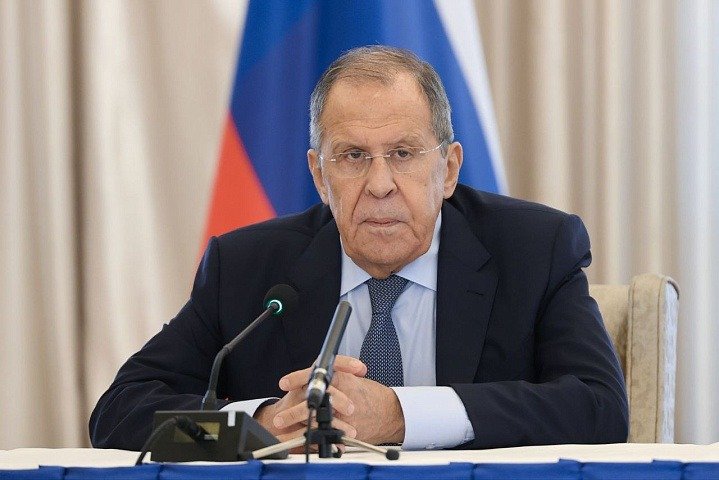
Foreign Minister Sergey Lavrov’s statement and answers to media questions at a news conference following BRICS Foreign Ministers’ Meeting, New Delhi, May 15, 2026
Good afternoon.
Our three-day visit to New Delhi has come to an end. The principal goal of the visit was to take part in the latest BRICS Foreign Ministers’ Meeting.
Before the BRICS meeting, we had extensive bilateral discussions with our Indian counterparts. Detailed talks have been held with Minister of External Affairs of India Subrahmanyam Jaishankar. We were hosted by Prime Minister of India Narendra Modi as well.
During the meeting with the prime minister and talks with the foreign minister, we reaffirmed all existing agreements…
(A reporter activated speakerphone.
Sergey Lavrov: Will you please take it outside? Who keeps talking? Is it you or your phone? Listen, could you step outside, please? I am not joking, please leave the room. Security, escort him out of here. If you do not hand over your phone, they will draw their guns.)
Let me start again.
During the talks with India’s Minister of External Affairs Subrahmanyam Jaishankar and during the extended meeting hosted by Prime Minister Narendra Modi, we discussed the key areas of our particularly privileged strategic partnership, which had been defined during the summits between President Putin and Prime Minister of India Modi, including the latest meeting held in New Delhi. Following that summit in December 2025, a highly important Programme for the Development of Strategic Areas of Russian-Indian Economic Cooperation to 2030 was signed which lays out the necessary steps to achieve the target of $100 billion in bilateral trade by 2030.
We reviewed ways to improve the mechanisms of practical, trade, economic, and investment cooperation that already exists, as well as to further strengthen and expand them in such a way as to remain independent from the negative and unfriendly influence of third countries. We agreed to fortify transport, technology, and investment cooperation, including the joint development of the International North-South Transport Corridor and the Northern Sea Route.
We also looked into measures to streamline the direct mutual settlement system. We share a common commitment to increasing supplies of Russian hydrocarbons and fertilisers. Cooperation in peaceful nuclear energy is making wide strides, as does cooperation in the peaceful exploration of outer space. Regarding civilian nuclear energy, we discussed the possibility of providing us with a new site for the construction of several additional nuclear power units, which would significantly strengthen India’s energy security.
Following the tradition, military-technical cooperation between our countries, including the joint production of advanced weapons systems based on cutting-edge defence technologies, remains at a high level. We also have ambitious plans in the outer space exploration sector, including satellite navigation, crewed programmes, and joint scientific research. We saw our positions on international agenda overlap both in bilateral talks with our Indian friends and at the BRICS ministerial meeting. We focused primarily on preparations for the 18th BRICS Summit in New Delhi in September. At the ministerial level, we share the view that over the 20 years of its existence BRICS has come a long way and has evolved into an independent and multifaceted partnership encompassing virtually all areas of cooperation between the countries. The group is genuinely viewed as a leading building block in the efforts to form a multipolar world order and advancing the interests of the World Majority.
A highly reliable and solid culture of dialogue has taken shape within BRICS which is steeped in mutual respect, sovereign equality, and a commitment to taking into account the opinions of all parties and achieving a fair balance of interests as the key to implementing all existing and future agreements. This particular approach, we believe, ensures the resilience and authority of BRICS with the World Majority and preserves its appeal to a growing number of countries. We placed special emphasis on reviewing crises around the world, including the Middle East, namely, the crisis surrounding the Strait of Hormuz and Iran, as well as the situation in Lebanon and the Palestinian territories, where, in violation of UN resolutions, even the slightest prospects for the establishment of a Palestinian state are being systematically obstructed. Libya, Yemen, and Syria get intertwined in a web of stark differences that further compounds the situation in the Middle East and North Africa. Virtually every one of these hotspots is the result of gross interference by Western countries in the affairs of a particular country, including armed interventions and regime changes that we have witnessed over the past 15 years, beginning with the Arab Spring.
We spoke about the unacceptability of the continuing practice of unilateral coercive measures aimed at punishing sovereign governments and interfering in their internal affairs. In this context, we reaffirmed our solidarity with our Cuban friends. As you are aware, Cuba is one of the BRICS partner countries. This category of partner countries was established at the BRICS Summit in Kazan in October 2024 and is now represented by more than a dozen countries that already possess this status.
We clearly spoke in favour of continuing the reform of the global governance system. Essentially, the West which had long promoted the globalisation model originally put forward by the United States as the best solution to ensure the development of the international community has, through its own unilateral sanctions, dismantled that universal model, which rapidly fell apart. International financial institutions that were created to fit the old globalisation model must be reformed, which is long overdue. Above all, these reforms should reflect the countries’ real weight in the global economy and global finance. As you may be aware, BRICS and its partner countries now account for more than 40 percent of global GDP, whereas the share of the G7 which still retains control over the Bretton Woods institutions is barely over 30 percent of global GDP. Therefore, reform is overdue. Our Western colleagues are trying in every possible way to hold it back, but the trend is irreversible. According to forecasts, average growth rates among BRICS countries will amount to approximately 3.7 to 4 percent compared to global average growth rates of 2.6 percent over the coming period.
We discussed these issues in depth. The Indian chairmanship will issue consolidated statements later today. I believe our main goal has been accomplished. We identified the key themes that will be put on the agenda of the upcoming BRICS Summit in October. Given the circumstances, such an event will undoubtedly become one of the major developments in global politics and the economy.
Question: Good afternoon, Mr Lavrov. Twenty years of BRICS. Over this time, the composition of participating countries and partners has grown considerably. Many Western states do not like this. It is no secret that some countries are being subjected to pressure. In your view, does this affect the further expansion of the group? And are there currently any applications?
Sergey Lavrov: There is interest, coupled with the understanding that BRICS is a prototype of the future multipolar world order.
At the same time, I wish particularly to underscore that no one is trying to fence themselves off from the rest of the world, from the “global minority.” The platform where one can discuss, in a business-like and honest manner, on the basis of seeking a balance of interests, the subjects that concern the Global Majority and the “global minority” is the G20, which includes both the leading BRICS states and partners, as well as the G7 countries and their Asian allies – Japan and South Korea. In the G20, the supporters and participants of BRICS and the participants and partners of the G7 are represented roughly equally. Overall, this is a very promising platform, provided, however, that our Western colleagues cease their attempts to Ukrainianise the agenda of the G20, which they were actively pursuing some time ago.
Over the past couple of years, under the chairmanships of South Africa, Brazil, and now India, we have been ensuring that BRICS resolutely opposes any political discussions within the G20 framework that would overshadow the pressing tasks of reforming the global economy and the global financial system.
Therefore, attempts to steer the discussion towards certain scandalous topics concerning problems created by the West itself as a result of its aggressive policies will not be supported by the BRICS countries, which seek to address in the G20 the issues for which this group was initially created: the global economy, global finance, global trade, a fair reform of the Bretton Woods institutions, and, more generally, a fair approach to the system of global governance. So that the countries that have considerable weight in the global economy, finance, trade, and logistics receive adequate representation in these institutions – the International Monetary Fund, the World Bank, and the World Trade Organisation.
I do not see a decline in interest in BRICS as a result of pressure from Western countries, which (especially the United States) have publicly declared BRICS virtually the main adversary of “progress,” by which is meant everyone’s agreement with Washington’s initiatives. I do not see a decline in interest in joining the ranks of our group, both in terms of membership and in terms of partner countries. There are specific applications for full membership. I do not consider it expedient to speak publicly on this matter.
A practice has been introduced whereby applications for full membership in BRICS will be considered only from those states that have received the status of a partner state. Secondly, there is an understanding that at this stage we will not rush to expand membership, because BRICS doubled its ranks a couple of years ago, and we need, if you will, to “settle in” to working in a new, substantially enlarged format.
Question: Continuing on BRICS expansion. Two full members since 2024 – the UAE and Iran – are currently, de facto, in a state of armed conflict. Is the use of the organisation’s mechanisms for their reconciliation being discussed within BRICS? And is the situation regarded as threatening the unity of the association?
Sergey Lavrov: Indeed, contradictions have manifested themselves between these two countries. In discussions of this kind, as in the discussion of any other conflicts, one must bear in mind the need to concentrate on matters of paramount importance.
Where are the root causes of the current crisis? The root cause is well known to all of us. The completely unprovoked aggression of the United States and Israel against the Islamic Republic of Iran.
Now everyone is appealing to Iran (and who else are they not appealing to) with a demand to open the Strait of Hormuz. Let me remind you that before February 28, 2026, when the aggression began, the Strait of Hormuz was functioning without any problems whatsoever. Freedom of navigation was ensured in its entirety.
The aggression against the Islamic Republic of Iran was instigated with a very specifically declared goal – to put an end to the 47 years during which Iran allegedly “terrorised” all its neighbours and the entire surrounding world. In exactly the same way, in order to kidnap the President of Venezuela, the theme of his “involvement” in drug trafficking was invented. Then it turned out that it was not drug trafficking at all, but Venezuelan oil that the United States was interested in. In the same way now, it is evident that it has all come down to oil, which must pass through the Strait of Hormuz.
But it is not Iran that has blocked this situation. It is not the Islamic Republic that created the problem, including in relations with its neighbours, the Gulf Cooperation Council countries. For many years, we promoted the Collective Security Concept for the Persian Gulf Region, which envisaged initiating a process of normalising relations and strengthening trust between Iran and the Arab monarchies, with the participation of their main neighbours, the League of Arab States, and the five permanent members of the UN Security Council. We did this because the situation in which the Arabs and Iran were at enmity with each other was abnormal, intolerable, and only harmed the peoples of the respective countries.
For many years, we held seminars and conferences. Scholars from all the states I have mentioned came to us. Not so long ago, our Chinese comrades put forward a similar idea. Tehran, even before the current crisis began, had expressed its readiness to support such an approach. In my ongoing contacts with representatives of the Arab monarchies (and we are in regular contact), I discern that they too understand the need for precisely such an approach.
Of course, the most important thing now is to stop the current war, to translate the ceasefire, which is being observed after a fashion, into a final agreement on the cessation of any hostilities. But in the long term, it is necessary to think about some kind of stabilising regional structure, about some kind of regional process. This matter was discussed at the BRICS Foreign Ministers’ Meeting held yesterday and today.
I do not think that the group must necessarily lay claim to the role of moderator, but individual BRICS members could take this on, especially those who are, one way or another, interested in ensuring that there are no problems in the Strait of Hormuz and in the Persian Gulf. For example, India, in its capacity as chair, is directly dependent on oil supplies, including from this region. Why not offer its good offices, including as the country chairing BRICS, and invite Iran and the UAE, to begin with, to talk to each other and ascertain how to prevent enmity. And this enmity is being instigated from outside.
I have not the slightest doubt that one of the tasks of the aggression against the Islamic Republic of Iran was precisely to prevent the normalisation of relations and even to create new problems in these relations, to antagonise Iran and its Arab neighbours. We must pursue precisely the opposite objective.
Pakistan is currently helping to establish a dialogue between Iran and the United States. This aims to resolve the immediate problem – the ongoing crisis. In the long term, the role of such an intermediary, a mediator between Iran and its Arab neighbours, could well be played by India, given its considerable diplomatic experience and standing.
Question: Do the BRICS countries share the view that the Ukrainian crisis is coming to an end, and can they contribute to this in any way?
Sergey Lavrov: I briefed my partners in considerable detail at today’s and yesterday’s meetings on our assessments of the current situation around Ukraine. This included issues on the BRICS agenda, such as the reform of the global governance system.
If we look at the Bretton Woods institutions from this angle, consider the statistics over the last three to four years. I don’t recall the exact figure off the top of my head, and I wouldn’t swear to the precise number, but look at which countries have received loans and how those loans compare. Over the last three to four years, Ukraine has received loans from the International Monetary Fund (I’m afraid I may be slightly off) of roughly 600 percent of its quota, in other words, six times its quota.
This is several times higher than the loans received by all African countries taken together over the same period. This is a clear illustration of how the Bretton Woods institutions are currently being run, and in whose interests. It is certainly not in the interests of fair global governance.
None of my colleagues made any remarks on the Ukrainian crisis at yesterday’s or today’s meetings. But I repeat, we gave a fundamental assessment of what is happening, especially given that UN reform was also on the agenda of our meetings in New Delhi. Among other things, we called for firm insistence on the observance of all principles of the UN Charter without exception – not selectively, but in their entirety and interdependent integrity.
We paid particular attention to a section of the UN Charter that, for some reason, our Western colleagues have stopped citing and referring to. I am talking about the requirement in the very first article of the UN Charter to uphold human rights regardless of race, sex, language, or religion. We have pointed out that this specific clause concerning language and religion is being flagrantly violated by the Nazi regime that the West installed in Kiev in February 2014.
I have already made this point to journalists: Ukraine is the only country in the world where an entire language – and an official UN language at that – has been banned from all spheres of life. And those Western and other representatives who see fit to engage with the Kiev regime never mention (at least not as far as we are aware) the need to return to universally accepted norms on language and religion.
In Arab countries, there is no problem with Hebrew. Israel has no problem with Arabic or Farsi. Wherever you look around the world, different religions, traditions and civilisations coexist. Yet in Ukraine, this flagrant violation of basic human rights is considered normal.
Incidentally, I have heard that when our Western colleagues, including some Americans, are reminded of this, they say that if a settlement is reached, they will certainly include the objective of restoring respect for human rights in the areas of language and religion. But this cannot be a condition for a settlement. These things must be done without any mutual concessions, simply because it is Ukraine’s obligation not only under the UN Charter but also under its own Constitution – which, last time I checked, remains in force – where the rights of Russians and other minorities are enshrined and guaranteed by the state. Yet they have passed a bunch of laws that violate their own Constitution, and these laws are being forcibly imposed on the people in everyday life.
My colleagues listened attentively. I am sure they understand what is going on. But no comments were made on Ukrainian affairs.
Question: Energy cooperation between India and Russia has grown significantly. Are there any discussions underway for long-term oil energy or nuclear energy agreements in local currencies?
Sergey Lavrov: Yes, all of this is being discussed. Our trade with India has long since moved away from the dollar and into national currencies and the currencies of other countries that do not abuse their position in the global monetary and financial system.
There are no restrictions for us in any of the areas you mentioned. We are ready to consider anything that might interest our Indian partners. There have never been any disruptions or refusals so far. And I don’t foresee any.
Question: Before leaving for China, US President Donald Trump answered journalists’ questions and gave a curt ‘no’ when asked whether there is a mutual understanding between him and Russian President Vladimir Putin on the Donbass issue. What does this mean, given that such an understanding has previously been reported?
Sergey Lavrov: We have always said that we have clear understandings following the talks held in Anchorage, Alaska, on August 15, 2025.
As a reminder – we have discussed this repeatedly, and President Putin has mentioned it – a week before that summit, President Trump’s special envoy, Steve Witkoff, visited Moscow. He brought with him American ideas on how to achieve a long-term, sustainable resolution to the conflict in Ukraine. Those ideas were based on the US understanding of the root causes of the current crisis, including, as President Trump has repeatedly stated, the view that Ukraine’s involvement in NATO is unacceptable, as well as the recognition of the realities on the ground resulting from the referendums held in the relevant territories.
Based on that understanding, Mr Witkoff brought the relevant proposals to Moscow. We took them into consideration. A week later, during the meeting in Alaska, President Putin said he was prepared to support this American initiative – all of these American proposals.
I should mention (I hope I am not revealing any great secret) that our President listed all the American components of these proposals one by one. After each component, Mr Putin turned to Mr Witkoff, who was present at the talks, and asked whether he was accurately presenting what the special envoy had brought. All these questions were answered in the affirmative, and so the Alaska meeting concluded with an understanding.
The spirit is a separate matter. For some reason, everyone is talking these days about the “spirit of Alaska” or the “spirit of Anchorage.” The “spirit” in relations between the presidents of Russia and the United States is always friendly, comradely and mutually respectful.
In Alaska, in addition to the “spirit,” understandings – indeed, agreements – were reached on the basic principles of a settlement proposed by the United States and supported by the Russian Federation. Since then, the Europeans, including Vladimir Zelensky (he wouldn’t miss the chance, of course) and especially London, have been doing everything they can to prevent the United States from staying committed to its own initiative.
I just want to reiterate: this never meant that we would publish the Anchorage decisions and everything would be settled overnight. The basic principles were agreed there. But there remain many issues that require more detailed consideration. Such consideration will become possible as soon as we confirm the Alaska agreements.
I hope this happens sooner rather than later. As Russian President Vladimir Putin has stated, we will achieve the goals of the special military operation under any circumstances. Preferably through diplomatic means, but if not, we will continue to do so within the framework of the special military operation.
Question: Could you provide an update on energy supplies to India? Has Russia increased export volumes amid the well-known disruptions in global energy supply chains?
Sergey Lavrov: This data is not classified and everything that is published here, or other publications, in neighbouring countries, and in the international media generally show that oil supplies to India have increased recently. Everything here depends not on us, but on our Indian friends, who have always received a positive response whenever they requested more energy. We stand ready to keep doing so in the future as well.
Question: Is it possible that a joint statement on the situation in Iran will be adopted following this meeting?
Sergey Lavrov: I mentioned earlier and as the foreign minister assured us, a statement by the Indian chairmanship will be issued later today.
Question: What will India-Russia relations be like in the coming months in the run-up to the BRICS Summit?
Sergey Lavrov: I addressed this in detail in my opening remarks. We are making preparations for the BRICS Summit. Prime Minister Modi confirmed yesterday that this year it was his turn to pay a visit to the Russian Federation. We will be making preparations for this summit. With regard to bilateral relations, there are so many areas of cooperation that we could hardly cover them all today. I briefly outlined them in my opening remarks.
We are interested in ensuring that our particularly privileged strategic partnership continues to expand across all areas on the most effective basis possible. During the talks held as part of this visit, we sensed reciprocity from the Indian side. They share exactly the same approach.
Question: The Europeans are now talking about their growing desire to resume dialogue with Moscow and are planning to appoint their own representative. What is your assessment of this position on the part of Europe? Do you believe their intentions are serious and sincere?
Sergey Lavrov: Speaking of European “sincerity,” I’d rather not go over the examples mentioned by both President Vladimir Putin and myself on earlier occasions. It was all about hypocrisy and outright lies. The admission made by former German Chancellor Angela Merkel and former French President François Hollande, who signed the Minsk Agreements in February 2015 together with President Putin and then leader of Ukraine Petr Poroshenko, speaks volumes. Those agreements were unanimously approved by the UN Security Council, and several years later they openly admitted that they had never intended to implement them. They merely needed time to pump weapons into Ukraine.
Now no one is wearing masks anymore. Germany is once again leading the movement in support of Nazism in Europe. Zelensky has been assigned the role of führer, and a new unification of Europeans is underway, with Germany playing a proactive and leading role. All of this is disturbingly reminiscent of certain historical events. But that concern is tempered by the fact that we know how such stories end, and there can be no other ending.
So now that the Europeans have suddenly come to their senses and stopped repeating the mantra about inflicting a strategic defeat on Russia on the battlefield and ensuring all-out victory for Ukraine, they have suddenly changed the script and are now saying that, yes, at some point they will have to talk to Russia. But at the same time, they add a caveat that they – the Europeans – will decide when and on what terms such talks will take place. I can’t take such statements seriously. President Putin tested the Europeans on their political maturity and sensitivity. During the evening news conference on May 9, in response to a question, he said that former German Chancellor Gerhard Schröder could serve as the Europeans’ representative in negotiations with Russia. Remember the outrage that followed? Some said it was absolutely unacceptable. EU foreign policy chief Kaja Kallas – she is everywhere as always – argued that only she could fill such a role. Others, including some in Germany, did not reject the possibility outright. The discussion that followed our President’s remark was quite amusing. Some even said, yes, Schröder might be acceptable to Moscow, but he needs supervision. The name of Frank-Walter Steinmeier, the current President of the Federal Republic of Germany, was mentioned.
Back to whether the West can be trusted, you may recall another event that took place a year before the Minsk Agreements. In February 2014, a peace agreement was concluded between then President Viktor Yanukovych and the opposition, providing for early elections and a settlement of all aspects of the Maidan crisis. That agreement was guaranteed by France, Germany, and Poland. It was signed on Germany’s behalf by none other than Frank-Walter Steinmeier himself. Next morning after Steinmeier signed it, the opposition tore up the agreement, disregarded Germany, France, and Poland and their guarantees, seized government buildings, and went after President Yanukovych seeking to physically eliminate him.
We urgently contacted Berlin, Paris, and Warsaw asking them to talk some sense into the opposition, since they have leverage with it and acted as guarantors of this agreement. All of them bashfully avoided responding to our request and said that democracy sometimes takes unexpected turns. So we already know how much trust can be placed in Mr Steinmeier. We are not seeking any negotiating processes with Europe. President Putin’s response should be viewed precisely in the context that we are ready, but we will never chase anyone or beg for favours.
To reiterate, Europe’s track record regarding its ability to honour agreements is entirely negative. They had their chances to contribute to Ukrainian settlement, which I mentioned earlier. First, it was in February 2014, when a coup took place in violation of the agreement, and then in February 2015, when the Minsk Agreements were signed. In both cases the Europeans acted as guarantors. In both cases they failed in their role as guarantors and honest brokers.
Question: Yesterday the White House stated that during his meeting with US President Donald Trump, Chinese President Xi Jinping expressed interest in increasing purchases of US oil in order to reduce China’s dependence on the Strait of Hormuz. Do you think that carries the risk of China reducing its purchases of Russian energy? Do you think broader cooperation between the United States and China represents an attempt to drive a wedge between Moscow and Beijing? How likely do you think such efforts by Washington are to succeed?
Sergey Lavrov: You’ve put too much in one question. We do not interfere in trade relations between third countries. Russia and China have ramified agreements enshrined in contracts, intergovernmental treaties, and other arrangements covering virtually all areas of relations between our countries, including trade, the economy, and investment cooperation, energy supplies included. We use these agreements as a basis to duly fulfil all our obligations, while the People’s Republic of China fulfills its obligations. However, we are not asking our Chinese partners to discuss with us their plans concerning their relations with other countries, nor does China approach us with similarly inappropriate requests.
If the agreements that have been or will be reached between Beijing and Washington meet the interests of our Chinese friends, we will welcome them, but we will never engage in yet another geopolitical gamesmanship. Henry Kissinger once bequeathed the idea that Washington’s relations with Beijing and with Moscow should each be better than relations between Beijing and Moscow. This is the old divide-and-conquer strategy that the United States and colonial powers have generally practiced for many years now. We are familiar with this game. It remains very much alive in Western policy. It is not our tactic, nor is it China’s, either.
Russia and China are bound by relations which, as President Vladimir Putin and President Xi Jinping have repeatedly stated in their joint statements and elsewhere, are much deeper and stronger than traditional military-political alliances. They represent relations of a new type which contribute more than any other factor to stabilising global politics and the world economy.
Question: US Secretary of State Marco Rubio stated that the United States plans to ask China to exert pressure on Iran in order to end the conflict, including the reopening of the Strait of Hormuz. What is your assessment of such an approach? Did you discuss this with your BRICS colleagues? Are any contacts with the Chinese side planned in order to comprehensively discuss the results of Donald Trump’s visit to China and the agreements reached in China?
Sergey Lavrov: We have no knowledge of any such approaches by the United States towards the People’s Republic of China. As for the substance of what you just described, namely, that China helps the Americans “reopen” the Strait of Hormuz, let me once re-emphasise the point that the strait was never closed and remained fully open to navigation until February 28, when for the second time in six months the United States and Israel launched aggression against the Islamic Republic of Iran. I find it hard to understand what China has to do with this and what exactly the Americans expect from Beijing. It’s as if they are saying that they started something and found themselves in a deadlock. Now they need to reopen the waterway for energy, fertiliser, and food shipments through the Strait of Hormuz to resume, but apparently do not find they are in a good position to deal with the matter themselves. Iran is reluctant to play along, so, they say, put some pressure on Iran. It is a rather simplistic approach. I don’t believe this is the kind of example international diplomacy should follow.
The main point is to eliminate the underlying cause, which everyone is well aware of, and you can read about it in analytical articles and even in political cartoons appearing in the Western media outlets.
Question: How are relations with Armenia being built at the ministerial level and how will they continue to be built in view of all the developments and statements made by Nikol Pashinyan?
Sergey Lavrov: We do have relations with Armenia. They are close and allied, but at the same time complicated, given how the West is trying to “subjugate” Armenia, as was done with some other CIS members, and sever mutually beneficial trade, economic and investment ties between Armenia and its CIS and EAEU partners.
President of Russia Vladimir Putin frankly said, as he was receiving Armenian Prime Minister Nikol Pashinyan at the Kremlin on April 1, that Russia would respect any choice made by our Armenian friends, yet it should be understood that commitments within the EAEU cannot be maintained if Armenia embarks on the EU accession track, which has been declared multiple times at the highest level. Those are just incompatible commitments, including trade regimes and many other matters. Russian Deputy Prime Minister in charge of EAEU affairs Alexei Overchuk also spoke about that.
We are absolutely honest with our Armenian friends. It is our allied duty to explain how economic integration processes are being built in the contemporary world and how the EAEU is different from the EU. Judging by the ongoing talks on joining the EU between Brussels and our Serbian friends, one of the conditions for everyone who seeks rapprochement with the EU and its membership is total adherence to its foreign policy. The essence of the EU’s foreign policy activity at the moment is outright, rampant and aggressive Russophobia. I believe our Armenian colleagues are aware of that and will take this into consideration.
I have good personal contacts with Armenia’s Foreign Minister Ararat Mirzoyan. We normally talk on the phone. Armenia was represented by a deputy foreign minister at the last CIS Foreign Ministers’ Meeting. We know him well. He was actively engaged in the discussion and preparation of the final documents. In late May, at the EAEU summit in Kazakhstan, there will be a perfect opportunity for us to discuss, in an open and honest way, emerging problems related to the European Union’s insistence on drawing Armenia into its orbit, including at the cost of risking the benefits Armenia is enjoying within the EAEU. I know that Prime Minister Pashinyan mentioned he was busy with election campaign and would be unable to attend the EAEU leaders’ meeting. This would be sad, since it is a good opportunity to discuss the things which are about to happen.
Question: President of France Emmanuel Macron said recently that Russia is a real coloniser in Africa. How would you comment on such statements by the French leadership?
Sergey Lavrov: The French know better that anyone what real colonialism and real colonisers are. About five years ago, when the Sahel countries were undergoing changes, particularly Mali, I was participating in the work of the UN General Assembly session. Many bilateral meetings were held on its sidelines. I had talks with the then head of EU’s diplomacy, Josep Borrel, along with French Foreign Minister Jean-Yves Le Drian. Since Mali was a “hot” topic on the international agenda at the time, they were perplexed – how come Russia supported the change of government. Among other arguments, I told them that the new government of Mali had approached us with a request to help them reform and strengthen their security forces, and we responded to their request. Later this was also voiced at the UN General Assembly plenary meetings. But in response, my interlocutors said that Sahel and Africa as a whole was the “European Union’s zone.” I said I did not know that. I know that there were colonial possessions there, but later you proclaimed political independence and stopped colonisation. The UN adopted special decisions on this matter. I added that I had never read anywhere that former colonies were assigned to you forever as countries where other nations had no right to “meddle.” That’s the philosophy they have. It is in the DNA of our French colleagues. They measure everyone by their own yardstick. But our yardstick is different.