

Transcript : Vladimir Putin took part in the plenary session of the 29th St Petersburg International Economic Forum (SPIEF)
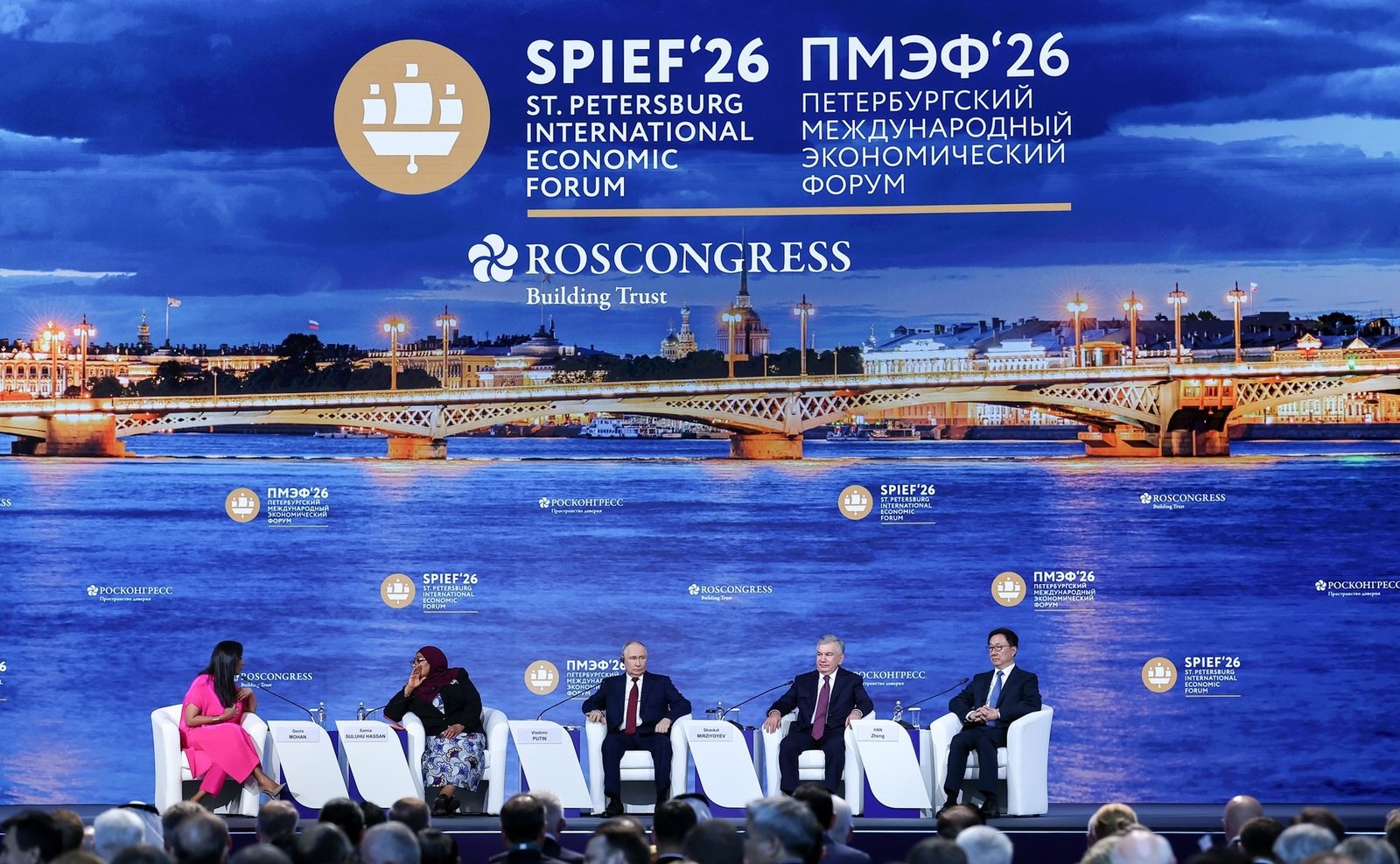
Joining him on the panel were President of Uzbekistan Shavkat Mirziyoyev, President of the United Republic of Tanzania Samia Suluhu Hassan, and Vice President of the People’s Republic of China Han Zheng.
The discussion was moderated by Geeta Mohan, Foreign Affairs Editor at India Today, TV Today Network.
Held annually since 1997, this year’s forum runs from 3 to 6 June under the theme “Pragmatic Dialogue: The Path to a Stable Future,” bringing together more than 20,000 participants from 130 countries.
* * *
Moderator of the discussion, India Today Group Foreign Affairs Editor Geeta Mohan: Namaskar, namaste, zdravstvuite, hello.
Excellencies, distinguished guests and friends, it is a privilege to welcome you to this very important conversation at a time when the world is clearly standing at an inflection point.
For decades, the global economic order was shaped by a few powerful capitals, a few dominant institutions, and a few accepted rules of engagement. But a new global economic order and architecture is emerging: one that is more diverse, more contested, of course; but also more representative. The countries on the stage reflect that shift. We have Russia – a major power at the centre of today’s geopolitical realignment; China – one of the world’s largest economies, and a defining force when it comes to AI, trade, and infrastructure. We also have Uzbekistan representing the rise of central Asia and as a region of energy, connectivity, and geostrategic opportunity. And then, we have Tanzania – an important African voice led by one of the most significant women leaders of our time.
And, of course, since the moderator is from India, we can say the stage also has a little bit of Indian spice, a little bit of balance, and just enough to keep everyone comfortable.
The question before us is simple but profound: are we witnessing only a redistribution of power, or are we witnessing the birth of a fair world order? The era of being lectured, pressured, or bullied is seriously being challenged.
At the same time, independence is not easy. Strategic autonomy comes with costs. So today’s discussion is not merely about geopolitics. It is about the price of sovereignty – something President Putin has emphasised time and time again.
Can countries protect the national interests without being forced into camps or being sanctioned? It is about whether a multipolar world will be genuinely fair or simply replace one centre of power with several competing centres. It is about whether BRICS and South-South cooperation can move from rhetoric to real economic instruments. It is about whether alternative payment systems, new trade corridors, energy partnerships, and technology cooperation can give the Global South true agency.
And it is about a new world order, where countries no longer want to be spoken for but want to speak for themselves.
With that, let us begin our conversation today. I would like to begin by inviting President of the Russian Federation honourable Vladimir Putin for his opening remarks.
President of Russia Vladimir Putin: Good afternoon, ladies and gentlemen. Mr Mirziyoyev. Madam Samia Suluhu Hassan. Mr Han Zheng. Ladies and gentlemen.
It is a real pleasure to see such a distinguished audience here. The President of Uzbekistan and I were just comparing notes. He remarked that the hall is full – which speaks to the level of interest that the St Petersburg International Economic Forum generates. I would like to welcome all participants and guests.
Russia and St Petersburg are once again hosting executives from leading companies, business leaders, and experts – this year from more than 130 countries – all here to expand business contacts and forge new ties.
Our host has set the bar and outlined the topics, which I will try to cover. But before entering this auditorium, she also mentioned that, in her opinion, the excellent atmosphere was created by those who organised the event. So I would like to start by thanking everyone who made this forum possible. Thank you very much.
The unrivalled and appealing nature of the St Petersburg Forum lies precisely in the opportunity to engage in free dialogue on matters that are of interest to entrepreneurs, entire industries, and even entire countries. We remain open to everyone interested in engaging with our country and is ready to pursue equal and mutually beneficial cooperation. We are convinced that this particular approach where partners hear one another, understand their partners’ interests, and identify common solutions represents a harmonious path of development and makes it possible to respond to the serious challenges facing the modern-day world.
We are witnessing turmoil in the energy markets and tensions being provoked in certain regions, primarily in the Middle East, and how the short-sighted EU bureaucracy policies are being implemented to the accompaniment of aggressive rhetoric and leading to Europe continuing to lose its standing in the global economy, while also undermining regional and global security. In fact, European elites are inciting chaos and are trying to embroil ever more countries into it.
These processes did not arise all by themselves; they are the result of the world undergoing the largest structural transformation in decades. This transformation is not a transition from one phase of a cycle to another. We are witnessing a change in the paradigm of global development.
I would like to bring your attention to what came before. For decades, the global development model was built around a limited number of financial centres, technological solutions, insurance and logistics hubs, credit rating agencies, and reserve currencies. This construct was presented as universal and supposedly suitable for everyone, and, above all, as supposedly neutral. In reality, however, it was increasingly used as a tool to exert political pressure and promote unfair competition, where settlements, technologies, logistics, or even access to information could be cut off at a moment’s notice in order to punish those who chose to act in their own national interests. In essence, it was a deliberately created system of dependency and resource extraction.
Today, the overwhelming majority of countries see this, as do entrepreneurs, banks, manufacturing companies, farmers, and transport operators. It has become clear that investment plans and business development steps may face serious risk where the external infrastructure on which they rely could be used against them. Therefore, countries are beginning to develop their own technological solutions, create their own supply routes, and build their own institutions.
Russia is experiencing these transformations firsthand. Although pressure on our country persists, the changing global landscape has also created greater room for manoeuvre. New partnerships are emerging, new financial and technological solutions are being developed, and access to promising markets is expanding. Against this backdrop, Russia views global change not only as a source of challenges but also as a tremendous opportunity. To make the most of these opportunities, we seek to act swiftly and pragmatically.
Let me reiterate: the roots of today’s global turbulence lie in the ongoing transition from a vertical, hierarchical model – one that primarily served the interests of a limited number of states – to a far more complex, distributed, and multipolar international order. What does this mean in practice? Above all, it means that the geography of economic growth is changing, with new centres of development emerging across the countries of the Global South. And, colleagues, as you can clearly see for yourselves, this is not a political slogan; it is an objective reality. In these countries, populations are growing, the middle class is taking shape, industrial capacity is expanding, and domestic markets are developing. As a result, new cities, roads, ports, energy infrastructure, and digital networks are being built. At the same time, these nations are establishing their own financial institutions, educational systems, and scientific and technological centres.
In this context, I would like to emphasise that the world becomes more equitable when economic growth is distributed more broadly and opportunities become available to billions of people who have long remained on the periphery of the global economy. It is very important that these new centres of growth seek to shape their own development paths, increase their share of value creation, and build their own brands, standards, and capabilities.
If you look at the global GDP dynamics of the last five years, you will see that almost half of its annual growth, 49 percent, is accounted for by BRICS countries, whereas the contribution of the so-called Group of Seven is estimated at 18 percent. To put this into perspective, between 2021 and 2025, the global economy expanded at an average annual rate of 4.1 percent. Of that growth, 2 percentage points were generated by the BRICS countries, compared with only 0.8 percentage points contributed by the G7. Today, the BRICS share of global GDP, measured in purchasing power parity terms, stands at approximately 40 percent, while the corresponding figure for the G7 is below 29 percent. By this measure, BRICS surpassed the G7 as early as 2020, and the gap has continued to widen ever since.
This trend is expected to continue increasingly in favour of the BRICS countries. The reason is straightforward: economic growth rates in the BRICS economies are already higher than those of the G7 and are projected to remain so in the years ahead. By the end of the current decade, annual economic growth in the G7 countries is expected to average no more than 1.5 percent, while the BRICS economies are projected to expand at an average rate exceeding 4 percent.
Ladies and gentlemen, friends. This is not something we made up. It is the data from the IMF and the World Bank – international institutions. They are forced to acknowledge this reality.
Naturally, businesses are drawn to places where growth is more dynamic and where there are greater opportunities to expand production and sales. As a result, the centre of gravity of global trade — and, with it, the global financial system — will continue to shift. In fact, that shift is already under way, and the trend is set to continue.
For many years, the principal flows of goods, capital and information passed through a small number of Western infrastructure hubs. Even when goods moved from one Eurasian country to another, payments, logistics, insurance and arbitration often relied on institutions located in third countries. This created additional costs and fostered political dependencies.
Today, international trade is becoming more effective, as direct shipments without intermediaries are growing, national currency payments are developing, and new corridors are opening. In Eurasia, these include the North-South Corridor, the Trans-Arctic Route, and links running through the Caspian region, Central Asia, the Black Sea, and the Far East. All of these projects and logistics routes are defining features of today’s economy and, importantly, of future development.
To give you an example of the global trade system ceasing to be Western-centric, I want to note the following. Over the past 25 years, the BRICS share in global merchandise trade has more than doubled. Last year, our group accounted for almost 25 percent of global exports. This indicator continues to grow steadily, as does trade within BRICS itself, which now exceeds $1 trillion annually.
A particularly important role in these processes is being played by what might be called “connector countries”. These countries link markets, technologies, financial flows and business cultures. Their role extends far beyond simple transit or transportation through a particular territory. What matters most is their ability to ensure trust and provide efficient logistics, reliable payment mechanisms, legal certainty and technological compatibility.
Taking part in this panel session is the President of the Republic of Uzbekistan – and I would once again ask you to welcome him. Thank you very much for being with us today.
He is the leader of a country that is one of the centres of economic growth. Its population is growing fast; industrial plans are being fulfilled; its agricultural and energy potentials are growing, as is the domestic market. At the same time, Uzbekistan is an essential link between Russia, Central and South Asia, China and the Middle East. There will be more and more examples of countries whose own development is enhanced by, and benefits from, their links with other centres of the emerging multipolar world.
The same is true of our other guest, from Tanzania – let us welcome her once again – who plays a similar role in East Africa. I would also like to draw your attention to another important trend: the architecture of global trade is gradually moving away from the principles that originally underpinned the World Trade Organisation. Since the beginning of this century, the number of bilateral, regional, and mega-regional trade agreements has increased nearly fourfold.
Why is this happening? The erosion of the World Trade Organisation was set off by the very authors of this organisation: the Western nations, to be more precise. When it benefited them, they promoted the WTO, they invited other countries to join. But once the West started to lose in this competition, universal and common rules for trade introduced by the WTO lost their appeal to them. Instead, they adopted unilateral restrictions and so-called sanctions. By doing so, Western countries effectively sidelined the mechanisms of the World Trade Organisation and undermined confidence in these institutions. And when trust disappears, and an institution no longer functions as intended, businesses and governments inevitably begin looking for alternative solutions. These alternatives take the form of bilateral and multilateral trade agreements.
One more point. As I have already noted, the sanctions and, basically, the theft of Russia’s international reserves have had an irreversible effect on the positions of the world currencies, the US dollar and the euro. This is an objective reality that cannot be ignored. Today, every country – let me stress, every country without exception – understands that, like Russia, it could at any moment lose access to assets lawfully held in dollars or euros, as well as to Western financial and payment infrastructure.
We recognise that this ultimately boils down to the issue of unfair competition. The specific pretexts may vary, and they can always be found. In Russia’s case, it was the conflict in Ukraine. In other instances, it may be developments in the Middle East, conflicts in Africa, or even a country’s stance on LGBT-related issues. A justification can always be found. But the underlying problem remains the same: this is unfair competition.
Incidentally, confidence in the West is also being undermined by the state of its public finances, reflected in rising government debt and persistent budget deficits. In 2025, public debt in the eurozone reached 81.7 percent of GDP. The highest levels are well known: Greece stands at 146 percent of GDP, Italy at 137 percent, France at 115 percent, and Belgium at 108 percent. By comparison, Russia’s public debt remains at approximately 16.4 percent of GDP. In fact, during a meeting with the heads of major news agencies yesterday, some experts cited a figure of 15.8 percent. In any case, the difference is simply not comparable.
The budget deficit of the European Union in 2025 stood at 3.1 percent of GDP. The highest deficits are recorded in countries such as Poland 7.3 percent, Belgium 5.2 percent, France 5.1 percent, and the United States 5.9 percent. In Russia it is 2.6 percent. It may increase by the end of this year, but I believe it will still remain lower than in other industrialised countries.
Such a situation is fraught with a new surge in inflation for Western currencies, as was the case in 2021–2022, when prices in the euro area and in the United States rose by 14 percent in a matter of two years. Clearly, given the circumstances countries around the world are taking their assets out of the West and shifting to payments in national currencies, increasingly using alternative payment systems, and expanding the role of digital financial assets, including central bank digital currencies.
In its trade relations with its key partners, Russia uses national currencies as the primary means of payment. Thus, the share of the ruble in our export transactions is currently standing at 65 percent, or almost two thirds.
Importantly, the world needs modern, flexible and responsible financial architecture without risks, prohibitions or barriers, but with incentives for sovereign development. Its instruments must reduce costs, speed up settlements, and expand access to financing, and, of course, ensure proper counteraction to tax evasion, fraud and money laundering. Naturally, this must always be given special attention.
Next. Historically, the West has been regarded by other countries as a source of technological development, but we are seeing a major transformation here as well. Over the past 25 years, BRICS countries have significantly increased their high-tech exports; they now account for over a third of global supplies, which indicates a shift in technological leadership around the world. This is happening gradually, but it is happening.
For example, our strategic partner China holds the largest number of patents in AI, where Russia also has excellent prospects. Let us welcome the Vice Chairman of the People’s Republic of China. (Applause.)
Another key partner of ours, India, is a leading player in the IT industry. It accounts for a significant share of the global software market. Russia holds strong positions in the pace of adoption of digital platforms, online marketplaces, and financial solutions, as well as municipal services, healthcare and education which improve the quality of life for people in Russia and in dozens of countries around the world, where they successfully compete with their foreign counterparts.
We also lead in a complex field such as nuclear energy. Over 80 percent of NPP construction projects on the global market are implemented with the participation of Rosatom. Over 80 percent is a substantial figure. (Applause.)
We also have significant engineering and technological capabilities in managing the water energy balance, which is becoming increasingly important in Asia, Africa, and indeed throughout the world. I believe that our colleagues participating in the panel session cannot but agree with this, and they do agree.
Clearly, technological progress is the most important factor in global transformation. Experts identify three key technologies of today and tomorrow that are capable of making a difference in people’s lives, business operations, and public administration.
What are they? First, artificial intelligence, which can process massive amounts of data and make the best decisions available across virtually all areas. Second, autonomous systems, which dramatically increase productivity and transform entire sectors of the economy. Finally, third, platform-based solutions, which allow market participants to exchange information and conclude transactions directly, in real time, and in an automated manner.
According to forecasts by researchers and specialists, the countries or groups of countries that possess a full set of their own technologies in AI, autonomous systems, and digital platforms will become powerful centres of sovereignty in a multipolar world. Moreover, without these technologies, genuine sovereignty will be unattainable in principle.
Importantly, possessing an independent technological base is critical for countries with large populations, vast territories, and distinctive cultures. Such countries cannot act merely as users of foreign-made solutions, because in that case they risk becoming objects of control by external platforms. And how those platforms are used is another matter.
In essence, major countries – true civilisations – face a historic choice: either they create their own platform and technological ecosystems, or they become a digital periphery. There should be no illusions about this. Foreign services may initially be user friendly, but over time the cost of such dependency will inevitably become apparent.
Russia has learned one such lesson. We have seen certain software providers walk away from the market, payments get blocked, and interference in commercial relations ensue. Therefore, we will strengthen our own critical infrastructure and cooperate and engage only with the partners who respect mutual obligations.
We have gained such experience over many years in our relations with the People’s Republic of China which is Russia’s truly strategic partner. Our economic cooperation covers virtually all areas, including high-tech sphere, transport, mechanical engineering, and, of course, energy.
Friends,
As I have said before, a country’s position in the global economic system and its claim to global leadership depend on its ability to ensure its own sovereignty. It is no exaggeration to say that the race for sovereignty has begun – and it is gaining momentum.
This is not just about resisting external pressure or protecting national interests. It is also about the quality of the state, the economy, and society. Sovereignty means being stronger and, I emphasise, smarter – managing resources more precisely and investing more effectively, including in technological development.
True sovereignty demands efficiency. It is not a licence to do things expensively, slowly, or inconveniently. On the contrary, we must act with maximum initiative and maximum efficacy across all areas of our work. We must produce faster, thereby increasing revenues for the state, for business, and for our citizens.
In these tense and challenging conditions, Russia continues to strengthen its sovereignty – not by isolating itself, but by expanding its circle of partners. Yes, economic momentum is currently subdued, and we will probably discuss that further. But let me remind you of the task set for the Government: starting next year, we must return to sustainable growth rates in the domestic economy.
That can only be achieved under one condition: by increasing capital investment and launching a new investment cycle. Between 2021 and 2024, investment in Russia grew by nearly 38 percent in real terms, though last year, of course, it saw a decline.
I want to stress that launching a new investment cycle is a key task for our economic authorities, and investment growth is a crucial indicator of their effectiveness. It is important that economic growth be balanced, supported by domestic demand, and combined with a further reduction in inflation, which has already slowed significantly and continues to fall. I believe I mentioned yesterday that inflation is forecast to approach 5.2 percent this year.
My colleagues and I regularly discuss economic issues. I should point out that the dynamics of industrial production, GDP, and consumer activity in Russia are positive. Despite all the problems, industrial production grew in April. There will likely be some questions about this today.
In any case, industrial production in our country grew by 1.9 percent in April, including manufacturing, which grew by 3.1 percent. Retail added 6.5 percent. GDP grew by 1.3 percent in April, and by 0.2 percent over the period from January to April.
What would I say about all this? Of course, we hear criticism from all sides – that we have lost momentum. Yes, but we have fallen only to the level that the eurozone countries have been experiencing for the past few years. And now we are on the upswing.
Most importantly, we have preserved the fundamentals of our macroeconomic policy. I am confident that this will ensure continued forward progress. These trends must be consolidated, while our country’s position in the world and its sovereignty must become even stronger.
In this regard, I would like to share several thoughts on the kind of sovereignty Russia needs. I have already touched on this topic, but I would like to elaborate further.
First, as I noted earlier, a sovereign economy is built on the full-cycle implementation of technologies and the use of advanced solutions that simplify business operations, automate processes, increase labour productivity, and improve the overall efficiency of the economy. This is especially important in such areas as defence and security.
Russia has made significant progress in the development and adoption of digital platforms across all sectors of the economy. We are also witnessing rapid growth in e-commerce, which is expanding by approximately 30 percent annually. Our country ranks among the global leaders in this field. This, among other things, reflects the quality of Russian platform solutions, which benefit both domestic producers and foreign suppliers.
Today I have already mentioned our friends and partners in the Republic of Uzbekistan. Let me give you an example. In 2023, the value of Uzbek goods sold through the Wildberries platform amounted to $418 million. That was in 2023. By 2025, that figure had reached nearly $1.5 billion, and this year it may exceed $2 billion.
What does this mean in practice? It means that producers of a wide range of goods, including small and medium-sized enterprises, are gaining easy access to the Russian market through this platform. In fact, they are not only entering the Russian market but also reaching consumers in other countries through our platform. The volumes are growing, businesses are operating efficiently, people are earning good incomes, and small and medium-sized enterprises are developing successfully. All of this is being achieved through modern logistics systems, with taxes and customs duties being properly paid. This is something we can only welcome.
As a result, turnover has already increased 3.5 times and continues to grow, including through access to consumers throughout the Eurasian Economic Union and in partner countries, for example, the rapidly developing markets on the African continent. This is what our platform infrastructure makes possible.
Today, this Russian platform provides businesses with access to nearly half a billion potential customers worldwide, and that number continues to increase. In this way, Russian platform solutions are becoming a genuine driver of economic growth and development for our partners.
Apart from trade, the transition to a platform-based framework has been affecting the transport sector, finance, logistics, tourism, as well as healthcare, education, the media sector and other domains. Of course, we need to generate greater momentum to move towards a platform-based approach to developing various sectors by introducing artificial intelligence and autonomous systems.
We have already adopted a national Strategy for Artificial Intelligence Development. I ask the Government to prepare similar national strategies for autonomous systems and digital platforms.
I suggest that we discuss the topic of ecosystems for a platform-based economy at the Future Technologies Forum, which is scheduled to take place in early 2027. I also ask for an inter-agency working group to be formed under the Presidential Executive Office’s supervision to oversee preparations for this forum.
The second point I wanted to highlight is that people, the knowledge they have, their skills and their ability to master advanced technology and create breakthrough goods, services and shape entire market segments – all this has an immediate and defining bearing on sovereignty, both today and tomorrow. It goes without saying that people who have these professional skills must get adequate compensation for their work.
Only high living standards and generous salaries can make our country competitive and enable it to succeed on the demographic front, and to have excellent talent who can be confident about their professional careers and their future.
Russia has one of the lowest unemployment rates among industrial countries. It is equal to about 2.2 percent of the economically active population. This is a very robust result compared to other developed countries. For comparison, Japan is catching up to us with an unemployment rate of 2.5 percent, while this indicator for India is 4.2 percent, the United States has an unemployment rate of 4.2 percent, and the eurozone stands at 5.9 percent.
Over the past five years, salaries within the Russian economy increased by over 30 percent in real terms. I am referring to real wages, which means that the inflation rate is taken into consideration. Of course, this is a high growth rate.
Let me emphasise once again that any further increases in wages must be primarily driven by higher labour efficiency, as well as increased manufacturing efficiencies based on the latest technological solutions as developed by our excellent engineering schools.
Labour mobility is a separate matter. It consists of enabling specialists to find relevant and well-paid jobs at new enterprises in other regions of the country that need talent more than others, while their companies belong to emerging strategic sectors committed to making high value-added products.
As you know, young people graduating from educational institutions or during their senior years at universities and other higher education institutions are more prone than anyone else to move around the country. In order to empower them to start their professional careers, we agreed to set forth laws governing internships by introducing obligations for employers. We also agreed to update the apprentice contract so that it corresponds to present-day reality.
I know that the amendments to the Labour Code have been drafted. I ask the Government and the State Duma to adopt them faster.
Thirdly, it is evident that the sovereignty of a nation as expansive as Russia is defined not solely by the strength of its capital or a few major industrial centres. It is crucial that each region attracts investment, creates high-quality jobs, and develops both its production capacity and its urban environment.
Exhibition stands have been set up at the forum, where the constituent entities of the Federation showcase their strengths, achievements, and future plans, engaging in dialogue with investors and businesses seeking to enter their markets. I am confident that the participants in our panel discussion, along with our guests, have already witnessed this rich diversity of Russia’s regions and have had the opportunity to familiarise themselves with them.
However, in keeping with tradition, the forum’s sidelines also see the announcement of the results of the national investment climate ranking in the constituent entities of the Russian Federation. This year, the leading positions are held by Moscow, the republics of Tatarstan and Bashkortostan, and the Nizhny Novgorod and Moscow regions. St Petersburg and the Sakhalin Region have entered the top tier for the first time. Among the regions demonstrating the most robust growth are the Khanty-Mansi and Yamalo-Nenets autonomous areas, the Omsk, Vladimir, and Volgograd regions, as well as the Krasnodar and Primorye territories.
I congratulate my colleagues on these achievements. (Applause.)
We will continue to provide financial assistance to the regions in this area, including through infrastructure budget loans. Over the past four years, more than one trillion rubles have been allocated to the regions through this mechanism. By 2030, we plan to allocate an additional 750 billion.
At the same time, we are writing off the regions’ debt on budget loans: over the past two years, this has amounted to nearly 440 billion rubles, and this year we will defer the repayment of this debt by a further 100 billion rubles. These freed-up funds may be directed by the regions towards development projects as well.
Let me add that, starting this year, the National Investment Climate Ranking also includes a new component. This relates to reducing the investment and construction cycle for cultural heritage sites: historic houses, estates, and buildings. The aim is to expedite their restoration, bring them into economic circulation, and make them accessible to the public. This is particularly relevant for the cities of Central Russia, and for our tourist destinations, including those along the route of the renowned Golden Ring.
I would like to recognise the Yaroslavl, Nizhniy Novgorod, Lipetsk and Novgorod regions, as well as Tatarstan for their successful work with cultural heritage sites. It is my hope that other regions follow their lead. Engaging strategic business partners in efforts to restore cultural heritage sites and in regional development efforts in general is instrumental. I am referring to our major corporations and enterprises which play a defining role in the economies of the corresponding regions.
The decision has been taken to devise mechanisms for enabling these corporations from the construction sector to contribute to developing social infrastructure. This includes kindergartens, schools, hospitals, and outpatient clinics. I ask you to complete this work as quickly as possible.
At this juncture, let me also remind you that we had an agreement on moving major state-owned companies and corporations from Moscow to the regions in order to free up some space in the capital and create a regional development driver by enabling regional budgets to generate more revenue and create new jobs. Mr Sobyanin, Moscow also stands to benefit from this initiative.
RusHydro and PSB Bank both offer positive examples of relocated corporations. The United Engine Corporation has adopted the corresponding resolutions, and similar decisions are about to be taken by the Russian Railways group, as well as other structures involved in railway construction. I can understand that changing a company’s office location is not easy, but we must step up these efforts.
Moving on, businesses in today’s world go beyond expanding their operations and often contribute to shaping their operating environment. A people-friendly urban environment emerges around them, and sometimes even entire communities, which offer greater comfort and are attractive. We already have examples of this kind.
I believe that it would be advisable to support innovative approaches by private investors and enable them to be more creative, as they say, by using new solutions in their economic operations and construction. This can be done by setting up dedicated legal frameworks blending high-technology investment, tourism, culture, creativity and local identities.
In addition, we must encourage collective investment in projects to develop urban spaces. This involves mechanisms enabling grassroots participation in developing the home region or community by investing in making it look better. I ask the Government to work with development institutions and the Agency for Strategic Initiatives to set forth these regulations.
Next. A strong, sovereign and dynamic economy requires the promotion of private initiative, as it is entrepreneurs and companies that identify and create market niches, produce goods and services, and stimulate employment. Predictability and stability of the investment climate are important for high business activity. Businesses must clearly understand the tax system, tariffs, regulation, government support measures and mechanisms, and, in general, operating conditions for many years to come.
We have already made additional adjustments to the tax system and have established a line of investment support at both federal and regional levels. In conjunction with the business community, we have drafted a national model of targeted business environment. Among other things, we are talking about specific steps to simplify company registrations and the filing of tax reports. These efforts should certainly continue; connection to infrastructure should be made easier, the effectiveness of law enforcement improved, and so on, and so forth.
I would like to underscore once again that it is vital for the national model to yield tangible results for businesses and entrepreneurs.
On a separate note, I will just say a couple of words about the systematic work of small and medium-sized businesses.
A lot has already been done to ensure that ambitious and enterprising people can easily start their own business, launch production, and provide sought-after services to the public. However, when a business grows and develops, organisational issues and additional financial costs sometimes arise, and not all entrepreneurs are ready to cope with them. We need to minimise these costs and ensure a seamless transition of the business to a higher category, including through ready-made digital solutions or individual support.
I ask the Government, together with VEB and, of course, with business associations, to draft a concept for a smooth transition in business development and growth, which will cover all stages: from self-employment to individual entrepreneurship, and then to a company with all the advantages of corporate governance. In this work, it is necessary to factor in the transition of the economy to a platform path.
In addition, I draw your attention to a topic that I know has also been a centrepiece of discussion: starting this year, the revenue threshold for applying the simplified taxation system has been lowered. Now it is 20 million rubles, next year it is expected to be 15 million, and a year later – 10 million. We have discussed this issue in detail with representatives of the business community and with the Prime Minister.
I would like to say the following. I believe it is feasible to postpone further lowering of the revenue threshold. (Applause.) I knew that there would definitely be a reaction from the audience at this point. (Applause.) And the threshold should remain at today’s level, at the current level. I won’t give you a deadline, but the longer it does, the better. I ask the Government, together with the deputies of the State Duma, to make the necessary amendments.
I also propose that we, together with representatives of business associations, consider introducing preferential and more favourable conditions for small and medium-sized enterprises in the manufacturing sector. I believe this will have a positive impact on the creation of a fairer and more competitive business environment. The goal of bringing the economy further out of the shadows has been set, and we will continue to move steadily in that direction.
Finally, in conclusion, I would like to emphasise once again that a strong and sovereign country cannot be isolated. As I have said many times, recent experience has demonstrated that we need to produce critical goods domestically and to strengthen infrastructure that is essential for national security, business development, and improving the quality of life of our citizens. At the same time, we must continue to strengthen ties with foreign partners, expand cooperation, and promote cross-border projects.
Naturally, we will continue implementing plans to increase the capacity of our road and rail networks, including the development of a high-speed rail system based on domestic technologies. As is well known, the pilot project in this area is the Moscow–St Petersburg high-speed railway.
I am also referring to the expansion of seaport capacity and the development of the Trans-Arctic Transport Corridor as a major global transport artery. We will continue developing our merchant and icebreaker fleets, building tankers and vessels of various classes. Our goal is to rank among the world’s top ten countries in terms of the total deadweight tonnage of the national merchant fleet.
I would like to ask the Government and the Ministry of Transport to continue their work to increase the attractiveness and competitiveness of the Russian national trade flag.
A strong domestic logistics, production, technological, and financial infrastructure, together with a predictable business environment and the development of human capital, constitute powerful competitive advantages in the global economy. These are the foundations for successful cooperation with countries and investors interested in partnership, those who seek to build mutually beneficial alliances with us, invest in Russia and in joint ventures, and invite Russian companies to take part in joint projects.
I am confident that events such as the St Petersburg International Economic Forum make a significant contribution to this broad and important effort and help all of us achieve new successes in advancing the prosperity and wellbeing of our countries and peoples.
Thank you for your attention. (Applause.)
Geeta Mohan: Thank you so much, Mr President, for setting the tone and tenor for the conversation that we are having but before we go further, let me invite the President of the Republic of Uzbekistan, Honorable Shavkat Mirziyoyev. Thank you so much, sir. Please.
President of the Republic of Uzbekistan Shavkat Mirziyoyev: Mr Putin, heads of state and government, ladies and gentlemen,
First and foremost, I would like to express my sincere gratitude to President of the Russian Federation Vladimir Putin for the invitation and for the warm welcome that our delegation has enjoyed in St Petersburg over the past few days.
I also wish to greet President of Tanzania Samia Suluhu Hassan and Vice President of the People’s Republic of China Han Zheng.
It is a great honour for me to participate in the St Petersburg International Economic Forum, which over its three decades of existence has become one of the most authoritative and highly sought-after platforms for exchanging views on the most pressing issues on the global agenda.
I am truly delighted to be in St Petersburg once again, the cultural capital of Russia, a city bound to Uzbekistan by a unique history, spiritual affinity, and the destinies of our people. During the harsh years of the war, many Uzbek citizens fought in the defence of Leningrad, and Tashkent provided refuge for over one and a half million evacuated children, women, and the elderly. The memory of this remains an integral part of our shared moral heritage.
Ladies and gentlemen,
Today, right here on the banks of the Neva, mindful of our past, we are discussing challenges of the future and the new architecture of the global economy. The President of Russia has just paid particular attention to these matters. This new architecture of the global economy – we all see it, recognise it, and feel it.
The world is undergoing a profound restructuring: transport routes are changing, new supply chains are being formed, modern technological platforms are emerging, artificial intelligence is being introduced across the board, and a fundamental reappraisal of energy, food, and digital security is taking place. Competition is increasingly manifest not only in the contest for markets and natural resources – it is shifting into the sphere of technology, logistics, and infrastructure.
Amidst turbulence in the global economy, the importance of states and regions that play a consolidating role – I wish to emphasise this in particular – a consolidating role, and that are capable of fostering around themselves a space of cooperation, stability, and mutual benefit, is growing.
For millennia, Uzbekistan stood at the heart of the Great Silk Road. Samarkand, Bukhara, and Tashkent were not merely points along a trade route; they were crossroads where ideas, knowledge, and cultural and religious traditions converged. For this reason, openness has never been simply a choice for us, but a vital necessity and part of our civilisational identity.
Today, this openness is acquiring new significance. Uzbekistan, and Central Asia as a whole, are becoming an independent centre of economic growth. It is here that the transport, technological, and demographic contours of the future are taking shape. It is here that the key corridors linking North and South, West and East are converging. In order to firmly consolidate this positive trend, we urgently need an entirely new level of connectivity.
This is not only about linking traditional transport, logistics, and energy corridors. It is also about integrating digital, payment, and industrial infrastructure. A strong, united, economically interconnected, open, and stable Central Asia serves the strategic interests of all our partners.
Ladies and gentlemen,
For Uzbekistan, Russia is more than just a neighbouring country. It is a longstanding strategic partner and ally. Today, our relations have entered a new stage, characterised by deep and multifaceted cooperation. We have moved beyond simple trade in goods to the development of complex industrial value chains, technological alliances, joint design initiatives, and localised production.
According to our statistics, bilateral trade has more than tripled over the past decade, increasing from $4 billion to $13 billion. The current portfolio of joint projects with Russia exceeds $50 billion.
Trade and economic cooperation between the regions of our two countries continues to expand steadily. Our key partners are actively involved in this process: Moscow and St Petersburg, the Moscow and Leningrad regions, the republics of Tatarstan and Bashkortostan, the Krasnoyarsk Territory, the Perm Territory, and many other Russian regions.
The value of regional projects currently under implementation exceeds $5 billion, while an additional investment package worth another $5 billion is in preparation. Cooperation spans virtually all major sectors of the economy, including energy, chemicals and petrochemicals, mechanical engineering, agriculture, logistics, textiles, food processing, and many others.
Among these initiatives, the joint industrial parks established in five regions of Uzbekistan deserve particular attention. They are already delivering tangible results. Another notable example of our successful cooperation is the creation of a railcar manufacturing cluster in Tashkent.
I would like to turn specifically to the energy sector. Through investment projects, including those with Russian participation, we have expanded electricity production by 50 percent, from 58 to 87 billion kilowatt-hours. By 2030, we plan to increase generation to 120 billion kilowatt-hours, 54 percent of which will come from renewable sources.
Our capacity will grow further with the commissioning of the first hybrid nuclear power plant in Uzbekistan, with Russian participation. As you may have seen, yesterday President Putin and I took part in the concrete-pouring ceremony for that plant. For us, this represents a long-term development project – the growth of a new engineering school and the advancement of cutting-edge technologies.
We also intend to collaborate in other areas of peaceful nuclear applications, including medicine, agriculture, industry, and science.
Friends,
In the current climate, technological and industrial cooperation between Uzbekistan and Russia should not be limited to bilateral ties. We are focused on wider cooperation areas that can combine industrial potential, resources, markets, and competencies.
That is why we are proposing the formation of a Eurasian Technological Industrialisation Belt – a system of interconnected production and technology clusters united by a single digital industrial cooperation platform. This would involve creating full-cycle supply chains, from technology development and personnel training to the localisation of industrial production and access to foreign markets.
We propose implementing this initiative on the proven platform of the “Innoprom: Central Asia” Innovation and Industrial Exhibition, because, I should say, we have built up very good experience working together over the years. We hold it annually in Tashkent. This approach will allow businesses to find partners directly and establish mutually beneficial relationships.
Ladies and gentlemen,
A promising area of cooperation is undoubtedly digitalisation, which is becoming the new language of the economy. Where infrastructure once meant roads, pipelines, and power lines, today it primarily means digital platforms. These platforms create entire ecosystems around themselves – generating jobs, logistics, payment services, and new export opportunities.
Uzbekistan’s businesses are pushing forward with digital solutions and, at the same time, are open to technological partnerships with a wide range of countries – through Russian marketplaces and digital services, for example.
The Russian President noted in his speech, and I would also like to point out that we only began this process recently. It has not been long, but we are already seeing good results. Our sales volume has grown 3.5‑fold over the past few years, reaching, as already mentioned, over $1.5 billion. I think this is a positive outcome, and it bodes well for our future collaboration.
We suggest embarking on an effort to deepen our cooperation by building a shared digital ecosystem. This could include enacting similar regulations for e-commerce and city services, and then moving on to promoting brands from both Uzbekistan and Russia on our respective platforms, creating a single digital profile for employment-related matters, and developing AI-driven products. This would create new markets for businesses, while people stand to benefit from additional revenue streams.
At the same time, while seeking to promote the digital transition, it is essential that we remember that people must always be front and centre in any changes or reforms. Today, Uzbekistan is one of the world’s youngest countries where young people account for over a half of the population. This is more than just statistics, since it creates positive development momentum, a new kind of demand. This is our future.
Today, our goal does not boil down to offering up-to-date knowledge to our young people. It is instrumental that we create an environment in which young people can master the most advanced competences and fulfil their potential. Cooperation in education and personnel training plays a special role in this regard.
There are 32 branches of foreign higher education institutions in Uzbekistan. I would like to repeat this number, since the President of Russia has offered a lot of support regarding each and every university. In fact, Russian higher education institutions account for 15 out of 32 branches of foreign universities. This is therefore Russia’s biggest university network abroad.
At the same time, vocational training is also essential, especially when it comes to introducing hands-on training programmes. We already have good examples of these practices as demonstrated by the launch of the first joint engineering schools in Almalyk and Tashkent.
Online training seminars could offer an effective cooperation framework in this domain. They could enable young people to acquire the knowledge they need, especially in the most remote locations. This, in turn, would radically change the labour mobility model and elevate it to a whole new level.
In this connection, we suggest creating a joint online platform for developing human capital. Its objective consists of bridging education, professional training and the employment market. This framework could bring together under a single umbrella educational programmes, language and IT courses, projects to support young business leaders, and the ability to get in touch with employers. This would create an intelligible path for young people for integrating in the new economy, while business could access a talent pool of trained personnel. As for universities and colleges, they will have a window connecting them to what the market actually needs. This would be a long-term effort for Uzbekistan and Russia, and a long-term investment too, but we would be investing in people, which is our highest priority. This is what matters the most. If Mr Putin supports this undertaking, we can instruct our sectoral agencies and their senior executives to launch these platforms as quickly as possible.
Vladimir Putin: Of course.
Shavkat Mirziyoyev: I wish to highlight tourism as the cultural cornerstone of our partnership. This sector epitomises the building of a trust-based economy. When people visit Uzbekistan, they do not merely see monuments and cities, but also experience its culture, hospitality, business environment, and business opportunities.
In 2025, nearly one million Russians travelled to our country. This year, we are set to welcome even more. To facilitate this, we are developing not only our tourist infrastructure but also the creative economy. By 2030, its contribution is expected to reach five percent of GDP, making this creative sector one of the drivers of economic growth.
To enhance the cultural and educational dimensions of our collaboration, we propose the establishment of a creative tourism corridor from Samarkand to St Petersburg. This initiative envisages the organisation of joint art and film festivals, museum exhibitions, gastronomic weeks, and musical events. Projects highlighting Uzbekistan’s culture and arts have already been launched at the Mariinsky Theatre and the Hermitage.
Ladies and gentlemen,
The year 2026 holds special significance for our nation: we are on the cusp of a pivotal milestone in systemic reforms. A decade ago, we embarked on the building of a new Uzbekistan, committing to openness, inclusivity, and pragmatism. Over this period, a robust foundation has been laid for long-term growth, a favourable business climate has been cultivated, and a sustainable industrial base and new infrastructure have been established. The scale of our economy has expanded: in 2016, our economy was valued at just 50 billion dollars; by the end of 2025, it had grown to 147 billion dollars. This year, we expect growth exceeding eight percent
Over the years of reform, over 150 billion dollars in foreign investment has been attracted to the country, and thousands of modern enterprises have been established. Exports of goods and services have nearly tripled. Even today, amid global instability, Uzbekistan continues to maintain sustained growth. Our economy is becoming increasingly diversified, the domestic market is expanding, and demand for modern technologies, infrastructure, and quality employment is rising.
One of Uzbekistan’s principal advantages lies in its youthful, dynamic, and rapidly growing population. This provides a long-term basis for the development of entrepreneurship, technology, services, and industry. However, demography alone does not guarantee success; this potential must be converted into a powerful intellectual resource, into skills, into productivity, and into the capacity to create high-value-added products and technologies.
From the outset of our reforms, we have endeavoured to combine market efficiency with social responsibility. This is the defining characteristic of the Uzbek model of economic development. Growth must not solely be rapid – it must be sustainable, inclusive, and aimed at enhancing the quality of life for our people. In just five years, total household incomes have grown 150 percent.
Our primary criterion is a high quality of life, human dignity, and the realisation of each individual’s potential. The Uzbekistan‑2030 development strategy is dedicated to this purpose. By this date, we aim to elevate household incomes to levels above the average, to transition all industries to a model of technological and innovative growth, and to expand the economy by a further 50 percent, to more than 240 billion dollars.
Ladies and gentlemen,
Uzbekistan is consistently building all necessary conditions for global investment, creating a favourable business climate, improving market institutions, boosting competition and production potential. We invite investors present here to create new industrial chains with high added value. Our priorities are deep localisation and competence of production and development, as well as the development of modern engineering and new export routes. It is particularly important for the industries creating the new economy, such as industrial processing, agrotechnology, biochemistry, robotics, digital solutions and artificial intelligence.
We see great cooperation potential in projects in the public-private partnership format – in energy, aviation, education, geology, and many other industries. We offer our interested partners not only a growing domestic market but also direct access to neighbouring countries and regions.
Friends,
Uzbekistan is a reliable and predictable country for the global and business communities. Our economy’s progress towards utmost openness has been objectively attested by leading rating agencies. This year alone, our country has gone up 14 positions in the economic freedom index. Over the past years, we have placed $16 billion worth of sovereign and corporate bonds in international markets. Last month, the National Investment Fund of Uzbekistan launched its first share offering at the London Stock Exchange, with assets of our largest state corporations.
To continue developing the capital market and build a stable financial and investment platform that operates to the highest standards, we have launched the construction of the Tashkent International Financial Centre. The centre’s special legal and tax regime will provide investors with convenient tools and reliable guarantees for doing business.
I want to take this opportunity to invite you all to the Tashkent International Investment Forum on June 16–18 июня, where you can learn the new Uzbekistan’s opening opportunities in person.
Ladies and gentlemen,
This forum’s slogan is symbolic: Pragmatic dialogue for the stable future. Indeed, open and respectful dialogue is becoming the main condition for sustainable development. New opportunities open where there is trust, readiness for cooperation, and intention to look for solutions together. The partnership between Uzbekistan and Russia is a telling example of such cooperation.
Once again, I want to express my sincere gratitude to Russian President Vladimir Putin for the invitation to this major international forum and for the opportunity to present the new Uzbekistan’s development priorities.
Finally, I wish all participants productive work and a meaningful exchange of opinions.
Thank you. (Applause.)
Moderator Geeta Mohan: Ladies and gentlemen, that was the President of the Republic of Uzbekistan. I’d now like to invite the President of the United Republic of Tanzania, Honourable Samia Suluhu Hassan. Madam President, the floor is yours.
President of the United Republic of Tanzania Samia Suluhu Hassan: Your Excellency, Vladimir Putin, President of the Russian Federation and our gracious host; Your Excellency, Shavkat Mirziyoyev, President of the Republic of Uzbekistan; Your Excellency, Han Zheng, Vice President of the People’s Republic of China; honourable ministers and heads of delegations, distinguished captains of the industry, scholars and friends of Africa, ladies and gentlemen. At the outset, permit me to convey warm greetings from the fraternal people of the United Republic of Tanzania. Greetings from the snow of Mount Kilimanjaro, the highest freestanding mountain in the world. (Applause.)
Thank you. Greetings from the great plains of the Serengeti, where the wildebeest migration writes one of nature’s oldest and most magnificent stories. And greetings from the spice island of Zanzibar. (Applause.)
It is a profound honour to stand before you, before this distinguished plenary [session], a stage that, for over 29 editions, has become one of the world’s most significant platforms for candid economic conversations. I sincerely reiterate my profound appreciation to our host, His Excellency President Putin, and the people of the Russian Federation for the warm hospitality extended to me and my delegation since our arrival in this magnificent country. Excellencies, as you may be aware, Tanzania and Russia share a longstanding partnership that spans more than six decades.
In December this year, our two countries will commemorate 65 years of diplomatic relations. Certainly, we do not take this milestone for granted. We treat it as an enduring testament of strong commitment to a mutually beneficial partnership that seeks to uplift the lives of our people.
Excellencies, Tanzania is one of the fastest growing economies in Africa. Our economic growth currently stands at six percent and is projected to expand to 6.3 percent by the end of this year. The goal is to attain an upper middle-income economy status with a per capita income of around $7,000, in line with the Tanzania Vision 2050.
In order to achieve this goal, we are building three pillars at once. We are prioritising construction of transport infrastructure, including the Standard Gauge Railway, with plans to connect the Dar es Salaam port to the land-linked countries of Rwanda, Burundi, and the Eastern Democratic Republic of the Congo. On the same note, the Five Years Development Plan 2026–2031 outlines plans to extend the railway networks connecting Tanga Port in the north of Tanzania to Musoma Port in Lake Victoria, to facilitate transportation facilities in Lake Victoria to the neighbouring countries.
The Southern Corridor Railway, which is going to connect Tanzania to Malawi and Mozambique, is another railway project. We have successfully completed the construction of the Julius Nyerere hydropower project, which has added more than 2,000 megawatts to our national grids. Plans to generate 8,000 megawatts by 2030 and 70,000 megawatts by 2050 are underway.
On the other hand, we joined hands with Uganda in implementing the East African oil pipeline that will transport crude oil through our territories to global markets. Similarly, we are expanding the soft infrastructure by increasing the broadband coverage to more than 95 percent, also building more data centres and extending cross-border fibre as part of our ICT broadband project. This project stretches beyond our borders and connects to the neighbouring countries of Kenya, Uganda, Rwanda, Burundi, Zambia, Mozambique, and Malawi, positioning Tanzania as a regional digital hub for land-linked countries.
Excellencies, allow me now to narrate a thought that I believe deserves a place in this forum. By 2050, one in four human beings in this planet will be African. Africa will be the only continent on Earth still adding workers to the global labour force on a large scale. Africa will host nine of the world’s 20 fastest growing economies. Africa’s middle class will exceed one billion people, and the African continental free trade area, when fully operational, will constitute the largest single market in the world by population. This is not just a forecast but an arithmetic. Africa is destined to grow. The question, however, is on what terms, with which partners, and on whose model of growth. Africa somehow has charted its own development model.
It is clearly articulated in the African Union’s Agenda 2063, operationalised through the African continental free trade area, the programme for infrastructure development in Africa, and the development plans in our regional blocs. To date, talking of our bilateral relation between Tanzania and Russia, to date, relations between our investment authorities, Russia’s Roscongress, and the Tanzania Investment Authority have been formalised through signing a memorandum of understanding which will open a new bridge of business to Tanzania. Concrete steps have been taken to review our laws and regulations for purposes of creating favourable investment environment and henceforth attracting more capital investment.
In 2025, we created a one-stop centre for all investors coming to Tanzania. New companies can now register online within 24 hours. (Applause.)
This has transformed Tanzania into the fastest-growing investment destination in Africa, receiving around $12 billion worth of foreign direct investment in 2025, compared to nearly $3 billion in 2021. We are proud to say Russian enterprises have contributed to this growth trajectory.
Our trade has equally remained steady at around $4 million annually. Tanzania’s challenge is to export more to Russia, and Russia is exporting more to Tanzania.
Ladies and gentlemen, at this juncture, allow me to mention five main projects for which we are here to seek partnership from international business community.
First, we are delighted to inform you that Tanzania is embarking on one of the most ambitious port infrastructure development projects, encompassing a special economic zone, and this is being done just four kilometres north of our commercial city, Dar es Salaam. We are turning a small historic trade vicinity into a global hub of commerce, manufacturing, and maritime sector development. The Bagamoyo special economic zone is our number one flagship project, and we welcome international enterprises to partner with us. Moreover, we are developing a complex Mangapwani port – a transshipment port on our beautiful island of Zanzibar. The feasibility studies for both ports are ready, and we are eagerly encouraging partners to join us in investments.
Second, on mining and mineral beneficiation, we have endeavoured to ensure that the existing wealth of gold, uranium, nickel, graphite, helium, niobium, and other rare earth elements bring us massive economic returns. Our national policy is clear. We intend to move steadily from being a producer of raw materials to a producer of finished products. We invite partners to invest with us in industrial parks that will give real meaning to mining beneficiation.
Third comes tourism. Tanzania is one of the world-renowned tourist destinations. Our remarkable hospitality industry continues to dominate the global tourism platforms. Last year, for the second time, the Serengeti National Park won the Africa’s leading national park at the World Travel Awards, held in December 2025. At the same time, Tanzania has also been crowned as Africa’s leading destination, and Zanzibar was awarded Africa’s best corporate retreat destination. As part of our plan to attract tourists from Russia, we have designated our national carrier, Air Tanzania – The Wings of Kilimanjaro – to begin direct flights between Dar es Salaam, Moscow, and Zanzibar. The first flight is expected to be on the 2nd of July this year. We aim to increase the number of Russian visitors to Tanzania to 500,000 by the year 2030, and a million shortly after.
Fourth, as part of efforts to transform the agriculture sector and enhance food security, we have prioritised local fertiliser production to sustain our growing domestic demand. Since Russia is the world’s largest exporter of fertilisers, Tanzania highly encourages the establishment of the local fertiliser plants geared to serve the country and the region at large. Fifth is the critical issue of energy generation: Tanzania has huge deposits of uranium.
Our main target is to use some of it in generating nuclear energy to meet the growing demand, which is expected to reach 8,000 megawatts by 2030 and subsequently 70,000 megawatts by 2050. It is in this context that Tanzania is advancing to nuclear energy as part of our long-term strategy to diversify our energy mix and support sustainable economic growth. To guide this effort, we have developed an ambitious national roadmap for nuclear power development, including the use of small modular reactors in our long-term energy strategy. And here, the Rosatom company of Russia has shown great interest, and we are holding discussions with them.
In conclusion, Excellencies, it suffices to say that the world is moving faster, and that necessitates developing countries to keep the pace. We must go where the wind blows. Indeed, this is a time for partnership, clarity, and trust. Above all, it is a time for us to take charge and realise our full potential. In this situation, I dare say that Tanzania is open for business. Tanzania is ready for new ideas and innovation. Tanzania is open to collaboration with international partners. This meeting has been a useful platform for enriching engagement in such endeavours.
We are confident that the outcome of this forum will contribute significantly to promoting greater partnership in trading and investment. Your Excellency President Putin, allow me once again to reiterate my gratitude to you, Your Excellency, for the generous invitation to be part of this important engagement. I also look forward to closer and greater economic collaborations between Tanzania and the Russian Federation, as well as other international enterprises who are ready to work with us.
Asante sana. Thank you very much.
Moderator Geeta Mohan: Ladies and gentlemen, that was the President of Tanzania. Tanzania is open for business.
With that, I call upon our next speaker, Vice President of the People’s Republic of China Han Zheng.
Vice President of the People’s Republic of China Han Zheng: Mr President Putin. Mr President of Uzbekistan. Madam President of Tanzania. Ladies and gentlemen. Friends, good afternoon.
It is a great pleasure to meet with you on the banks of the Neva River for the 29th St Petersburg International Economic Forum.
This year’s forum is held under the theme Pragmatic Dialogue: The Path to a Stable Future – a theme that reflects the shared aspirations of all countries, particularly in the current climate, for stability, cooperation, and development. This forum is of great significance.
On behalf of the Government of China, I would like to take this opportunity to express my heartfelt congratulations on the successful opening of the forum.
Against a backdrop of accelerating global transformation, challenges and governance deficits are growing worldwide. Last September, President Xi Jinping solemnly launched the Global Governance Initiative based on five guiding principles: commitment to sovereign equality, international rule of law, multilateralism, a people-centred approach, and a focus on real actions and results.
This initiative has received a broad positive response from more than 160 countries and international organisations. The establishment of the Group of Friends of Global Governance within the UN is rightly considered a modern manifesto for upholding the purposes and principles of the UN Charter, defending genuine multilateralism, and opposing unipolarity.
China, as the initiator, is bringing all parties together through practical steps to jointly promote the reform and improvement of the global governance system.
Ladies and gentlemen,
Friends,
Implementing the Global Governance Initiative requires the joint efforts of the international community. As leading global powers and permanent members of the UN Security Council, China and Russia play an important role in transforming the global governance system.
Following the recent summit in Beijing, President Xi Jinping and President Putin approved the Joint Declaration on the Formation of a Multipolar World and a New Type of International Relations. This document demonstrates the firm resolve and responsibility of China and Russia, as leading powers, to jointly promote a more equitable and rational global governance system.
China intends to strengthen cooperation with Russia and other countries through the Global Governance Initiative, and to work together towards a world of openness, tolerance, equality, justice, and mutually beneficial cooperation.
In this regard, I would like to share the following vision.
First, we must adhere to the principle of equal cooperation and uphold the concept of global governance based on joint consultation, joint development, and shared benefit. In the face of unipolarity and protectionism within the international community, defending the core values and fundamental principles of multilateralism is more urgent than ever.
We must adhere to genuine multilateralism, promote equal engagement of all countries, as well as equality in decision-making, and equal use of benefits in global governance. We must categorically support democratisation in international relations, expand representation, make sure the opinions of the developing countries are taken more seriously, and abandon ideological divides to ensure that the rational demands of different countries are fully accounted for by global governance.
Second, we must unequivocally protect international justice and defend the status and authority of the UN. China invariably supports the following: the parties must work together to defend a UN-centric international system, a world order based on international law and the fundamental norms of international relations focused on the goals and principles of the UN Charter. At the same time, China is against hegemonism and the policy of force in any form.
We must protect international justice in accordance with the generally recognised norms of international law, counter double standards and selective enforcement. We should support the restoration of authority and vitality of the UN in the new environment so that this organisation continues to serve as a key platform for coordinating international efforts and overcoming challenges together.
Third, we must promote comprehensive development and provide tangible benefits to all nations. To increase the effectiveness of global governance, improving people’s wealth and prosperity must become a focus. It is necessary to comprehensively fulfill the 2030 Agenda for Sustainable Development, assist in joint development and prosperity of all countries, and adhere to the principles of mutually beneficial cooperation.
China will continue to maintain a high level of external openness and provide unique progress opportunities to the world with its own high-quality development. As the host of the 33rd informal meeting of APEC leaders, China is ready to give a new impetus to the development and prosperity of the Asia-Pacific Region and the entire world.
Fourth, to strengthen coordination and create more visible results. China continuously promotes the high-quality construction of the Belt and Road, playing a leading role in cooperation within the SCO, BRICS and other multilateral bodies, supporting development and progress of the Global South, and assisting with the dialogue and cooperation within the international community on such significant areas as AI and climate change. China is also a co-founder of the International Organisation for Mediation along with over 30 other states.
It is necessary to coordinate international actions while focusing on aligning strategic initiatives with political coordination both among different countries and among international organisations and international bodies for the purpose of shaping a powerful force to respond to global challenges and promoting joint development.
Ladies and gentlemen, friends,
This year launches China’s 15th five-year plan that includes both grand development plans for our country in the next five years and broad horizons of China’s mutually beneficial cooperation with all countries in the world.
China is ready to work with all of its friends to fully realise the global governance initiative, create a more just rational system of global governance, and open the brilliant future for humanity shoulder to shoulder.
Thank you. (Applause.)
Moderator Geeta Mohan: Thank you so much. That’s the Vice President of the People’s Republic of China.
We are now going to open up the Q&A session and we begin with what this room looks like: hundred and thirty countries, representations from not just the Global South – we are looking at America for the first time being represented in this room, yes, Rodney Mims Cook Jr. right there in front of me.
This is also a room where Saudi Arabia is the guest of honour and so we have the Minister of Energy of Saudi Arabia sitting right there.
So, honourable President Putin, my question to you is, with hundred and thirty countries being represented in this room: when the world talks about economic isolation of Russia, does this look like isolation?
And, pardon me for being a little forward when it comes to thoughts and opinions – is it Russia that is isolated or is it partly Europe today that stands isolated?
Vladimir Putin: The answer came with an obvious hint – thank you very much. However, I must assure you, there was no need for any hint, as there was never any isolation.
The initiator of these attempts at isolation was the previous administration of the United States – a fact well known to all. Subsequently, their satellites in Europe followed suit, and have now surpassed even the US administration in these efforts. Yet, isolation never materialised, largely due to ongoing cooperation with certain partners in the United States.
I have previously cited this example. Present here today is a representative from one of our energy companies. Despite persistent opposition from the previous administration to one of our liquefied natural gas projects, once the project was launched, the first shipment was directed to the American market. To be honest, I was surprised – I could hardly believe it. I enquired: why? Because it was profitable.
We continue to supply uranium to the American market. The leading supplier in terms of uranium volumes is the United States – an American company; the second is an international company with both European and American capital; and Russia, still, ranks third in terms of volumes. And all is well. Where there is profit, Americans are pragmatic, and we ought to follow their example – nothing ever ceased with us.
Nor have our energy projects in the Far East with certain countries that, ostensibly, have formally announced their withdrawal from those projects, come to a halt. Everything is now operational – they seek expansion and are requesting more in numerous other sectors.
I am not even speaking of our friends – and I wish to underscore this: not merely friends, but partners who are reliable for everyone. I refer to both African nations and the countries within the Asian region – and, naturally, India, which never yields to external pressure, and the People’s Republic of China, whose sovereignty and independent decision-making are indisputable.
Within the framework of the well-known organisations, everything has always been satisfactory – and even more so with our closest allies, partners, and historical neighbours. Everything is advancing and proceeding without any significant detriment to us.
The fact that we now, as you have noted, are joined by official representatives of the United States here – and I am aware that there are also representatives from European countries in attendance – is a development we can only welcome. We have never isolated ourselves from anyone. If the circumstances have evolved in such a way that representatives from these states are also present here with us, we are only too pleased. Welcome! (Applause.)
Moderator Geeta Mohan: I promised to stick to the economic questions, but being a journalist, I have to ask you this. Ukrainian President Vladimir Zelensky wrote an open letter and he has not just offered direct talks – in the same letter he directly threatened you and has called this your war.
I would like to quote him, if I may. He says, “Our long-range drones paid a visit to the opening of your forum in St Petersburg covering a distance of more than a thousand kilometres.”
He says this war is your personal choice, a war without a real cause.
“We often hear you are comfortable with this war. Of course, not in those cases when it comes to the security of your residence in Valdai or your parade in Moscow. You own life is valuable to you.”
He adds you will have to fight much harder for your own existence, not Russia but your own.
He has proposed to set a clear date for a meeting between you and him. Your first reaction.
Vladimir Putin: As for the [strikes on the] residence or the parade – that is not my personal matter. They later gave us information, telling us, “We knew you were not there at the residence,” and so on. Why they are doing that is a different issue.
My press secretary, Mr Peskov, showed me this letter yesterday. But we had a working meeting – a working dinner with the President of Uzbekistan, so honestly, I did not have time to look at it. This morning, Peskov slipped it to me again. I glanced at it briefly, but still. A few things I would like to point out.
First, the author mentioned my age. Well, what can I say? Of course, everyone should think about age, but I imagine many other political figures my age are fulfilling their duties, some of them are even older than me. Age is not the most important thing… (Applause) …It certainly matters, but it is not everything. What matters is political capability and mental sharpness. Some of my colleagues, who, I repeat, are older, show enough vigour. Whether they are doing well or badly is another question – that is a matter of political judgment, but on the whole, they work actively.
Now, he also noted the length of time spent in elected office. That is an important issue, of course. But we have to stand for election – not be afraid to run for office – and always act within the framework of the Constitution. Holding power outside the Constitution is called usurpation; it is a criminal offence. So there is no need to be afraid. We have to stand, and I would advise everyone to do the same. Especially since in Ukraine, they were talking about elections coming soon, and then it all went quiet, for no clear reason.
The author also argues that the agreements reached in Anchorage should not be fulfilled, and that genuine guarantors of any potential Russia-Ukraine agreement need to be sought – and they should be sought in Europe. Reliable guarantors are always helpful, but why the US administration and President Trump are being denied that role is beyond me. They want weapons from the United States, but for some reason they do not want the US administration and President Trump as guarantors. That raises questions.
But we all saw how Donald, in front of the whole world, disciplined the author of that letter – insisting on a dress code, remember? Playing Rambo: First Blood all the time may work, but only up to a point, and not everywhere. That is the first point. And on manners: overall, I want to thank Donald for that effort – it was certainly useful. But there is still room for improvement. The work needs to continue. (Applause.)
Now, to address the central issue. Given that the Ukrainian side has chosen to thrust our relations into the public sphere, moving towards open discourse and debate – which, in my estimation, is somewhat inappropriate or altogether incorrect – this provides me with the opportunity, and indeed the right, to discuss certain matters that are either little known or entirely unknown to the public.
What am I referring to? This is a serious matter, let me assure you, without a trace of irony or jest.
Three weeks ago, a representative of our business community contacted me with a matter. I have been acquainted with this individual for a considerable time; although we do not maintain close ties, I regard him as trustworthy and honourable. He called me and said: “Mr President, I am being invited to Kiev.” I responded: “Well, by all means, go ahead; how does this concern me?” He replied: “I felt it was imperative to inform you, as the discussion will likely involve issues pertinent to relations between our two countries.”
I advised him: “Listen, I cannot dispatch you in any official capacity; such matters should be the remit of qualified professionals from the Ministry of Foreign Affairs, the Ministry of Defence, and other relevant services – much as occurred during our negotiations in Istanbul. Therefore, I cannot sanction any official action on your part.” He replied: “I merely wished to inform you of this invitation. I would go, listen, and subsequently report back to you on the discussions.” I replied: “I cannot prevent you; feel free to go.”
He travelled to Kiev, where he met with the individual, the author of that letter, at his residence, not at Valdai. Upon his return, I convened with him. Amidst the less substantive elements, the salient point was this: Mr Zelensky was requesting a meeting. I remarked: “I have never declined such requests.” However, to convene merely for the sake of empty dialogue, as we say – I am well familiar with that.
If I am not mistaken, the letter contains a reference to the Minsk agreements. We laboured through the night on those Minsk agreements – drafting them – only to have it subsequently revealed, through the statements of the leading representatives of the Federal Republic of Germany and France, that it was all a futile exercise. The entirety of the Minsk agreements served one purpose: to buy time for the rearmament of Ukraine. What need do we have for such agreements?
Thus, I stated: “I see no merit in such a meeting.” The sole objective, from the Ukrainian perspective, is to impede the progress of our Armed Forces, nothing more. We require agreements that endure not for mere months, not for half a year, but for a significant historical period. Let the specialists deliberate, devise solutions, and only thereafter can we convene, attend – as I mentioned – the signing of pertinent documents, or even append our signatures ourselves. However, a solution must first be formulated.
Now, to the most critical point, which the audience, particularly the Russian audience, will comprehend. This occurred, I believe, on May 21, and on May 22, Ukrainian forces executed a heinous terrorist attack on a college dormitory in the Lugansk People’s Republic, resulting in the tragic loss of children, adolescents. This constitutes a grievous crime. There were no military installations nearby, nor were there any military vehicles in the vicinity.
That morning, I contacted this – shall we say – colleague who had journeyed to Kiev and asked: “What does this signify?” They ask for a meeting whilst perpetrating such horrendous crimes as the murder of children. What is the implication of this? He responded: “I am at a loss for an explanation. They are contacting me once more; I will speak with them and subsequently apprise you and keep you informed.” I replied: “Very well.” I have not communicated with him since.
And the letter you have just mentioned does indeed contain certain rudeness. Is this really a way to create the conditions for personal meetings and negotiations? Or does it instead create an atmosphere in which such meetings become virtually impossible? I believe it is the latter.
Therefore, our attention should be directed not towards the authors of this letter, not towards the fans of the epistolary genre, but towards our soldiers on the line of contact. (Applause.) And addressing them, I would like to say: “Comrade soldiers and sailors! Comrade sergeants and warrant officers! Comrade officers, admirals, and generals! The entire country is watching you. The entire country is proud of you and places its hopes in you. Keep up the good work, brothers!” (Applause.)
Moderator Geeta Mohan: So, I will take that as a “No”, that you are not going to meet the author of the letter.
Vladimir Putin: I do not yet see the point.
Moderator Geeta Mohan: Because you have mentioned the American President, is Trump your window to once and for all settle the Russia-Ukraine question?
I ask you this, President Putin, because President Trump is, maybe, the only American President who is engaging Ukraine in a way to bring them to the talking table to strike a deal. He puts President Zelensky on notice. If it were Biden or Obama this would not have been offered at all. Is he the window?
Vladimir Putin: I already spoke about this in Anchorage, and I was sincere about that. I believe that if President Trump had been in power at that time – and I believe he had been deprived of victory through what I consider serious irregularities in that election – events might have unfolded differently. I believe that the widespread use of mail-in voting did not meet accepted international standards for ensuring fair elections. Had he held the office, perhaps these events would not have occurred. Perhaps he would have devoted greater attention to finding a peaceful solution.
In fact, during the final days of President Biden’s tenure, I spoke with him by telephone and told him exactly that. However, the administration at the time did not respond to the proposals we had put forward in December 2021. Well, that is now a matter of history. Perhaps, had President Trump been in office, developments would have taken a different course.
I regard him as a colleague of mine, and I respect him. As far as I can judge, the current US Administration’s attitude toward Russia is similar. Our personal relations are based on mutual respect. But naturally, key issues must ultimately be resolved between Russia and Ukraine. Our colleagues in the United States and other regions of the world can only help create the necessary conditions and act as guarantors. That is what we proceed from.
Moderator Geeta Mohan: President Putin, we are sitting and discussing this at SPIEF 2026: how do you really offer a stable economic future and invite investors to Russia when we are looking at critical infrastructure being actively targeted by Ukraine?
Vladimir Putin: You know, these attacks certainly do not contribute anything positive. Moreover, they cause us vertain damage. However, when investors make investment decisions, they assess the entire range of risks.
Yesterday, when speaking with your colleagues – the heads of major news agencies – I said that this means only one thing for us: we must strengthen our security, reinforce our missile defence capabilities, and enhance our air defence systems. And this is what we will do. However, businesses, especially serious investors, think in terms of long-term historical perspectives. Above all, they evaluate the economy in which they intend to invest.
We have discussed the current situation in the Russian economy. We acknowledge that the GDP growth has slowed and that there are certain other challenges. However, we have conceded to this in order to strengthen the foundations and, so to speak, improve the overall health of the Russian economy and its macroeconomic indicators. We are deliberately cooling the economy. And I want to assure you that we see no threats either today or in the foreseeable future. On the contrary, we can see that the measures we are taking are producing results. I know that many of my colleagues are present here, including representatives of the real sector of the economy. I meet with them regularly, and we discuss all of these issues.
As for the cries of “All is lost!” – a kind of Yaroslavna’s Lament – this expression is not entirely clear to you, but the Russian audience will understand the reference, we are aware that the key interest rate and other factors undoubtedly make investment activity more difficult. However, I want to emphasise once again the main point: the fundamental foundations of the Russian economy remain strong. This gives us every reason to believe that Russia continues to be an attractive destination for investment, not only domestic but also foreign. And I must say that we do see this interest. We will certainly welcome our partners. (Applause.)
To be continued.