

M.A.D. – The D for Doctrine
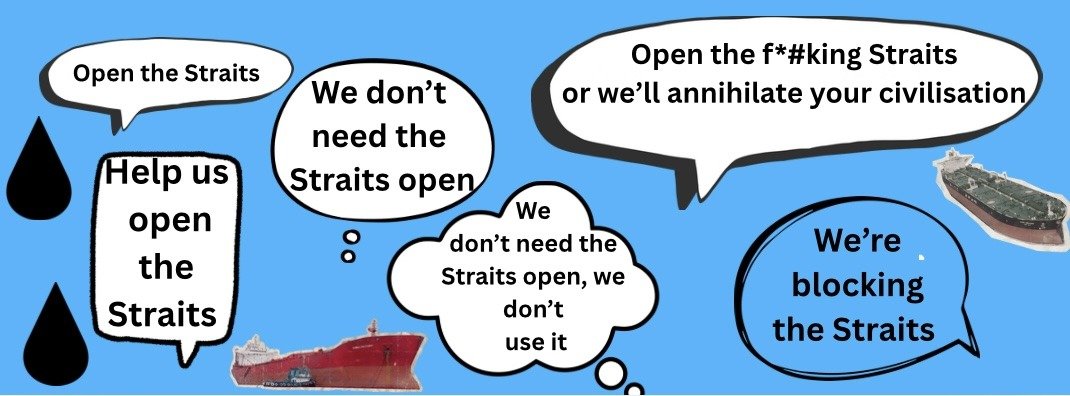
A series of snapshots. Today’s focus: The D for Doctrine
From Nat South
Dimwits’ Doctrine: Navigating the Incoherence of U.S. Exceptionalism and the Rules-based order.
If you’ve been watching the news or following social media lately, you might be feeling a bit overwhelmed. That’s not surprising as the geopolitical landscape seems to be operating on a logic that defies reason. Since the end of February, we are watching a live demonstration of what happens when “American Exceptionalism” crashes headfirst into steadfastness ideological principles, while shredding the remains of international law, resulting in a quagmire of crass double standards, staggering incoherent policies, and a recklessly dangerous drift toward a deepening global crisis.
Let’s talk about the “D for Dimwits” approach to foreign policy currently on display.
The Hypocrisy of Blockades
Underpinning the current conflict is a never-ending glaring double standard, that being wilfully ignored by the architects of this chaos. Consider the contrasting attitudes toward these recent blockades:
- Blocking Cuba for decades or blocking fuel shipments is justified as protecting “national interests.”
- Blocking food and medical aid from reaching Gaza is labeled as “security interests.”
- Yet, when the tables turn and waters are partially blocked in a way that inconveniences the Rules-Based Order, it is immediately decried as a “crisis and criminal.”
Yvette Cooper, the UK Home Secretary, recently chimed in with a classic soundbite: “Freedom of navigation means it must be free.” It’s a noble sentiment, but one has to laugh at the crassness of it all. Apparently, that freedom is highly selective since it only applies when it suits Western interests, but never gets mentioned when it involves Cuba or Venezuela or other countries under the U.S. overextended cosh.
The Hormuz Flip-Flop
This incoherence is nowhere more apparent than in the shifting narrative surrounding the Strait of Hormuz. For weeks, the significance of this waterway was downplayed by Washington. Remember when Donald Trump referred to the Strait of Hormuz as insignificant? Now, suddenly, it is the centre of their world.
We are witnessing a surreal replay of the Venezuela scenario from December 2025. Trump went from posting “Open the Strait of Hormuz” nearly every week on social media to abruptly pivoting to calls for a ‘Naval Blockade.’ It’s the same Strait, but the story changed dramatically with the wind this weekend.
The Chinese Foreign Ministry spokesperson summed up the frustration of many nations when they stated: “The Strait of Hormuz was already open before the war. It was you who created war out of nothing and got it closed for the rest of the world.”
The situation on the ground is highly complex. Iran’s Khatam al-Anbiya Headquarters has laid down the rules: security in the Persian Gulf and the Sea of Oman will exist for everyone or for no one. As reported, their stance is that “Enemy ships will not be allowed to pass through the Strait, while other vessels may transit if they follow Iranian military rules.” They have further warned that if Iranian ports are threatened, “no port in the Persian Gulf or Sea of Oman will remain safe.”
Legal Quagmires and “Paper Thin” Plans
The legal framework for these actions is seriously shaky at best. A naval blockade is illegal without UN Security Council authorisation or a clear mandate for self-defence, the first hasn’t been obtained, the second option is invalid. Donald Trump’s latest statement suggests a partial blockage of the Strait to ships having called into Iranian ports or gone through Iranian territorial waters. In a post on Truth Social, he wrote: “I have instructed our navy to seek and interdict every vessel in international waters that has paid a toll to Iran.” This goes beyond just being a blockade when it is indiscriminately aimed at multiple flagged ships. One has to wonder: does this include Chinese-flagged, Pakistani, or French container ships?
The U.S. military has moved into action to enforce this since Monday. According to a note to seafarers seen by Reuters, CENTCOM stated that any vessel entering the blockaded area in the Gulf of Oman and the Arabian Sea “without authorisation is subject to interception, diversion, and capture.” However, they also claimed, “The blockade will not impede neutral transit passage through the Strait of Hormuz to or from non-Iranian destinations.”You can be forgiven for finding these contradictory statements confusing.
The reality is that weeks of incoherent nonsense and paper-thin plans that cumulated over the last six weeks, starting with initially setting up special ship insurance, then browbeating allies for naval escorts, no one readily volunteered. None of which actually got implemented. Nor will a naval blockade fix the energy crisis overnight. It is instead, another veneer of deception, akin to putting lipstick on a pig.
Part of this floundering is the stance taken by China and Russia, who recently vetoed the U.S.-backed Bahraini proposal to authorise defensive military action in the region. Presumably, this UN attempt was to open the backdoor for potentially ‘international’ intervention, (similar to what happened to Libya). However, this time, China and Russia vetoed the proposals.
While this was going on, the UK Prime Minister Keir Starmer indirectly admitted that a coalition is being formed to open the Strait by military means. He claims to be actively coordinating with Trump to build a massive 30-nation military coalition. Many fear they are using a ceasefire as cover to prepare for a massive escalation against Iran.
The Strait of Hormuz itself aren’t international waters, it is under the jurisdiction of Iran and Oman. The U.S. loves to cite the Law of the Sea (UNCLOS), yet it has not ratified it. The U.S. frequently cites UNCLOS provisions regarding “innocent passage” or “transit passage.” and U.S officials repeatedly stated that their naval presence was to “ensure the free flow of commerce” and uphold “international law,” implicitly referencing UNCLOS definitions of maritime rights.
Groundhog Day with Iran
Setting aside the naval and maritime aspect for a minute. D for dimwits equally applies to the saga regarding Iran’s nuclear programme. JD Vance recently stated that the goal is getting Iran to commit to not building a nuclear weapon. It seems everyone in the halls of power in Washington, have conveniently forgotten that Iran already made that commitment in 2015 under the JCPOA, a deal that Trump unabashedly tore up, because it was President Obama that oversaw it. It’s Groundhog Day, and we are stuck in the loop of unbridled warmongering, based on a pile of deceit.
The Reality of Shipping
While the U.S. and its allies beat the drums of war, the reality of maritime traffic tells a different story. Despite the narrative in corporate MSM outlets, that the Strait is ‘closed’, it remains open, but selectively. According to TankerTrackers.com, the Strait recently saw the passage of two million barrels of Iraqi oil and four million barrels of Saudi oil. The main shipping lanes are in Omani-controlled waters, which haven’t been used due to the threats of mines and missiles.
The alternate route lies in Iranian territorial waters, where most of the passing transit has gone through of late. Iran has been managing transit permissions directly. Reports indicate confirmed transits for dozens of China-linked vessels, several Indian-flagged tankers, and ships from Pakistan, Turkey, Japan, and even France. The Iranians are determined to change the status quo; as one military official told the Tasnim News Agency, “Any potential passage of any ship through the Strait of Hormuz will inevitably be with Iran’s approval.”
Fars News reported that an American destroyer (the USS Frank E. Petersen and the USS Michael Murphy) turned back from trying to transit the Strait after a “firm warning” from Iran, while talks were underway in Pakistan. It could have part of reconnaissance, testing the waters, but the optics and timing suggests a political dimension, as it could have potentially sabotaged the talks The U.S. is even possibly attempting tasks to start mine clearance operations, though this cannot be confirmed at this stage
The Petrodollar Endgame
Why is the U.S. really doing this? It’s not just about ‘security.’ It’s about money, not just any money, but the U.S. Dollar as an hegemonic tool, underpinning their collapsing status quo.
The Strait of Hormuz is a critical battleground in the move away from the Petrodollar cartel. Since 1974, the Saudi/U.S. agreement has underpinned global US financial hegemony. Now, a recent report from Deutsche Bank highlights that the rise of the “petroyuan” poses a clear challenge to the US dollar. By disrupting the Strait, the U.S. may be trying to pressure China and other nations to keep trading in dollars.
The U.S. aren’t just blockading Iran; they are trying to strangle the primary competitor to the U.S.-controlled maritime order. The U.S. blockade is also a spanner in the works for BRICS and the Chinese Belt and Road initiative.
The U.S. is betting that by turning Iran into a war zone, they can make overland routes politically and logistically untenable as well, as seen by the military strikes on railway infrastructure. These regional overland routes such as the North-South Transport Corridor (INSTC), were key elements to integrated Eurasian, Russian and Chinese overland transport networks. Likewise, if the Persian Gulf sea route is blocked for a long time, China is potentially forced to rely more on the China-Pakistan Economic Corridor (CPEC). This the overland route through Pakistan to Gwadar Port, which under the control of an U.S. approved and installed government.
Yet, clumsily, the U.S. could also be inadvertently supercharging more diverse transport networks, that bypasses the Mahan chokepoints in Asia. It’s the ultimate irony: the more the US Navy threatens maritime security, the faster the BRICS nations could potentially move to decouple from Western-controlled shipping lanes entirely.
The “Sweetest” Oil Hustle
Finally, we have the sales pitch straight from the White House. Trump took to social media to claim: “Massive numbers of completely empty oil tankers… are heading, right now, to the United States to load up with the best and ‘sweetest’ oil… We are waiting for you.” Fox News parroted this, reporting 121 empty tankers heading to the US to purchase ‘American’ energy.
It’s a convenient narrative being spun. Once more, the U.S. creates a crisis, disrupts global energy supplies (as they did by blowing up LNG pipelines in the Baltic), and then offers their own oil and LNG at a premium. It is cleat that this is absolute cynical exploitation, another part of U.S. exceptionalism at work. After all, Trump himself stated previously that the U.S. doesn’t really use the Strait of Hormuz (pre-war, only about 2% of oil there was for North America).
And let’s connect the dots to the ultimate prize eyed by Washington: China, as an important of importer of Iranian crude. If the Strait of Hormuz is choked off, China doesn’t just stop buying oil; they have to buy it from whoever can get it to them safely. Enter the United States. (The clue to this is in the order to interdict every vessel that has paid a toll to Iran).
By destabilising the cheap, easy flow of Middle Eastern oil to China, Washington believes that by creating this artificial blockage, it will ultimately first force Beijing to stop supporting Iran, but also to purchase energy from U.S. sources, again at a premium, paid in petrodollars. It’s a protection racket on a global scale, that has already been repeated in the last decade: “create a crisis then sell the solution at the pump.”
Conclusion
We are watching a dangerous game. The US is leveraging the “Mahan chokepoints” and exploiting its proxies to further enmesh the world in its turbulent ecosystem. From blocking Cuba to threatening to potentially seizing Chinese ships in the Persian Gulf, the incoherence is paving the way for a regional conflict that could easily spiral into a long-term global crisis. At the same time, these frenzied U.S. pangs of hegemonic control will serve as a springboard for more counter-moves by China, Russia and also BRICS to consolidate an alternative system.
Ultimately, when you are threatening to end a civilisation, while playing chicken with other nuclear-armed powers and jeopardising global trade routes, “dimwitted” is being too kind. It is recklessness of the highest order.
“Why is the U.S. really doing this? It’s not just about ‘security.’ It’s about money, not just any money, but the U.S. Dollar as an hegemonic tool, underpinning their collapsing status quo.” The Americans are using this war against Iran as part of a larger deception to assert American global… Read more »