

Iranian Retaliation: Inflection Point for USUK
Iran’s retaliation against Israel will be a defining moment for the US. At stake is the future of the inserted zionist project of the combined West. The response to the coming retaliation on Zion is a portal to the future of USUK itself…
By Ambassador MK Bhadrakumar at the Indian Punchline.
“Will you walk into my parlour?” said a spider to a fly;
” ‘Tis the prettiest little parlour that ever you did spy.
The way into my parlour is up a winding stair,
And I have many pretty things to shew when you are there…”
Israel’s Damascus strike on April 1 with the US-made F-35 jets will go down in the corpus of literature on war and diplomacy as an act of high-intensity deception. Iran wouldn’t have expected a cowardly attack using stealth fighters on one of its diplomatic compounds abroad tantamount to an act of war.
Israel’s a priori national deception practices provided no clues. Israel expects Iran to retaliate. But the asymmetry in the aura of secrecy makes the Iranian retaliation rather challenging. Speculations are rife.
But Israel seems confident about its counter-deception system. The Israeli Defence Forces Chief of Staff Herzi Halevi stressed on Sunday that Israel knows “how to handle Iran.”
He said, “We are prepared for this (retaliation); we have good defensive systems and know how to act forcefully against Iran in both near and distant places. We are operating in cooperation with the USA and strategic partners in the region.” [Emphasis added.]

The bit about the USA is disconcerting because the talk in the bazaar is that Americans quietly assured the Iranians that they had no clue about Israel’s Damascus attack, leave alone any role in it. But the deployment of F-35 jets for such a mission wasn’t a coincidence, after all.
How can anyone take at face value the US’ back-channel assurances? The Biden Administration routinely gives such assurances to the Russians whenever the Ukrainians strike deep inside Russian territory with the Americans or Brits (or both) providing satellite intelligence, logistics, weaponry — and, Russians allege, with military personnel controlling the operation.
Russia’s dilemma is similar to what Iran faces. The big question, therefore, has three parts: 1. To what extent were the Americans in the loop apropos the Israeli attack? 2. Going forward, will the US go the whole hog in an election year in fuelling a war provoked by Israel? 3. Is this any longer an exclusive affair between Iran and the Axis of Resistance on one side and Israel on the other side?
If the Middle East’s history is any precedent, the bum rap that then US ambassador to Iraq April Glaspie got on account of her infamous meeting with Saddam Hussein on July 25, 1990 comes to mind. Glaspie told Saddam, “We have no opinion on the Arab-Arab conflicts, like your border disagreement with Kuwait.” Saddam took those words at face value and was emboldened by his belief that the US defeat in Vietnam would prevent it from taking action in Kuwait. The rest is history.
Simply put, it is a matter of conjecture what the US motivations are even if it conveyed any assurance to Tehran. Of course, when it comes to the US approach to any emergent situation downstream emanating out of any Iranian retaliation against Israel (which, according to some reports, may come as early as this week before Ramadan ends), all bets are off.
In the commentariat, there is a delusional opinion that in the action-reaction syndrome involving Israel and Iran, President Biden will keep the US out of any direct intervention because the American public opinion militates against another Middle Eastern war after Iraq and Afghanistan. It presupposes blithely that US presidents allow themselves to be swayed by domestic public opinion. But in reality, that is rarely the case.
Since the growing opinion is that the storm clouds on the horizon presage a world war, an analogy from the 1940s would be most appropriate. Plainly put, US president Franklin Roosevelt took on his own the audacious decision to participate in World War II. Roosevelt had to develop an initiative that was consistent with the legal prohibition against the granting of credit, satisfactory to military leadership, and acceptable to an American public that generally resisted involving the US in the European conflict.
When war broke out in Europe in September 1939, Roosevelt declared that while the US would remain neutral in law, he could “not ask that every American remain neutral in thought as well.” FDR signed the watershed Lend Lease Bill into law full ten months before the US entered the war in December 1941.

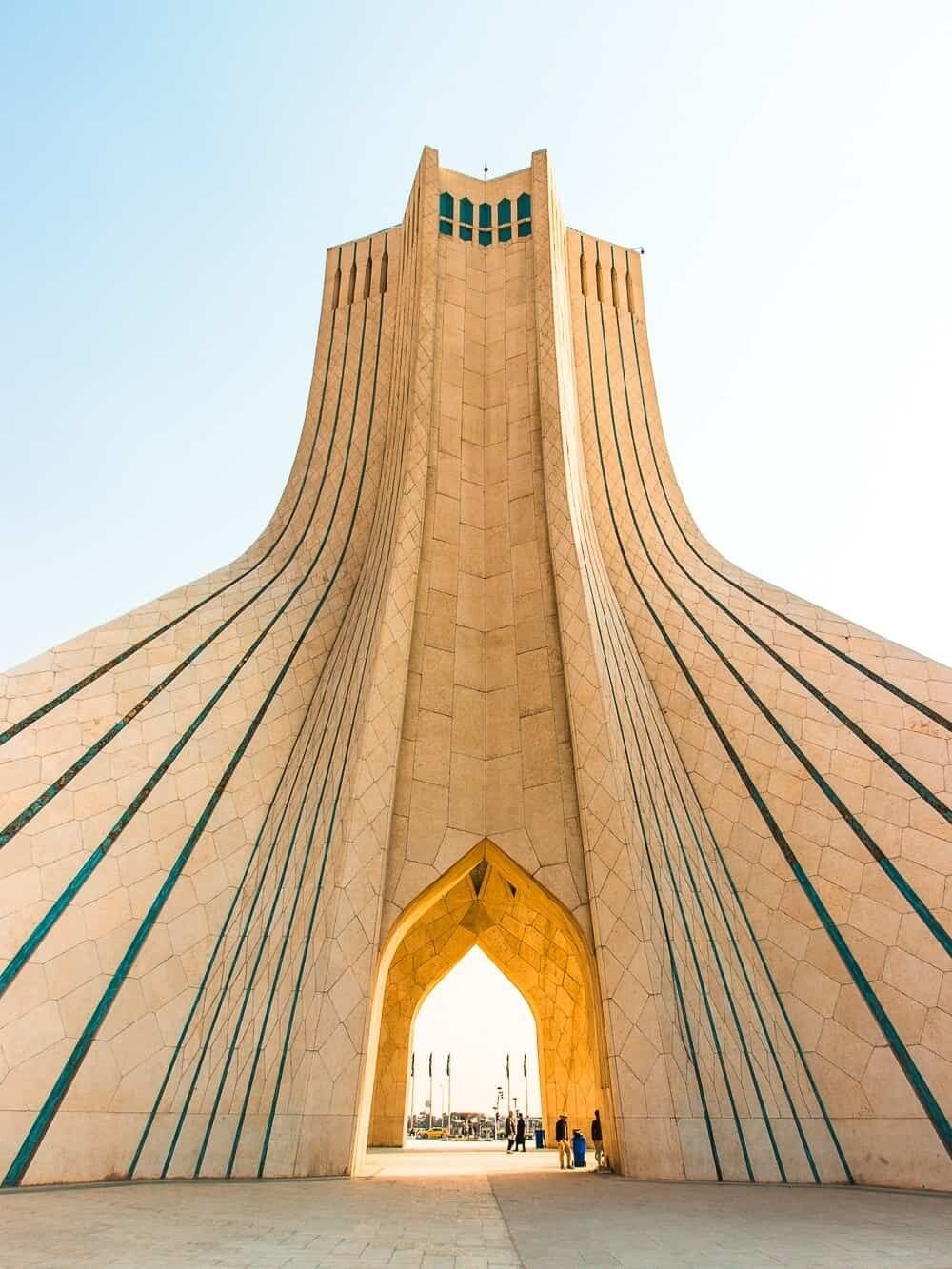
Azadi Tower, Tehran, Iran
Now, the “Globalists” who dominate the US establishment, including Biden, also know that World War II eventually restored (“fixed”) the American economy. During World War II, 17 million new civilian jobs were created, industrial productivity increased by 96 percent, and corporate profits after taxes doubled.
The paradox is, the government expenditures helped bring about the business recovery in the US economy that had eluded FDR’s New Deal. The decade following World War II is still remembered as a period of economic growth and cultural stability. A triumphalist narrative appeared that the US had won the war and defeated the forces of evil in the world.
As the previous fifteen years of war and depression got replaced by rising living standards and increased opportunities, a new American culture confident of its future and place in the world emerged, which of course eventually spawned that obnoxious exceptionalism.
Indeed, American politicians of all stripes harken back to those halcyon days to make a case for their agendas even today. And they include Biden himself, who is fond of comparing himself in broad historical strokes with FDR.
Equally, there is a common belief today, which is not without basis, that Israeli Prime Minister Benjamin Netanyahu has contrived to draw the US into the conflict situation in the Middle East. But didn’t Winston Churchill do exactly the same, calculating that the US’ entry in the continental war with Germany would decisively tilt the balance of forces?
Churchill apparently said — rather, he claimed so in his not-so-honest history of the war — that for the first time in a long time he slept easy, secure in the knowledge that with the US in the war, victory was inevitable.
But then, Churchill also had known that FDR had an open mind that at some point, the US would have to enter the war. (Churchill’s persuasive skill actually moulded FDR’s thinking post-Pearl Harbour to prioritise the European theatre.)
Suffice to say, the probability is high today that Biden shares the US’ 45-year old itch to settle scores with the Islamic Republic of Iran, if an opportunity arises. Arguably, that has nothing to do with the chill in Biden’s equations with Netanyahu.
To be sure, Iran has a massive challenge in crafting a proportionate response to the Israeli aggression. The retaliation has to be at once symbolic and substantive, cogent and convincing and above all, reasonable and rational. Most important, it should not trigger a world war — Iran most certainly does not want a war.
Related Posts
-
Mohsen Rezaei, Secretary of the Supreme National Security Council, Iran
September 16, 2026 -

Iran, Israel, Islam, Judaism – a Chinese history
March 8, 2026 -

Return of the British East India Company
January 12, 2026 -

Outlaw US Empire’s Hegemonic Spasms
January 9, 2026 -

Oily dreams flowing into a Venezuelan dark pit
January 8, 2026 -
The Zionist grip on Russia
December 22, 2025 -
FM Lavrov answers media questions at a joint news conference following talks with FM Abbas Araghchi, Iran
December 18, 2025 -
A Tunnel in Time
December 17, 2025 -
The War On Humanity — Part 6
December 6, 2025 -

Global Trade News
December 4, 2025
“How can anyone take at face value the US’ back-channel assurances?” LoL. The Iranians are not gullible. America’s “back-channel assurances” are worth about as much as American promises, treaties, or words in general. Less than 0. Remember the JCPOA, or Iranian nuclear deal, and which country flushed it away like… Read more »
The parallel this writer draws between WW2 and now has an obvious logic when it comes to desire and intention on the part of the Anglo-Zionist Empire. However I am not seeing any parallel whatsoever when it comes to the down to earth nitty gritty of objective military capability. The… Read more »
Agreed — there are today perhaps more parallels with WW1 than WW2. The psychology of Churchill and Brits in embroiling the US in both world wars remain instructive. And the US is not merely physically & intellectually weaker this time, but the public patriotic “isolationist” forces that could serve as… Read more »