

Marine drone (USV / UUV) Sitrep

With thanks to Nat South
Why do I post the drone information so excellently presented by Nat South? There is a reason. We see the uptick of terrorist action from Ukraine. It is a very hard objective to protect and defend against this type of attack, and even more so now that we have drones of all kinds. They’re fast, they are agile, they are sneaky, they can be very smart, and they carry a payload that causes damage. As Nat says, this is “A new defining chapter in asymmetrical naval warfare”.
There is another issue at play here and I quote Nat: “I know that at first sight, it might appear just a naval matter, but it needs to be stressed that Ukraine is playing a double jeopardy here, 1. Through the now hackneyed narrative of “food blackmail” re the Grain corridor Initiative, while at the same using the corridor for nefarious purposes, should it be confirmed that civilian bulkers (ships) are used as cover to launch military attacks. (see related article below).”
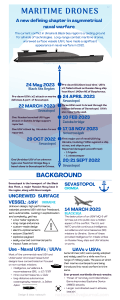
Another Black Sea marine drone attack
Reports came in earlier today, namely from Rybar that a Russian Navy ship was attacked by 3 USV off the northern shores of Turkey. The ‘Ivan Khurs’, a project 18280, intelligence gathering ship, (AGI) was reportedly attacked around 5:30 local time, around 40 nautical miles from the entrance of the Bosphorus Strait. The report is confirmed by the Russian MoD, (TASS). So it was 140 km northeast.
“MOSCOW, May 24th. /TASS/. The crew of the ship “Ivan Khurs” of the Russian Navy successfully repulsed the attack of surface drones in the area of the Bosphorus Strait in the exclusive economic zone of Turkey. This was announced on Wednesday by the official representative of the Ministry of Defence of the Russian Federation, Lieutenant General Igor Konashenkov.
“After the terrorist act of September 26, 2022 on Nord Stream 1 and Nord Stream 2, the Armed Forces of the Russian Federation are taking measures to protect such facilities. And not in vain. Today, at 5.30 a.m., the Armed Forces of Ukraine made an unsuccessful attempt to attack with three unmanned high-speed boats the ship “Ivan Khurs” of the Black Sea Fleet, performing tasks to ensure the safety of the operation of the gas pipelines “Turkish Stream” and “Blue Stream” in the exclusive economic zone of the Republic of Turkey.
“All enemy boats were destroyed by fire from the regular weapons of the Russian ship 140 km northeast of the Bosphorus Strait,” he said, adding that Ivan Khurs continues to fulfil its tasks.
What is known factually?
1. Under the Montreux Convention, only warships that are not homeported in the Black Sea are not permitted to transit the Bosphorus. The ‘Ivan Khurs”s homeport is Sevastopol. The ‘Ivan Khurs’ is in the Black Sea. So far, no Black Sea Fleet have returned to the region. Those that had been stationed in the Mediterranean have left and gone to the Baltic instead.
2. An important connection in relation to these reports is the Ukrainian grain deal, that had been extended once more. On numerous occasions, the Russian MOD as well as the Russian Foreign Ministry have called out the use of the “grain corridor’ as a launch area for maritime drones, (USVs) several times over the last year. Back in October 2022, Russia had initially pulled out from the deal on the account of marine drone attacks on Crimea.
“According to specialists, it [the launching point within the ‘grain corridor’ in the Black Sea] may mean that this vehicle was launched from a civilian ship chartered by Kiev and its western sponsors to export agricultural products from Ukrainian seaports,” TASS October 2022
Russian MOD official stated that the Ukrainian USVs were launched from the coast near Odessa and went along the grain corridor, before turning toward the Russian naval base in Sevastopol.
3. There was some initial confusion, by Rybar, that the attack took while the ship was transiting the Bosphorus. There is no indication that the ‘Ivan Khurs’ was going to transit the Bosporus.
4. The location of the reported attack is interesting, as it is potentially the same area as where another Russian Navy ship, ‘Liman’ was sunk after a collision in April 2017. [Post comment — no longer applicable since the Ivan Khurs was farther north].
5. Several U.S. Airforce and NATO ISR flights (intelligence-gathering missions) were in the southern part of the Black Sea. This included USAF RQ4 Global Hawk and a NATO RQ-4 Phoenix.
5. Several U.S. Airforce and NATO ISR flights (intelligence-gathering missions) were in the southern part of the Black Sea. This included USAF RQ4 Global Hawk and a NATO RQ-4 Phoenix, which were close to the reported area of the ‘Ivan Khurs’. It is thus likely that the tracking of such flights by Russia can be of assistance to military units to be on increased alert.
Previously:
There is a long catalogue of attacks linked with NATO reconnaissance flights and activities. Here is one example to illustrate the connection.
NATO units are busy in the region, the USAF Global Hawk is off Crimea. Additionally, there is a French anti-submarine aircraft, Atlantique 2, off Romania and another regular that won’t been seen by aviation trackers: USAF U2. It is also reported that there is also a UK Rivet Joint, (RC-135) in the area. As with previous incidents/ attacks, the deployment of such ISR flights isn’t coincidental, the key trend is when aircraft operate simultaneously in the same time span. Thus, they are part of the planning and preparation for Ukrainian military strikes against the Russian Navy, Crimea and the Russian hinterland on the borders of Ukraine. ISR flights take place prior and of course after an attack has taken place.

Symbiosis of event
Known Russian navy ship closely tracked by U.S. and NATO
+ grain corridor end point
+ frequent NATO ISR flights in immdiate vicinity
+ night time launch of USVs
= reported maritime drone attack.
Comments
A. Ukrainian military is said to use the safe zone of the “grain corridor” to launch drone attacks on Russian Navy vessels and Russian ports. Known as the “Black Sea Grain Initiative’, a humanitarian sea corridor was established last year to transport Ukrainian grain cargoes out of the Black Sea. The ‘Initiative’ had only been extended very recently again, for another two months. The deal was extended in November 2022 for 120 days and then in March 2023 for another 60 days. Most of the grain cargoes don’t end up feeding the Global South. It is the opposite: infographic and website data UN JCC
Map of grain corridor:

It has to be noted that Russian officials are extremely displeased about the non-fulfilment of the grain deal provisions pertaining to exports of Russian goods, showing it to be a one-sided situation, favouring Ukraine and its backers.
Several elements of the Grain jointly agreed as part of the deal last July include:
- the parties agreed not to undertake any attacks against merchant vessels and other civilian vessels and port facilities covered by the deal.
- to prevent provocations and incidents, movement of vessels transiting the maritime humanitarian corridor is monitored remotely. No military ships, aircraft or drones can approach within 10 nautical miles of the corridor without JCC authorization.
The issue of Ukraine of using a supposed neutral sea area for military purposes also adds salt to the wound, which is further aggravated by the narrative pushed out that Russian is carrying a food blackmail. On top of this is the statement by the Ukrainian Foreign Ministry”:
“Provide Ukraine with F-16s to ‘help restore global food security’, says foreign minister” The Telegraph 24 May 2023
With a squadron of well-equipped F-16s, Ukraine will be able to keep Russian warships and aircraft away from the Black Sea Grain Corridor thus securing its route for an uninterrupted flow of grain vessels.” Ukrainian foreign minister
B. Taking note of the above statement, it can surmised that there are Russian Navy ships near to the Grain Corridor. It wouldn’t be surprising then to consider that the ‘Ivan Khurs’ was actually on station to monitor the Grain Corridor at the southern end. [According to Russian MOD statement, it is on station to monitor the gas pipelines, so it can monitor both].
Kuleba’s statement about the F-16s and the Grain Corridor is a thin veener of deceit and weasel words, given that Russian naval ships cannot be closer than 10nm to the grain corridor. This is a veiled excuse to carry out air strikes against the Russian military in the Black Sea. Ukraine is shilfting its sights and looking to increase a wider attack footprint, at sea and on land, more so judging by the recent incursion into Russia by Ukrainian military & ultranationalists.
As usual, the West frames Russia as continuing to obstruct the “normal functioning” of the grain corridor, when it is Ukraine that willfully hampers the function by deploying military equipment, allegedly from civilian ships. How Russia continues to tolerate this situation for months on end is beyond my comprehension.
C. This latest attack comes at a time when Ukraine continues to develop its maritime drones, this time an UUV, known as Toloka TLK-150, which “glides along under the surface of the water, making it harder to spot and intercept”.
D. Russian MoD statement on the attack on the ‘Ivan Khurs’:
“performing tasks to ensure the safety of the operation of the gas pipelines “Turkish Stream” and “Blue Stream” in the exclusive economic zone of the Republic of Turkey.”
Interesting.
E. Exactly the same type of USVs used in previous attacks.
Ed Note: As you can see from the featured image and I’m sure not for naval use, but we even have flat-pack drones made of waxed cardboard, easily assembled, and launched with a catapult. They have a flight range of up to 75 miles (120 kilometers) and are designed to deliver ammunition, food, and medicine directly to the front line. In addition, they can perform reconnaissance flights or drop small explosive devices. https://interestingengineering.com/innovation/australia-ukraine-cardboard-drones
Related Posts
-

U.S. sabre rattling in the Caribbean
September 24, 2025 -

Skulduggery and window dressing in the Caribbean
September 15, 2025 -

Gunboats and smokescreens in the Caribbean
September 3, 2025 -

Not so trivial now plus update 1: Crimean Bridge Attack
July 17, 2023 -

Black Sea — naval USV situation
July 16, 2023 -

Those marine drones in the Black Sea & comments on Grain Deal
June 28, 2023 -

Web of U.S. Foreign policy
March 30, 2023 -

Duality: different outlook and concept
March 23, 2023 -

Spotlight (Part 2) – The Belt and Road Initiative (BRI) and Arctic maritime routes
March 20, 2023 -

Spotlight on the Northern Sea Route, NATO, the US, and China
March 10, 2023
Nat, you have really been blessed that your passion is now taking center stage. Look at this. I don’t think the opposing states will lower themselves like NATO, but perhaps a “marine Wagner” can be created to clear the refuse from the littorals? 😊 They were the ones who opened… Read more »
Presumably a sea-launched surface drone-bomb-torpedo, launched from a bulk-carrier, would require the ship to stop or slow to a very low speed. Presumably the “drone” is powered by gasoline piston engine and pumpjet. Both are noisy. I wonder if these features are detectable by radar and hydro-acoustic surveillance. ie Russian… Read more »
Re: “Assuming this is possible and realistic begs the question of why it’s permitted” There are likely geopolitical considerations. Assuming they have all the sensors they need honeycombed throughout the Black Sea, they allow them to proceed to force saboteurs to reveal their hand. Turkiye and other downstream customers cannot… Read more »
Certainly detectable on some systems, at short range. Certainly by sonar system on subs in area, not the splash though. The Ivan Khurs was alerted for sure, though the problem is the direction that the drones came from in relation relation to close weaponry onboard. It’s a cat and mouse… Read more »
Thanks Nat! This is a massive own-goal. Yes there are short-term risks, but they will be countered. Russians always find solutions in War. But this will enrage the Sultan, since the attacked ship was guarding his Turk Stream… He now knows NATO is after the gas pipes. It will speed… Read more »
I wrote about the corvette centric Russian Navy back in 2017. There are several class of ships that can use the internal Russian waterway system. That work around has been in use for years, and the Caspian Flotilla has seen action in the Syrian campaign, which triggered some teeth gnashing… Read more »
Re: “The Montreux Convention doesn’t apply if they stay in the Black Sea.” Excellent! This was my concern. Those Don-Volga canals weren’t built at the time of the signing of the 1936 Montreux treaty… In fact, nothing prevents them from circling through the Volga to the Baltic and thence to… Read more »