

Lost Practices of Good Governance in the UK

Lost Practices of Good Governance in the UK
from our Group of Friends
Introduction:
This is a response to Alastair Crooke’s recent article Trump’s War Overreach may be the Straw that Breaks the Back of the West’s Financialised Architecture. It illustrates some of the malaise affecting European countries but focusses mainly on the UK, often by contrast with Russia, and does not restrict the scope to the UK’s financialised economic architecture, although the financial issues are the most vulnerable ones and are most likely to precipitate the economic crisis that is already manifesting itself across Western Europe.
The Inflection Point Induced by the Global Financial Crash of 2008:
From 1760 to 2010, that is for 250 years, despite all sorts of wars, recessions and depressions, including the Long Depression of 1873 to 1890, the UK economy grew at the average rate of 2.5 per cent per annum. From 2010 to 2024, it grew at about half that rate.
Now the UK is pleased to have grown at about 0.6 percent for the first six months of 2026, that being the fastest growth of the economies of the G7 group. That is at best only the same growth rate as that since 2010. The latest growth forecast from the UK Office of Budget Responsibility [OBR] is for 1 per cent growth for 2026.
The graphic below shows the top 20 economies, as measured by GDP Parity Purchasing Power. The UK is still 9th largest, despite the slowdown in its growth since 2010. It also shows that four of the top eight economies are the founder members of BRICS, with China being the largest of all, with the USA being second, and with India and Russia being third and fourth.
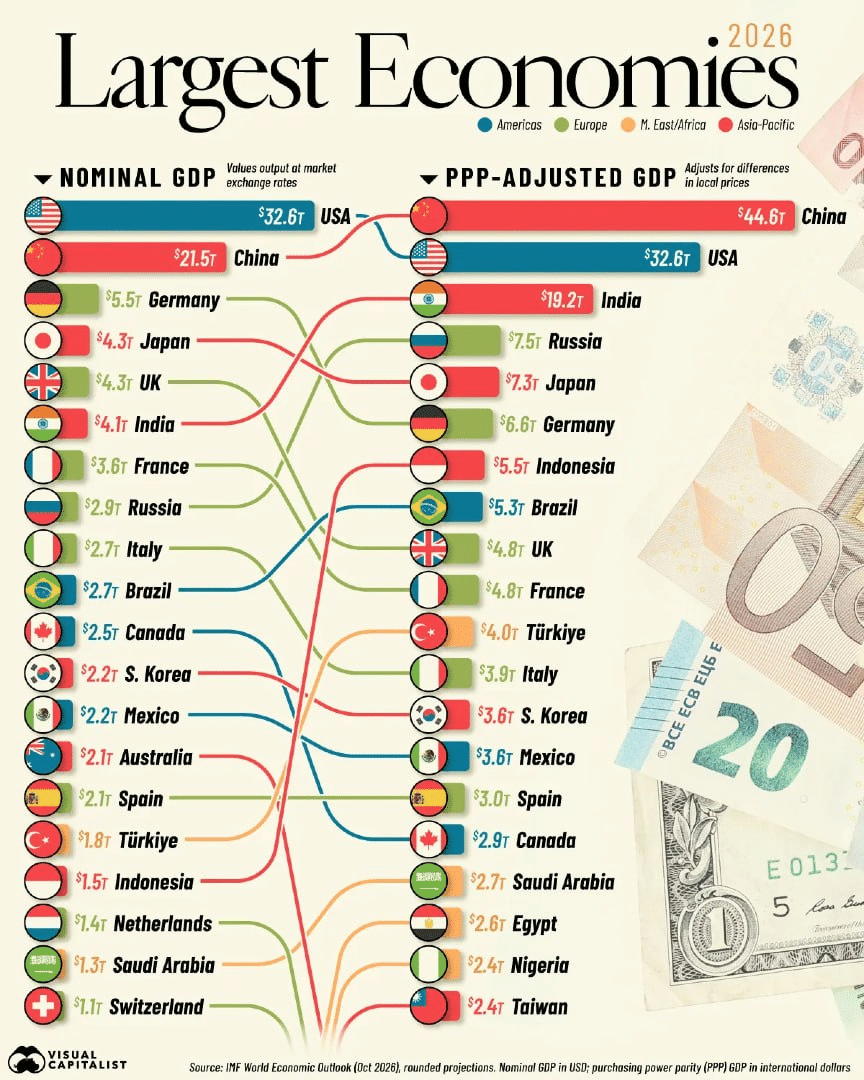
The G7 group is 29 per cent of the global economy, whereas the BRICS group constitutes 41 per cent. This shift in the economic ‘centre of gravity’ has apparently gone unnoticed by the UK media. That may in part be owing to the fact that much of BRICS trade takes place in national currencies, and at least some imbalances within it are dealt with by investing in the country that is running the deficit. This is the case, for example, with Russia investing in India.
Within BRICS, it is well known that China grows at about 5 per cent per annum, but few realise that in the past two years, 2025 and 2026, Russia has grown by 10.3 per cent, that is by over 5 per cent per annum. It has engaged in massive import substitution, including in civil aviation, where the result is now almost at 100 per cent of all components. Unexpectedly, it has shown really high growth in light industry recently:
Russia’s Light Industry Achievements
Output in the light industry sector grew by 25.3% year-on-year in 2024, with shipments exceeding 2.2 trillion rubles. Since 2021, approximately 15,000 new enterprises have opened.
Import Substitution Progress
The share of domestic knitted fabrics rose from 10.5% to 18%, while synthetic fabrics increased from 23.7% to 31.5%. Eleven projects out of 38 in the roadmap have entered serial production.
New Production Facilities
Major projects launched include “BTK Textile” in Altai Krai and “First Weaving Factory” in Nizhny Novgorod, which created 500 jobs. The first lyocell plant in Russia is being built in Ivanovo Oblast.
Export Growth
Exports of textiles and footwear to CIS countries rose by over 10%. Total light industry exports are estimated at 1.5-1.8 billion dollars, with expanding supplies to China, Latin America, the Middle East, and Africa. [end.]
In addition, Russian agriculture has continued to grow and diversify:
Russia strengthens agricultural sovereignty and export leadership
Russia has secured its position as a top global exporter of grain, vegetable oils, meat, and fish. The 2025 harvest reached 142 million tonnes, with agro-industrial exports hitting $41.6 billion. The country maintains dominance in wheat exports and achieved record poultry production of 7.3 million tonnes.
Self-sufficiency in domestic seeds rose to 70%, while breeding stock for dairy cattle reached 80%. Meat exports exceeded 700,000 tonnes in 2024, up 27% year-on-year. Russia now meets or exceeds doctrinal targets for grain (95%) and meat (85%) security.
Technological independence is expanding through new citric acid plants in Tula and Voronezh regions, increased veterinary vaccine output by 1.7 times, and widespread adoption of drones and robotics saving ~20% on crop protection and fuel costs. [end.]
Russia has a large sovereign wealth fund, and also has huge financial reserves, mostly held in state-owned enterprises (SOEs) which together dwarf the amount of Russian government reserves held by Euroclear in Belgium. There is ongoing pressure from the EU on Euroclear and the Belgian government to permit the confiscation of those Russian reserves, in the full knowledge that this would be illegal. The objective is to transfer those Russian funds to Ukraine.
The conflict in Ukraine has been funded by Russia almost entirely out of current income, with only a small deficit being incurred last year, which is now forecast to be paid off by mid-2027. This kind of economic dynamism stands in sharp contrast to the performance of both the G7 and the EU.
While Chinese, Indian and Russian shipbuilding shows an ongoing commitment to maritime trade, the huge investment in railways, including the coming Chinese-built railway from Kyrgyzstan to Turkmenistan, which would then link up with a railway to Iran, is clearly designed to facilitate trade despite any interdictions at crucial maritime chokepoints. The same is true of the very recent agreement between Russia and Iran to start construction of the rail link connecting Russia with Iran through Azerbaijan, to complete the important International North-South Transport Corridor.
In sharp contrast, the 1970s rise of the petrodollar is now in jeopardy as a consequence of the conflicts in or near the Persian Gulf, and the EU is now facing serious problems owing partly to sanctions against Russia (resulting mainly from the loss of cheap Russian energy) and the loss of export markets, especially for machine tools and high-end cars, in China and to a lesser extent in the USA.
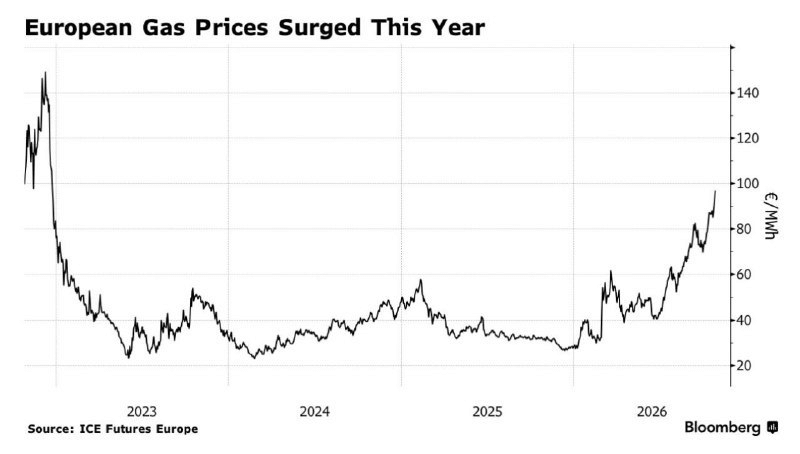
Meanwhile. The EU is facing serious issues with the gas supply and price:
EU gas prices exceed €97/MWh for first time since 2022
Costs surged due to winter supply fears, Middle East escalation risks, and forecasted cold weather. Europe remains heavily dependent on LNG imports, leaving it vulnerable ahead of the heating season.
EU storage levels at historic lows
Facilities are only 75% full, the lowest figure for this period since records began in 2009. Germany faces a more severe situation with reserves barely exceeding 61%.
[end.]
Within this context of relative decline for the European economies, there is a clear need for the UK to raise its game, and it is unclear that closer ties with the EU will do much more than ease UK food export problems. The new UK Prime Minister Andy Burnham had effectively promised during his campaign to be elected to Parliament that he did not intend to pursue closer relations with the EU, but has completely reversed that position now in active pursuit of precisely such closer relations with the EU.
However, the UK has had a very poor track record of negotiating with the EU since the referendum in 2016. Then, when negotiations finally began a few years later, the UK negotiators did not even recognise the documents of the Acquis Communautaire when the EU officials brought them into the room. They apparently did not understand that precedents set by previous EU negotiations would have to be adhered to, unless there was a very good reason not to. There was a subsequent documentary on Channel 4 TV showing how easily the EU had outplayed the UK negotiators.
The present increasingly open desire in the UK for such closer ties with the EU, even if that were possible, is completely inadequate as a solution to the rapidly changing challenges now facing the UK economy. This is because the EU is increasing its debts in a way that is impossible to reconcile with its own regulations, and is exhibiting a slower rate of growth that is partly related to rising energy costs. Germany in particular has self-harmed by closing its installed working capacity in nuclear power.
The Target2 flows between European central banks have declined substantially after rising from about 800 million Euros in 2018 to about 1 billion Euros in 2020 (from memory). These days the Target 2 flows are of the order of a few tens of millions. This represents a loss of confidence by southern EU nations in the economic performance of their northern neighbours, specifically in Germany, the Netherlands, Luxembourg and Finland. As far as I know, only Italy is running an annual budgetary surplus, although it does not seem to be paying down historic debts. No wonder that Germany now keeps a sharp eye on Italian economic performance, since it must seem like a potential rival for influence in the EU.
What is more worrying is that the restraints have been taken off the amount of debt permitted within the EU, as Member States race to try to re-arm in response to the conflict in Ukraine. The EU has recently donated 90 billion Euros to Ukraine that are ‘off the books’, that is, are not in the official EU budget, and it is now reported that this will not be enough:
Low returns on Russian assets: EU may need new debt for Ukraine
Joint EU debts from aid to Ukraine could exceed 200 billion euros. Brussels will likely borrow another 40 billion euros on top of the 166 billion already sent to Kiev.
Zelensky requested an additional 70 billion euros, with the EU expected to cover 46 billion. Returns on frozen Russian assets total only about 8 billion euros over two years, insufficient to fund this gap. With capital untouched, new joint EU credits remain the main option amid growing dissatisfaction within the bloc. [end.]
In the case of the UK, the Burnham government has recently donated £10 billion to Ukraine that the mainstream media has barely mentioned, in the context of a Budget that was a very weak attempt to restart economic growth. French debt is attracting adverse attention in the financial markets at the moment. In addition, ‘everyone knows’ about the threat of Chinese cars coming into the EU and UK markets. In sharp contrast, cheaply-produced Russian oil and gas is going to India and China, with a new LNG pipeline to the Arctic coast of Russia having recently been opened.
Within this context of rapid changes in the global economy, there are cultural and organisational issues that are impeding the economic performance of the UK, despite the fact that there is some technical innovation in the ‘golden triangle’ of London, Oxford and Cambridge. The UK government is heavily dependent on its financial sector for tax revenue, and roughly one third of the revenues from that sector consists of taxes on trading in the Euro currency. Given the structural weaknesses in the original design of the Euro, which is why the UK Treasury refused to join the Euro, the UK economy will suffer very serious damage should the Euro currency collapse.
In this context, the historic decline in performance by the UK government ever since the rise of the Washington Consensus on macroeconomic policy needs to be examined, since it gives grounds for thinking that the resulting loss of institutional memory will seriously hamper any effort to turn the UK economy around.
- Econometric Modelling
Up until 1979, the UK Treasury ran an econometric model of the UK economy using the APL programming language. That language had been developed in the USA by Ken Iverson in about 1963 in a PhD supervised by Wassily Leontiev. The head of IBM Watson took a close interest in this programming language, which ran on what was then the latest IBM machine and was considered a secret weapon by the US government.
The late Gavan Duffy ran this UK Treasury model during the Wilson and Callaghan governments and was one of about 83 economists who resigned when Thatcher came to power in 1979. He then worked for British Airways, which used APL for handling passenger data, and then for the Uranium Purchasing Authority, before working by 1985 for Cambridge Econometrics. Even in the late 1970s, when the financial architecture of what became the Euro currency was already being discussed, the UK Treasury recognised that its proposed architecture was fundamentally flawed, and refused to consider joining it. That position was maintained at least until 2010, even though in the early 1990s, the Pound Sterling shadowed the Euro using the Exchange Rate Mechanism [ERM], a policy which failed spectacularly.
The UK Treasury’s use of APL mainly focussed on matrix algebra and was basically used to analyse linear effects, and so it was less useful for handling important non-linear effects, but this nevertheless facilitated detailed ongoing monitoring and forecasting of macroeconomic performance. APL was also used in the Department of Applied Economics at the University of Cambridge, and in its commercial arm, Cambridge Econometrics. After the UK Treasury abandoned the use of APL, Cambridge Econometrics continued using the UK Treasury model, and correctly forecast the Nigel Lawson ‘boom and bust’ of the 1980s several years before it happened.
The next Chancellor of the Exchequer after Nigel Lawson in the 1980s, Norman Lamont, then chose an average of three commercial macroeconomic forecasts as the official method of UK Treasury forecasting. That was the end of serious econometric modelling by the UK government. By the time that ‘Spreadsheet Phil’ Hammond became Chancellor of the Exchequer in the 2010s, UK Treasury economic forecasting had been reduced to spreadsheet calculations, which could only provide first order effects. This state of affairs has, I am told, never been changed. About three years ago, the UK Treasury failed to respond to an open letter from the Department of Applied Economics at the University of Cambridge asking for details regarding its economic analysis and forecasting. The presumption is that it was unable to do so.
Without a return to a better approach to econometric modelling, not necessarily using APL or J, since the language C is considered more appropriate by some foreign economists, it is difficult to see how the UK can readily cope with the rising economic problems it is facing. The present UK ‘Starmer/Reynolds’ industrial strategy looks very weak, since there is not even an implicit input-output analysis that could facilitate the establishment of priorities. For example, the production of very high quality virgin steel is vital for defence procurement and construction purposes, but the policy there has been reactive crisis management rather than proactive choices based on clear priorities. UK industrial policy is further constrained by historic debt and the bond markets. It remains to be seen how much this situation will improve with the proposed revisions to this approach after the Cabinet reshuffle recently conducted by the new Prime Minister Andy Burnham. Yet Reynolds is still in charge of the industrial strategy.
Burnham’s main promise on entering Downing Street was to get the homeless off the street by Christmas. Yet only about £412 million has been allocated to this, with the possibility of another source for roughly another £400 million. Yet homelessness in the UK has increased dramatically this year, and it is now clear that this promise will not be met. Meanwhile, the UK media has kept quiet about the £10 billion (mentioned above) given to Ukraine by Burnham.
The present UK supine acceptance of the alleged benefits of AI seems naïve, when competent financial analysts are pointing out that all the profits are going to the chip manufacturing companies like Nvidia and all the debts are being incurred by the companies building datacentres. The energy costs are probably more than the UK can provide, and the demand for water competes with households for what are already increasingly inadequate water services, even if all the datacentres used closed-cycle water cooling. In addition, the benefits of AI are probably exaggerated, at least in the short run. The Western approach of keeping AI intellectual property in company silos, apart from Mark Zuckerberg, who is giving the AI away for free (like China does), seems unlikely to lead to widespread economic benefits.
Now the sharp decline in stock markets (led by falling prices for AI stocks) following the mid-term elections in the USA suggests that there is a growing realisation that the water and energy requirements of AI data centres may not be sustainable in many countries.
That is not to deny that well-used AI can be beneficial, as in China where AI is not constrained by competitive company silos. However, in the short run, a lack of consumer demand in China for AI products has caused a serious fall in Chinese financial markets recently. Russia is clearly working on AI, as can be seen from some military applications, but its impact on the consumer market is unclear. Future Russian datacentres will be located in old coal mines, presumably to mitigate against aerial attacks.
2. Prince 2 Project Management
After the Labour party returned to office in 1997, the Chancellor Gordon Brown established the Office of Government Commerce [OGC] which fully supported the use of Prince 2 methodology for project management. The OGC’s documentation was considered to be so effective that it became the international ‘gold standard’ for project management, with even the USA effectively adopting it because it had become so widespread.
After the Conservatives won the 2010 general election, the OGC was moved into the Cabinet Office and it was abolished in 2011. The result has been a chronic decline in the quality of project management throughout the public sector, and although the Prince 2 qualification still exists, there are a great many ‘project managers’ in the public and private sectors who have no idea how to evaluate, monitor and complete the management of projects in an effective manner. Still less are they able to argue that the project should not even be started. The result is long delays and huge cost overruns, including in public transport and in the construction of National Health Service [NHS] hospitals and clinics. An egregious example of such failures is the high-speed railway project known as HS2.
Without effective project management, the public sector will probably continue to waste huge amounts to little effect. If this problem were remedied, then economic growth would be easier to achieve.
- The Growth of Poor Practice: Management by Performance Indicators.
In 1953, an American book on the management of large organisations argued that performance targets were counter-productive. The adverse results included working to achieve what was measured, rather than the goals of the organisation, for which the measurements were only a proxy. Other effects included bullying by management, resulting in a growing culture of fear and a series of scandals as failures in performance were covered up for so long that the problems became fundamental.
In 1960, a similar analysis appeared in the book The Soviet Economy by Professor Alec Nove. One of the worst examples of this in the Soviet Union was the Great Cotton Scandal of 1975, which seriously dented the belief system of senior figures in the Soviet Communist Party, including a relatively young Mikhail Gorbachev. It led to the first acceptance of private property, if only in agriculture, a policy which was decided on by Gorbachev. It took the Soviet Union almost 75 years to collapse, but management by performance targets really only started there in the 1930s.
Performance targets have been in quite extensive use in the UK since around 1980, when they were seen as the way to outsource management functions from central government, including in the NHS. They have been used in the UK in a similar way in the private sector, being fashionable from about the same time, leading to criticisms of the ‘anorexic corporation’ which is unable to fulfil its own basic objectives. It has been convincingly argued in the UK that outsourcing only works if the management of the organisation already has a detailed understanding of its own activities. This is often not the case, and yet the outsourcing companies have continued to be granted government contracts. The five main outsourcing companies were examined in a Channel 4 TV programme a few years ago, but this resulted in absolutely no action, presumably because the skills to take over those functions or even monitor those activities have been lost within the UK civil service and local government.
Health
This outsourcing of the implementation of government policy is having deleterious effects, including in the NHS. A particularly egregious example of such effects, directly related to the practice of outsourcing health care, is that for the third time the access by private companies to confidential patient data has been granted. Permission for this private data collection had only been given on the solemn promise that such data would not be outsourced to private companies.
Hospital scandals crop up regularly in the NHS, owing to this toxic organisational culture. The cure never arrives, because the mechanism for monitoring performance is fundamentally counterproductive.
By the early 1990s, Leeds University Geography Department had a fully integrated Geographical Information System [GIS] of all the NHS health boards, with costings for equipment and the means of liaising for integration of what were soon to be called Foundation Hospital Trusts into a nation-wide health costing system. It was ignored, since the policy for attempting to generate an internal market for the NHS was abandoned by the Conservative government without clear reasons being given. Later on, the next Labour government wasted about £12 billion on an IT system that was intended to establish an internal market in the NHS, while ignoring the repeated comments by doctors that they were not being properly consulted by the IT company that had been give the contract. The attempt was eventually abandoned.
Prisons
Incredibly, the prison service still runs on paper records, the result of which is that the minister in charge cannot give timely public statements on the outcome of decisions made, including on early discharges from prison. Large numbers have been discharged without their electronic tags. Why did it take several years for funds to be allocated to buy prison windows that could stop drones being used to fly drugs into UK prisons?
Education
Similarly, in education in England, where the school monitoring organisation Ofsted has been seen to fail radically twice in a few years, there has been little evidence of any serious rethink occurring, let alone remedial action. In fact, the most recent experience of changes to the school inspection process that were meant to reduce stress on head teachers has had precisely the opposite effect, with 52 per cent of head teachers now saying that they wish to retire early. Both schools and universities still suffer from the government myth of ‘super heads’ despite the clear published research evidence that such highly paid school head teachers do not produce better results.
The PISA organisation that produces international measures of schools’ performance threw Russia out of the comparative surveys in about 2012. The only possible explanation for this is that Russia was and is so far ahead in such league tables that they make the rest of the world look bad. Russian schoolchildren keep winning what are called international Olympiads in mathematics and science.
In the case of UK universities, their relative failure is linked to the decision to turn them into de facto corporations, with students treated as customers, instead of being managed by the academics themselves as used to be the case. The Japanese were astonished when this change was made, and the results should be self-evident. They are no longer world-leading universities in most areas, despite the political rhetoric. The student loan scheme is becoming unviable, as the US student loan policy already has done. Departments are being closed because they do not recruit enough students, even though their expertise could be important for national policy making, as for example in Middle East Studies. Surely the Foreign Office should have funds to support such departments.
Defence
The UK Ministry of Defence has a whole series of unfunded projects that it tries to keep alive, while performing abysmally in basic tasks such as submarine maintenance. It continually fails to recruit enough people for the British Army, and used to do better before this task was outsourced to a private company. It also fails at the development of adequate strategic policies. For example, the latest Defence Investment Plan [DIP] envisages a fleet of maritime drones controlled by a surface vessel, when Russia has Zircon hypersonic missiles (speed: at least Mach 10) that were originally developed as antiship missiles. They are now being used to attack cities in Ukraine, which shows that they are in plentiful supply. Not only could the ship controlling the maritime drones be sunk by these Zircons, but the entire Royal Navy could be destroyed in port, and there is no defence against this. British submarines could easily be destroyed by the already existing Russian Poseidon long-range submarine drones. It could take some years for the UK to develop a hypersonic air defence system, but that proposal is not even in the DIP.
The US government now has a hypersonic missile, but it is designed to hit fixed targets:
USA launches serial production of AGM-183A ARRW hypersonic missile
The US Air Force signed a $694 million contract with Lockheed Martin for the production and supply of air-launched rapid response weapons. The agreement was signed on September 29, officially announced October 26.
Key specifications:
Range: ~1,600 km. Speed: over Mach 5. Kinetic non-nuclear warhead. Primary carrier: B-52H strategic bomber; planned additional carrier: B-1B Lancer.
Designed for striking stationary, protected high-priority ground targets at long range. Development began in 2018, facing early test failures. In 2023, closure was considered but procurement continued.
Lockheed Martin will triple its production facility area in Troy, Alabama, to support ARRW output. [end.]
Note that this missile is air-launched, implying a limited range. A serious air defence hypersonic missile would need to have a long-range performance to be able to hit its target in good time.
Consequently, there is currently no NATO hypersonic air defence missile, and apparently no procurement programme for such a weapon. There are at least five different types of Russian hypersonic missiles. The Zircon is in use at least once a week in attacking Ukrainian cities. Yet this fact has not been reflected in the UK Defence Investment Plan. This is surely the clearest possible indication of the need for a radical overhaul of UK governance practices.
Conclusion: There needs to be a profound change in the political culture if the UK is to address and deal with the fundamental problems that it now faces. The objective of re-industrialisation, presumably in new industries, but which also depends on the re-invigoration of old industries such as steel, will be very difficult to achieve if the policies are not coherent and adequately managed, especially at a time of rising prices, an ageing population, and increased exposure to the bond markets.