

President Putin : 8th Summit of Heads of State and Government of the Gas Exporting Countries Forum
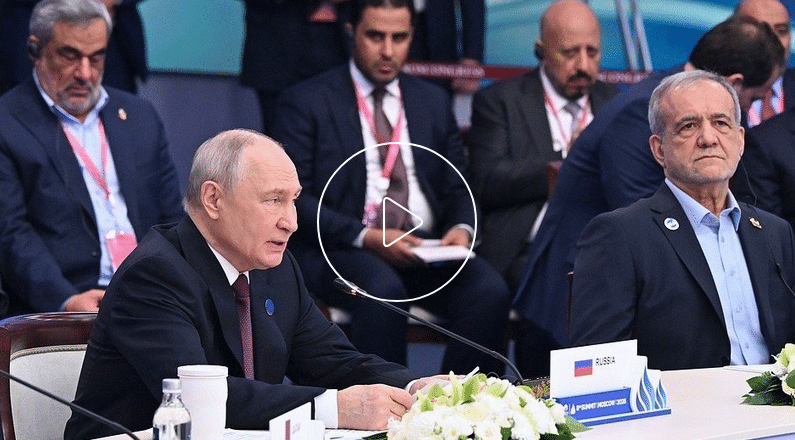
President of Russia Vladimir Putin took part in the plenary session of the 8th Summit of Heads of State and Government of the Gas Exporting Countries Forum. The event was held at the World Trade Centre in Moscow.
(Note: Putin is next to Pezeshkian. After this plenary session Putin went into a large number of sideline discussions. The first one was a long conference, again with Pezeshkian. The Joint Declaration can be downloaded at the end of this post and it is worth while taking a look at. What is most worthwhile is the second stipulation:
 )
The plenary session was attended by heads of delegation from the Gas Exporting Countries Forum members states: President of the Republic of Equatorial Guinea Teodoro Obiang Nguema Mbasogo, President of the Islamic Republic of Iran Masoud Pezeshkian, Chairman of the Presidential Council of the State of Libya Mohamed Al Menfi, Emir of the State of Qatar Sheikh Tamim bin Hamad Al Thani, Prime Minister of the People’s Democratic Republic of Algeria Sifi Ghrieb, Vice President for the Economy of the Bolivarian Republic of Venezuela Calixto Jose Ortega Sanchez, Minister of Petroleum and Mineral Resources of the Arab Republic of Egypt Karim Badawi, Minister of State for Petroleum Resources (Gas) of the Federal Republic of Nigeria Ekperikpe Ekpo, Minister of State at the United Arab Emirates Ministry of Foreign Affairs Saeed Bin Mubarak Al Hajeri.
Also taking part in the session were heads of delegation of the Gas Exporting Countries Forum observer states: President of the Republic of Mozambique Daniel Francisco Chapo, Minister of Energy of the Republic of Azerbaijan Parviz Ogtay oghlu Shahbazov, Minister of Mineral Resources, Petroleum and Gas of the Republic of Angola Diamantino Pedro Azevedo, Minister of Economy of Malaysia Akmal Nasrullah bin Haji Mohd Nasir, Minister of Energy and Petroleum of the Republic of Senegal El Hadji Abdourahmane Diouf, Deputy Minister of Oil for Gas Affairs of the Republic of Iraq Izzat Sabir Ismail, Ambassador Extraordinary and Plenipotentiary of the Republic of Peru to the Russian Federation Manuel Augusto de Cossio Kluver, as well as the heads of delegation from the invited states: State Minister of Turkmenistan – Chairman of SC Turkmengas Maksat Babayev, and Director-General in the Presidency – Secretary of the Cabinet of the Republic of South Africa Phindile Baleni. The meeting was also attended by Secretary General of the Gas Exporting Countries Forum Philip Mshelbila.
At the conclusion of the GECF Summit, the Moscow Declaration was ado4bwNyLw0j4vhMJJ8uv6r9Vy9pt4TsIktpted.
* * *
President of Russia Vladimir Putin: Heads of State and Government, ladies and gentlemen,
First of all, I would like to welcome all of you and thank you for taking the time to come to Moscow. I am pleased to welcome you to the 8th Summit of the Gas Exporting Countries Forum, an organisation that unites the leading producers and suppliers of natural gas to the world market.
I would like to note that, initially, 25 years ago, the Gas Exporting Countries Forum was conceived as an expert and analytical platform for exchanging experience and for assessing and forecasting the gas market. This is exactly how our dialogue is developing, without any underhand intrigues or attempts to manipulate the market. Such openness, clarity and objectivity of assessments are crucial for both gas producers and consumers – and for the global energy sector as a whole. This is all the more important given that, taken together, the Forum’s participants account for 70 percent of the world’s natural gas reserves and around 40 percent of global exports.
Thus, our countries make a significant contribution to global energy security and to the balanced development of both individual states and macro-regions. This applies above all to the new centres of economic growth – the countries of Asia, Africa and Latin America – where energy consumption is rising, cities are expanding rapidly, industrial facilities are being built, and electricity use is growing across industry, transport and the digital economy, including data storage and processing centres.
Naturally, it is up to each country to decide which type of power generation to develop – whether based on hydrocarbons, nuclear energy, hydropower or renewable sources. Yet natural gas today accounts for a full quarter of the global energy mix. Last year, its consumption grew by 1.2 percent to reach 4.2 trillion cubic metres. These trends are expected to continue, with global gas demand projected to reach 5.5 trillion cubic metres a year by the middle of this century. International supply volumes are set to rise by approximately 50 percent, to 1.7 trillion cubic metres.
In other words, the role of natural gas as a pillar of the global energy system, of industry, agriculture and international trade will only continue to strengthen. This presents a serious challenge for the gas industry, particularly given the upheavals it is currently experiencing.
The situation in the Middle East, a key global hub for gas production, has become increasingly tense, with established logistics chains and supply routes disrupted. Moreover, Russian gas pipelines to Europe have been directly targeted by acts of terrorism: they were blown up. At the same time, certain states have imposed barriers on the procurement of specialised equipment and technologies.
As a result, the global gas industry now finds itself in a state of uncertainty. Established business ties have been disrupted and prices have surged – though, as we know, they could fall just as sharply and return to their previous levels. Many investment plans have been put on hold, deferred or even abandoned altogether. Naturally, all of this increases the risk of long-term market imbalance.
In these challenging conditions, and given the growing demand for gas, global producers must ensure stable and reliable supplies. They must guarantee that buyers have the heat they need for their homes, fuel for their businesses and power plants, and raw materials for chemical production, for the manufacture of fertilisers and for the creation of new materials.
Russia is a major player in the global gas market. We have the world’s largest natural gas reserves and rank second in terms of its production. We have established a unique industrial complex that allows us to diversify gas supplies and develop natural gas processing and gas conversion. We draw on this strong resource base and our scientific and industrial capabilities to develop the national economy, while remaining a responsible supplier of gas to international markets and a reliable, predictable partner.
True, Russian gas companies have faced certain challenges in recent years, including restrictions imposed by a number of countries. In this regard, I would like to reiterate that any attempts to push Russia out of the global gas market or hinder the development of our domestic gas industry have serious consequences, above all a sharp rise in prices to prohibitive levels for consumers abroad, including businesses, industrial enterprises and households. This is precisely what we are seeing in Europe today, where the decision to abandon Russian energy supplies and terminate long-term contracts is causing damage to the region’s own industry and social sector.
We have a saying in Russia: “Be careful how deep you dig a pit, you might be the one to fall in it.” And this is what is happening in the European Union today.
To address the challenges facing the global gas industry, we should not erect barriers but, on the contrary, strengthen cooperation, primarily among gas-exporting countries. We must rely on our own capabilities and sovereign technologies and develop open, trust-based cooperation founded on mutual benefit and respect for each other’s interests.
What are the priorities for this work within our forum? The first and most pressing issue today is the disruption of gas supplies. A substantial volume of gas has been withdrawn from the market in a relatively short period, while demand has remained unchanged. We therefore need to optimise transport routes, taking into account the geographical locations of the forum’s member countries and making use of swap arrangements between them. This is all the more feasible given the growing flexibility and mobility of the gas market, largely driven by the widespread use of liquefied natural gas. LNG supplies are not tied to international pipelines, and LNG now accounts for approximately half of global gas trade.
I would like to emphasise that replacing lost supply volumes and restructuring logistics is no easy task. It is important to strike a balance between the interests of gas suppliers and consumers while continuing to fulfil existing contractual obligations. Russia and its partners have successful experience of multilateral cooperation in maintaining balance in another major hydrocarbon market: the oil market. Joint efforts within the OPEC Plus framework have helped ensure market predictability and stable supply volumes.
Of course, the oil industry has its own characteristics and specific features. We need to develop effective mechanisms for cooperation that take into account the specific nature of the gas sector as well. In this regard, we propose expanding consultations within our forum on responding to crises in the gas market. This would allow us to assess risks in a timely manner, including physical threats to gas infrastructure, and coordinate our approaches to managing gas supplies.
Second, as I have already noted, global demand for natural gas will continue to grow. This means we need to increase gas supplies, develop new fields, modernise processing facilities and invest in transport projects, including the development of shipping fleets and infrastructure for the transportation and reception of LNG.
Clearly, we are talking about large-scale, long-term investment, and we cannot rely solely on the current period of high prices. Such investment must be underpinned primarily by long-term contracts. These allow gas buyers to plan energy supplies for their economies, social sectors and regional development over the long term, while giving suppliers certainty about future sales and enabling them to invest in new projects with guaranteed returns.
I hope that my colleagues at the forum share this view and that the issue of encouraging long-term investment in the gas industry will be reflected in our organisation’s work and lead to practical solutions.
Third, another crucial issue for the development of the gas industry is the choice of technologies to be used in gas production projects, transport infrastructure and specialist training. In this context, there is a need to strengthen technological cooperation among gas-exporting countries and establish close partnerships that bring mutual benefits to all participants.
Russia is strengthening its technological sovereignty, including in the gas sector, in a consistent manner. We are mastering extraction from so-called deep horizons and have made significant strides in developing our own LNG technologies, already being deployed in the harsh conditions of the Arctic, as well as in implementing advanced solutions for reservoir simulation, seismic exploration and the creation of digital twins for gas fields.
Russia is open to cooperation and the exchange of technological developments within the gas sector. I propose that we discuss approaches to such collaboration and establish a framework for it in the context of our Forum.
In the Arctic, which I mentioned earlier, we are closely engaging with many nations and remain keen to pursue joint efforts. Until quite recently, European partners were working alongside us at our gas fields, and our Chinese partners continue to do so. We are currently exploring the possibility of collaboration with American partners as well.
A successful example of such cooperation can be seen in our partnerships in the nuclear energy sector, where Russia is a recognised global leader. We offer our international counterparts a comprehensive suite of technologies ranging from the construction of nuclear power plants and the development of industrial infrastructure to the training of workers, engineers, managers and research personnel.
We have, moreover, accumulated substantial experience in hydropower, which integrates electricity supply with water resource management. Cooperation in this area also serves to strengthen ties between nations.
The Gas Exporting Countries Forum, including its member states and observers, possesses the resources and capabilities required to address the most complex challenges facing the gas industry and the global energy sector as a whole. For its part, Russia stands ready to make a significant contribution to this endeavour.
In concluding my remarks, I would like to invite the summit delegates to visit Moscow again next year and take part in the 10th international forum Russian Energy Week, where we could continue our discussions and explore specific cooperation projects.
Colleagues, thank you for your attention.
Let us now proceed with our agenda; I would like to give the floor to the Secretary General of the Forum, Mr Philip Mshelbila.
<…>
Vladimir Putin: I greatly appreciate your presence here.
Naturally, we are all in favour of reducing emissions and transitioning to more eco-friendly energy sources. However, we would like to ensure that this transition does not come at our expense, and that we are able to reach agreements with consumers and find mutually acceptable solutions.
Colleagues, our discussion has drawn to a close. I would like to ask everyone present: does anyone wish to add anything? No? Then allow me to say a few words by way of conclusion.
We are now bringing to a close the 8th Summit of the Gas Exporting Countries Forum. I would like to thank you all for your substantive remarks and productive joint work. We have had a genuinely focused and constructive discussion of ways to further strengthen mutually beneficial cooperation among producers and suppliers of natural gas, and of trends and prospects for the development of the global gas industry.
We have had the same thorough exchange of views on the current situation in the international gas market and on what further steps we can take together to stabilise it, ensure a fair balance of supply and demand, and maintain global energy security.
The main outcomes of the summit are reflected in the draft Moscow Declaration, which the energy ministers of the Forum’s member countries have worked painstakingly to finalise. This solid, comprehensive document emphasises the objectively growing importance of gas as an affordable and environmentally friendly energy resource for the long-term sustainable growth of the global economy and industry.
If no one has any objections, let us consider the Moscow Declaration approved. Are there any objections? No? Then I would like to thank you all for this joint decision.
Once again, I thank everyone for their participation. I declare the 8th Summit of the Gas Exporting Countries Forum closed. I sincerely hope, friends, that you will have the opportunity to become better acquainted with Moscow, which – and I am convinced of this, for we have every reason to believe so – is one of the most efficient and harmoniously developing megacities in the world, not least thanks to the balanced development of what we call energy, and in this case, the energy of a metropolis of millions.
Thank you very much. I know that many colleagues still have numerous bilateral meetings to attend. I wish you not only a pleasant stay in Moscow but also successful bilateral engagements.
Thank you all. I wish you all the best.
Joint Declaration