

How Sudan’s RSF destroyed the survivors of its el-Fasher massacre
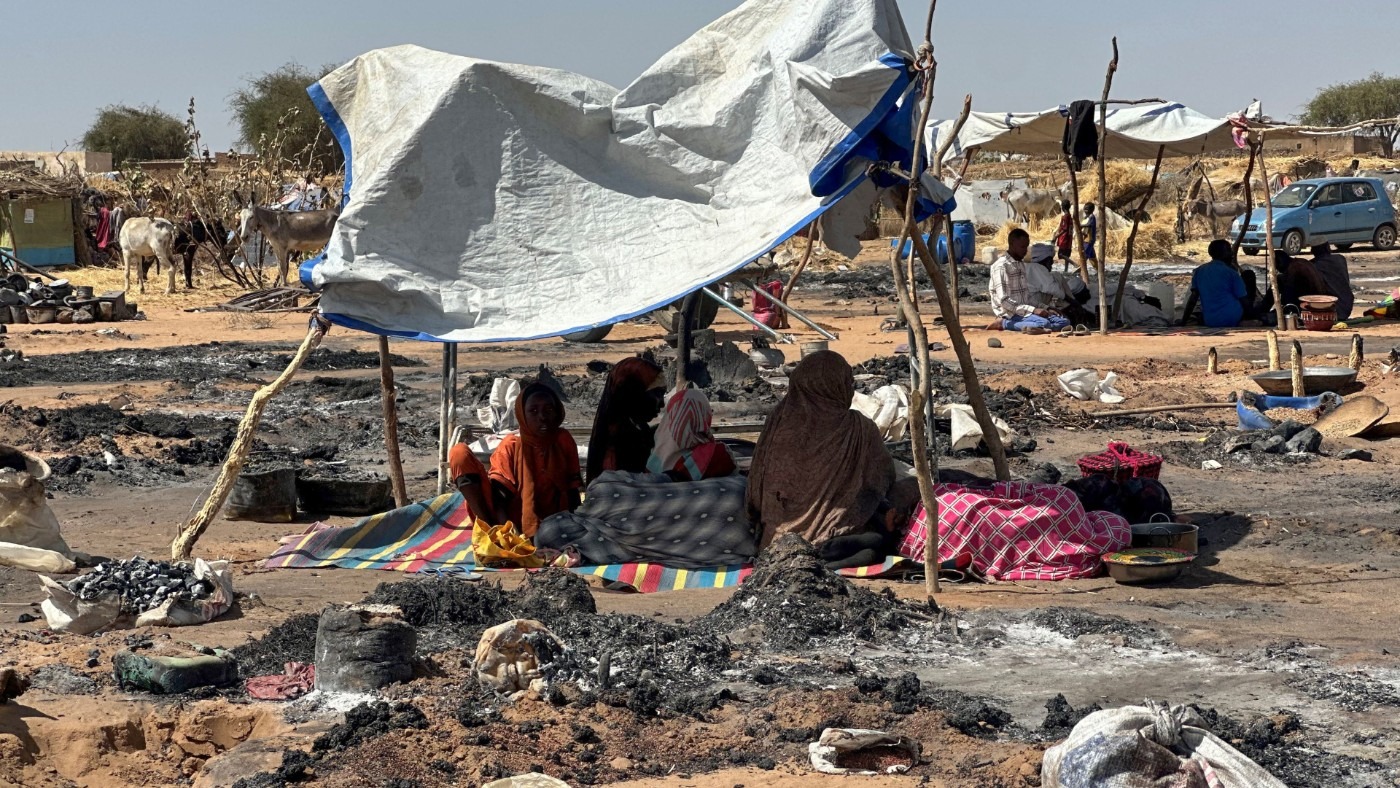
Displaced Sudanese people who fled el-Fasher after its fall sit in the shade amid the remains of a fire at a camp in Tawila on 11 February 2026 (AFP)
A year after the UAE-backed Rapid Support Forces seized North Darfur’s capital, Sudanese recount the horrors of el-Fasher and describe life now
Three weeks ago, Hala, a Sudanese woman, left the refugee camp in Tawila and returned to the city of el-Fasher.
She took a bag and got into a small vehicle operated by the Rapid Support Forces (RSF), the paramilitary group that took over the North Darfur capital a year ago, raping, killing and looting thousands of civilians like Hala.
When she arrived in el-Fasher, which is about 60km east of Tawila, she noticed that everything had changed. Houses had been looted or destroyed. The streets looked different.
RSF fighters immediately approached her as she got out of the vehicle. “They asked me where I was going,” Hala told the campaign group Avaaz, in an interview shared with Middle East Eye.
“I told them I was going to our family home because I needed to collect some documents, including my birth certificate and ID. They asked me how many days I was planning to stay and where exactly our house was located. They wanted to check whether I was lying to them or not.”
Hala, who used a different name for security reasons, had to describe the location of the house. She told the fighters she would need more than a day because it was a mess and she had to locate many documents. The house has no electricity, making the task harder.
“They agreed and issued me an entry permit for el-Fasher. It was a piece of paper with my name, their signature, and the date,” Hala said.
“Dealing with them is very difficult; they can easily enter your house and threaten to rape you if you refuse to go with them. They might rape you if you refuse, beat you, and if you argue with them, you could end up in prison,” she said.
“For women, travelling to el-Fasher is extremely dangerous. Most of the people who go there are fathers and elderly people because young people’s lives are at risk in el-Fasher. Even elderly people often face problems with RSF fighters,” Hala told MEE.
The day after she returned to the city, she was threatened. “Some RSF fighters saw me in the street and started speaking to me using abusive and insulting language. But there were other civilians in the street, so they did not physically assault me and eventually allowed me to return home,” Hala said.
“The strangest thing is that they might assault you and then tell you that el-Fasher belongs to you, that this is your home, and that you are welcome to return at any time. But there is no security in el-Fasher at all. Women face sexual violence, and anyone who refuses the RSF’s demands can be tortured or beaten.
“I returned to Tawila, and I will never go back to el-Fasher again, even if the situation improves and life changes.”
Killing on an industrial scale
On 26 October 2025, after over 500 days of siege, the RSF launched its final offensive on el-Fasher.
What followed was the largest single massacre to have taken place during Sudan’s war, which began in April 2023 between the RSF and the Sudanese Armed Forces (SAF) and has led to the largest humanitarian crisis in the world.
Researchers at Yale’s Humanitarian Research Lab said the speed and industrial scale of the killing could only be compared to the whole of the Rwandan genocide.
RSF fighters, backed by the United Arab Emirates, which continues to deny its involvement, filmed themselves massacring civilians. Survivors described RSF fighters raping young women and girls, executing civilians, moving survivors to makeshift clinics to take blood from them, and exhorting ordinary people and their families.
“In one of the streets they brought dozens of families outside the houses,” Mohamed Hassan, from el-Fasher, told MEE over the phone.
“They separated the men from the women and children. They lashed and insulted the women verbally and they fired on the men randomly. If they decided that you are a SAF or Joint Forces soldier, they will kill you immediately,” he said, referring to the allied militia fighting alongside the army.
Hanin, a Sudanese mother who escaped to Tawila, where she remains, described how she got out. “I left el-Fasher with only my daughter in my hands. I thought that once I reached Tawila, my daughter and I would finally be safe. I am still waiting for that feeling of safety to come,” she told MEE.
“I survived horrible things. There are things that happened to me that I struggle to speak about. I am a mother, and I tried to protect my daughter. I cannot explain what it does to you to see your child suffer violence and know that you could not stop it. We survived, but survival does not mean we are no longer hurting.”
Anna, an aid worker, said: “There are currently RSF prisons in el-Fasher.
“They are using old buildings as detention facilities, and the conditions of detainees are much worse than ours because they are not given food or medical care when they become sick.”
Where did everyone go?
Six weeks before the RSF took the city, roughly 107,000 had fled the capital of North Darfur. About 260,000 people were still inside the city when the assault began. Doctors Without Borders asked the question that still hangs over Sudan: where did everyone else go?
The true death toll may never be known. Monitoring groups counted at least 6,000 dead in the first 72 hours using satellite imagery, but the RSF has kept el-Fasher sealed behind a communications blackout, and human rights investigators have not been allowed in.
A year on, bodies keep surfacing and the count is still rising. In the North Kordofan town of Bara this week, 200 mass graves were found where volunteers have recovered more than 600 bodies, most of them civilians whom witnesses say the RSF killed in the same October offensive that took el-Fasher.
In the year since, the verdicts have come in one after another. In February, the UN Independent International Fact-Finding Mission for the Sudan determined that the RSF committed acts of genocide in el-Fasher and that genocidal intent was the only reasonable inference from its conduct.
The US government and a string of human rights groups, including the Raoul Wallenberg Centre for Human Rights and Amnesty International, have determined that the RSF has committed genocide in Darfur.
In July, Amnesty called the atrocities perpetrated in el-Fasher “a stain on the conscience of humanity”.
Walled in
The massacre was the last stage of a genocidal process.
The RSF besieged el-Fasher from May 2024 to October 2025, creating berms around the city to act as physical barriers trapping civilians. It shelled the city almost daily and cut off food and medicine. The World Food Programme reported that trade routes into el-Fasher were blocked and captive residents were surviving on animal fodder and food waste.
A doctor who spent almost two years living and working inside a hospital in el-Fasher spoke to MEE about the siege.
“Over time, the hospital became our entire world. We slept there, ate whatever food we could find and spent most of our days and nights caring for patients. For months, many of us barely saw our families,” he said.
“As the siege tightened, keeping the hospital functioning became increasingly difficult. Medical supplies stopped reaching the city, essential medicines ran out, and our equipment gradually broke down. We lost reliable access to electricity and clean water. Even finding enough food for ourselves became a daily struggle.”
Generators could only be run for two hours at night. Life-threatening emergency operations were carried out using mobile phone flashlights. Antibiotics ran out. Surgical gauze was unavailable.
“We had to improvise constantly, knowing that every compromise carried risks for our patients,” the doctor said. “Pregnant women arrived after travelling through dangerous roads, often in critical condition. We treated premature babies who depended on equipment we struggled to keep running,” he told MEE.
“Children suffering from malnutrition and civilians wounded by shelling, as well as people with chronic diseases, were also losing access to the regular treatment they needed.
“What made everything worse was that we were experiencing the same conditions as our patients. Some colleagues became severely malnourished. Others continued working while sick or injured. We were exhausted, but there were still people waiting for treatment,” the doctor said.
“One of the most painful experiences for a doctor is watching a patient deteriorate when you know exactly what treatment they need but have no way of providing it. That happened far too often in el-Fasher.”
The cover-up
The RSF punished anyone who tried to break the blockade. Young people and traders who brought food past the berm told Human Rights Watch about deadly RSF attacks on those runs.
Survivors spoke about the execution of people caught with supplies. During that period, a young woman, Qisma Ali Omar, was hung by her arms from a tree with her feet bound and videotaped for the world to see.
When the city fell on 26 October last year, the RSF went first to the places where civilians had taken refuge. Close to 500 people were killed at the Saudi Maternity Hospital, where patients and medical staff were sheltering alongside displaced families, mostly women and children.
UN investigators later documented mass killings at el-Fasher University and the Saudi Hospital, on the roads out of the city and at the berms built to trap its people.
Amnesty verified videos of an RSF commander executing civilian captives. Other footage showed dozens of dead civilians in a trench that ran along the berm. The RSF spent months building the walls that became the edge of a mass grave.
Then came the cover-up.
Between 26 October and 28 November 2025, Yale’s Humanitarian Research Lab identified 150 clusters of objects consistent with human remains. Twenty showed signs of burning. Fifty-seven disappeared completely within four weeks. At the Saudi Hospital, satellites captured a pit of what appeared to be bodies burned again and again through November.
A pile of suspected bodies beside the berm was later cleared away. The RSF tried to erase the evidence. Its leader, Mohamed Hamdan Dagalo, better known as Hemedti, announced an investigation into what he called violations committed by his soldiers during the capture of el-Fasher.
Life under occupation
El-Fasher today is a city of ruins and captives.
When a UN team finally entered in December, under close supervision, it called the city a crime scene and found few people left. One in six of those screened had severe acute malnutrition.
Those who escaped did not escape the RSF. Survivors say the group still detains men fleeing el-Fasher and demands ransoms of up to $3,000. One monitoring group documented the detention of nearly 68,000 civilians. Tawila, once a small town, now hosts around 800,000 displaced people, most of them from el-Fasher.
Khadijah is one of them. Her journey traces the RSF’s path across Darfur. “I’m an elderly woman from el-Geneina,” she told MEE, referring to the city in West Darfur, where the dead were also left lying in the streets as the RSF took over in the summer of 2023.
“I fled to el-Fasher seeking safety. But conflict followed, forcing me to displacement again. Now, I live under a tree on a farm, exposed to the elements. There is little food here, and I have no shelter. The cold is unbearable. I’m struggling to survive.”
Mudathir Mohammed Diqourni, of an el-Fasher resistance committee, warned that RSF militias are destroying farms across South and Central Darfur.
“They are also deliberately targeting farmers, shooting and killing them as they head to their farms or attempt to protect their crops and agricultural properties,” he said.
Hunger is pushing villagers toward Tawila in search of relief. Diqourni calls this demographic engineering, an effort to drive the last residents of rural Darfur into camps or across the border “through a policy of systematic impoverishment and starvation”.
Its most haunting image is of farmers “racing against the Janjaweed’s camels in the fields” to save scraps of fodder for their own animals.
Arms networks
From el-Fasher, the RSF carried the war back east into Kordofan, and south to the Ethiopian border.
The paramilitary does not arm itself. The UN’s fact-finding mission has found reasonable grounds to believe that private companies and recruiters operating from the UAE have routed supplies through Chad and southeastern Libya, as well as Bosaso in Somalia.
MEE has reported extensively on this supply network and on the use of army bases in Ethiopia to assist the RSF.
These routes were used, Mona Rishmawi, a member of the UN’s mission, said, to provide “weapons, drone-related equipment, logistical assistance and personnel… to commit the atrocities in el-Fasher.”
The US remains the UAE’s top source of weapons.
In May 2025, the Trump administration pushed $1.4bn in Chinook helicopters and F-16 parts to Abu Dhabi despite a congressional hold. In March this year, it approved more than $8bn in new weapons, drones and missiles, with billions more in sales that never had to go before Congress.
British weaponry has been found on battlefields in Sudan and the UK government has been accused of failing to stop the el-Fasher massacre because it feared the UAE.
In Bara, the volunteers are still digging. Khadijah still sleeps under a tree on a farm. The UN has named the network that armed their killers, and Washington has named the genocide.
“In Tawila every day, I see people around me getting weaker,” Hanin told MEE.
“People who were laughing and talking just days ago become too weak to stand. Sometimes, I wake up and learn that someone has died because they had nothing to eat.”
Hala said: “El-Fasher has completely changed. We have now reached a point where, if you want to visit your own home, you need permission from the RSF. That alone shows the situation we have reached. We just hope the war ends and things get better.”