

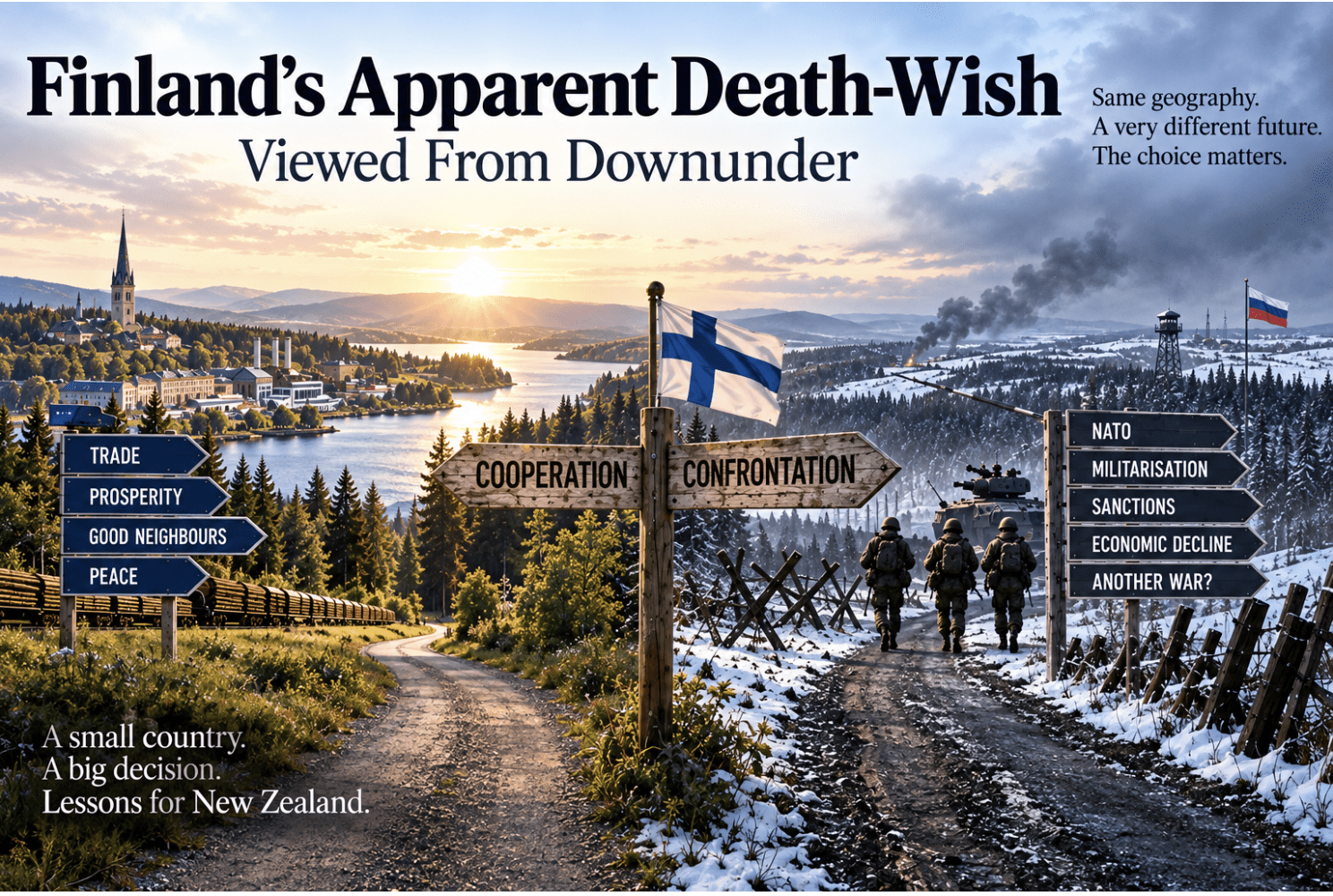
Finland’s Apparent Death-Wish — Viewed From Downunder
By Colin Maxwell
There is something about Finland’s extraordinary geopolitical transformation that ought to be particularly interesting to New Zealanders…. and also to humanity at large.
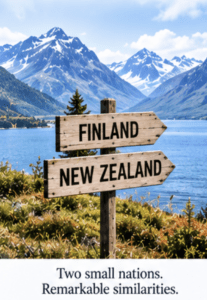
At first glance, Finland and New Zealand could hardly be further apart. One sits on the northeastern edge of Europe with a 1,340-kilometer border with Russia, the other is tucked away in relative isolation at the bottom of the South Pacific. But look beneath the geography and the similarities are remarkable.
Finland has around 5.6 million people and New Zealand around 5.3–5.4 million. Both are small “developed democracies” with relatively large land areas, strong welfare-state traditions, “high educational standards”, abundant natural resources and small domestic markets that make international trade absolutely critical to their prosperity.
Both have important forestry sectors and substantial renewable-energy resources. Both sit geographically on the periphery of much larger economic centers. Both have aging populations and increasingly difficult fiscal demands associated with maintaining the first-world infrastructure and social services their populations expect.
Finland nevertheless produces considerably more economic output from almost exactly the same number of people, reflecting in part the much deeper industrial, engineering and manufacturing economy it built on top of its natural-resource base.
And so, viewed from Downunder, Finland isn’t some remote European curiosity. It is in many respects a remarkably useful mirror, and that makes what Finland is presently doing all the more extraordinary.
 A Small Country That Understood Geography
This is what I found so fascinating about Pascal Lottaz’s recent interview with Finnish geopolitical analyst Sakari Linden. For most of the post-war period Finland understood something that small countries occasionally forget – you don’t get to choose your geography.
Finland shares that enormous border with Russia. That reality won’t disappear when Putin disappears, any more than it disappeared when Stalin, Khrushchev or Brezhnev disappeared. And so Finland developed its foreign policy around that permanent geographical fact. Its neutrality required pragmatism and geopolitical sophistication.
But perhaps the best way of judging the policy is simply to examine what it achieved. Finland remained independent. It remained democratic. It avoided becoming a battlefield between the nuclear superpowers.
And simultaneously it developed into one of the world’s most prosperous countries, trading with both East and West while building a highly productive industrial economy and comprehensive welfare state. That wasn’t weakness. It was remarkably successful small-country statecraft.
Indeed, Finland’s greatest strategic asset had to have been precisely that it wasn’t anybody else’s frontline.
 From Bridge to Potential Battlefield
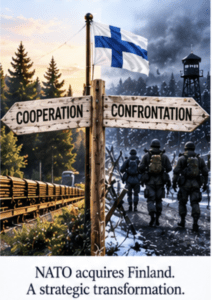
That has all now changed completely – following the dramatic escalation of the Ukraine conflict in 2022, Finland abandoned military non-alignment and joined NATO in April 2023.
The conventional argument is straightforward – Russia’s military action dramatically changed Finnish perceptions of security and NATO membership places Finland beneath the alliance’s collective-defense umbrella.
But security arrangements have two sides – Finland hasn’t merely acquired NATO. NATO has acquired Finland. And militarily it has gained an extraordinarily valuable piece of real estate.
NATO itself says that Finland and Sweden and their military capabilities are being integrated into the alliance’s plans, forces and command structures, while NATO is simultaneously expanding long-range weapons, air and missile defence, logistics and large land formations.
The country that spent decades ensuring it would not become the frontline between Russia and the West has therefore transformed itself into precisely that.
The old Finnish doctrine effectively said – stay out of the great powers’ wars.
The new one says – join one side, integrate yourself into its military architecture, massively increase military preparedness and hope that deterrence ensures the resulting confrontation never becomes a war.
The obvious question remains – how does deliberately making yourself vastly more strategically important in a potential NATO-Russia war necessarily make you safer?
 Apparently We Forgot 1962
Perhaps the most extraordinary aspect of all this is the historical amnesia is that we already know what happens when one nuclear power begins positioning strategic military capabilities close to another nuclear power’s territory.
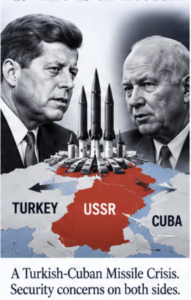
The event remembered as the “Cuban Missile Crisis” should more correctly be remembered as the Turkish-Cuban Missile Crisis.
The United States already had nuclear-capable Jupiter missiles stationed in Turkey. During the crisis, Khrushchev demanded their removal. Robert Kennedy subsequently told Soviet ambassador Anatoly Dobrynin privately, that Washington intended to remove them soon, although this could not form part of the public settlement.
The Soviet missiles left Cuba and the American Jupiters were removed from Turkey in April 1963. This isn’t some alternative-history interpretation – the U.S. State Department’s own historical account records it.
Washington’s position in 1962 was effectively that Soviet strategic missiles appearing close to the United States represented an intolerable security threat – surely then Russians are entitled to possess security interests as well.
And this is precisely the part of the Ukraine story that disappears when somebody conveniently presses the geopolitical reset button on 24 February 2022. NATO had declared at Bucharest in 2008 that Ukraine and Georgia “will become members of NATO.” NATO’s Secretary-General subsequently said there could be no misunderstanding about what those words meant.
Meanwhile, war had already been raging in Donbas for years and the Minsk process had failed to produce a durable settlement.
Whatever conclusion one reaches about Russia’s eventual SMO, and Russia’s justification remains strongly contested internationally, the security dilemma didn’t suddenly materialise in February 2022 – it had been developing for years.
And Finland is now recreating an important element of that same dilemma along another 1,340 kilometers of Russia’s border. Finland sees NATO as protection against Russia. Russia sees NATO’s military architecture moving towards strategically important Russian territory.
The lesson of 1962 should have been remarkably simple – nuclear powers become extremely dangerous when they believe hostile military capabilities are being positioned close to their borders.
Yet somehow the West appear to have converted that elementary principle of geopolitics into something rather more convenient – American security concerns are legitimate -Russian security concerns apparently aren’t.
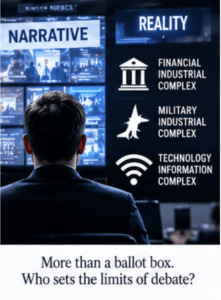 And How Democratic Is Any of This?
Which brings me to another uncomfortable question about our habitual description of countries such as Finland and New Zealand as “functioning democracies”. Certainly we possess the machinery of democracy – elections, competing political parties, parliaments, courts and nominally independent media :-).
But surely democracy means considerably more than being permitted to choose between political parties every few years. It requires citizens to have meaningful access to competing information and arguments before making those choices.
And this is where the extraordinary concentration of institutional power across what I would broadly describe as the Three-ICs – the Financial-Industrial Complex, Military-Industrial Complex and the Technology-Information Complex – becomes alarmingly relevant.
These aren’t hermetically sealed institutions.
Finance funds corporations and governments. Defense companies depend upon government contracts. Governments and intelligence agencies produce security assessments. Think tanks influence policy. Technology platforms increasingly determine how information is distributed, while major media organisations exercise enormous influence over which arguments are regarded as respectable and which are pushed beyond the boundaries of acceptable discussion.
https://sovereignista.com/2026/09/14/the-most-dangerous-dis-and-mis-information-mode-ever-devised/
None of this requires some smoke-filled room in which everybody conspires to manufacture the next war. The considerably more interesting problem is institutional alignment.
When political establishments, military bureaucracies, defense industries, financial interests, think tanks, technology platforms and major media increasingly operate within the same broad geopolitical assumptions, genuinely alternative policies can become extraordinarily difficult even to discuss.
The historical treatment of the “Cuban Missile Crisis” provides a wonderfully simple example – most people know about the Soviet missiles in Cuba.
How many were taught with equal emphasis about the American Jupiter missiles sitting in Turkey – or the secret understanding to remove them that helped resolve the crisis?
That’s not proof of some centrally directed propaganda operation – but it demonstrates how an overwhelmingly dominant narrative can omit facts that materially alter one’s understanding of an event.
And that matters enormously when democratic populations are being asked to make decisions about war and peace.
Democracy Requires More Than a Ballot Box
Finland’s NATO accession was certainly democratic in the conventional institutional sense. It commanded overwhelming parliamentary support, and Finnish public opinion shifted dramatically after February 2022.
But another democratic question surely remains – how healthy is a democracy when one strategic narrative becomes so overwhelmingly dominant that seriously questioning the wisdom of transforming your country into a potential frontline state becomes politically suspect?
This isn’t an argument over whether the top income-tax rate should be 35 or 40% – for a country of barely 5.6 million people sharing 1,340 kilometres of border with a nuclear-armed great power, getting this catastrophically wrong could have consequences beyond comprehension.
Surely that is precisely when democracy requires more dissent, more argument and more scrutiny, not less. And New Zealanders shouldn’t imagine this question applies only to Finland. We possess many of the same institutions, participate increasingly in the same Western security architecture and consume much of the same international information environment.
Our geographical circumstances are obviously enormously different, but perhaps the most important democratic question isn’t simply – who are we allowed to vote for? – it is, who determines the range of policies we are permitted to seriously debate before we vote?
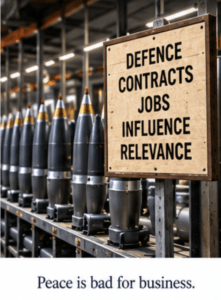 Peace Is “Unfortunately” Terrible for the War Business
And this brings us to the much larger issue raised by Linden’s interview – what happens to NATO if the Ukraine war eventually ceases to provide the organising principle around which European security policy has increasingly been constructed?
NATO doesn’t simply disappear – the bureaucracy remains. The weapons factories remain. The military infrastructure remains. The political careers constructed around confrontation remain. And the enormous defence budgets most certainly remain.
NATO members have now committed to investing 5% of GDP annually by 2035 – at least 3.5% on core defense requirements, and up to another 1.5% on defense and security-related expenditure.
This doesn’t prove that somebody sits inside NATO headquarters plotting the next European war – it doesn’t need to. Institutional incentives are much simpler. Bureaucracies seek budgets. Military establishments require perceived threats. Arms manufacturers require orders. Political institutions seek relevance.
Once an enormous security architecture becomes organised around the existence of a permanent enemy, genuine détente starts creating its own institutional problem, and peace is terrible for the war business.
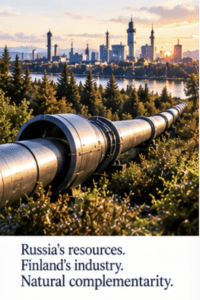 What If Finland’s Geography Is Actually a Gift?
And this is where the comparison with New Zealand becomes particularly fascinating – Finland isn’t cursed by having Russia next door. Looked at economically rather than militarily, it potentially possesses an extraordinary geographical advantage.
Russia is one of the world’s great resource economies, while Finland possesses sophisticated engineering, manufacturing, technology and forestry-processing capabilities. The potential economic complementarity is blindingly obvious. For decades Finland exploited precisely that opportunity while simultaneously trading with the West. It didn’t have to choose one hemisphere against another.
New Zealand, by contrast, sits thousands of kilometers from virtually everybody. We expend enormous resources transporting our exports across oceans and bringing energy, machinery and manufactured products back again.
Finland has an enormous complementary economy sitting literally next door. For a small trading nation that should be an extraordinary geographical gift.
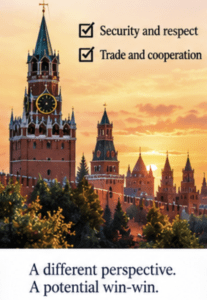 And this leads to what I regard as the fundamental misunderstanding of Russia that has increasingly infected Western foreign policy. Strip away all the propaganda and competing narratives and there is another interpretation of what Russia has repeatedly sought from its relationship with the West.
Firstly, that its national security and its position as a major civilisational state be treated with the respect they deserve, which necessarily includes taking seriously Russian objections to potentially hostile military infrastructure progressively approaching its borders.
Secondly, Russia has repeatedly sought extensive commercial relations with the West. And why wouldn’t it? Russia possesses enormous quantities of resources that Europe’s advanced industrial economies require. Europe possesses technology, machinery and high-value products that Russia can use.
That relationship doesn’t inherently have to be predatory or zero-sum. Russian resources plus European technology and industry could have been one of the great win-win economic relationships on the planet.
Finland was exceptionally well positioned to benefit from it. Its Russian border could therefore have been viewed not principally as a military vulnerability requiring fortification, but as an enormous commercial opportunity requiring intelligent diplomacy.
And for decades that is substantially what Finland did. It turned potentially difficult geography into trade, coexistence and prosperity.
Today they appear to be doing almost precisely the opposite. The border is increasingly conceptualised as a military frontier. Commercial relationships have been severed. Resources that could have flowed into productive investment and mutually beneficial trade are instead being redirected towards armaments and military infrastructure.
And then we are told that Finland has somehow become more secure.
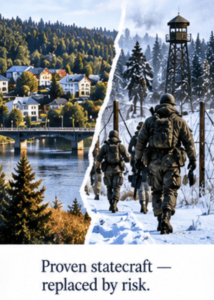 From Finlandisation to Frontline-isation
Finland’s old policy was frequently mocked in the West as “Finlandisation” – a term that portrayed pragmatic coexistence with Moscow as weakness or excessive accommodation.
But perhaps that description gets the lesson almost exactly backwards. Finland recognised geographical reality, maintained its independence and democratic political system, traded successfully with both East and West, became prosperous, and most importantly, kept itself out of the great powers’ wars.
That wasn’t weakness. It was remarkably successful small-country statecraft. The extraordinary thing is that Finland has now exchanged that proven strategy for something approaching its polar opposite.
Instead of maintaining sufficient strategic distance from competing nuclear powers to avoid becoming their battlefield, it has integrated itself into the military architecture of one side and consequently become strategically important in any future confrontation between them.
And yet the geography hasn’t changed. Russia isn’t going anywhere. Putin will eventually disappear. Governments will change. Political systems will evolve. Wars eventually end.
But Finland will still share that 1,340-kilometre border with Russia in 20 years. And in 50 years. And in 100 years time. Which is why diplomacy, neutrality and coexistence shouldn’t automatically be confused with weakness.
For a small country sitting beside a nuclear superpower, they can represent something considerably more important – an intelligent recognition of reality, and perhaps the difference between remaining somebody’s prosperous neighbour, and becoming somebody else’s battlefield.
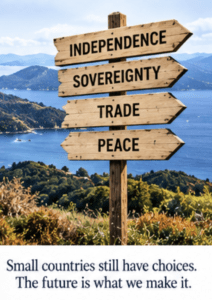 The View From Downunder
Perhaps this is why Finland’s story looks so extraordinary from New Zealand.
Two countries with almost identical populations. Two prosperous, “educated democracies”. Two geographically peripheral nations with relatively large territories. Two economies dependent upon international trade.
Two countries built substantially upon natural resources, forestry and renewable energy. Two societies expecting their productive economies to support expensive first-world infrastructure and welfare systems from populations of barely five-and-a-half million people.
But there is one extraordinary difference – New Zealand’s remoteness imposes enormous economic costs. Finland’s proximity to Russia potentially offers enormous economic opportunities.
The tragedy may therefore be considerably greater than Finland merely making itself a potential NATO-Russia frontline. It may be taking one of the greatest geographical advantages available to a small industrial nation and turning it into a manufactured security liability.
And perhaps the most disturbing question raised by Linden isn’t really about Finland at all.
It is about whether small countries still possess genuinely independent foreign policies when their political, financial, military and information institutions become deeply embedded within much larger geopolitical systems.
The Turkish-Cuban Missile Crisis demonstrated more than sixty years ago what happens when nuclear powers believe their vital security interests are being threatened close to home. The world came frighteningly close to catastrophe.
Eventually sanity prevailed because both sides’ security concerns were taken seriously enough to negotiate a way out. Perhaps that is the lesson we should have remembered.
Security doesn’t come from insisting that only your side’s security concerns are legitimate, and prosperity doesn’t come from permanently dividing the world into friends with whom one is permitted to trade and enemies who must be isolated.
For small countries especially, there is another model – respect sovereignty, take legitimate security concerns seriously. Trade wherever trade is mutually beneficial. Keep the great powers’ military confrontations off your territory. And turn geographical proximity into economic complementarity rather than a battlefield.
Finland spent decades demonstrating that this was possible, which makes abandoning that successful formula all the more extraordinary.
If NATO’s fundamental purpose is genuinely to prevent war, then a durable European security settlement in which Finland is secure and Russia doesn’t regard Finnish territory as part of a military architecture threatening its own security should represent success.
But if permanent confrontation is required to justify permanent militarisation, ever-increasing defense expenditure and NATO’s continuing geopolitical relevance, then peace itself becomes rather inconvenient.
An alliance created to protect Europe from enemies should surely welcome the disappearance of those contrived enemies.
An alliance that requires enemies to justify its existence has a rather different problem – it needs to keep finding them.